
Part 3: The End of an Era
How War, Migration, and the Collapse of Empires Changed the Christian World of the Black Sea

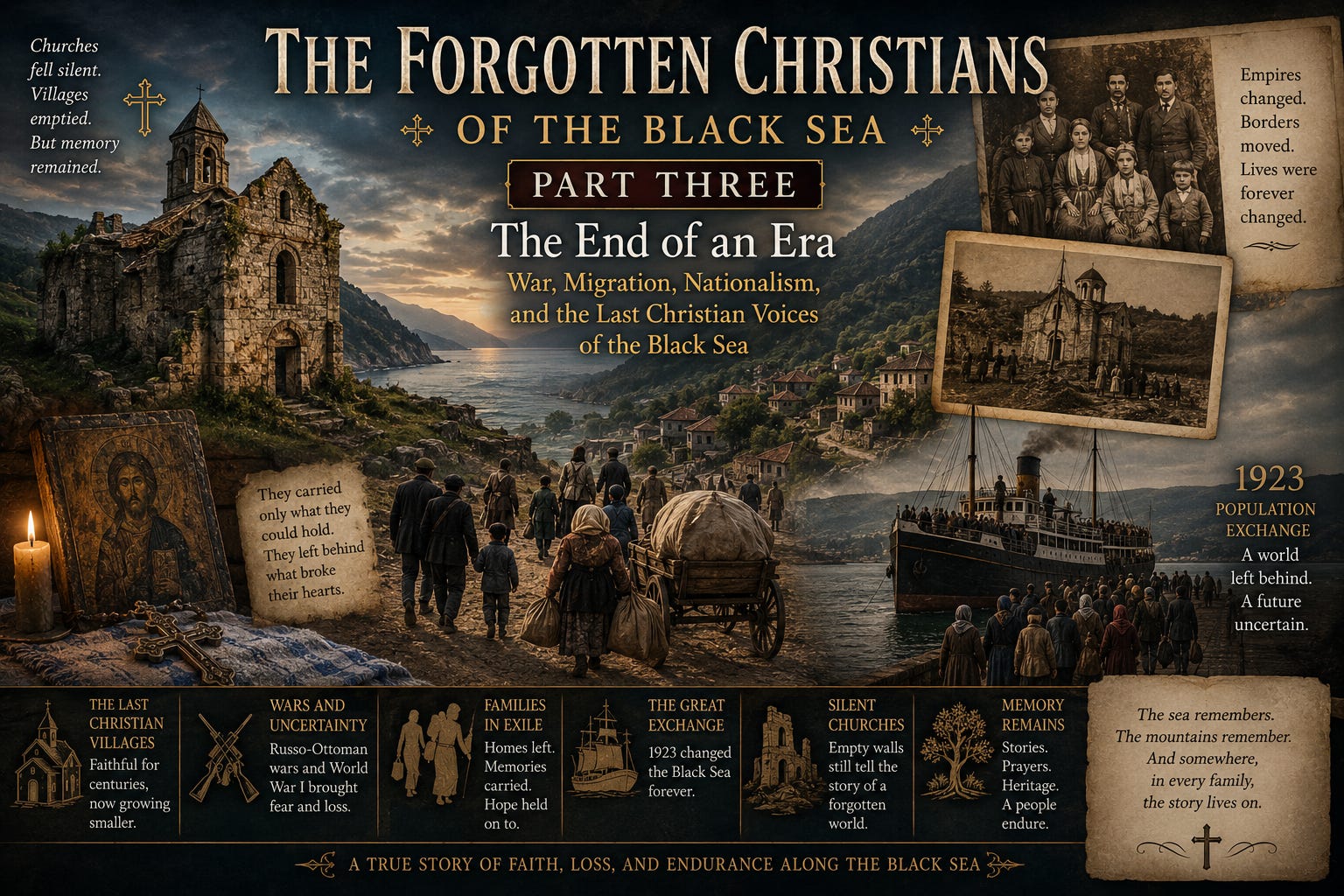
War, Migration, Nationalism, and the Last Christian Voices of the Black Sea
Welcome back, friend.
If Part One was the story of how Christianity arrived among the Laz people, and Part Two explored the hidden faith preserved behind closed doors, then Part Three is perhaps the most difficult chapter of all.
Because this is where we watch an ancient world disappear.
Not in a single day.
Not in a single battle.
But slowly, painfully, and often quietly.
For centuries, the Black Sea coast had been home to Christians, Muslims, Greeks, Laz, Armenians, Georgians, and many others. Villages spoke different languages. Markets echoed with different traditions. Families lived side by side, sharing the same mountains, rivers, and coastline.
The region was never perfect.
There were tensions, conflicts, and inequalities.
Yet generations grew up believing the world around them would remain much as it always had been.
They could not imagine how quickly history would change.
The Winds of Change
By the nineteenth century, the Ottoman Empire was facing enormous challenges.
European powers were growing stronger.
Nationalist movements were emerging across the Balkans and the Caucasus.
New ideas about nationhood, ethnicity, and identity began spreading throughout the empire.
For centuries many people had primarily identified themselves through religion, family, village, or local community.
Now new questions emerged.
Who are we?
Where do we belong?
What language should we speak?
What nation are we part of?
These questions affected everyone.
Muslims.
Christians.
Laz.
Greeks.
Armenians.
Georgians.
Nobody escaped the changes.
The Russo-Ottoman Wars
The Black Sea became a frontier of uncertainty.
Throughout the nineteenth century, repeated wars between the Russian and Ottoman Empires brought destruction to the region.
Villages were abandoned.
Families fled advancing armies.
Some communities found themselves caught between two powerful empires.
A father might leave home not knowing if he would return.
A mother might pack family possessions onto a cart, hoping her children would survive another winter.
Many Black Sea Christians looked toward Russia as a protector.
Others feared Russian rule.
Many simply wanted peace.
History rarely gave them that luxury.
The Last Christian Villages
Even as change accelerated, Christian communities still survived throughout the Black Sea region.
Church bells continued ringing.
Priests baptized children.
Ancient liturgies filled village churches.
Grandparents taught prayers that had been passed down for centuries.
Some communities had survived since the Byzantine era.
Others carried memories stretching back to Lazica itself.
Yet many sensed that something was changing.
The world of their ancestors seemed increasingly fragile.
Each generation grew smaller.
Each village lost more people.
Each year brought new uncertainty.
The old confidence that Christianity would always remain part of the region began to fade.
Family Memories
History books often focus on governments and wars.
But real life happens around family tables.
This is where memory survives.
A grandfather tells stories about a church that no longer exists.
A grandmother remembers a priest who baptized children in secret.
A family preserves an old cross hidden among household belongings.
These stories often become more precious as the years pass.
For many Black Sea families, memory became the final link connecting them to an older world.
My own family carried stories of hidden worship and ancestral faith.
Those memories survived long after the physical places themselves had changed.
Sometimes memory becomes its own kind of sanctuary.
The First World War
Then came the catastrophe of the twentieth century.
The First World War transformed everything.
The Ottoman Empire entered the conflict already weakened.
The Black Sea region became a zone of military operations, suspicion, fear, and displacement.
Communities that had lived together for generations suddenly found themselves divided by politics and war.
Many civilians suffered regardless of their background.
Refugees appeared everywhere.
Food became scarce.
Trust began to disappear.
The war did not simply destroy buildings.
It damaged relationships.
It changed how neighbors saw one another.
The Population Exchange
The events that followed were among the most dramatic in the region’s history.
After the Greco-Turkish War, the 1923 population exchange between Greece and Türkiye permanently altered the Black Sea world.
Entire Christian communities left ancestral homes.
Families packed what they could carry.
Churches stood empty.
Villages lost people who had lived there for generations.
Some families arrived in Greece speaking Turkish.
Others carried memories of mountains, rivers, and villages they would never see again.
For many, the pain lasted a lifetime.
They had not simply lost houses.
They had lost home itself.
What Was Left Behind
After the population exchange and the collapse of the old Ottoman order, the Black Sea region entered a new chapter.
Many churches became ruins.
Some disappeared entirely.
Old cemeteries were forgotten.
Ancient Christian communities became memories.
The Laz people remained.
Their language survived.
Their culture survived.
Their music survived.
Their love of the sea survived.
But much of the Christian world that had once shaped the region was gone.
The transformation was one of the most significant cultural changes in Black Sea history.
The Silence of Empty Churches
There is something deeply moving about standing before an abandoned church.
The walls remain.
The stones remain.
Yet the voices are gone.
No candles burn.
No hymns are sung.
No children are baptized.
Many places throughout the Black Sea region experienced this silence.
And yet silence is not the same as forgetting.
Because memory remains.
Stories remain.
Family histories remain.
And sometimes those memories are enough to keep the past alive.
What Their Story Means Today
Perhaps the greatest lesson of this history is that faith cannot be measured only by buildings or institutions.
Churches can fall.
Empires can disappear.
Borders can change.
But faith often survives in unexpected places.
It survives in family stories.
It survives in whispered prayers.
It survives in memories passed from grandparents to grandchildren.
The Black Sea Christians endured centuries of change.
Many lost homes.
Many lost communities.
Some lost everything except hope.
Yet their story still speaks.
Not because they were powerful.
But because they endured.
Looking Toward Tomorrow
Today, descendants of these communities live across the world.
Some remain in Türkiye.
Others live in Greece, Georgia, Europe, Australia, and beyond.
Many are rediscovering forgotten parts of their heritage.
Some are asking questions their grandparents never felt free to ask.
Others are searching for traces of the faith that once shaped their ancestors.
And perhaps that search itself is part of the story.
Because history is never entirely finished.
The mountains still stand.
The Black Sea still crashes against the shore.
And somewhere, in a family memory, an old prayer, or a forgotten photograph, the past still whispers.
The hidden flame has not gone out.
In Part Four, we will explore the Black Sea today, the survival of Laz identity, and why the story of these forgotten Christians still matters in the twenty-first century.
To be continued...

Dr. Daniel J. Grace
Faith • Civilization • Theology
Research • Journalism • Truth
🌐 danieljamesgrace.com
© 2026 Dr. Daniel J. Grace. All Rights Reserved.
No part of this article may be reproduced, distributed, transmitted, or published in any form or by any means without prior written permission from the author, except for brief quotations used in academic citation, review, or research purposes.