
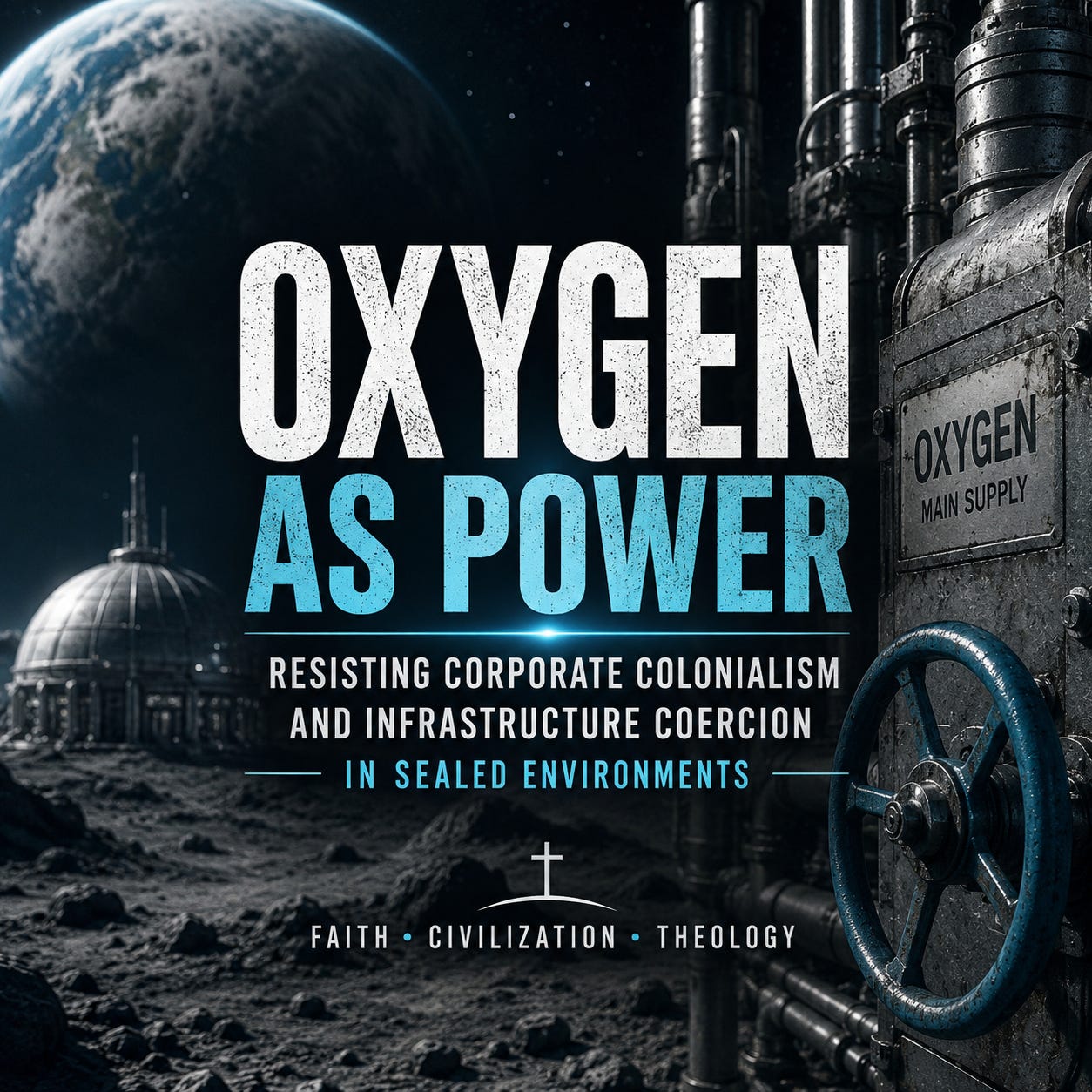
Oxygen as Power
Resisting Corporate Colonialism and Infrastructure Coercion in Sealed Environments

Humanity’s possible expansion beyond Earth is usually presented as a story of courage, innovation, and progress.
The Moon becomes a new frontier.
Mars becomes a second home.
Deep-space habitats become evidence that human civilisation can survive almost anywhere.
Corporate space companies and national agencies often describe this future as though leaving Earth will allow humanity to begin again. We’re told that new planets and new settlements could free us from old political failures, environmental damage, poverty, conflict, and social division.
But moving human beings to another world won’t remove human sin.
Greed will travel with us.
Pride will travel with us.
The desire for domination will travel with us.
So will inequality, fear, exploitation, and the temptation to turn necessity into power.
A Christian theology of space settlement must begin there.
The greatest danger in a future lunar base or Martian settlement may not be the distance from Earth. It may be the concentration of power inside the systems that keep people alive.
On Earth, air is not ordinarily controlled by a corporation.
Atmospheric pressure isn’t delivered through a private subscription.
A person’s ability to breathe doesn’t usually depend upon continued employment, political obedience, or compliance with a commercial contract.
In a sealed extraterrestrial habitat, all of that changes.
Oxygen must be produced.
Pressure must be regulated.
Water must be recycled.
Temperature must be controlled.
Food must be grown, stored, or delivered.
Every basic condition of life becomes dependent upon infrastructure.
That means whoever controls the infrastructure may possess a form of power humanity has never experienced before.
The person who controls the valve controls the breath.
The Totalitarianism of the Valve
Political tyranny on Earth has always relied upon force, surveillance, imprisonment, censorship, and economic pressure.
But even the most oppressive government doesn’t normally possess complete control over the surrounding atmosphere.
In a sealed habitat, authority could become biological.
A company or state responsible for oxygen, pressure, water, electricity, and waste systems would not simply provide services. It would control the conditions under which human life remains possible.
A strike could be answered by restricting access to essential systems.
A protest could be suppressed by isolating one habitat sector.
A dissenter could be threatened without a soldier ever entering the room.
The infrastructure itself could become the weapon.
This wouldn’t require dramatic violence. It could happen quietly through reduced oxygen allocation, restricted water access, altered heating, interrupted power, or the threat of removal from a protected habitat.
That is what makes sealed environments ethically unique.
When every breath is technologically mediated, political and economic power can become total.
The danger isn’t only that someone might deliberately turn off the oxygen. The deeper danger is that people may be forced to obey because they know it could happen.
The possibility of infrastructural punishment may be enough to produce silence.
The Breath of Life Is Not a Corporate Product
Genesis describes human life as beginning with divine breath:
“And the Lord God formed man of the dust of the ground, and breathed into his nostrils the breath of life.”
The theological meaning is clear. Human life is received before it is earned.
Breath isn’t first a commodity.
It isn’t a reward for productivity.
It isn’t a privilege granted by an employer.
It is a gift.
In a sealed habitat, oxygen will certainly require machinery, maintenance, energy, and technical expertise. In that practical sense, breathable air will be produced through infrastructure.
But Christian theology must resist the idea that the right to breathe can therefore become private property.
The machinery may belong to a company.
Human life does not.
When oxygen is treated as something that can be withheld to enforce obedience, infrastructure ceases to be a service. It becomes an instrument of domination.
A corporation may maintain the life-support system, but it cannot claim moral ownership over the lives sustained by that system.
Breath remains a gift of God before it becomes a technical product.
The Image of God in a Sealed World
The doctrine of the imago Dei teaches that every human being possesses dignity because every person bears the image of God.
That dignity doesn’t disappear when humanity leaves Earth.
It doesn’t depend upon citizenship, wealth, rank, employment, productivity, or physical location.
A worker on Mars would bear the image of God just as fully as a person living in Sydney, Nairobi, Istanbul, or Jerusalem.
A child born inside a lunar settlement wouldn’t owe a corporation moral ownership of their life simply because the company built the habitat.
A person’s dependence upon artificial infrastructure would not reduce that person to a replaceable component in a machine.
Augustine warned against the domination of one human being by another. Human beings were given responsibility for creation, not absolute ownership over other image-bearers.
That principle becomes especially urgent in sealed environments.
When a corporation controls the systems that regulate every breath, it may be tempted to treat residents as biological assets whose continued survival depends upon economic usefulness.
The worker becomes valuable only while productive.
The dissenter becomes dangerous because disagreement threatens efficiency.
The elderly, disabled, unemployed, or politically inconvenient may be treated as burdens upon a limited system.
Christian anthropology must reject that logic before it becomes normal.
Human value cannot be calculated according to oxygen consumption, labour output, or commercial usefulness.
When Technique Becomes Sovereign
Jacques Ellul used the word technique to describe more than individual machines. He was concerned with the way technological systems can begin to organise society around efficiency, standardisation, control, and measurable output.
In a sealed extraterrestrial settlement, this danger could reach an extreme form.
The habitat itself would be an artificial biosphere.
Life would depend upon constant monitoring.
Every person’s oxygen use, water consumption, waste production, movement, health, and energy use could be measured.
Some of that monitoring would be necessary for survival.
But necessity can easily become justification.
A system created to protect life could also become a system of permanent surveillance.
Efficiency could become the highest moral value.
Human freedom could be treated as a technical inconvenience.
Privacy could be dismissed as dangerous.
Dissent could be classified as a threat to habitat stability.
Once the whole environment is engineered, the temptation will be to engineer the people living within it as well.
That is where technique stops serving humanity and begins to rule it.
Corporate Colonialism Beyond Earth
The language of “colonising Mars” is already common.
It sounds adventurous, but it carries a difficult history.
Colonial projects have often involved the control of land, labour, movement, and resources by distant centres of power. They have frequently been justified as progress while creating dependency and inequality.
A future space settlement could repeat the same pattern in a more extreme form.
Imagine a corporation controlling:
the habitat;
the transport system;
the employment contracts;
the oxygen supply;
the water source;
the medical facilities;
the food production system;
the communication network; and
the legal authority of the settlement.
A person living there might technically be free while having no realistic ability to leave, protest, change employer, or survive independently.
That isn’t ordinary employment.
It is near-total dependency.
The problem becomes even more serious when corporations claim exclusive control over lunar ice, Martian water, mineral deposits, or solar-energy sites.
Scripture repeatedly challenges the fantasy of absolute human ownership.
Psalm 24 declares:
“The earth is the Lord’s, and all its fullness.”
The principle doesn’t end at Earth’s atmosphere.
The Moon isn’t ultimately owned by the first company to reach it.
Mars isn’t morally available to whichever corporation can afford to build the first permanent base.
Creation belongs to God.
Human beings may develop resources, organise settlements, and construct infrastructure, but stewardship is not the same as absolute possession.
No company should be allowed to monopolise the material conditions required for human survival.
Oxygen Must Never Become a Tool of Discipline
The most basic ethical rule of any sealed settlement should be simple:
No person’s access to breathable air, water, pressure, heat, or emergency shelter should depend upon political obedience, employment status, debt, or ideological conformity.
Life-critical systems must be treated differently from ordinary commercial services.
A company can charge for non-essential goods.
It should not be able to threaten death through the withdrawal of oxygen.
A government may enforce reasonable law.
It should not be able to manipulate atmospheric conditions to silence opposition.
An employer may discipline misconduct.
It should never possess the power to make survival conditional upon continued labour.
This means the infrastructure of life must be decentralised, transparent, and publicly accountable.
There should be independent oversight.
Emergency systems should not be controlled by one organisation.
Residents should have enforceable rights to oxygen, water, shelter, medical care, and safe evacuation.
No single corporate board should possess the power to decide who gets to breathe.
The Church Must Not Become Corporate Chaplaincy
In such an environment, the Church must resist becoming a spiritual department of the company.
A compromised church might preach obedience while ignoring coercion.
It might use Romans 13 to defend every decision made by the habitat authority.
It might tell exploited workers to endure silently.
It might describe resistance as rebellion against God.
It might offer private comfort while refusing to confront public injustice.
That would be a betrayal of Christian witness.
The Church’s role in a sealed environment cannot be limited to helping people emotionally adjust to corporate control.
It must become a sanctuary of truth.
It must also become a sanctuary of protection.
Christian communities have often created alternative networks of care when political systems failed the vulnerable. Early Christians shared food, supported widows, buried the abandoned dead, cared for the sick, and created bonds of loyalty that exceeded the structures of empire.
A church on Mars or the Moon would need the same courage.
It would need to defend workers, children, the sick, people with disabilities, migrants, dissenters, and anyone made vulnerable by dependence upon infrastructure.
It would need to say clearly that no company owns the human soul.
And no company owns the human breath.
A Sanctuary of Breath
What might faithful Christian witness look like inside a sealed settlement?
It could begin with mutual aid.
Churches could maintain emergency supplies, independent communication channels, pastoral-care networks, and support systems for residents facing corporate retaliation.
It could include public advocacy.
Christians could demand transparency in the management of oxygen, water, pressure, energy, and medical resources.
They could insist that life-support governance include residents, engineers, ethicists, legal representatives, and independent public bodies rather than remaining under private control.
It could also include worship.
In a tightly controlled technological environment, embodied worship would itself become a declaration of freedom.
To gather, pray, share communion, and confess that Jesus is Lord would remind the settlement that no technical authority is ultimate.
The Church would proclaim that life comes from God before it comes through machinery.
The machines are necessary.
They are not sovereign.
The Liturgy of the Free Breath
There may come a day when Christians worship inside a sealed habitat millions of kilometres from Earth.
Every breath in the room will pass through filters, pumps, valves, sensors, pipes, and control systems.
The congregation will know that life depends upon technology.
Yet Christian worship will make another claim.
Breath depends upon grace.
The words of prayer will be carried by manufactured oxygen, but the life speaking those words will remain a gift of God.
In that setting, worship could become what we might call a liturgy of the free breath.
Each hymn would declare that human life cannot be reduced to technical output.
Each prayer would resist the idea that corporate authority is absolute.
Each shared meal would challenge systems built upon scarcity and control.
Each act of care would affirm that the weak are not disposable.
The Church would not deny the importance of technology. It would place technology beneath moral judgement.
We Won’t Escape Ourselves by Leaving Earth
Humanity may one day establish permanent settlements beyond Earth.
That future could produce extraordinary achievements.
It could expand scientific knowledge, protect civilisation from planetary catastrophe, and open new forms of human community.
But it won’t automatically make us wiser.
Changing planets won’t heal the human heart.
A new environment won’t remove the desire to dominate.
Advanced technology won’t guarantee justice.
Without moral restraint, the tools that make life possible can become the tools that make tyranny complete.
The central question won’t simply be whether humanity can survive in space.
It will be whether we can remain human there.
Breath Belongs to God
The future of human settlement beyond Earth won’t be determined only by rockets, habitats, engineering, and commercial investment.
It will also be determined by theology, ethics, law, and the way we understand the human person.
A sealed environment magnifies the moral danger of concentrated power.
When one authority controls the atmosphere, infrastructure becomes sovereignty.
When survival depends upon obedience, employment becomes domination.
When oxygen is treated as private property, breath becomes a weapon.
Christian public theology must oppose that future.
It must defend the imago Dei.
It must demand accountable and decentralised control of life-critical systems.
It must protect the vulnerable from infrastructural coercion.
And it must remind every government, corporation, engineer, investor, and future settlement that human beings are not biological assets owned by the systems that sustain them.
The air inside a lunar habitat may be manufactured.
The breath of life is not.
It belongs to God.
Selected References
Augustine. The City of God against the Pagans. Translated by R. W. Dyson. Cambridge University Press, 1998.
Bauckham, Richard. The Theology of the Book of Revelation. Cambridge University Press, 1993.
Ellul, Jacques. The Technological Society. Translated by John Wilkinson. Alfred A. Knopf, 1964.
Grace, Daniel J. “The Astro-Missiology of the Unreachable: Christian Proclamation and Divine Grace Beyond Earthly Horizons.” Faith • Civilization • Theology, 2026.
Holy Bible, New King James Version. Thomas Nelson, 1982.
Daniel J. Grace
Australian author, journalist, and independent researcher
ORCID: https://orcid.org/0000-0002-9259-8032
Originally published on Daniel J. Grace’s Substack. For more articles on Christian faith, biblical theology, church history, public theology, and civilisation, visit:

© 2026 Daniel J. Grace. All rights reserved.