

Our Devices Are Discipling Our Desires
How the phone became a quiet pastor of the modern heart, and why Christians must recover attention before they lose their love.

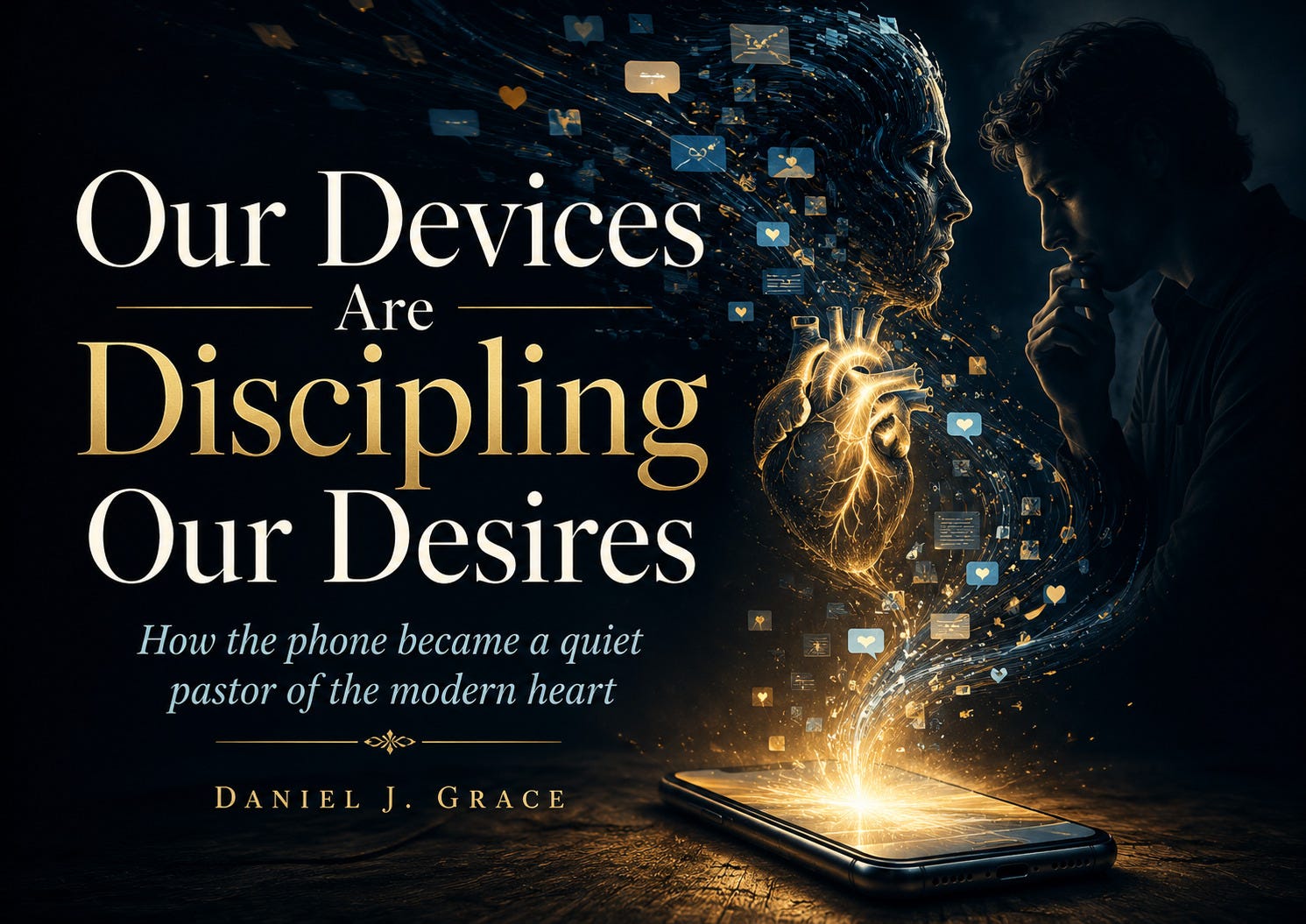
Our Devices Are Discipling Our Desires
How the phone became a quiet pastor of the modern heart
There was a time when discipleship meant sitting under a teacher, walking in a way of life, learning what to love, what to reject, what to hope for, and what kind of person to become.
Now, much of that happens in our hands.
Before Scripture, there is the screen.
Before prayer, there is the notification.
Before silence, there is the feed.
Before the soul has even gathered itself before God, another liturgy has already begun.
We should not be naïve about this. Our devices are not merely tools. They are teachers. They train the eye, the hand, the nervous system, the imagination, and finally the heart. They tell us what deserves attention. They reward impatience. They make comparison feel natural. They make silence feel like punishment. They make the ordinary seem unbearable.
In other words, our devices are discipling our desires.
And the church has not yet taken this seriously enough.
I do not mean that every Christian should throw away a phone, delete every app, and go live in a field. That would be too easy and probably too self-righteous. The problem is not that we use devices. The problem is that our devices are using our loves.
They do not simply ask for our time. They ask for our attention. And attention is never neutral.
What we attend to, we slowly become open to. What we repeatedly look at, we begin to desire. What we allow to interrupt us, we eventually allow to shape us.
The phone does not need to deny God to become spiritually powerful. It only needs to make God feel slow.
That is where the danger begins.
The phone is not neutral
We like to tell ourselves that technology is only a tool. A hammer can build a house or break a window. A phone can help us call a friend, read Scripture, find directions, listen to a sermon, send encouragement, or organise ministry. That is true, as far as it goes.
But the phone is not only a tool. It is also an environment.
It has a rhythm. It has a language. It has rewards and punishments. It tells us what counts, what matters, what should make us anxious, what should make us angry, what should make us want more.
A phone does not simply sit in the pocket waiting to be used. It calls. It lights up. It vibrates. It offers little bursts of importance. It makes us feel needed, wanted, informed, entertained, and seen.
And all the while, it is training us.
It trains us to expect interruption. It trains us to reach outward when we are uneasy. It trains us to fill every empty space. It trains us to confuse movement with life.
A quiet room becomes uncomfortable. A slow conversation becomes boring. A moment of prayer begins to feel too plain. A Bible passage demands more patience than the feed requires. A person sitting across from us can feel less urgent than a screen in the hand.
This is not only a distraction. It is formation.
The Christian tradition has always understood that habits shape the heart. We are not formed only by what we say we believe. We are formed by what we repeatedly do. The body learns. The mind follows. The heart adjusts.
That is why prayer matters. That is why worship matters. That is why Sabbath matters. That is why Scripture matters. They are not just religious activities. They are ways of becoming.
The same is true of scrolling.
It is not nothing. It is a kind of practice. It teaches the soul how to move through the world.
And much of the time, it teaches us badly.
Desire is the real battlefield
The deepest issue is not screen time. It is desire.
Christians often speak about discipleship as if it were mainly a matter of information. Learn the doctrine. Attend the class. Read the book. Listen to the sermon. Know the right answers.
All of that matters. But discipleship goes deeper than information. It reaches into love.
Jesus did not merely ask people what they knew. He asked what they loved, what they sought, what they treasured, what they feared, and what they served.
“For where your treasure is, there your heart will be also.”
That is not sentimental language. It is a spiritual diagnosis.
The heart follows treasure. The soul follows attention. The will follows worship.
So when a device trains us to crave constant novelty, comparison, approval, outrage, and stimulation, it is not only changing how we spend time. It is shaping what we want.
It teaches the heart to want the next thing.
The next post.
The next comment.
The next message.
The next reaction.
The next image.
The next little proof that we exist.
And the more we live this way, the harder it becomes to receive the ordinary gifts of God.
A quiet morning.
A meal with someone we love.
A slow walk.
A chapter of Scripture.
A prayer that does not feel dramatic.
A church service that is faithful but not spectacular.
A friendship that grows through presence rather than performance.
The device makes the simple life feel too small.
But most of the Christian life is simple.
Faithfulness is usually not cinematic. Holiness is often hidden. Prayer is frequently unglamorous. Love is built in small acts that no one records. The Spirit often works slowly, like seed in soil.
A heart trained by speed struggles to trust that.
A heart trained by spectacle struggles to notice grace.
A heart trained by comparison struggles to be thankful.
A heart trained by outrage struggles to be gentle.
And so the phone quietly pastors the modern heart into restlessness.
The feed has its own liturgy
A liturgy is a repeated pattern that forms us. Churches have liturgies, even the ones that say they do not. Families have liturgies. Nations have liturgies. Markets have liturgies.
And the feed has one too.
Wake. Reach. Unlock. Scroll. Compare. React. Save. Share. Check again.
It is simple, repeatable, portable, and deeply formative.
It gives us a world without requiring us to enter one. It offers relationships without the burden of presence. It gives us outrage without responsibility. It gives us beauty without gratitude. It gives us knowledge without wisdom. It gives us connection without communion.
That is why it is so powerful.
The feed does not ask us to kneel. It does not ask us to confess faith. It does not ask us to sing hymns. But it does train us in a way of seeing. It teaches us what is worth noticing and what can be ignored.
And slowly, it makes a claim on the soul.
It says, ‘You must be updated.’
You must be visible.
You must respond.
You must compare.
You must not miss out.
You must keep moving.
This is why many people feel tired without knowing why.
They have rested physically, but their attention has been hunted all day long. Their bodies have stopped, but their minds have been dragged from one thing to another. Their souls have not been given silence long enough to become whole.
The result is not only distraction. It is fragmentation.
A fragmented person finds it difficult to pray. Not because he or she does not believe in God, but because prayer requires a gathered self. Prayer asks us to be present. The feed trains us to be scattered.
A fragmented person finds it difficult to love. Not because there is no affection, but because love requires attention. It requires staying. It requires noticing. It requires patience with the real person before us.
A fragmented person finds it difficult to repent. Not because sin has disappeared, but because repentance requires stillness long enough to see the truth.
The feed keeps us moving just enough to avoid being found.
The church cannot out-content the world
Many churches know something is wrong, but the response is often to produce more content.
More posts.
More clips.
More livestreams.
More graphics.
More reminders.
More announcements.
More Christian material in the same exhausted stream.
Some of this is useful. Churches should communicate well. The gospel should be proclaimed wherever people are. Digital tools can serve real ministry.
But we need to be honest. The church cannot out-content the world.
The world will always be faster, louder, smoother, funnier, more seductive, more shocking, and more addictive. If the church tries to win the soul by becoming one more voice in the feed, it may gain attention while losing formation.
The goal of the church is not merely to be noticed.
The goal is to make disciples.
And disciples are not formed only by consuming religious content. They are formed by the life of Christ taking shape in them through the Spirit, in the body of the church, under the Word of God, in prayer, worship, repentance, service, suffering, and love.
A Christian reel may encourage someone for thirty seconds. Good. But it cannot replace the deep work of a life rooted in God.
We do not need less truth online. We need more wisdom about what online life is doing to us.
A church can post daily and still fail to teach people how to pray. A ministry can have excellent branding and still produce anxious disciples. A pastor can be visible online and still be spiritually absent from his own soul.
The question is not simply, “How can we reach people through devices?”
That is a good question, but it is not enough.
We must also ask, “What kind of people are our devices making us?”
And, “Can those people still attend to God?”
Jesus forms a different kind of person
Jesus was never frantic.
That should trouble us more than it does.
He carried the weight of the kingdom, but not the spirit of panic. He healed the sick, welcomed sinners, taught crowds, confronted evil, and moved with deep urgency. Yet He withdrew to pray. He slept in the boat. He noticed the woman in the crowd. He made time for children. He did not run after everyone who misunderstood Him. He refused the temptation to turn power into spectacle.
There is a holy steadiness in Jesus.
He was fully present to the Father and therefore truly present to people.
This is exactly what our devices threaten. Not because technology is evil in itself, but because it trains us away from presence.
Presence requires limits. Jesus accepted limits. He did not heal every sick person in the Roman Empire during His earthly ministry. He did not preach in every village at once. He did not make himself constantly available to every demand. He lived as one who trusted the Father.
We do not.
We are afraid to be unavailable.
Afraid to be unseen.
Afraid to be quiet.
Afraid to miss a message.
Afraid to be ordinary.
So we remain reachable, scrollable, searchable, and interruptible.
And then we call it ministry, connection, awareness, or productivity.
But Jesus shows another way.
His life teaches us that faithfulness is not the same as constant availability. Love is not the same as endless access. Presence is not the same as visibility. Fruitfulness is not the same as noise.
If we want to be formed by Christ, we must resist being constantly formed by the feed.
Recovering holy attention
The way forward is not dramatic. It is probably ordinary, which is why many of us will resist it.
Pray before the phone.
Not because God is fragile or because the phone is forbidden, but because the first reach of the day matters. The first reach teaches the heart what it needs.
Read Scripture before the feed.
Not every day will be perfect. Not every morning will feel spiritual. But give the Word a chance to speak before the world begins shouting.
Practice silence.
At first it may feel strange. That is not proof that silence is empty. It may be proof that we have become noisy inside. Stay there a little longer.
Recover Sabbath.
Not merely as a day off, but as an act of trust. The world will not collapse if you stop producing. God is still God when you are not available.
Eat with people without the phone on the table.
There is a kind of love that becomes possible only when no device is competing for the moment.
Do hidden things.
Pray without posting. Give without announcing. Serve without recording. Let part of your life be known only to God.
These are not small matters. They are acts of resistance. They retrain desire. They tell the heart that it does not need to be constantly stimulated to be alive.
And over time, they make room for God again.
The question we must ask
The question is no longer whether Christians will use devices. Of course we will. We live in this world. We work, communicate, learn, write, preach, encourage, and organise through digital tools.
The real question is whether we will let those devices disciple us.
Will they teach us to hurry, or will Christ teach us to wait?
Will they teach us to compare, or will Christ teach us gratitude?
Will they teach us to perform, or will Christ teach us hiddenness?
Will they teach us outrage, or will Christ teach us mercy?
Will they train our hearts to crave the next thing, or will we learn again to say with the psalmist, “Whom have I in heaven but You? And there is none upon earth that I desire besides You.”
The battle for the modern soul is not only fought in public arguments, political crises, cultural debates, or church controversies. Much of it is fought in the quiet moment when we decide what gets our attention.
The phone in the hand is not just a device.
It may be a teacher.
It may be a liturgy.
It may be a rival shepherd.
It may be a quiet pastor of the modern heart.
So we must ask honestly:
Who is discipling my desires?
Because the heart will always be formed by what it attends to.
And if we do not give our attention back to God, something else will gladly take it.
© 2026 Daniel J. Grace. All rights reserved.
Written by Daniel J. Grace
Faith • Civilization • Theology
Independent Researcher and Author/MEAA MemberOfficial Website: https://www.danieljamesgrace.com
Amazon Book: https://www.amazon.com/dp/B0H4DG8C98