
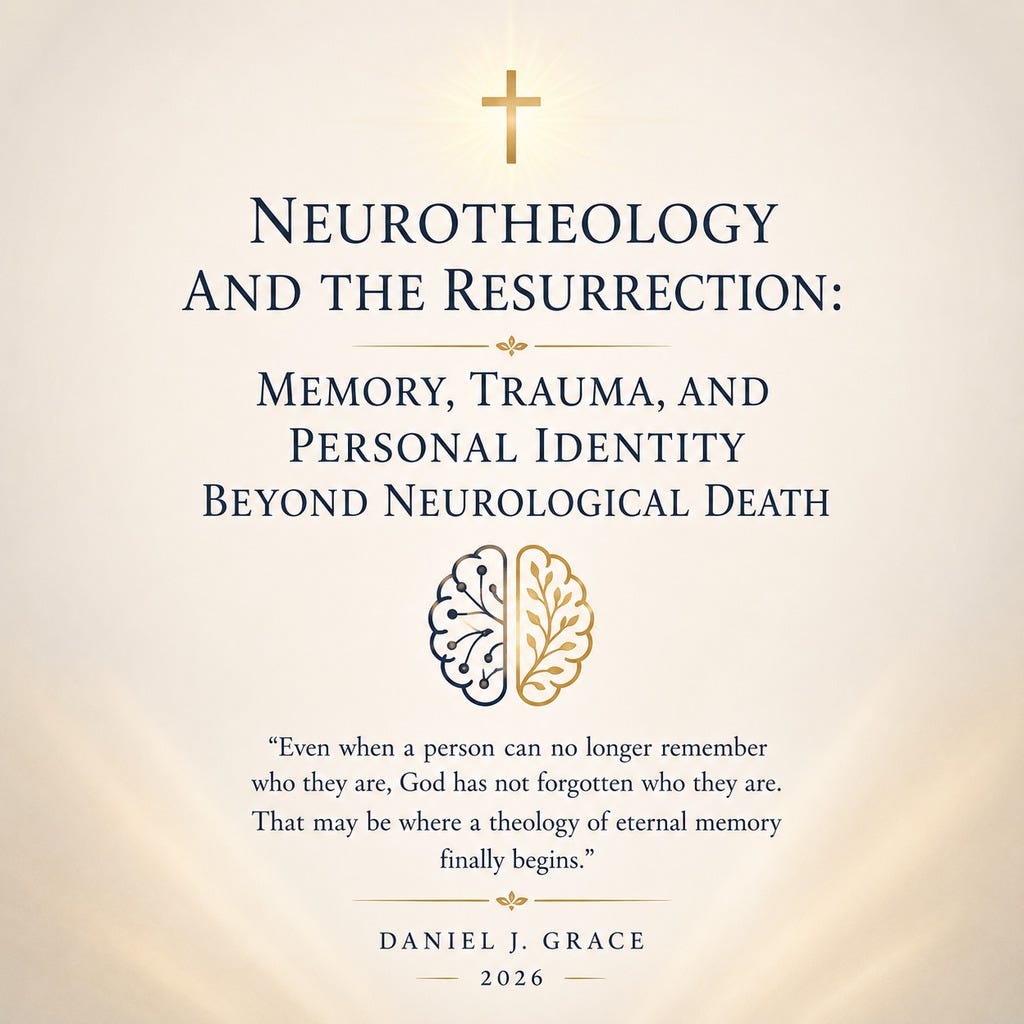
Neurotheology and the Resurrection
Memory, Trauma, and Personal Identity Beyond Neurological Death

Abstract
At the crossroads of neuroscience and Christian resurrection theology lies a conceptual issue this article sets out to examine: what becomes of personal identity in the face of memory that is damaged, incoherent or gone for good. One need only look at the like dementia, Alzheimer’s, trauma or profound amnesia to see how vulnerable autobiographical memory is. It is a function of the brain, to be sure, but it is also fundamental to how we understand ourselves. When neurological disease can cut off all access to a lifetime of experience, the Christian assertion of a resurrected “same person” calls for some rethinking.
In considering the work of neuroscientists and philosophers of personal identity alongside early Christian writings on the body and more recent theological takes on disability, we put forward an argument against reducing identity to one’s capacity to recall the past or to the condition of the brain at death. A better way to view it is through a model of restored memory that is rooted in transformation, divine recognition and embodied continuity. Dementia might make the past inaccessible but does not destroy the person who owns it. Trauma is another matter; here the past exerts a kind of destructive hold. Yet there is no requirement for resurrection to mean either the endless perpetuation of such suffering or the wiping of painful memories clean. The memory can stay true to history while the self is freed from its pathological grip.
Ultimately, the piece contends that Christian resurrection is less about a neurological rebuild or the keeping of some unchanging immaterial record than it is the transfiguration of the very same embodied individual. Memory is not made into the exclusive measure of identity nor is it done away with. It is mended and put back in its place in a person whose continuity is found in being raised and known by God rather than in perfect recollection.
Keywords: neurotheology; resurrection; memory; trauma; dementia; Alzheimer’s disease; personal identity; theological anthropology
1.Introduction: If Memory Disappears, Does the Person Disappear?
There is an intimate link between memory and personal identity. Put us to the test and we will define ourselves by the experiences we can recount: the places of our youth, family ties, acts of shame or enduring love, formative losses. We know who we are, in no small part, from the stories we can tell. Dementia makes for a very unstable ground on which to stand such an intuition.
Consider the advanced Alzheimer’s patient who has lost the ability to place himself in time or relation, who finds his surroundings alien or does not know the spouse of forty years. Severe amnesia is another matter altogether. As biological life goes on while the bulk of autobiographical memory vanishes, the question arises as to what exactly has been forfeited. Is the self constituted by memory, or is it just one of its conditions?
Christian theology would complicate the issue further. Resurrection is not to be thought of as the organism simply carrying on unchanged. Paul is clear in 1 Corinthians 15 about continuity in the face of transformation; what is sown in weakness is raised in power. The language is bodily enough, but it does not imply a straightforward repair of damaged biology. Introduce neurological disease into the mix and the difficulty is plain. When someone has succumbed to years of progressive dementia, what is there to resurrect? The person at death, the person before the illness set in, or some unity that is both and yet more?
One could say memory is the crux of the problem because it is a dynamic process, not a static storehouse. Neuroscience shows us how dependent it is on distributed brain systems. A lesion in one area might spare old habits but block new learning; neurodegeneration will eat away at recognition and orientation; and then there is trauma, which brings about the reverse pathology of involuntary, intrusive recollection.
All of this raises a theological question regarding healing. Would God restore a person whose memories have been obliterated or are a source of torment? To say that resurrection is merely the removal of suffering and the return of all memory is not quite careful enough. If traumatic memory is wiped clean, has some part of the person’s history been lost? And if the pain remains, in what sense is it redemptive?
A better way to put it is that resurrection is neither unending psychological torment nor permanent forgetting. It is a transfiguration of memory, a healing whereby what is recalled is true but no longer destructive.
This is of particular import when we consider dementia. The fact that a mother cannot identify her daughter does not mean she has ceased to be a mother; families tend to grasp this before philosophers do. While the cognitive impairment is devastating, it is a mistake to think the person has gone with it. Christian anthropology has good reason to resist such a reduction. Human dignity is not contingent on neurological efficiency or the capacity for autonomous thought, for that would make the value of a person wane with the disease, something at odds with the notion of grace and being made in the divine image.
It is for these reasons that this essay treats memory, dementia, trauma and resurrection as one and the same theological problem. Let the neuroscience explain the embodied processes and the theology affirm divine fidelity and the resurrected body, without either side collapsing into the other. Each should be allowed to show where the other falls short.
What I want to argue is that the Christian view of resurrection is immune to dualism and reductionism alike. The person God raises is the one who has died, but the process is transformative, not an indefinite holding of pathology. Trauma can be healed without being disavowed, and dementia need not be the end of identity.
So the issue is not whether memory outlives us. It is whether, in the raising of the dead, memory is itself brought into the truth.
2. Memory, Brain, and Personal Identity
It is clear that memory is not one thing. The point is made plain by neurological injury, which can sunder capacities we would normally consider inseparable. A man might be able to play the piano but have no recollection of a conversation he had ten minutes prior. Someone else may hold on to facts from his youth yet be unable to put himself back in the scene of a particular childhood event. There are those who carry a vivid knowledge of some trauma, though they experience it at a remove from normal recollection.
For decades neuroscience has tried to make sense of these dissociations. What has emerged is not the location of a single memory centre in the brain, but an understanding of the several interacting systems that give rise to memory, each with its own function.
Endel Tulving made a distinction that has been much cited: between episodic and semantic memory. The former is of events one has lived through – I know where I was and what happened and who was there. Semantic memory is different; I can tell you Rome is in Italy without having to go back in my mind to the moment I first learned it. Then there is procedural memory, which adds another layer of complexity. Even when conscious recall has failed, a person can still perform a learned skill. Riding a bicycle is the usual illustration, but the clinical record is more compelling. One cannot simply treat memory as a repository that is either whole or gone.
The case of Henry Molaison (H.M. in the older literature) put the hippocampus at the heart of the matter. After surgery in 1953 to stem his epilepsy took out large parts of his medial temporal lobes, he was left with severe anterograde amnesia. He could not put down new long-term declarative memories as he once did. But he could pick up motor skills and not remember learning them. It was a stark demonstration that the various ways of remembering can be separated.
This has theological import.
Were memory the self, then any chink in one’s memory would seem to be a loss of personhood. But Molaison was no less a person for his inability to form new ones. Nor does an everyday lapse make us less than who we are. We forget much of yesterday and move on.
One might object that this is not the same as Alzheimer’s. Of course not. The order of magnitude is quite different.
With Alzheimer’s the impairment is progressive, reaching into language, reasoning and the simplest tasks of daily living. The neuropathology takes its toll on the networks required for cognition. Autobiographical memory falls apart; one may not know one’s own family. The coherent story of the self is no longer there to be told.
We are then hard put to ignore John Locke. In the *Essay Concerning Human Understanding* he tied personal identity to consciousness running back through memory. It is an attractive notion. I own an act of twenty years ago because I can recall being the one to do it.
But dementia puts a strain on such a view. Take Anna. At seventy she has no trouble recalling her marriage at twenty-five or the raising of her children. By eighty-five, with advanced Alzheimer’s, none of that is there. If identity is a matter of remembered consciousness, what is she?
Most would say she is still Anna. Her family will not claim she has ceased to be. They will say Anna has the disease. The phrasing is telling: the disease is hers, she is not the disease.
They may well say “she is not herself,” and one should not correct them. There is truth in it. Old habits and personality can shift; the person you have known for years is hard to reach. To pretend otherwise would be disingenuous.
Still, it is seldom meant literally that another human being has taken her place. It is the expression of personhood that has been upset.
There is a difference between identity and what can be readily expressed of it. Neurological illness can break down the means of communication and recognition, but that is no proof that identity is nothing but the good working order of those mechanisms.
Antonio Damasio is useful on the question of selfhood in that he will not have the self reduced to a narrative unmoored from the body. Selfhood is embodied, inextricably linked to emotion and bodily regulation. This complicates matters for theology. The Christian cannot just say the brain is irrelevant and the soul is all that counts.
Damage the brain and the personality, the language, the memory will change. The brain is plainly of consequence. One can alter emotional regulation; injury has a way of changing the very capacities we are wont to think of as character. Any theological anthropology that fails to take this into account is not dealing with the human creature in any real sense.
Then again, one should not go to the other extreme and make an equally reductive case. It is true that memory relies on neural systems at work in our embodied life, but that does not mean personal identity is coterminous with some particular neural set up. There is a difference between dependence and identity.
Take sight for an example, though the analogy has its limits. You need functioning eyes and visual processing to see, and damage there will make a person blind. We would not be so quick as to say the impairment has in some way diminished his standing as a person. The capacity is gone, but the person who had it is still there.
Memory is of course more intimate. It underpins the narrative of a life, one’s commitments and relationships. Its loss is a more radical alteration of experienced identity than blindness. But the principle is the same: a human subject is not destroyed simply because a capacity has been damaged.
Christian resurrection theology needs to make that distinction, since death is the ultimate interruption of biology. A dead brain has no memories. If numerical personal identity hinged on unbroken neurological activity, then resurrection would be a problem before you even get to the question of dementia. The New Testament is quite clear that the dead are raised; Christianity cannot have it depend on biological continuity from the grave.
That moves us beyond simple persistence, but we must not swing to the opposite of an immortal memory archive. Resurrection is bodily. Paul in 1 Corinthians 15 is talking about the body and its transformation, not salvation as a permanent exit from embodiment. The task is to show how there is continuity without the resurrection body having to mirror every pathology present at death.
Look at Alzheimer’s. Should Christian hope be so odd that if a woman dies unable to know her children, she is preserved in that state for eternity? Or does God restore the power to recognise them, making available what was neurologically out of reach at the time of death?
The plain answer is restoration. But of what? Not the neurons in their diseased final form. What is restored is the person whose life was made up of both health and sickness. The pathological end is real, yet it has no exclusive right to define who she is for all time.
We put too much stock in the last state of a person, I think, because death puts a stop to the biography as we see it. The hospital bed and the final cognitive test become the measure of all things. But why should that final condition have more ontological weight than the decades before it?
The one who dies of dementia is not just the patient from the last week. She is the child who played in the yard, the adolescent in dispute with her parents, the adult who kept her word and laughed at the right jokes. Much of that may be inaccessible to the dying brain, but it did happen.
There is a difference between personal history and the autobiographical memory of it. I can forget something I did at six years old, but it remains my doing. The theological case is that resurrection brings back the person whose history is more than what the brain could hold.
This leaves a hard question: who remembers the whole person when the person cannot?
God does, says the tradition. One must be careful not to turn “God remembers” into a slogan or imply that He is running a cosmic database to put a human being back together like a digital file. A perfect copy of my memories would hardly be me. Resurrection is not replication.
To speak of divine memory is to refer to God’s relation to His creature. My identity is found in being the one God has created and will raise, not in my own self-recollection. The early Christians were at pains to argue that the one raised is the same creature who died, not a substitute.
But dementia compels one last thought before we get to those texts. If a person can lose most of the recollection of being a person and yet remain one, then memory is not the be all and end all of identity.
It matters greatly. It is not everything.
3. The Person Endures When Memory Does Not
There is a disconcerting way in which dementia makes of the abstract philosophical questions of personal identity something quite concrete. One is faced with a living human being, and yet she might not know her husband or be able to put together the day’s events in any narrative form that modernity would have us accept as the self. And still we speak to her as a person, rather than some organism from whom personhood has been siphoned off. That is an instinctive response, but it is also telling.
John Swinton makes a compelling case that you cannot base personhood on cognitive accomplishment alone. To make memory or rational autonomy the measure of a human being is to consign those with advanced dementia to the fringes of humanity. There are good reasons for Christian theology to put up resistance to such a view.
Western thinking today puts a premium on psychological continuity. I know who I am because I can string together a story: my childhood and yesterday are mine, and my relationships make sense because I have the history to place myself in them. Dementia breaks that story apart. A wife of forty years may turn to her husband and ask who he is. For him the decades they have shared are vivid; for her they are no longer there to be had. The marriage becomes unbalanced, but I would not say it has dropped out of her identity.
Some of what made up their past was never within easy reach of present consciousness anyway. Her husband now holds the memories she cannot. There are the old letters, the photographs, the way the children remember things, the rituals and habits of the home. They do not put back what she has lost, but they show that a person’s history is not walled off in his own head. We tend to forget this when our faculties are in order. No one keeps a perfect record of every conversation that cemented a friendship or every instance of care in youth. Our identity is already spread out across relationship and narrative; dementia only forces us to notice it.
It is also true that a degree of emotional responsiveness can remain even when explicit recollection is gone. A familiar voice or a certain melody will elicit a reaction even if the person cannot put a name to it. One should not be sentimental about it – the disease is often devastating and there is no pristine self hiding beneath it. But it is not always a matter of all or nothing. Recognition, affect, language and habit do not all fail at once. The neurology of it argues against the notion that if the memory is absent so too is the person.
What is the metric? If a man has no recollection of the last week, has a tenth of him disappeared? What if it is twenty years? There is no line in the sand where one human being is turned into another by virtue of forgetting. We see this with amnesia; a patient may be cut off from his past but the doctor does not hand him a new identity and the family does not treat him as a stranger.
Then there is the question of vocation before God, a dimension of continuity the theological tradition has long understood. A person is not of value to God only when she can give a coherent account of herself. An infant cannot. Nor can one under anesthesia. Even in sleep we lose our conscious self for hours without our identity vanishing. Dementia is not sleep, but the point stands: making constant self-awareness a condition of personhood is a weak argument. The imago Dei is not something you win by passing a test of recall. A Christian with dementia may have forgotten Christ, but the Church will go on to say that Christ has not forgotten him. One cannot overstate the importance of that asymmetry. It is a reminder that personhood is not something to be found only in oneself; it is upheld from without as well, through divine address and a kind of covenantal faithfulness.
To think otherwise is to make one of the more serious errors in our approach to dementia: the notion that identity is a matter of inward self-possession. We are prone to picture the self as an entity we have to keep together by way of memory. But in truth no one is alone in this. There are those who remember us in ways we can no longer do for ourselves. A parent will hold on to parts of us we have let go; a friend may keep alive some version of us from a time we cannot now get back to. Our communities have our names and our histories in their keeping, and the church puts forward prayers for people who may be unaware of them. In short, human identity is relational well before any signs of dementia set in.
Of course, this does not answer the metaphysical question of resurrection. The fact that a community remembers the dead is not the same as reconstituting them. Still, it undercuts the idea that continuity has to mean an unbroken first-person recollection. For the Christian, the issue is pressed even harder. Continuity is not guaranteed by what the family recalls or what is in the ecclesial archives; all of that will eventually pass. What holds is God’s fidelity to the individual.
There is a world of difference between saying God has facts about me and saying God remembers me. The first is what one might say of a database, the second speaks to covenant. When the Bible speaks of God “remembering” a covenant, it is not suggesting He has put aside some data and is now looking it up again. It is a relational term, denoting faithful action toward a promise and a people. Such theological grammar lets us talk of resurrection in terms other than the preservation of mental content. An Alzheimer’s patient may have lost the ability to tell her story, but God has not lost the story, nor has He lost her.
At the same time, one should not give the impression that the body is of no consequence, as if God were to put away some immaterial copy of the self. That would be at odds with Christian resurrection theology. The hope is in the raising of the dead, so the body has to be central to the conversation. If the disease has done its work on the brain, and the brain is of the body, then resurrection has to deal with embodiment. Theology cannot simply step around neurological injury. It must affirm the raising of the damaged person while refusing to let that damage be his final identity. One has to distinguish between the continuity of the person and the continuity of pathology; the former is what is required.
Consider the man who dies blind or the one who has lost a limb. They need not carry those conditions into eternity to be the same person numerically. Nor does a person whose cortical systems have been ravaged by neurodegeneration need permanent impairment for there to be a true resurrection and not a replacement. What is continuous is personal identity, not the pathology. Without it you have new creation, not resurrection.
Early Christians were debating these very matters when it came to bodily corruption and dismemberment. Theirs was an ancient biology, but the problem is as modern as it gets: how to have radical transformation and not lose one’s identity? Neurodegeneration is just the contemporary form of that old dilemma. How can memory be restored in such a way that it is still mine?
It would be too simple to suggest a perfect replay of every mental representation. Human memory is not some static file to be retrieved; it is unstable and reconstructive. Forgetting and interpretation alter it. To demand a flawless record of every stage of life would be to ask for something with no stable object to begin with. A better question is whether the resurrected person can know her life in truth, unencumbered by the distortions and fragmentation of disease. Christian theology can certainly allow for that.
Then there is the inverse problem that dementia invites, which is trauma. Where dementia makes memory off limits, trauma makes it unbearable. In one case the past is gone, in the other it comes at you with force. Either way, they show how fragile identity is when memory is fractured or becomes a tyrant.
4.Resurrection and Identity in Early Christianity
One cannot confine the early Christian understanding of resurrection and personal identity to a matter of psychological continuity, nor should it be viewed through the narrow lens of modern controversies over cognition, memory or neurodegeneration. At the same time, the classical sources put forward a conceptual framework that is still well suited to these kinds of questions. They are at pains to avoid two reductive positions: the idea that resurrection is simply an immaterial self persisting apart from the body, or that it is no more than the putting back together of the same biological parts. The early Christians would have none of it; for them there is a paradoxical continuity-in-transformation. The person who is raised is the one who died, but the life he is given is not a mere return to mortality.
We must start with Paul’s argument in 1 Corinthians 15. He was making his case against those who would deny the resurrection of the dead, not against any theory of autobiographical memory or neurological disorder. But the logic of what he says endures. For Paul, this is not about leaving embodiment behind or resuscitating a corpse. It is a transformation under divine order. What is sown is not the same in condition as what is raised.
He makes his point with an agricultural metaphor that is hard to miss. “What you sow does not come to life unless it dies” (1 Cor. 15:36). There is a material discontinuity between the seed and the full-grown plant, yet they are related. In a series of antitheses Paul drives home the difference: the body is sown in weakness and dishonour, but raised in power and glory (1 Cor. 15:42–43). The theological import is clear in his refusal to make something holy of decay. Resurrection is the move from corruption to incorruption.
This has a bearing on how we think about dementia and its like today. Given that Paul’s eschatology is predicated on a shift from the mortal to the immortal, there is no need to carry pathology into the resurrected state. To have Alzheimer’s in glory would run counter to the Pauline distinction between the perishable and the imperishable; it is not continuity in any robust sense. The clinical condition of the present is not simply extended.
And yet, continuity is not lost. God does not fashion a new being with similar traits to stand in for the dead. The language of resurrection refers back to the very individual who has passed away. The link is not an unbroken biological line but the fidelity of God to the person.
The patristic writers make this plain in their opposition to gnostic or dualistic views. Irenaeus is a case in point. In *Against Heresies* he will have nothing of the notion that salvation is an escape from our created bodies. For him, the material is the ground of God’s redemptive work, not a shell to be discarded. The same God who made the flesh redeems it. This is a check on any theology of personhood that would relegate the body to a secondary status by locating identity in some immaterial interiority. With Irenaeus, the human is saved by the renewal of embodied existence.
Tertullian puts it even more forcefully in *On the Resurrection of the Flesh*. His tone may be polemical, but his thesis is in keeping with the wider Christian witness: if the flesh has a part in our moral life and suffering, it has a part in redemption. To say otherwise is to deny that the whole person is part of the economy of salvation. Tertullian had no concept of amyloid plaques or synaptic plasticity, and it would be anachronistic to cast him as a neuroscientist. But his instinct is sound: the body is not incidental to who we are. Salvation is the healing of the creature, not the rescue of a ghost from a machine.
Then there is Augustine, who in Book X of the Confessions turns his attention to the vast and paradoxical interiority of memory and what it holds. One will not find a neurological explanation in Augustine, yet he is well aware of the part memory plays in how the self relates to itself. The self is not merely the owner of its memories; it comes upon itself in them, and at times in their failure. His meditations are all the more compelling for giving as much attention to forgetting as to remembering. We are prone to losing our memories and then hunting them down; we can be certain of having forgotten something prior to its recovery. In this way, memory is defined by absence no less than presence.
Such an observation has an unanticipated utility when one considers dementia. Were forgetting to mean the end of the self, human identity would be an impossibility from the start, given that we all make do with partial recall and displacement. Augustine does not have an answer for neurodegenerative disease, but he does put to rest the idea that the self is nothing more than what is at the moment available to conscious recollection.
There is value in this line of thinking since contemporary discourse has a habit of making autobiographical memory the benchmark of personal identity. Early Christian writers were more open to other possibilities. They did not dismiss memory’s importance but would not have it be the exclusive source of selfhood. The person is not so easily reduced to episodic recall. Identity endures biological and psychological change because it is rooted in a history that goes beyond what can be accessed in any given moment.
The point holds up when applied to the material side of things as well. Modern biology makes it hard to tie identity to strict material sameness. A body at seventy is made of different particles than it was at seven, and yet the individual is still recognizably the same. The brain is no more static; synaptic arrangements shift, neural pathways are reworked and the organ takes on the wear of time. So identity cannot be a matter of keeping every component in its original place.
Then there is the matter of resurrection theology, which is a sterner and odder proposition than simple conservation. God raises the organism that has been before him. The corruption is not carried forward, nor is the history wiped clean. It is a claim about the whole person vis-a-vis divine action, not the indefinite upkeep of a biological condition.
This opens the door to a finer theological reading of dementia. One who passes away with advanced Alzheimer’s is not to be equated with the illness. Their life is made up of a long history before God, of habits and bonds and earlier ways of knowing. To speak of the same person being raised is not to demand that the final pathology be reproduced in glory. Resurrection may be seen as the healing and completion of that history.
It forces us to ask how history is transfigured. Must suffering be obliterated or can it be redeemed? The early theologians do not make it easy, but they imply that divine restoration is no mere repetition or amnesia. The resurrected life does not deny what was put through, it overcomes what has deformed the person. There is room for remembrance without being ruled by it, for continuity free of affliction.
Trauma adds another layer of difficulty, being as much the violent hold of memory as its loss. But the Christian vocabulary of resurrection is still in order here. The God who restores the person does not need to annihilate his history. What is done away with in resurrection is death, not the past; what is mended is the wounded subject, not some form of anonymity.
In the end, the early Christians are not putting forward a technical theory of neuropsychological identity. From Paul’s seed metaphor to Tertullian on the body and Irenaeus on created flesh, and Augustine’s own reflections, they provide a framework that is perhaps less exact but more lasting. It resists reductionism and allows for embodied continuity and divine fidelity to coexist. The hope of the Christian is not for the past to be kept intact or for bodily decay to become one’s identity. It is that the person, with all the creaturely history they have, will be known fully by God and raised to the fullness of life they were meant for. Resurrection is neither survival nor a simple fix; it is transformation.
Should the need arise, I can rework this into an academic piece with the proper citations, a briefer article, or go deeper on the question of trauma.
5. Trauma: Erased, Remembered, or Transformed?
Below is a revision of your meditation, put in an academic register to give the prose more bite and theological exactness without losing the force of your argument.
Trauma is not the same sort of problem as dementia. With the latter the past has a way of vanishing; with trauma, the trouble is that the past will not stay in the past.
One can be quite aware that an event took place years ago and still respond as if the danger were at hand. A face, a smell, some unremarkable circumstance is enough to call up what was never put there by conscious design. The memory turns somatic: muscles tighten, the heart rate goes up, sleep is broken. Fear is there before one has time for reflection. It is reductive to call post-traumatic stress simply “remembering something bad.”
There is normally a sense of temporal distance in our autobiographical memory; I recall what happened then while being fully present here now. Trauma obliterates that distinction. The nervous system registers the reminder as a present threat even though the event is behind us.
This poses a theological question for resurrection.
Suppose God heals trauma. What does that entail? One might think it merciful for God to excise the traumatic memory entirely, but the case is not so simple. Take the person who has been through war or abuse. That experience is woven into his biography, having steered decisions and relationships over the course of a life. To wipe it out would be to remove knowledge of what actually transpired.
And there is a moral dimension to it. Some memories are evidence of injustice. If they are all gone in the resurrection, what of the truth of what was done? Does the survivor of persecution come to forget that he was persecuted? Christian hope is not well served by making evil unreal after the fact. Resurrection is no claim that history did not occur.
Look at the wounds of the risen Christ in John 20 (24–29). The resurrected Jesus is transformed but you can identify him by the marks of the cross. One need not make a whole neurotheology of it, but the example is hard to ignore. The wounds are there, yet Christ is not being crucified for eternity on account of them. The past is neither erased nor allowed to have its destructive way.
The same could be said of traumatic memory. There is a vital difference between a traumatic event and a trauma disorder. The former is a historical fact; the latter is the ongoing neurological and bodily toll of it. Resurrection may leave the truthful memory intact while curing the pathological hold it has on the individual.
“I was harmed” is remembered, but “the danger is happening again” is no longer felt. They are not the same thing.
This bears on forgiveness too. In the wake of trauma, a victim is sometimes told to let go of the matter or else his distress is read as a lack of faith. But the amygdala is not moved by theological resolution, and a nightmare is not proof of an unforgiving heart. We should not picture eschatological healing as God ordering the injured to “get over it,” which is just another imposition.
Resurrection finishes what this life leaves off. The person is still the one who endured it, and justice is still meaningful, but the terror is gone from the nervous system.
Then again, trauma can define a person in ways that are not all bad. A survivor’s empathy or convictions may be born of suffering. This is no justification for the inflictor, nor does it make the suffering good, but biographies are rarely straightforward. Take away a single event and the rest of the story loses its coherence. A survivor might be heard to say “I wish it had not come to pass,” and at the same time acknowledge that some part of his later life was a direct consequence of it. There is no contradiction in holding both views.
One should not think of resurrection as an act of editorial revision, scrubbing a biography until only the agreeable episodes are left. The result would be an oddly contrived individual. Christian eschatology has a word for what it is: redemption. And redemption is not denial. In fact, one can only redeem something when there has been a genuine wrong.
This goes some way to explaining the importance of memory in resurrection. Should the person be raised with no recollection of his earthly past, it is hard to call it the fulfillment of a life; it looks more like the start of something entirely new. Relationships are predicated on history. Suppose I were to meet someone I have loved but cannot recall. What kind of restoration is that? Recognition is essential, as is reconciliation and justice. So the biblical hope implies a continuity of personal history, even if Scripture is silent on the neurological means of it.
There is an objection to be made. Revelation 21:4 has God wiping every tear from the eyes so that pain and mourning are things of the past. Isaiah 65:17 says the former things will not be remembered. Does that mean we are to abolish painful memory? Read literally, one runs into trouble. But the biblical idiom of not remembering usually refers to the loss of an oppressive hold, not a form of neural erasure. Scripture is full of redemptive announcements while still recalling the suffering; Israel does not forget Egypt after being freed any more than Christians put aside the crucifixion in their proclamation. Hope in the biblical narrative is not won by excising all the hard parts of the story.
What is meant by the passing of former things is likely a change in their power in a redeemed creation. Death and trauma are not made eternal, but neither is history falsified. Here the theology of eternal memory is more compelling than the notion of perfect recall, which could be quite unbearable. To have equal vividness for every failure, every cruel word and physical injury of a lifetime would hardly be healing. We are selective in our memories for good reason; forgetting is a normal part of cognition.
Resurrection calls for truthful continuity, not an infinite storehouse of autobiography. The one who is raised knows herself to be the one who lived. Disease has not obliterated her identity and there is no need to put anything false in its place. Nor must evil retain its psychological sovereignty over her simply because it was once done.
Consider the difference between restoration and perfection. The former is of theological import; the latter is not. Restoration is what happens when neurological impediments are removed. Perfection is to remember without discrimination. Put dementia and trauma side by side and the distinction is plain. Dementia bars the way to the past; trauma forces it upon the present with too much violence. Resurrection would be a matter of integration in either case. With dementia, you have restored access and coherence. With trauma, you have a truthful memory unburdened by pathology.
The end point is much the same. The person is in possession of her history, not undone by its absence or its uncontrolled return. That is the meaning of peace in this context. It is not ignorance. One can know what transpired and not be broken by it. That seems the better logic of the Christian hope than any form of divine amnesia.
6. The Neurological Problem for Resurrection Theology
One might put forward a more forceful objection at this point: **where are the restored memories to come from?**
Assume that autobiographical memory is contingent on material neural systems. Those systems are being methodically taken apart by Alzheimer’s and will be completely obliterated in the end by the processes of biological death and decay. What is left, then, to be put back together?
The ready answer is: *God*.
In Christian theology there is merit to that response. But standing alone it is not much of an explanation. A robust account should not conflate several distinct claims into one.
There is the scientific claim to consider first:
**Memory is a function of the brain in the course of an ordinary human life.**
Empirical evidence is hard to ignore here. Alter the neurochemistry and cognition is affected; damage the relevant neural substrates and memory is compromised. Let a neurodegenerative disease run its course and you see capacities erode. Any neurotheology worth its name has to deal with such facts.
Then there is a stronger assertion:
**Since the brain holds the memory, personal identity is simply the physical state of the brain.**
This is a step too far. It is a philosophical reading of the science, not a scientific result in itself.
And finally the theological position:
**God has the power to raise the dead.**
Were this untrue, the doctrine of resurrection would be untenable without any need to bring up Alzheimer’s. If true, however, the fact that present neural structures have been destroyed is no barrier to resurrection, which in any case requires divine agency well beyond what a corpse can offer.
Still, a problem persists.
Imagine God fashions a new body with a brain that holds all of Daniel’s memories. This being can call to mind his moral choices, his fears, his old friends and even his youth. On what grounds do we make of him Daniel and not a perfect copy?
We are faced with the duplication problem. Information alone is insufficient. Put two physically identical beings before us with the same autobiographical record and each can in good faith say “I was Daniel.” They cannot both be numerically the same as the man who died.
Resurrection is not a matter of moving data into new hardware. Classical Christian theology sidesteps this kind of reductionism. The point is not that God makes another in your image with your memories intact. The claim is that **God raises you**. The continuity is personal, not merely informational.
It does not provide a mechanism, and perhaps none can be described scientifically if resurrection is not to be treated as a routine biological affair. That is no failing of the doctrine; theology must be able to concede where explanation yields to mystery.
Neuroscience does have a role to play in defining what resurrection is not. It cannot be about holding onto the final brain state, which may be deeply pathological. Nor can memory be the only measure of identity, for a person remains the same subject of experience even when memory has gone.
A better model is one that starts with the whole embodied history of the individual.
Take the case of Anna at thirty, at sixty and at eighty-five with her advanced Alzheimer’s. One would not call them three separate people. One could say they are the physiological and psychological phases of a single, unbroken human life, and in many ways they are at odds. The neural architecture is not what it was, nor are the memories or the body’s capacities. But for all that, common sense tells us there is one person who has endured the change.
Put death into the equation and you have the Christian argument: resurrection is an extension of that person’s identity, not just a continuation of some last impression of Anna at eighty-five.
In a word, identity is diachronic; it is about the person over time. There is nothing particularly technical in the notion that **a human being is a life, not a still image**.
Here neurotheology and the theology of resurrection can be mutually illuminating. Neuroscience would have it that the embodied self is a work in progress. The brain is always being modified, memory reconstructed and not put away in static form, with plasticity reordering function as it goes. A disease may upset the system but does not provide a neat metaphysical moment where one individual ends and another starts. For its part, resurrection theology holds that such transformation need not mean the end of identity.
From this we get a model of sorts:
**embodied person → neurological life in flux → illness or injury → death → the resurrected person**
The person provides the continuity, not the pathology.
This steers clear of two extremes. On one side is the reductionist view that a destroyed brain means the person is metaphysically done for, with no hope of resurrection – a conclusion science does not force on us. On the other is a kind of blunt dualism where the brain is of little consequence since the “real” person is an unscathed soul with all the memories stowed away. Hard to make that stick in the face of neuroscience; the person one meets is fully embodied.
So resurrection is best seen as God putting right an embodied personhood that is now subject to decay, rather than a release from the body. It is very much in the vein of Pauline thought on transformation.
It also allows for a way to talk of neurological disability that does not reduce the disabled to a flawed copy of something “real” yet to come. That is offensive if one is not careful. With dementia, for instance, the progressive nature of the condition invites the error of thinking only the earlier, sound mind was the true self. But the present person counts. The one with dementia is no mere remnant of what was before.
Resurrection is not about erasing the final years of decline to vindicate an older version. Dependence, confusion, fear, care, and connection are written into the biography. To heal is not to render them void.
A more generous view of restoration opens up. God will not wind the clock back to when Anna was thirty and feign that the next fifty-five years did not happen, any more than He would keep the neurodegeneration in perpetuity. The Anna who is raised will be one whose history is made of both strength and weakness, of remembering and of forgetting.
There is a deep Christianity to that. Resurrection is not a rewind or an erasure. It is fulfillment. And in that category, even memory makes sense.
7. Toward a Neurotheology of Restored Memory
On the surface, talk of restoration is unproblematic, but it invites the question of what exactly is being put back in order. One can repair a broken artifact by looking to an earlier, more whole condition. A human being is not so easily categorized; we are not static things. We are shaped by time and by our biology and psychology, reconfigured in the course of memory, suffering, grace and relationship. There is no original self tucked away in the past to be found.
That is what makes resurrection a matter of theological distinction. It would be a mistake to see Christian resurrection as nothing more than divine rejuvenation, a return to some favored biological age. To wonder if God would make one eighteen or fifty again is to miss the point; this is not medical remediation in any ordinary sense, but the very overcoming of death.
In that light, we must think of restored memory as part of a restored personhood, not the other way round. The person is not simply an assemblage of mnemonic data from which identity is cobbled together. Memories are of the person, elements of a life lived, not the ontological foundation of the self.
Here the nature of divine knowledge comes into play, assuming it is not viewed in mechanistic fashion. It is not as though God is an infinite archive with every experience filed in some celestial database. Christian theology posits a relational kind of knowing; God knows persons, not just facts about them. Psalm 139 puts it in intimate terms: we are known in our rest, our speech, our bodily formation. Or consider Jesus’ words in Matthew 10:30 on the hairs of the head being numbered. The import is not divine arithmetic but the fact that the individual cannot be reduced even in the face of creation’s vastness.
This has real bearing on the doctrine of resurrection. From where we stand, death seems to wipe out the means by which identity is held. The body decays, neural function ends, and as people go, so do the communal memories they carried. Papers and photographs may last for a while but they too have their day. Were resurrection to hinge on having enough empirical information left over to piece someone back together, the Christian hope would wear thin over time.
But Christianity has never made its case on the basis of archaeological retrieval. It is founded on divine fidelity. What holds the raised and the dead in continuity is God’s steadfast knowledge of and commitment to the creature, not any surviving neural tissue. God has no need of biological residue to know who a person is.
None of this should be read as an argument for a disembodied anthropology. The eschatology of the faith is resolutely embodied. The one God knows is the creature who loved and suffered in history, in the fullness of concrete existence. That is far more in keeping with resurrection theology than to speak of an immaterial soul that was once in a body.
Within such a framework, memory can be embodied without difficulty. Whatever form it takes in the resurrection, it is of an existence restored by God; there is no call to picture it adrift in some metaphysical no man’s land between death and the raising. How one views the intermediate state is a matter for another discussion, with traditions varying on whether there is conscious continuity or not. The issue at hand is simpler: is it possible for the same person to be raised with memory made whole after neurological impairment?
One can say yes. We survive shifts in memory all the time. When I put my finger on something today I could not yesterday, I have not become a different self. Amnesia may break autobiographical continuity but it does not destroy the person; we call it recovery. In resurrection, access to one’s own history is made possible where it was before obstructed. Memory is how we inhabit and tell the story of our identity across time, but it is not the source of it. When memory is not just out of reach but physically compromised, the matter grows in complexity. Take Alzheimer’s for instance: the neural tissue has been truly degraded. It would be a mistake to talk as if there are intact memories held in reserve behind some neurological lock. In all likelihood, the living brain has lost some of its data. Then again, resurrection is predicated on a divine restoration that follows bodily destruction of a much more profound order than neurodegeneration. If God can call the dead back, the recovery of faculties forfeited in life is no new obstacle for Him. The real issue is one of identity logic, not what is within God’s power.
We might put it this way: there is a **relational embodied continuity** to a person. One is who one is by virtue of an embodied history, upheld by relationships and by God’s own knowledge. Memory is part of that story but does not make up the self in isolation. Resurrection puts the subject back in a state where personal identity is not hampered by neurological pathology.
Trauma is of a different order. The memory may be there, but the person’s hold on it is broken. What is needed is integration, not just the ability to retrieve it. This points to at least three aspects to the memory of the resurrected.
To begin with, there is *truth*; the record of a person’s life is not expunged or watered down. There is also *access*, in that disease will not stand in the way of owning one’s history. And finally, *integration*: the kind of fragmentation that breeds shame or fear is put right. These are better terms to use than the imprecise idea that one will “remember everything.” There is no basis for thinking resurrection means having conscious recall of every triviality of one’s days. A human being need not spend eternity mulling over an unremarkable lunch from 1997 to be himself. Some measure of forgetting is inherent to being a finite creature. The redeemed are human, not omniscient; only God is without cognitive limits.
This is worth stressing given how popular conceptions of heaven tend to give the saved a kind of quasi-divine knowledge. Scripture does not warrant such an assumption. When Paul says we shall know “fully” in 1 Corinthians 13:12, he is drawing a line between partial and fuller knowledge, not erasing the distinction between the finitude of the creature and the infinitude of the Creator.
Restored memory will be finite. The resurrected individual has sufficient knowledge to live in the truth of his history, but not necessarily every detail. That is how the Creator-creature distinction is maintained.
It also speaks to the problem of traumatic memory. If the point of resurrection is integration and not erasure, then amnesia is not a prerequisite for peace. A victim can know what was done to him, and the perpetrator, even if redeemed, cannot hide behind universal forgetfulness. This is a morally serious prospect for reconciliation, as it should be. Christian eschatology has room for judgement, and you cannot have judgement without truth. Evil must be called out and not papered over with sentimentality.
But judgement is not the same as being perpetually traumatized. The event can be morally real without the victim being psychologically held captive by it. Justice, in a word, remembers; grace changes the effect of that remembrance.
There is a pastoral value in this. Some in the grip of trauma worry that if the pain eases, so too does the truth, as though healing were to make light of the offense. But a scar is evidence of survival, not a denial of the injury. Peace is no falsification of what transpired.
Look to Jesus in his resurrection. He is not a model of neurology but an image: the wounds are still to be seen, yet they do not destroy. He is not the man before the cross, nor has he been cut off from his suffering. He has gone through death into a glorified life, bearing his history without being its slave. So it may be with us in the end. The person is made whole by divine fidelity, having passed through what was, neither confined to it nor unchanged by it.
8. Dementia, Disability, and the Ethics of Christian Hope
One has to be wary of a certain danger in how resurrection is put forward in conversation. When it is made to sound like nothing but the restoration of one’s faculties, there is an undercurrent that can suggest those with dementia are in some way defective or morally wanting as they are now. That would be a grave error.
It is true that a person in the advanced stages of the disease will have severe cognitive impairment; to deny that is of no ethical or theological use. Those who care for such patients, be they family or clinicians, are often acutely aware of its devastation. But one must not mistake impairment for a loss of human value.
Christian anthropology offers a ready defence against such thinking. It holds that dignity is a divine endowment, not something won by one’s accomplishments. A person does not need to demonstrate sufficient intelligence, self-direction or social utility to be an image-bearer of God. That is a gift, and dignity is received on that basis alone. In this sense the position is also a necessary corrective to the prevailing culture.
Today’s societies make of autonomy the premier attribute of the adult. The ideal is someone who is independent, who keeps his finances in order, remembers what was said and so on. Dementia erodes these things and in the process shows how tenuous such ideals are. If you make independence the measure of a person, then dependence looks like a kind of failure.
But all of us start out in a state of radical dependence and many come to it again through age or infirmity. Even the most self-reliant are propped up by the care of others and the systems around them. Dementia does not invent dependence, it merely puts it on display.
John Swinton has been particularly insightful on this point. He steers the focus from what cognitive functions are left to the relational world where the individual is still known. It is not a cure for the condition, but it changes the way the person is seen.
The church has a duty in this regard. Forgetting the words of Scripture or being unable to track a sermon does not make one irrelevant to the community or put sacramental grace out of reach. Instead, the body of believers is called to greater patience and faithfulness, to remember for the one who cannot.
There is an irony in the fact that while we speak of salvation by grace, it is easy for Christians to judge by cognitive ability. Dementia makes that contradiction plain. If grace is to mean anything, the person who can no longer put together a coherent account of his faith has not been cast out for that reason.
When the capacity for prayer is gone, the act of holding a hand may be all that is left. Yet that is no small thing; it is communion. And the hope of resurrection ought to give more force to such care, not less. The promise of future restoration is no licence to treat the impaired body of the present as something to be done with. The body is of consequence because resurrection vouches for it.
The individual with dementia is not in a holding pattern to be a real person once more. He or she is already whole in that respect. Resurrection is the statement that the disease has not had the last word.
The same goes for trauma. One does not have to be symptom-free to be worthy of love or serious attention. Healing is to be welcomed, but dignity does not have to wait for it. This is perhaps the most useful lesson neurotheology can provide: the brain is of great importance, but a person is never just a set of neurological statistics.
9. Conclusion: The Person God Remembers
The question with which we set out is deceptively simple in its phrasing: **does the person vanish when memory does?** Yet the more one probes the matter, the less one can be satisfied with a plain yes or no. While it is true that memory is at the heart of selfhood, it does not comprise the whole of personhood. We see this in the case of amnesia, Alzheimer’s and dementia; these conditions can strip a human being of much of their autobiographical record, and still they are recognisably the same individual to those who care for them, and to themselves on some level. On the other hand, trauma shows us how memory can be anything but passive, intruding on the present with an intensity and disruption that normal recollection lacks.
It follows that any Christian theology of resurrection has to make room for both the excess and the absence of memory – for what is inescapably alive as well as what has been damaged or put aside. There are certain inadequate ways of thinking about this that theologians must eschew. To claim the soul holds every memory intact is to render the body and brain of little theological consequence. To view resurrection as a kind of divine reassembly from informational residue makes for a replica, not a raising of the dead. And if one suggests that painful memories are simply wiped away, one is too close to calling it divine amnesia; redemption should be a transfiguration of history, not its obliteration.
A better way to put it is to start from the premise that the person is an embodied creature with a past. Memory is part of that past but is not coterminous with the self. Neurological damage may cut off access to former experience without destroying the person to whom it belonged. Resurrection, then, is the restoration of the person in the full complexity of an embodied life, not the retrieval of data. The fact that disease was the last earthly state does not make it the eternal one.
Nor can we think of resurrection as an erasure of history. The one who has suffered is still that one, but in the life of God suffering is divested of the power to define the whole of a person. This is of particular import with regard to trauma. A memory can be truthful and yet cease to wound; justice can be done without the victim being made to relive the injury. One need only look to the wounds of the risen Christ for a sign of this: they are there to be seen, testifying to continuity, but they are no longer emblems of defeat.
We must also respect the limits of our knowledge. It is beyond the purview of neuroscience to confirm resurrection or of theology to chart the neural pathways of glorified remembrance. To try and detail the mechanics of how God might mend an autobiographical memory would be overstepping the bounds of either discipline. That is no failing on their part, but a safeguard against passing off speculation for empirical fact.
What neuroscience tells us is that memory is fragile and distributed; what theology brings to the table is the assurance that death and neurological decline do not have the final say. For the one lost to dementia, the confusion is real but not the end of the story. For the trauma survivor, the wound is not sovereign. In the end, we are more than what we can call to mind. Christian hope is placed in the God who knows fully even when we cannot. If a person has forgotten who they are, God has not. It is here, perhaps, that the conversation of eternal memory ought to begin.
Bibliography
Augustine. Confessions. Translated by Henry Chadwick. Oxford: Oxford University Press, 1991.
Damasio, Antonio R. Self Comes to Mind: Constructing the Conscious Brain. New York: Pantheon Books, 2010.
Irenaeus. Against Heresies. In The Ante-Nicene Fathers, vol. 1, edited by Alexander Roberts and James Donaldson. Buffalo, NY: Christian Literature Publishing, 1885.
Kandel, Eric R. In Search of Memory: The Emergence of a New Science of Mind. New York: W. W. Norton, 2006.
Locke, John. An Essay Concerning Human Understanding. Edited by Peter H. Nidditch. Oxford: Clarendon Press, 1975.
McKhann, Guy M., David S. Knopman, Howard Chertkow, Bradley T. Hyman, Clifford R. Jack Jr., Claudia H. Kawas, William E. Klunk, et al. “The Diagnosis of Dementia Due to Alzheimer’s Disease: Recommendations from the National Institute on Aging-Alzheimer’s Association Workgroups on Diagnostic Guidelines for Alzheimer’s Disease.” Alzheimer’s & Dementia 7, no. 3 (2011): 263–269.
Schacter, Daniel L. The Seven Sins of Memory: How the Mind Forgets and Remembers. Boston: Houghton Mifflin, 2001.
Squire, Larry R., and Stuart M. Zola-Morgan. “The Medial Temporal Lobe Memory System.” Science 253, no. 5026 (1991): 1380–1386.
Swinton, John. Dementia: Living in the Memories of God. Grand Rapids, MI: Eerdmans, 2012.
Tertullian. On the Resurrection of the Flesh. In The Ante-Nicene Fathers, vol. 3, edited by Alexander Roberts and James Donaldson. Buffalo, NY: Christian Literature Publishing, 1885.
Tulving, Endel. Elements of Episodic Memory. Oxford: Clarendon Press, 1983.
Van der Kolk, Bessel A. The Body Keeps the Score: Brain, Mind, and Body in the Healing of Trauma. New York: Viking, 2014.
Copyright
© 2026 Daniel J. Grace. Licensed under Creative Commons Attribution 4.0 International (CC BY 4.0).
How to Cite
Grace, Daniel J. “Neurotheology and the Resurrection: Memory, Trauma, and Personal Identity Beyond Neurological Death.” 2026. https://doi.org/10.5281/zenodo.21961485