

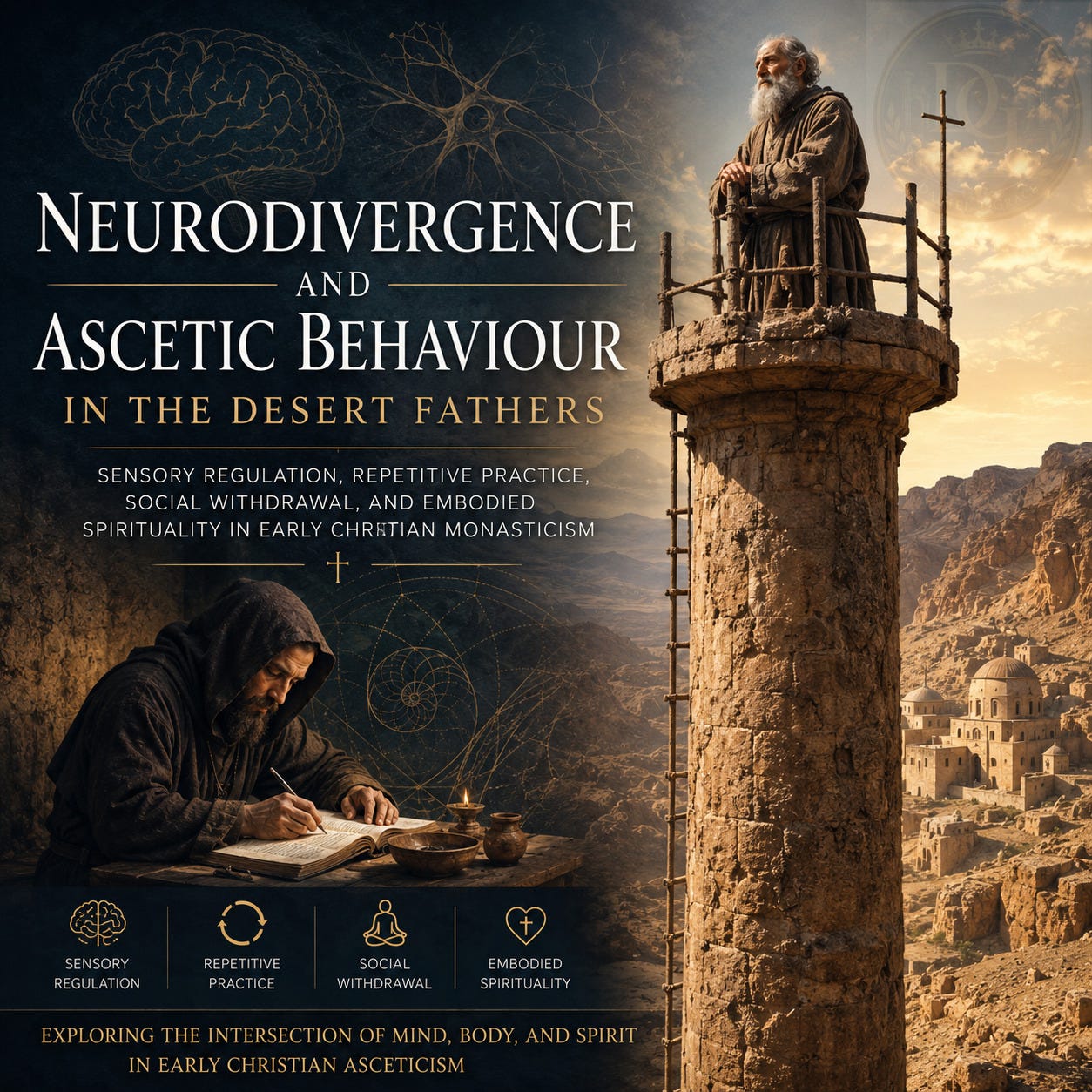
Neurodivergence and Ascetic Behaviour in the Desert Fathers
Sensory Regulation, Repetitive Practice, Social Withdrawal, and Embodied Spirituality in Early Christian Monasticism

Abstract
Extreme ascetic practices among the Desert Fathers and Stylites have traditionally been interpreted through theological, spiritual, and historical frameworks. Solitude, fasting, repetitive prayer, sensory deprivation, prolonged standing, and bodily exposure are commonly understood as forms of renunciation, spiritual warfare, discipline, and devotion to God. These interpretations remain essential, but they do not fully address why particular individuals were drawn to unusually severe practices or how differences in cognition, attention, sensory processing, routine, and social interaction may have shaped their ascetic lives.
This paper introduces neurodivergence as a cautious interdisciplinary framework for reconsidering early Christian ascetic behaviour. It examines possible connections between ascetic practices and traits such as intense focus, preference for predictable routines, repetitive behaviour, sensory sensitivity, sensory seeking, limited social interaction, and distinctive communication styles. Particular attention is given to the Desert Fathers, the sensory and social environment of the monastic cell, and the extreme embodied asceticism of the Stylites.
The paper does not attempt to diagnose historical figures with autism, attention-deficit/hyperactivity disorder, or any other modern condition. Ancient hagiographies and collections of sayings were theological and literary texts rather than clinical records. Neurodivergence is therefore employed as a heuristic lens rather than a retrospective medical verdict.
The study argues that some ascetic environments may have been especially compatible with particular cognitive and sensory patterns. Solitude could reduce social and sensory demands. Repetitive prayer and manual labour could regulate attention. Strict routines could create predictability. Extreme bodily practices could provide intense sensory focus. Monastic communities could also transform behaviours regarded as unusual in ordinary society into recognised forms of discipline, holiness, and spiritual authority.
A neurodivergence-informed interpretation does not reduce religious experience to psychology. Instead, it broadens the study of Christian asceticism by recognising that theological devotion was lived through diverse human minds and bodies. Early Christian monasticism may therefore preserve not only a history of renunciation and spiritual struggle, but also a neglected history of cognitive, sensory, and social diversity.
Keywords: Desert Fathers; neurodivergence; neurodiversity; Christian asceticism; early monasticism; Stylites; Simeon Stylites; sensory processing; religious psychology; retrospective diagnosis
1. Introduction
A man living for decades on top of a pillar appears almost impossible to explain through ordinary categories of human behaviour. Simeon Stylites endured exposure to heat, cold, wind, hunger, physical restriction, and the constant attention of those who travelled to see him. Other early Christian ascetics entered caves, abandoned cities, reduced their food and sleep, repeated prayers for extended periods, or remained almost entirely silent. Some withdrew from ordinary society so completely that their lives became symbols of another world. Christian tradition remembered these people as saints, spiritual warriors, teachers, and witnesses to the power of radical devotion.
Historical studies have usually interpreted such practices through theological, social, and political categories. Ascetics withdrew from the world to resist temptation, discipline the passions, imitate Christ, confront demonic powers, and seek uninterrupted communion with God. Their rejection of comfort also challenged the values of wealth, family status, imperial culture, and social respectability. The emergence of Eastern monasticism during the fourth and fifth centuries became one of the most influential developments in Christian history, producing diverse forms of solitary and communal religious life. These interpretations remain essential because they reflect the language, beliefs, and intentions found within the ancient Christian sources themselves.
Yet theological interpretation does not answer every question raised by extreme ascetic behaviour. Why were some individuals drawn to severe solitude while others entered communities? Why did certain ascetics appear able to tolerate intense repetition, restricted movement, hunger, silence, physical discomfort, and reduced sensory stimulation for periods that others could not endure? Why did highly unusual individuals sometimes flourish in religious environments after withdrawing from the social expectations of ordinary life? These questions are rarely explored through sustained conversation between religious history and contemporary psychology.
Secular psychological approaches present a different difficulty. Religious experience can easily be reduced to pathology, compulsion, trauma, hallucination, or social dysfunction. Such explanations may treat theological meaning as an illusion hiding a supposedly more authentic psychological cause. This paper rejects that reduction. The Desert Fathers and Stylites understood their practices as responses to God, Scripture, temptation, salvation, and the coming kingdom. Any responsible interpretation must take their religious world seriously. Psychological analysis should not replace their theology. It may, however, help illuminate dimensions of their behaviour that theological interpretation alone does not fully explain.
The concept of neurodivergence provides one possible interdisciplinary lens. Neurodivergence broadly recognises that human beings differ in attention, sensory processing, communication, social interaction, emotional regulation, patterns of interest, and need for routine. It does not describe one uniform type of person. Nor should every unusual or repetitive behaviour be regarded as evidence of a neurological condition. Research nevertheless shows that atypical sensory processing, differences in attention, repetitive patterns, and distinctive responses to environmental stimulation can be significant features of several neurodevelopmental conditions. These concepts raise new questions when placed beside historical accounts of solitude, patterned prayer, bodily discipline, sensory restriction, and sustained spiritual concentration.
This approach must be used cautiously. Modern diagnostic categories cannot simply be carried backwards into late antiquity. The surviving accounts were not clinical observations. They were theological narratives, collections of remembered sayings, biographies of saints, moral teachings, and stories shaped by communities of admiration. The Apophthegmata Patrum, for example, offers valuable insight into the lives and concerns of Egyptian monastics, but it is also a literary and spiritual tradition rather than a collection of neutral psychological reports. Hagiographical descriptions may simplify, idealise, exaggerate, or symbolically arrange behaviour. The available evidence cannot establish that a particular ascetic was autistic, had attention-deficit/hyperactivity disorder, or possessed any other modern diagnosis.
For that reason, this study does not attempt retrospective diagnosis. It examines neurodivergent traits and patterns as interpretive possibilities. Solitude may have been both a theological vocation and an environment with fewer social or sensory demands. Repetitive prayer may have carried profound spiritual meaning while also providing predictability, concentration, and emotional regulation. Strict fasting schedules and daily routines may have disciplined the body while creating a highly structured life. Extreme exposure or deprivation may sometimes have functioned not only as self-denial but also as an unusual form of sensory seeking, sensory control, or embodied focus. These possibilities do not cancel spiritual explanations. Human behaviour often carries several meanings at once.
The central research question is therefore: Can contemporary understandings of neurodivergent traits illuminate extreme ascetic behaviour among the Desert Fathers and Stylites without retrospectively diagnosing them or reducing their religious experiences to psychological conditions? The paper argues that they can, provided that neurodivergence is used as a cautious historical heuristic rather than a clinical verdict. Certain ascetic practices may have offered individuals with atypical sensory, attentional, social, or behavioural characteristics a structured environment in which difference could be transformed into spiritual discipline and religious authority.
This reassessment also carries a wider implication. The history of Christianity may include people whose cognitive and sensory differences shaped religious practices, communities, and traditions, even though ancient writers possessed no modern language for describing those differences. Recognising this possibility does not diminish the faith of the Desert Fathers. It allows their humanity to be considered more fully. Early Christian asceticism may therefore be understood not only as a history of renunciation and spiritual struggle, but also as a neglected history of human neurological, sensory, and social diversity.
2. The Historical World of Desert Asceticism
Christian asceticism did not suddenly begin when men and women entered the Egyptian desert during the fourth century. Practices such as fasting, celibacy, prayer, poverty, and voluntary self-denial were already present within earlier Christian communities. Some Christians remained unmarried, renounced property, or adopted disciplined lives while continuing to live near towns, churches, and families. The rise of desert monasticism therefore represented an intensification and reorganisation of an existing ascetic tradition rather than the creation of an entirely new religious ideal. The desert gave that tradition a distinctive location, social identity, and spiritual mythology.
Egypt became the setting for some of the most influential forms of early Christian monastic life. By the fourth century, ascetics were living near villages, in abandoned structures, in small desert dwellings, and in more remote regions beyond ordinary settlement. They did not all follow a single rule. Early Egyptian asceticism included considerable independence, and different monks organised their lives in different ways. Some lived alone. Others settled near experienced teachers. Some formed loose clusters of cells, while others entered organised communities governed by shared discipline. Archaeological and documentary research has also shown that these ascetics were not always as physically separated from ordinary society as later legends might suggest. Monastic dwellings could remain connected to roads, villages, trade, visitors, and local networks.
The solitary or eremitical form became strongly associated with Antony of Egypt. Antony was not the first Christian to practise withdrawal or live ascetically near the desert, yet later tradition elevated him as the exemplary Desert Father and one of the symbolic founders of monasticism. Athanasius’s Life of Antonypresented his withdrawal as a radical response to the Gospel. Antony abandoned property, separated himself from ordinary social life, and moved gradually further into solitude. His desert became both a physical landscape and a spiritual battlefield in which he confronted temptation, fear, bodily weakness, and demonic opposition. His reputation spread widely, and his life helped establish the desert monk as a recognisable model of Christian holiness.
The desert was not understood merely as an empty place. Biblical memory gave it deep theological meaning. Israel had wandered in the wilderness. Moses encountered God beyond settled life. Elijah withdrew into isolation. John the Baptist appeared in the desert, and Jesus entered the wilderness to fast and face temptation. Early Christian ascetics entered this symbolic landscape believing that withdrawal could expose the hidden movements of the soul. The removal of possessions, social distractions, sexual relationships, abundant food, and ordinary comfort was intended to reveal the passions that governed human behaviour. The desert was therefore imagined as a place of purification, spiritual combat, dependence on God, and preparation for the kingdom.
This spiritual struggle required the disciplined use of the body. Fasting reduced attachment to appetite. Vigils resisted sleep and trained attention. Celibacy redirected desire. Silence restrained harmful speech. Poverty weakened dependence on possessions and status. Manual labour supported the ascetic and guarded against idleness. Repeated prayer disciplined wandering thoughts. These practices were not usually presented as hatred of the body itself. Ideally, the body was trained so that it would no longer dominate the soul through uncontrolled appetite, fear, anger, lust, pride, or comfort-seeking. Ascetic practice sought freedom from the passions, although the severity of particular practices differed considerably between individuals and communities.
Food became one of the most visible areas of discipline. Accounts of the Desert Fathers regularly describe limited diets, delayed meals, bread measured by weight, abstention from cooked food, or fasting that continued for extended periods. Yet food in monastic life was not simply rejected. Monks needed to survive, work, receive guests, and care for the weak. The historical sources preserve tensions between heroic fasting and the obligation of hospitality. An ascetic might interrupt a personal fast when visitors arrived because charity could be judged more important than individual severity. Food therefore became a moral language through which humility, self-control, pride, generosity, competition, and communal responsibility were expressed.
Not all Egyptian monks lived as isolated hermits. Pachomius became associated with organised communal, or coenobitic, monasticism in Upper Egypt. In such communities, monks lived according to shared expectations involving worship, labour, meals, obedience, clothing, and authority. Community life reduced some of the independence found among solitary ascetics and placed spiritual discipline within an organised social structure. Between complete solitude and large communal monasteries were other arrangements, including clusters of individual cells in which monks lived separately but gathered for worship, instruction, or practical support. The early monastic landscape therefore contained a range of environments, from intense isolation to highly regulated communal life.
The teachings associated with Egyptian ascetics were eventually preserved in collections known as the Apophthegmata Patrum, or Sayings of the Desert Fathers. These accounts often take the form of brief encounters. A younger monk asks an elder for a word, describes a temptation, or seeks guidance about prayer, fasting, anger, sexuality, obedience, or intrusive thoughts. The elder responds with a short saying, symbolic action, scriptural interpretation, or memorable story. These collections provide an important picture of early monastic concerns, but they must be handled carefully. They are not direct transcripts or modern eyewitness reports. They were transmitted, collected, translated, and shaped by later communities seeking to preserve an authoritative vision of desert wisdom.
The world described in the Sayings is populated by individuals with markedly different temperaments and practices. Some elders offered gentle advice and warned against excessive fasting. Others pursued severe bodily discipline. Some welcomed visitors, while others protected their solitude. Some spoke frequently, while others communicated through silence, brief statements, or unusual symbolic acts. The tradition did not present every form of severity as spiritually healthy. Pride in ascetic achievement could itself become a passion. An impressive fast, prolonged vigil, or extreme act of withdrawal might be condemned when it produced self-glorification, harmed the body without wisdom, or weakened charity toward others.
Asceticism also developed beyond Egypt. Palestine became an important centre of monastic settlement and literary transmission, while Syrian Christianity produced distinctive and sometimes more visibly extreme forms of bodily renunciation. Monastic ideas moved across the Eastern Mediterranean through travel, pilgrimage, texts, personal relationships, and migrating communities. At the same time, scholars caution against describing every regional form of monasticism as a simple export from Egypt. Ascetic traditions in Syria and Mesopotamia had their own histories and may have developed partly through local Christian impulses rather than through direct Egyptian imitation.
Syrian asceticism became especially associated with public and embodied forms of discipline. Some ascetics lived in the open air, wore restrictive garments, practised prolonged standing, enclosed themselves within small spaces, or exposed their bodies to harsh environmental conditions. The Stylites represented the most famous expression of this tradition. Simeon Stylites lived for years on increasingly elevated pillars, combining radical physical separation with extraordinary public visibility. His restricted platform limited movement and exposed him to weather, discomfort, and observation. Yet he was not socially irrelevant. Crowds gathered below, visitors sought counsel, and religious and political questions were brought to him. The Stylite withdrew from ordinary life while becoming a centre of spiritual influence.
This paradox is important. Desert ascetics were separated from society, but they were rarely disconnected from it. Visitors travelled to see them. Communities preserved their teachings. Bishops sought their support. Laypeople requested prayer, healing, arbitration, and advice. Their refusal of ordinary status created a different kind of authority. The ascetic who abandoned wealth, comfort, marriage, and social ambition could be regarded as unusually free to speak truth. Behaviour that might have appeared eccentric, antisocial, or impractical in another context could become evidence of spiritual seriousness within the ascetic world.
The historical sources consequently interpret unusual behaviour through an overwhelmingly theological vocabulary. Solitude becomes renunciation. Repetition becomes ceaseless prayer. Restricted food becomes fasting. Sleeplessness becomes vigilance. Silence becomes control of speech. Physical exposure becomes warfare against comfort. Withdrawal from family becomes devotion to God. These interpretations must remain central because they reflect the ascetics’ own religious environment. Nevertheless, they do not prevent further questions about why particular individuals were attracted to certain forms of discipline, how they experienced the sensory and social conditions of ascetic life, or why some appeared unusually capable of sustaining extreme routines.
The historical world of the Desert Fathers was therefore neither uniform nor entirely isolated. It included solitary hermits, organised communities, travelling monks, spiritual teachers, visitors, labour, trade, worship, conflict, bodily discipline, and regional diversity. Ascetic practices were shaped by Scripture and theology, but they were lived through particular bodies, temperaments, cognitive patterns, and sensory experiences. Establishing that historical complexity is necessary before neurodivergence can be introduced as an interpretive framework. The question is not whether psychology can replace the spiritual meaning of asceticism. It is whether greater attention to human cognitive and sensory diversity can help explain why ascetic life took such different and sometimes extreme forms.
3. Neurodivergence as an Interpretive Framework
Neurodivergence is a modern term used to describe variations in cognition, attention, sensory processing, communication, emotional regulation, learning, and social interaction. It emerged partly from the neurodiversity movement, which challenged the assumption that every neurological difference should be understood only as illness, defect, or dysfunction. The term does not refer to one condition or one type of person. It can include autism, attention-deficit/hyperactivity disorder, dyslexia, dyspraxia, Tourette syndrome, and other forms of cognitive or neurological difference. In broader usage, it also draws attention to the fact that human minds do not all process experience in the same way.
This paper uses neurodivergence as an interpretive framework rather than as a diagnostic conclusion. That distinction is essential. The purpose is not to identify particular Desert Fathers as autistic, attention-deficit, obsessive-compulsive, traumatised, or otherwise clinically classifiable. Such claims would go beyond the available evidence. Ancient ascetic texts were not written by trained observers using modern diagnostic criteria. They rarely provide detailed developmental histories, family accounts, childhood behaviour, communication profiles, or consistent descriptions across different stages of life. Without such evidence, retrospective diagnosis would be speculative and methodologically weak.
Nevertheless, avoiding diagnosis does not require historians to ignore cognitive, sensory, or behavioural difference. Historical individuals possessed nervous systems, personalities, habits, vulnerabilities, and distinctive ways of experiencing their environments. They were not abstract theological figures. They lived through bodies and minds that varied from one person to another. A cautious neurodivergence-informed approach can therefore ask whether certain features of ascetic life may have been especially attractive, manageable, or meaningful to individuals with atypical patterns of attention, sensation, social interaction, or behavioural regulation.
One important area is sensory processing. Human beings differ significantly in how they respond to sound, light, touch, temperature, movement, hunger, pain, crowding, and other forms of stimulation. Some individuals experience ordinary environments as overwhelmingly intense. Noise, conversation, physical contact, unpredictable movement, or crowded social spaces may produce distress or exhaustion. Others may seek strong sensation, repetitive movement, pressure, pain, or extreme physical experiences because these create focus, calm, stimulation, or a stronger sense of bodily presence.
These differences provide a possible lens for understanding the attraction of ascetic environments. The desert reduced some forms of stimulation. A solitary cell removed conversation, crowds, social performance, domestic obligations, and much of the unpredictability of ordinary life. Repeated prayer, fixed labour, restricted possessions, and regular fasting created structure. At the same time, ascetic practice introduced other intense sensations, including hunger, sleeplessness, heat, cold, rough clothing, restricted movement, and prolonged standing. The desert could therefore function both as a place of sensory reduction and as a setting for highly controlled sensory intensity.
This does not mean that ascetics consciously entered the desert to regulate neurological difference. They understood their actions through Scripture, prayer, spiritual warfare, repentance, and the pursuit of holiness. Yet a behaviour may serve more than one function at once. A monk may have regarded silence as obedience to God while also finding relief from verbal interaction. Repetition may have been an act of ceaseless prayer while also supporting attention and emotional regulation. A restricted environment may have been understood as renunciation while also offering predictability and control.
Attention provides another relevant area. Some people possess an unusual capacity for sustained focus on a narrow field of interest, while others experience attention as inconsistent, rapidly shifting, or dependent on intensity and personal significance. Ascetic traditions demanded prolonged concentration on prayer, Scripture, bodily discipline, and spiritual self-observation. The ability to repeat a short prayer for hours, memorise large portions of Scripture, remain absorbed in a single spiritual aim, or continue a demanding physical practice over many years may have been connected, in some cases, to unusually focused patterns of attention.
The language of intense interest must be used carefully. Christian ascetics were shaped by a religious culture that encouraged total devotion to God. Their concentration was not automatically evidence of neurological difference. It was also the expected result of conversion, training, imitation, and communal teaching. Still, the degree of intensity varied greatly. Some individuals appeared capable of organising nearly every detail of life around one spiritual purpose. Their attention to prayer, fasting, silence, or bodily control could become so complete that ordinary concerns seemed almost irrelevant. A neurodivergence-informed interpretation asks whether certain cognitive styles may have made such total concentration more possible or more compelling for particular individuals.
Repetition and routine are equally important. Early monastic life often depended on repeated actions: memorised prayers, recited Psalms, fixed times of worship, manual labour, limited meals, repeated prostrations, silence, and regular periods of solitude. Repetition had clear theological meaning. It trained the mind, restrained distraction, and directed the whole person toward God. It also created predictable patterns that reduced uncertainty.
For some neurodivergent individuals, routine can provide stability, emotional regulation, and a sense of control. Unexpected change may be tiring or distressing, while repeated structure makes daily life more manageable. The monastic cell, especially when governed by a stable rhythm of prayer and labour, offered a life with fewer social roles and fewer unpredictable demands. The ascetic did not need to negotiate the changing expectations of marriage, business, status, public entertainment, or extensive family life. The spiritual rule defined what mattered, when it should be done, and how the day should be ordered.
At the same time, routine could become severe. Fixed fasting, restricted sleep, repetitive posture, or unchanging living conditions might be experienced not simply as discipline but as necessary order. Some ascetics resisted visitors, changes in schedule, movement from one location to another, or interruptions to prayer. Ancient writers usually interpreted such behaviour as dedication, vigilance, or the protection of solitude. A neurodivergence-informed reading does not deny that meaning. It asks whether the need for consistency may also have been part of the individual’s cognitive or emotional experience.
Social interaction forms another area of possible comparison. Some neurodivergent individuals find complex social environments exhausting, confusing, or overwhelming. They may struggle with indirect communication, shifting expectations, group behaviour, or the emotional demands of constant interaction. Others may desire connection but prefer highly structured relationships based on shared interests, clear roles, or limited forms of contact.
Desert asceticism radically simplified social life. The monk could leave behind family obligations, public status, economic competition, and many of the unwritten expectations of ordinary society. Relationships within the ascetic world were often more clearly defined. A younger monk sought instruction from an elder. A visitor asked for prayer. A disciple obeyed a rule. A hermit controlled when and how contact occurred. These relationships could still be difficult, but they were organised around an explicit spiritual purpose.
This may help explain why some socially unusual individuals gained authority within monastic settings. Behaviour regarded as eccentric or withdrawn in ordinary life could be reinterpreted as holiness. Limited speech became wisdom. Social distance became detachment. Resistance to comfort became spiritual strength. Intense focus became devotion. The ascetic environment did not simply tolerate difference. In certain circumstances, it transformed difference into religious meaning and social authority.
Emotional regulation must also be considered. The sayings and biographies of early monks frequently describe anger, fear, intrusive thoughts, despair, temptation, grief, and inner conflict. Ascetic practices were designed partly to discipline emotional life. Prayer, fasting, silence, confession of thoughts, manual labour, and obedience were used to manage inner instability. These practices may have functioned as spiritual disciplines while also helping some individuals regulate anxiety, agitation, sensory overload, or emotional intensity.
There is a risk, however, of turning every spiritual practice into a psychological coping mechanism. That would merely replace one reduction with another. Prayer cannot be understood only as self-soothing. Fasting cannot be reduced to behavioural regulation. Silence was not simply avoidance, and solitude was not necessarily social dysfunction. The ascetics believed that they were responding to God, resisting evil, and seeking transformation. Their theological claims must remain part of the explanation.
A balanced approach therefore recognises layered causation. Human actions can be spiritual, cultural, psychological, social, and bodily at the same time. A person may fast because of theological conviction, communal expectation, emotional need, sensory preference, personal temperament, and the desire for control. These factors need not be mutually exclusive. Historical interpretation becomes weaker when it insists that only one of them is real.
The concept of neurodivergence also requires ethical caution because it can easily become another way of labelling unusual people from a distance. Historical figures cannot confirm, reject, or explain the categories imposed on them. Modern readers may project current debates into ancient contexts or selectively identify behaviours that appear familiar while ignoring contradictory evidence. Extreme solitude, repetitive prayer, limited speech, or unusual pain tolerance do not belong exclusively to neurodivergent people. They may arise from religious training, trauma, personality, physical illness, social pressure, deliberate imitation, or many other causes.
For this reason, the method used here is comparative rather than diagnostic. It identifies patterns of behaviour described in ascetic sources and places them beside contemporary knowledge of sensory, attentional, social, and behavioural variation. The comparison does not prove that a particular individual possessed a specific condition. It shows that traditional spiritual explanations may not exhaust the range of possible human meanings within the behaviour.
The term “heuristic” is useful here. A heuristic is a tool for asking new questions rather than delivering final certainty. Neurodivergence allows historians to reconsider why some ascetics preferred extreme solitude, how repetitive prayer may have shaped attention, why highly structured routines were sustainable for certain individuals, and how religious communities converted unusual behaviour into authority. It opens a line of inquiry that has often been neglected because psychology and religious history have remained separated.
Used responsibly, this framework does not undermine the holiness, sincerity, or theological convictions of the Desert Fathers. It does not claim that their spiritual experiences were symptoms. Instead, it acknowledges that religious life is always lived through human diversity. Different minds may seek God differently. Different bodies may experience silence, pain, repetition, community, and solitude in different ways. Early Christian asceticism may therefore preserve evidence not only of theological devotion, but also of the varied cognitive and sensory forms through which that devotion was expressed.
4. Solitude and Social Withdrawal
Solitude stood at the centre of early Christian asceticism. The desert monk withdrew from ordinary society in order to seek God with fewer distractions. Family expectations, economic obligations, public status, social competition, and daily conversation were deliberately reduced. In theological terms, this withdrawal was not simply escape. It was understood as renunciation, spiritual warfare, repentance, and preparation for a life centred entirely on God. The ascetic left the city not because human relationships were meaningless, but because attachment to ordinary life was believed to interfere with spiritual freedom.
The desert also carried strong biblical associations. Moses encountered God in the wilderness. Elijah withdrew into isolation. John the Baptist lived outside conventional society. Jesus fasted in the wilderness and confronted temptation. Early Christian ascetics entered the desert with these models in mind. Their withdrawal was therefore shaped by Scripture and imitation. Solitude became a sacred environment in which the individual could confront the passions, examine the mind, resist temptation, and listen for God without the constant demands of ordinary social life.
Yet the attraction of solitude may not have been identical for every ascetic. Some may have entered the desert primarily because of theological conviction. Others may also have found ordinary social environments exhausting, confusing, intrusive, or difficult to manage. A neurodivergence-informed approach does not deny the spiritual meaning of withdrawal. It asks whether solitude may have served additional psychological or sensory functions for certain individuals.
Social interaction requires constant interpretation. Facial expressions, tone of voice, indirect expectations, status, humour, obligation, conflict, and emotional response all shape ordinary relationships. For some people, these demands are manageable and even energising. For others, they are tiring, overwhelming, or difficult to interpret. Neurodivergent individuals may experience social environments as unpredictable or cognitively demanding, especially when expectations are not clearly stated. The complexity of village, family, commercial, and civic life may therefore have been more difficult for some individuals than the structured world of ascetic practice.
The monastic cell simplified this environment. It reduced the number of daily relationships and allowed interaction to occur within clearer boundaries. A hermit could determine when visitors were received. A disciple approached an elder for a specific purpose. A monk’s obligations were often defined by prayer, work, fasting, obedience, and hospitality rather than by the shifting demands of ordinary society. The reduction of social complexity may have created a more manageable life for individuals who struggled with conventional forms of interaction.
This does not mean that all ascetics disliked people. Many offered counsel, received guests, settled disputes, prayed for communities, and maintained relationships with disciples. Some became highly influential public figures. The attraction of solitude should therefore not be equated automatically with complete social avoidance. A person may desire meaningful connection while finding frequent, unstructured, or emotionally complex interaction exhausting. Ascetic life could allow relationships to remain limited, purposeful, and organised around shared spiritual concerns.
The Sayings of the Desert Fathers repeatedly describe monks who guarded their cells and resisted unnecessary conversation. Some avoided visitors. Others spoke only briefly or answered questions with a single sentence. Silence was praised because speech could lead to anger, gossip, pride, judgement, and distraction. Within the tradition, restraint in speech was a sign of wisdom and self-control. However, these practices may also have suited individuals who found extended conversation difficult or who preferred direct, limited communication.
Brief speech could acquire spiritual authority. An elder who rarely spoke might be regarded as profound because every word appeared deliberate. The monk who avoided ordinary conversation could be remembered as detached from worldly distraction. Behaviour that might be interpreted elsewhere as social awkwardness, emotional distance, or communication difficulty could therefore be transformed by the ascetic setting into evidence of discipline and wisdom.
The religious community provided a vocabulary that made unusual social behaviour meaningful. Withdrawal became renunciation. Silence became discernment. Limited emotional display became calmness. Resistance to social convention became freedom from the world. These interpretations did not necessarily misrepresent the ascetic. The behaviour may genuinely have been rooted in spiritual conviction. Yet the same environment could also provide recognition and dignity to people whose social styles differed from the majority.
The distinction between chosen solitude and social exclusion is especially important. Some individuals voluntarily withdrew from society after receiving education, family support, or social recognition. Others may already have felt marginal, misunderstood, or unable to function comfortably within ordinary expectations. Ascetic life could turn an experience of exclusion into a recognised vocation. Instead of being regarded as a person who failed to participate normally, the individual could become someone who had rejected ordinary life for a higher purpose.
This transformation may have been psychologically significant. Religious identity can provide meaning where social life has produced shame or confusion. A person who struggled with conventional roles could receive a clear identity as monk, hermit, virgin, disciple, elder, or holy person. The ascetic vocation gave difference a narrative. Solitude was no longer evidence of failure. It became obedience to God.
At the same time, the desert should not be romanticised as a safe refuge for all forms of difference. Solitary life could intensify anxiety, depression, intrusive thoughts, fear, and emotional instability. Early monastic texts frequently describe logismoi, or troubling thoughts, that emerged with particular force in isolation. Anger, despair, sexual desire, pride, boredom, grief, and spiritual doubt could become more visible when ordinary distractions disappeared. The desert reduced social pressure, but it also removed many forms of comfort and support.
The danger of acedia was especially important. Often described as spiritual weariness, restlessness, boredom, or despair, acedia could make the monk hate the cell, resent the passing of time, and desire escape. This shows that solitude was not automatically peaceful. The same environment that regulated one person might distress another. Neurodivergence does not provide a single explanation because neurodivergent individuals also respond differently to isolation, structure, and sensory reduction.
Communal monasticism offered another form of adaptation. Some ascetics may have found complete solitude too difficult but benefited from a structured community with clear rules. Coenobitic life reduced the unpredictability of ordinary society while preserving regular contact with others. Meals, worship, labour, sleep, dress, and obedience followed established patterns. Roles were more clearly defined than in wider society. Such communities may have provided a form of social belonging that was organised, purposeful, and predictable.
The relationship between solitude and community was therefore flexible. Some monks lived alone but remained close to other cells. Others entered large communities. Some alternated between isolation and contact. An experienced ascetic might receive visitors but preserve long periods of silence. These arrangements suggest that early monasticism created several levels of social participation rather than offering only a choice between society and complete isolation.
This diversity is important for a neurodivergence-informed reading. Different individuals may have required different balances of solitude, structure, sensory control, and human contact. A remote hermitage may have suited one person, while a regulated monastery suited another. What united these forms was not a single psychological type but a religious culture capable of accommodating several patterns of life.
Solitude also altered the relationship between social difference and authority. In ordinary society, authority often depended on wealth, family, education, office, or public reputation. The desert monk rejected these sources of status. Authority came instead from discipline, prayer, perceived holiness, spiritual insight, and freedom from ordinary ambition. This reversal allowed individuals who might not have succeeded within conventional institutions to become influential.
The ascetic’s distance from society strengthened this authority. Because the monk was believed to desire nothing from the visitor, his advice could appear impartial. Because he had abandoned comfort and status, his words carried moral weight. The more radically he withdrew, the more society sometimes sought him. This paradox became especially visible among famous hermits and Stylites. Physical separation did not remove social influence. It intensified it.
The Stylite illustrates the paradox clearly. Living on a pillar created extreme separation from ordinary social contact. Access was controlled. Movement was restricted. Conversation occurred at a distance. Yet crowds gathered below, and the ascetic became publicly visible. The pillar offered both withdrawal and connection. The Stylite could remain physically separate while participating in social life through limited, structured encounters. For someone who found ordinary interaction difficult, such an arrangement might have reduced unpredictable intimacy while preserving purpose and authority.
The neurodivergence-informed interpretation must remain cautious. Preference for solitude does not prove autism, trauma, anxiety, depression, or any other condition. Religious withdrawal existed as a recognised cultural practice, and people could learn it through imitation and discipline. Many ascetics deliberately trained themselves to tolerate solitude even when it was initially painful. The historical evidence rarely allows the researcher to distinguish clearly between natural preference, spiritual obedience, social difficulty, and acquired habit.
Even so, the possibility of cognitive and social variation should not be ignored. Some ascetics may have experienced solitude differently from others. For one person, the cell may have felt like deprivation. For another, it may have brought relief from noise, obligation, and social confusion. For another, it may have created the conditions for intense focus. The shared theological language of renunciation could therefore contain a variety of individual experiences.
Solitude among the Desert Fathers should consequently be understood as both a spiritual practice and a human environment. It carried biblical meaning, disciplined the passions, and expressed rejection of worldly attachment. It also reduced sensory stimulation, simplified relationships, limited social demands, and created predictable boundaries. These features may have made ascetic life particularly sustainable for some individuals with atypical social or sensory needs.
A neurodivergence-informed reading does not claim that the Desert Fathers withdrew because they could not cope with society. It suggests that the desert may have offered certain people a form of life in which their differences became manageable, meaningful, and respected. The same qualities that produced difficulty in ordinary society could become sources of spiritual identity. Social distance could become contemplation. Limited speech could become wisdom. Resistance to convention could become holiness. In this way, early Christian asceticism may have created one of the ancient world’s most unusual spaces for transforming human difference into religious vocation.
5. Repetition, Routine, and Intense Spiritual Focus
Repetition was one of the defining features of early Christian ascetic life. Prayer was repeated. Psalms were memorised and recited. Manual work followed a regular pattern. Meals were limited and often taken at fixed times. Silence was practised deliberately. Prostrations, vigils, fasting, and scriptural meditation formed rhythms that gave shape to the day. For the Desert Fathers, repetition was not empty habit. It was a method of training the mind and body toward continual awareness of God.
The aim of ascetic repetition was spiritual transformation. The human mind was understood as unstable, easily distracted, and vulnerable to temptation. Thoughts moved rapidly from fear to desire, from pride to anger, and from memory to fantasy. Repeated prayer redirected attention. Memorised Scripture gave the mind something stable to return to. Manual labour occupied the body while the heart remained focused on God. Through repetition, the monk attempted to weaken harmful habits and cultivate new ones.
The repeated use of short prayers became especially important within the wider development of Eastern Christian spirituality. A brief biblical phrase or petition could be recited again and again until prayer seemed to become almost continuous. This repetition was intended to unite thought, breath, body, and spiritual attention. The practice was not based on novelty. Its strength came from returning to the same words until they became deeply internalised.
Modern readers may be tempted to regard such repetition as mechanical or compulsive. That judgement would overlook the theological meaning attached to it. Repetition did not necessarily indicate a lack of thought. It could create the conditions for deeper thought. The repeated phrase became a stable point around which attention could gather. Instead of producing boredom, repetition could strip away distraction and intensify awareness.
A neurodivergence-informed interpretation introduces another dimension. Repetitive actions and predictable routines can support emotional regulation, concentration, and sensory stability. For some individuals, repeated words, movements, sounds, or tasks create calm. They reduce uncertainty and provide a sense of continuity. The same action can become an anchor when the surrounding world feels unpredictable or overwhelming.
This does not mean that repetitive prayer should be classified as a symptom. Religious repetition is widespread across cultures and is practised by people with many different cognitive profiles. The point is more limited. Certain individuals may have experienced repeated prayer as especially natural, sustaining, or effective because it matched their preferred way of regulating attention and emotion.
Monastic life offered an unusually structured environment. The ascetic did not need to reinvent the day each morning. Prayer, work, silence, fasting, and rest followed a recognisable order. Possessions were limited. Choices were reduced. Social roles were simplified. For individuals who found uncertainty difficult, such a pattern may have provided stability that ordinary life did not offer.
Routine can reduce cognitive strain. Every decision requires attention. Clothing, meals, work, relationships, travel, conversation, and social expectation all demand mental processing. Ascetic simplicity narrowed these demands. The monk might wear the same type of clothing, eat a restricted diet, remain in one place, and perform similar tasks each day. These limits were understood as renunciation, but they also created predictability.
Predictability should not be confused with ease. Monastic routines could be severe. The same fixed schedule that brought stability could involve hunger, interrupted sleep, hard labour, and physical discomfort. Yet difficulty and predictability are not opposites. A demanding practice may still feel manageable when its pattern is known. For some individuals, a harsh but stable routine may be easier to endure than a comfortable but unpredictable life.
The cell itself reinforced this structure. It confined the monk to a limited environment and reduced the number of possible actions. The instruction to remain in the cell was repeated throughout early monastic teaching. The cell was described as a place where the monk would learn everything. This language expressed the belief that spiritual growth required endurance rather than constant movement.
Remaining in one place could be deeply challenging. Restlessness, boredom, intrusive thoughts, and the urge to leave were common themes in monastic literature. The discipline of staying forced the ascetic to confront internal instability. Yet the fixed environment may also have helped some individuals focus. Reduced movement, limited social contact, and a familiar physical setting removed many competing demands.
The relationship between routine and control deserves careful attention. Asceticism involved deliberate control over food, speech, sleep, movement, possessions, and sexuality. The monk attempted to govern aspects of life that might otherwise feel disordered. This control was interpreted spiritually as mastery over the passions. It could also provide a stronger sense of internal order.
For some neurodivergent people, control over routine and environment is especially important. Sudden interruption, unexpected change, or loss of structure may cause distress. The ascetic ideal valued consistency and resistance to distraction. A monk who followed the same discipline for years might be praised for steadfastness. What modern observers might interpret as rigidity could be interpreted within monastic culture as faithfulness.
The distinction between discipline and rigidity is not always easy to draw. A healthy routine supports life. A rigid routine may become impossible to interrupt, even when circumstances require flexibility. Early Christian teachers recognised this danger. Ascetic achievement could become a source of pride. A monk might refuse hospitality, neglect the sick, or judge others because of attachment to personal discipline. In such cases, the routine no longer served love or humility.
Stories from the Desert Fathers often challenged excessive attachment to personal practice. An ascetic might break a fast to welcome a visitor. Another might reduce his discipline because of illness. A teacher could advise a younger monk not to imitate an extreme practice beyond his strength. These accounts show that monastic wisdom did not always identify greater severity with greater holiness.
This flexibility is important for the argument of this paper. Repetitive practice and routine were valued, but they were supposed to remain subordinate to charity, humility, and discernment. The tradition recognised that discipline could become spiritually harmful when it was followed without wisdom. This suggests that early monks themselves distinguished between meaningful structure and destructive inflexibility, even though they did not use modern psychological terms.
Intense spiritual focus was closely connected to routine. Some ascetics organised nearly every aspect of life around one central aim: constant remembrance of God. Ordinary ambitions were abandoned. Marriage, property, public career, entertainment, and social advancement lost importance. The entire life became concentrated on prayer and purification.
Such focus can be understood through the religious language of total devotion. Christianity already contained demands for wholehearted love of God, single-minded discipleship, and freedom from divided loyalty. Ascetics took these demands with unusual seriousness. They did not merely add prayer to an ordinary life. They reconstructed life around prayer.
A neurodivergence-informed reading asks whether some individuals were especially capable of this form of concentration because of highly focused patterns of interest. Certain neurodivergent people describe deep absorption in a subject, activity, or system. Attention can become intense and sustained when the object is personally meaningful. Time, bodily needs, and surrounding events may become less noticeable during periods of absorption.
The ascetic sources sometimes describe a similar narrowing of attention. A monk may remain in prayer for long periods, forget food, continue reciting Scripture through the night, or become so absorbed that ordinary surroundings seem distant. Ancient writers understood such experiences as spiritual concentration, grace, or victory over distraction. Those meanings should be preserved. Yet the individual capacity for sustained absorption may also have varied according to cognitive style.
This possibility becomes especially relevant when devotion is unusually narrow and enduring. Some ascetics pursued one discipline with extraordinary consistency. One became known for silence. Another for standing prayer. Another for fasting. Another for remaining enclosed. Another for constant recitation. These practices became not merely activities but defining features of identity.
Religious culture gave such intensity public meaning. The ascetic’s highly focused behaviour became a sign of calling. A pattern that might have seemed socially unproductive elsewhere could become spiritually admired. The individual was no longer described as obsessively attached to one activity. He was regarded as faithful to a vocation.
There is a danger here of romanticising intense focus. Absorption can support creativity, devotion, and discipline, but it can also narrow life excessively. Extreme attention to fasting, prayer, or bodily control may damage health, relationships, and judgement. Ascetic literature itself records concern about imbalance. The most respected teachers often emphasised humility and discernment rather than dramatic achievement.
Intense spiritual focus therefore existed within tension. It could produce depth, perseverance, and extraordinary concentration. It could also become pride, competition, self-harm, or inability to adapt. The presence of repetition or intensity alone cannot determine whether a practice was spiritually or psychologically healthy.
The same caution applies to repetitive movement. Prostrations, standing, pacing, manual work, and the handling of prayer ropes could create bodily rhythm. Repeated movement can support concentration by giving physical form to attention. It may also regulate arousal or relieve internal restlessness. In ascetic life, bodily repetition linked prayer to the nervous system, even though ancient writers would not have described it in those terms.
The body was not passive during prayer. Breath changed. Muscles tired. Hunger intensified. The same words passed repeatedly through the mouth. Posture shaped awareness. Through repetition, the ascetic entered a patterned physical state. Spiritual concentration was therefore embodied rather than purely intellectual.
This helps explain why repetition cannot be divided neatly into either theology or psychology. Theological meaning operated through the body. Prayer affected attention. Posture affected emotion. Routine affected perception. Hunger affected thought. A practice could be sincerely directed toward God while also influencing neurological and sensory regulation.
The relationship between repetition and intrusive thought is particularly important. The Desert Fathers often spoke of unwanted thoughts that entered the mind repeatedly. These could involve fear, anger, sexuality, despair, pride, or memory. Repeated prayer and scriptural recitation provided a method of response. Instead of debating every thought, the monk returned attention to a stable phrase or action.
From a psychological perspective, this could function as attentional redirection. From a spiritual perspective, it was watchfulness and resistance to temptation. These interpretations are not mutually exclusive. The same practice may have changed both the monk’s spiritual orientation and immediate cognitive state.
Routine also created a sense of temporal order. The day was not an unstructured expanse. Prayer, labour, meals, and rest marked the passing of time. This order may have been especially important in solitary settings where ordinary social markers were absent. Without appointments, family schedules, markets, or civic events, time could become difficult to organise. Repetition gave the desert day a recognisable shape.
This structure may have protected some ascetics from disorientation. It may also have intensified the experience of those who struggled with monotony. Again, the same environment could regulate one person and distress another. The paper does not claim that monastic routine was universally therapeutic. It argues that individual cognitive differences likely influenced how such routines were experienced.
The strongest interpretation is therefore one of compatibility rather than causation. Neurodivergent traits did not create Christian asceticism. The theological, biblical, and cultural foundations of ascetic practice are clear. However, ascetic forms of life may have been especially compatible with certain cognitive styles.
A person who preferred repetition, stable environments, clear rules, limited social complexity, and intense concentration might find monastic life unusually coherent. A person who struggled with such conditions might find the same life unbearable. The diversity of monastic forms allowed different individuals to seek solitude, community, structure, movement, silence, or public ministry in different combinations.
Repetition and routine were therefore more than background features of early monasticism. They were central technologies of spiritual formation. They shaped attention, emotion, behaviour, time, and bodily experience. A neurodivergence-informed reading reveals how these practices may also have supported individuals whose cognitive and sensory needs differed from those of the wider society.
This interpretation does not reduce ceaseless prayer to self-regulation or spiritual focus to restricted interest. It recognises that devotion was expressed through particular minds and bodies. Some ascetics may have found in repetition not only a path toward holiness, but also a way of organising consciousness itself. The rhythm of prayer, labour, fasting, and silence created a world in which intense focus could become vocation, routine could become faithfulness, and repetition could become communion with God.
6. Sensory Regulation and Sensory Deprivation
The desert was not merely a symbolic landscape. It was a sensory environment. Silence, darkness, heat, cold, wind, hunger, thirst, physical exposure, restricted movement, and isolation shaped the ascetic experience at every level. The Desert Fathers did not pursue spirituality apart from the body. They prayed, fasted, watched, endured, and withdrew through bodies continually affected by their surroundings.
Modern discussions of neurodivergence often recognise that people experience sensory environments differently. Some are highly sensitive to noise, light, touch, temperature, smell, movement, or social stimulation. Others may be less responsive to ordinary sensation and seek stronger physical input. These patterns are commonly described as sensory avoidance, sensory sensitivity, sensory seeking, or reduced sensory responsiveness. They vary considerably between individuals and should not be treated as fixed categories.
This framework offers a useful way to reconsider ascetic practice. The movement from city or village into a cell, cave, tomb, or remote desert settlement involved a dramatic change in sensory conditions. Ordinary life contained voices, animals, trade, family interaction, work, smells, movement, conflict, and constant unpredictability. The desert reduced many of these demands. It created a narrower and more controllable environment.
For some ascetics, this reduction may have supported concentration. Silence reduced auditory interruption. A small cell limited visual distraction. Repeated daily routines reduced uncertainty. Restricted possessions simplified the physical environment. Solitude removed much of the need to interpret facial expressions, social expectations, and changing conversations. The ascetic could direct attention toward prayer, Scripture, bodily discipline, and internal thought.
Within the Christian tradition, this reduction was interpreted as renunciation. The monk removed distractions so that the soul could become attentive to God. Yet spiritual meaning and sensory effect are not opposites. A practice chosen for theological reasons can also alter arousal, attention, and emotional regulation. The cell may have been a place of spiritual battle while also functioning as a low-stimulation environment.
This possibility is especially important for individuals who may have found ordinary social and sensory environments overwhelming. A crowded household, marketplace, church gathering, or village could demand continual adjustment. Noise, touch, movement, conversation, and obligation might produce exhaustion. Withdrawal into a controlled space may therefore have felt not only spiritually demanding but also relieving.
The word “relief” must be used carefully. The desert was not comfortable. Ascetics experienced hunger, heat, cold, insects, poor sleep, loneliness, illness, and fear. The reduction of one kind of stimulation often increased another. A silent cell might remove noise but intensify awareness of bodily discomfort. Isolation might reduce social demands but amplify intrusive thoughts. The desert simplified the environment without making it easy.
This tension is central to ascetic life. The ascetic controlled some sensations while deliberately accepting others. Food was reduced. Sleep was interrupted. Clothing could be rough. Posture could be restricted. Movement might be limited. The body was exposed to temperature, fatigue, and pain. These conditions were not accidental side effects. They were often treated as part of the discipline itself.
A neurodivergence-informed reading therefore has to consider both sensory reduction and sensory intensity. Some individuals may have sought quiet, stillness, and enclosure. Others may have been drawn to strong bodily experience. Hunger, exposure, pressure, prolonged standing, repetitive motion, or physical exhaustion may have created a powerful sense of focus.
Sensory seeking can involve a desire for intense input. Strong pressure, repetitive movement, physical strain, cold, heat, or pain may help some individuals feel regulated, alert, or present. This does not mean that ascetic suffering was secretly a form of sensory seeking. The historical sources consistently describe fasting and endurance through theological categories such as repentance, discipline, imitation, purification, and spiritual warfare. Yet the bodily experience of these practices may have affected different ascetics in different ways.
Hunger provides a clear example. Fasting was one of the most widespread ascetic disciplines. It was intended to weaken attachment to appetite, create humility, support prayer, and imitate biblical models. It also changed consciousness. Hunger affected attention, mood, sleep, bodily awareness, and emotional intensity. Some ascetics may have experienced these effects as distraction. Others may have found that hunger sharpened focus or created a stronger sense of spiritual seriousness.
The regularity of fasting also mattered. A restricted diet reduced choice and created predictability. Meals could be measured, delayed, or simplified. For some individuals, this structure may have reduced anxiety around food or daily decision-making. For others, it may have encouraged harmful rigidity. The historical tradition reflects both possibilities by praising discipline while warning against excessive severity and pride.
Sleep deprivation functioned in a similar way. Vigils were intended to resist spiritual laziness and create time for prayer. Night provided silence and separation from ordinary activity. Yet interrupted sleep also altered cognition, emotional regulation, and perception. Fatigue could produce unusual experiences, heightened emotion, confusion, or intense concentration. Ancient writers often interpreted such states spiritually.
A careful modern reading should neither dismiss those experiences nor accept every report uncritically. Theological meaning remained real for the ascetic, but altered bodily states may have shaped how visions, temptations, fear, or spiritual presence were experienced. Severe fasting and sleeplessness can affect perception. Recognising this does not prove that religious experiences were false. It acknowledges that spiritual experience is mediated through the human nervous system.
Darkness and enclosure also played significant roles. Some ascetics lived in caves, tombs, small huts, or enclosed cells. These spaces reduced movement and visual stimulation. They also created strong boundaries between the ascetic and the outside world. For individuals who needed environmental control, enclosure may have produced a sense of order. The physical walls of the cell defined where the body belonged and what the day required.
At the same time, enclosed spaces could intensify fear and internal distress. The early monastic imagination often placed demons, memories, temptations, and disturbing thoughts within the solitude of the cell. When external stimulation was reduced, internal experience became more noticeable. The ascetic could no longer escape easily through conversation, work, entertainment, or travel.
This helps explain why the desert was described as a battlefield. Sensory deprivation did not necessarily create peace. It removed competing input and exposed the monk to his own thoughts. For some, that exposure may have produced clarity. For others, it may have created severe anxiety, despair, or disorientation.
The ascetic response was usually not to eliminate all stimulation but to replace uncontrolled stimulation with patterned spiritual activity. Prayer, chanting, recitation, labour, movement, and posture filled the sensory environment. The monk created rhythm where ordinary life had produced unpredictability. Repetition became a form of controlled input.
Manual labour was especially important. Basket weaving, rope making, gardening, copying, and other tasks occupied the hands and gave the body repetitive movement. Such labour supported the community materially, but it also structured attention. The rhythm of physical work could accompany prayer and help prevent restlessness.
Repetitive bodily activity may have regulated arousal. The hands moved. The eyes focused. The body followed a known sequence. The mind returned to prayer. This combination of movement and repetition may have been particularly effective for individuals who found stillness difficult or who concentrated better while physically engaged.
Prostrations provided another form of patterned sensation. Repeatedly lowering and raising the body created pressure, movement, rhythm, fatigue, and spatial orientation. Within Christian worship, prostration expressed humility and reverence. It also involved the whole nervous system. The spiritual act was inseparable from the physical experience.
Standing prayer operated differently. Prolonged standing restricted movement and created sustained muscular strain. Some ascetics became known for remaining upright for extended periods. The practice signalled vigilance and refusal of comfort. It may also have produced intense bodily focus. Pain and fatigue narrowed attention to the immediate physical moment.
The Stylites carried this form of sensory restriction to an extreme. A pillar platform reduced movement, limited space, and exposed the ascetic to the weather. The body remained visible, elevated, and confined. Ordinary movement through social space became impossible. The environment was highly restricted but also physically intense.
Such an arrangement combined sensory control with sensory exposure. The Stylite controlled access, space, and routine. At the same time, he could not fully control wind, heat, cold, rain, crowds, sound, or bodily pain. The pillar therefore created both predictability and extremity.
For some individuals, this combination may have been especially compelling. The narrow platform provided clear physical boundaries. The daily routine was highly stable. Social contact occurred from a distance. The body remained under constant pressure. The ascetic’s entire environment reinforced one central identity and purpose.
Again, this should not be treated as evidence of a neurological diagnosis. Stylitism was also a public religious performance shaped by theology, symbolism, imitation, and regional culture. The pillar represented separation from the world, closeness to heaven, and visible spiritual authority. The practice cannot be explained through sensory regulation alone.
Nevertheless, the sensory structure of Stylitism should not be ignored. The body was placed within an environment of restricted choice, repeated posture, intense exposure, and limited social intimacy. These conditions may have affected how the ascetic experienced attention, emotion, pain, identity, and spiritual concentration.
Pain tolerance presents another interpretive challenge. Hagiographical literature often celebrates individuals who endured extraordinary discomfort. Modern readers may assume that such accounts prove exceptional willpower. Yet pain is not experienced identically by everyone. Sensory thresholds vary. Some individuals may experience pain more intensely, while others may perceive or interpret it differently.
The meaning attached to pain also shapes endurance. When suffering is understood as purposeful, chosen, spiritually valuable, or identity-defining, it may be experienced differently from accidental or meaningless pain. Ascetics believed bodily suffering could weaken attachment, imitate biblical figures, demonstrate devotion, and resist temptation. This theological framework gave pain direction.
Neurodivergent sensory variation may have interacted with this meaning. An individual with reduced sensitivity to some physical sensations might endure conditions that others found intolerable. Another person with heightened sensitivity might experience ordinary discomfort as spiritually intense. The same outward practice could therefore involve very different internal experiences.
The surviving texts rarely allow access to those experiences. They tell readers what the suffering meant, not always how the nervous system processed it. This limitation requires restraint. The historian can identify possible sensory dimensions without claiming certainty.
Sensory deprivation also affected social identity. By enduring conditions rejected by ordinary society, the ascetic became visibly different. Rough clothing, hunger, silence, enclosure, and exposure marked the body as belonging to another order. Sensory discipline was therefore not private. It communicated holiness.
The more unusual the practice, the more memorable the ascetic could become. Extreme behaviour attracted visitors, stories, imitation, and criticism. The body functioned as a public text. People saw in it victory over appetite, freedom from comfort, or closeness to God.
This public recognition may have reinforced the practice. The ascetic’s unusual sensory life became central to identity. The community interpreted endurance as authority. The individual became known for a specific discipline and may have felt pressure to continue it.
This dynamic complicates any purely psychological explanation. Ascetic behaviour was shaped not only by internal needs but also by social expectation. Once a person became famous for fasting, silence, standing, or enclosure, the surrounding community helped preserve that identity. Spiritual charisma and public reputation could strengthen routines that had begun for other reasons.
There is also a danger in assuming that sensory deprivation was always harmful or always beneficial. Modern psychology recognises that prolonged isolation, sleep loss, hunger, and restricted stimulation can produce serious physical and psychological consequences. At the same time, controlled silence, solitude, simplicity, and reduced distraction may support reflection and emotional regulation.
The difference depends on intensity, duration, consent, health, context, and individual variation. Early asceticism included all of these factors in different combinations. Some practices were moderate and communal. Others were severe and prolonged. Some ascetics remained physically active and socially connected. Others moved toward extreme isolation and bodily restriction.
A responsible neurodivergence-informed account should therefore avoid both celebration and condemnation. It should not romanticise suffering as therapeutic. Nor should it assume that every severe practice was irrational. The task is to understand how theology, sensory experience, personal difference, and community meaning interacted.
The most useful conclusion is that ascetic environments were sensory systems. They reduced some forms of stimulation, intensified others, and organised bodily experience through repetition, restriction, and meaning. Individuals likely responded to these systems differently.
For some, silence may have been relief. For others, it may have produced fear. Hunger may have sharpened concentration for one person and destabilised another. Repetition may have calmed one mind and exhausted another. Enclosure may have created security or distress. The diversity of response matters as much as the practice itself.
Neurodivergence provides language for considering this variation. It allows historians to ask why one person might flourish in a low-stimulation environment, why another might seek strong bodily input, and why controlled repetition could become spiritually and psychologically sustaining.
This interpretation does not explain away the Desert Fathers. It restores attention to the physical conditions through which their spirituality was lived. Their prayer was shaped by breath, hunger, posture, temperature, sound, movement, and fatigue. Their bodies were not obstacles to religious meaning. They were the means through which that meaning became real.
The desert can therefore be understood as both sacred landscape and sensory architecture. It removed ordinary stimulation, imposed new forms of bodily intensity, and created environments in which unusual patterns of attention and sensation could become religious discipline. For some ascetics, this may have transformed sensory difference into spiritual vocation. Silence became prayer. Restricted movement became endurance. Hunger became watchfulness. Exposure became witness. The body itself became the place where neurological diversity, ascetic practice, and theological meaning met.
7. The Stylites and Extreme Embodied Asceticism
Among the many forms of early Christian asceticism, Stylitism remains one of the most visually striking. The Stylite lived on top of a pillar, sometimes for years or even decades, exposed to weather, restricted in movement, and visible to the public below. The practice appears extraordinary even within the wider history of monastic discipline. It brought together solitude, bodily endurance, repetition, social distance, public performance, and religious authority in a single form of life.
Simeon Stylites the Elder became the most famous representative of this tradition. Born in the late fourth century, he first entered communal ascetic life before pursuing increasingly severe forms of discipline. His practices reportedly included prolonged fasting, bodily restraint, enclosure, and extended standing. Eventually, he settled on a pillar, with the height increasing over time. His life became a model that others later imitated in Syria and beyond.
The pillar was not merely an unusual residence. It carried powerful theological symbolism. Elevation suggested separation from the ordinary world and movement toward heaven. The Stylite remained physically between earth and sky, detached from conventional life yet still visible to those below. His position symbolised watchfulness, spiritual struggle, and total devotion. The pillar turned the ascetic’s body into a public declaration that ordinary comfort and social ambition had been rejected.
At the same time, the Stylite’s life was not one of complete isolation. Visitors travelled to see him. Crowds gathered. Pilgrims asked for prayer, counsel, healing, and judgement. Clergy, officials, and ordinary people sought his guidance. Messages were carried between the pillar and the wider world. The Stylite was therefore separated from society while remaining deeply involved in it.
This paradox is central to understanding the practice. The ascetic withdrew from ordinary social interaction, yet his withdrawal created extraordinary public authority. He did not participate in society through domestic life, employment, hospitality, travel, or conventional leadership. Instead, he communicated from a controlled distance. The pillar structured every encounter.
For a neurodivergence-informed interpretation, this social arrangement is especially significant. Some individuals may find ordinary social interaction exhausting because it is unpredictable, physically close, emotionally demanding, and difficult to regulate. Stylitism reduced many of these demands. Contact occurred within clear boundaries. The ascetic remained physically separated. Visitors approached for a specific purpose. Conversation could be limited, mediated, or ended more easily than in ordinary social life.
The Stylite controlled proximity while preserving influence. This does not mean that Simeon or other pillar ascetics withdrew because of social difficulty. The theological and cultural meanings of the pillar remain primary. Yet the arrangement may also have suited individuals who preferred limited, structured, and purpose-driven interaction.
The pillar reduced environmental complexity. The platform was narrow. Possessions were minimal. Movement was restricted. The daily pattern was repetitive. The ascetic’s role was stable. There were fewer choices about where to go, what to wear, what work to perform, or how to organise the day. The entire environment reinforced one identity and one purpose.
Such reduction may create psychological clarity. Ordinary life requires continual decision-making. The Stylite’s life removed most alternatives. The ascetic remained in one place, followed a repeated discipline, and received visitors within an established ritual setting. The absence of ordinary choice became part of the spiritual sacrifice, but it also created an unusually predictable environment.
Predictability did not mean comfort. The Stylite endured extreme weather, physical strain, limited space, hunger, fatigue, and public observation. The body remained under pressure. Standing, bending, praying, and maintaining balance on a restricted platform required constant physical effort. The pillar was therefore both controlled and severe.
This combination of restriction and intensity is important. Some people seek low-stimulation environments, while others seek powerful bodily sensations. The Stylite’s environment offered both. Social and spatial complexity was reduced, but physical sensation was intensified. Heat, cold, wind, pain, fatigue, and muscular strain became unavoidable.
A neurodivergence-informed reading may therefore ask whether Stylitism combined forms of sensory avoidance and sensory seeking. The ascetic avoided ordinary social environments, movement, possessions, and domestic stimulation. At the same time, he accepted or pursued strong sensory experience through exposure and bodily discipline. This combination may have been psychologically meaningful for some individuals, even though it was interpreted religiously.
Prolonged standing offers one example. Standing for extended periods can create strong bodily feedback. Muscular pain, pressure through the feet, fatigue, and balance demands narrow attention toward the body. The practice may induce a state of intense physical awareness. For the ascetic, this state represented vigilance and refusal of comfort.
The same practice may also have regulated attention. Physical strain reduces the space available for wandering thought. Pain and posture anchor awareness in the present. The body becomes difficult to ignore. In this sense, prolonged standing may have supported concentration, even while causing suffering.
Repeated bowing or prayer movements could produce a similar effect. Hagiographical accounts sometimes describe extraordinary numbers of prostrations. Whether every number should be accepted literally is uncertain, but the emphasis on repetition is clear. The Stylite’s prayer was visible, embodied, and rhythmic.
Repetitive movement may have helped organise both physical and mental experience. The body followed a predictable sequence. Attention returned repeatedly to the same act. The movement created rhythm within an otherwise restricted environment. Its theological meaning remained central, but its regulatory effect may also have been important.
The Stylite’s response to bodily discomfort raises questions about pain perception. Pain tolerance varies between individuals. Culture, expectation, purpose, and attention all affect how suffering is experienced. A chosen pain understood as spiritually meaningful may be endured differently from accidental injury or meaningless distress.
For the Stylite, pain was embedded within a narrative of sacrifice. Bodily hardship demonstrated freedom from comfort and commitment to God. It also produced public credibility. The more visibly the ascetic endured, the stronger his reputation could become.
This creates a difficult interpretive problem. Did the ascetic endure because of extraordinary spiritual discipline, atypical sensory processing, learned tolerance, public expectation, or some combination of these? The historical evidence cannot provide a simple answer. It is likely that several factors interacted.
Hagiography also complicates the picture. Accounts of saints were written to inspire, teach, and defend religious ideals. Physical severity could be exaggerated in order to display holiness. Numbers, durations, and descriptions may have been shaped symbolically. The Stylite’s body became part of a theological narrative, not merely a record of observable behaviour.
Yet even if some details were idealised, the practice itself was real. Pillar asceticism became visible enough to attract imitation, pilgrimage, and architectural support. Communities built structures around famous Stylites. Disciples and attendants helped manage access. The ascetic’s apparent separation from society depended on a network of people below.
This network challenges the idea that Stylitism was pure individualism. The pillar required social cooperation. Food had to be provided. Messages had to be carried. Visitors had to be organised. The Stylite’s body occupied the platform, but the religious institution extended far beyond it.
The community also helped interpret the behaviour. Without a theological audience, living on a pillar might have been regarded simply as bizarre or self-destructive. Within Syrian Christian culture, however, the practice became intelligible as holiness. People recognised the symbolism, valued the sacrifice, and sought the ascetic’s blessing.
This process shows how communities transform unusual behaviour into authority. The ascetic performed difference in a way that religious culture could understand. Extreme restriction became discipline. Social distance became purity. Repetition became prayer. Exposure became sacrifice. Unusual bodily endurance became evidence of divine favour.
The neurodivergence framework contributes to this analysis by asking whether certain individuals were especially suited to such forms of life. A person with a strong need for routine, intense focus, restricted social contact, clear physical boundaries, or unusual sensory responses might find the Stylite environment coherent in ways that others would not.
This claim should remain modest. Stylitism was not created by neurodivergence. It emerged from specific theological, cultural, and regional traditions. Nor does every unusual practice indicate a neurological difference. The argument is that individual cognitive and sensory variation may have influenced who adopted extreme forms of asceticism, how those practices were experienced, and why some individuals sustained them for exceptional periods.
The Stylite also demonstrates how neurodivergent traits, where present, could be socially reclassified. In ordinary life, rigidity might be criticised. On the pillar, it became steadfastness. Limited social contact might be seen as withdrawal. On the pillar, it became detachment from the world. Repetitive movement might appear purposeless elsewhere. In Stylite practice, it became ceaseless prayer.
This reclassification did not necessarily involve deception. The ascetic’s behaviour could be both genuinely religious and cognitively distinctive. The community’s interpretation gave spiritual meaning to a real pattern of life. Neurodivergence, in this sense, would not compete with vocation. It could shape the form through which vocation was lived.
The pillar also offered a powerful solution to the tension between solitude and public responsibility. Many ascetics desired withdrawal but became surrounded by followers. Fame threatened the solitude that created it. The Stylite arrangement preserved physical separation while allowing continued ministry.
This may have reduced the emotional strain of public authority. The ascetic did not have to move through crowds, host visitors within a shared room, or participate in ordinary social rituals. He remained in a fixed location. Others adjusted themselves to his environment.
The structure of authority was therefore reversed. Rather than the ascetic adapting to society, society adapted to the ascetic. Visitors travelled to him. They waited below. They accepted limited access. They interpreted his silence, distance, and unusual behaviour through the language of holiness.
This reversal may be one of the most significant social features of extreme asceticism. Individuals whose differences might otherwise produce marginalisation could become centres of attention without abandoning those differences. Religious authority formed around the ascetic’s distinctive mode of life rather than requiring conformity to ordinary expectations.
Yet this authority also carried risks. Public admiration could reinforce increasingly severe behaviour. The Stylite might feel pressure to maintain his reputation. Followers could interpret physical decline as spiritual achievement. Extreme endurance could become competitive, imitated by others who lacked the same capacity.
Early Christian leaders sometimes expressed concern about ascetic excess. Severe practices required discernment. Bodily discipline that produced pride, illness, or public spectacle could be criticised. Not every extreme ascetic was accepted without question.
This ambivalence is important because it shows that the Christian tradition did not possess a single response to bodily extremity. Some saw the Stylite as a saint. Others may have regarded the practice as excessive. The boundary between holiness and harmful behaviour remained contested.
A modern interpretation should preserve that tension. It would be simplistic to celebrate the Stylites as examples of neurodivergent flourishing. Their practices involved genuine danger, deprivation, and possible self-harm. At the same time, it would also be simplistic to dismiss them as mentally ill or irrational.
The more responsible approach asks how the practice functioned within the person, the community, and the religious tradition. It considers theology, sensory experience, social structure, identity, and bodily regulation together. None of these dimensions alone is sufficient.
The Stylites provide a particularly valuable case because they make the body impossible to ignore. Their theology was written through posture, exposure, space, endurance, and repetition. The pillar was both symbol and environment. It created a highly controlled way of living while placing the body under constant stress.
From a neurodivergence-informed perspective, this environment may have supported some forms of cognitive and sensory difference while intensifying others. It offered predictability, reduced ordinary social demands, and allowed intense focus. It also imposed pain, public scrutiny, sensory exposure, and extreme physical limitation.
The Stylite therefore should not be treated as a simple example of either pathology or holiness. He represents the intersection of personal difference, religious imagination, social recognition, and embodied discipline. His unusual way of life became possible because a community possessed the theological language to understand it.
Stylitism reveals how early Christianity could turn radical difference into vocation. The pillar separated the ascetic from ordinary society, but it also gave him a place within it. His restriction became influence. His isolation became visibility. His bodily difference became religious authority.
For the wider argument of this paper, the Stylites demonstrate that ascetic behaviour cannot be understood only by asking what a practice symbolised. It is also necessary to ask what kind of sensory environment it created, what type of social interaction it allowed, and what forms of cognition or temperament it may have supported.
The pillar was a theological symbol, but it was also an architecture of attention. It narrowed space, reduced choice, controlled access, intensified sensation, and organised the body around one repeated purpose. For some individuals, such an environment may have transformed atypical patterns of attention, sensation, and social engagement into one of the most recognisable forms of Christian holiness.
8. Religious Communities as Spaces of Belonging
Early Christian asceticism is often described through the language of withdrawal. Monks left cities, families, possessions, and ordinary forms of social participation. Yet monastic life did not simply remove people from society. It also created new communities, identities, relationships, and forms of belonging. Even the solitary ascetic existed within a wider network of teachers, disciples, visitors, patrons, clergy, and admirers. The desert was therefore not only a place of separation. It was also a social world with its own expectations, values, and forms of recognition.
This point is especially important for a neurodivergence-informed reading. Individuals who struggled within ordinary social structures may have found in ascetic life a more coherent environment. Wider society expected participation in family life, work, property, marriage, public religion, and local obligations. These roles could be demanding for people whose social, sensory, or cognitive patterns differed from those around them. Monastic culture reduced some of those expectations and replaced them with a more limited and clearly defined identity.
The ascetic did not need to fulfil every conventional role. He could become a monk, hermit, disciple, elder, or spiritual teacher. These identities came with recognised duties. Prayer, labour, obedience, hospitality, fasting, and scriptural meditation gave structure to life. The expectations could be strict, but they were often explicit. For some individuals, clear rules may have been easier to navigate than the shifting and unwritten demands of ordinary social life.
Clarity of role can be deeply significant. A person who feels uncertain about how to behave in changing social situations may function more confidently when relationships are organised around specific purposes. In the desert, a younger monk approached an elder for instruction. A visitor asked for prayer. A disciple obeyed a teacher. A community member completed assigned work. These roles reduced some of the ambiguity present in ordinary relationships.
This did not make monastic life socially simple in every respect. Communities still experienced conflict, jealousy, authority struggles, misunderstanding, and exclusion. Obedience could be harsh. Spiritual leaders could misuse power. Monks could judge one another or compete in ascetic achievement. Yet the monastic environment offered a social language through which unusual behaviour could become intelligible.
A person who spoke very little might be regarded as disciplined rather than unfriendly. Someone who preferred routine could be praised for faithfulness. Intense attention to Scripture could be admired as devotion. Withdrawal from social entertainment could be interpreted as detachment. Resistance to bodily comfort could become evidence of spiritual seriousness. These reinterpretations gave positive value to behaviours that might have caused difficulty elsewhere.
The transformation of social difference into spiritual identity may have protected some individuals from shame. A person who did not fit expected patterns of family, employment, or public sociability could enter a recognised religious vocation. The community did not necessarily require that person to become socially typical. It could instead treat distinctiveness as part of the ascetic calling.
This possibility should not be exaggerated. Monastic communities were not modern therapeutic spaces, and they did not possess a concept of neurodiversity. They could be demanding, punitive, and intolerant of behaviour viewed as disobedient or spiritually dangerous. Individuals whose differences disrupted communal expectations may have suffered misunderstanding rather than acceptance. Belonging depended partly on whether unusual behaviour could be interpreted within recognised spiritual categories.
The distinction between accepted difference and condemned difference is therefore important. Silence could be praised, but refusal to obey might not be. Solitude could be honoured, but uncontrolled wandering might be criticised. Repetition could be treated as prayer, while behaviour perceived as disruptive could attract suspicion. Monastic culture did not simply welcome every form of human difference. It selected and interpreted difference according to theological ideals.
Even so, it offered alternative routes to dignity. The wider ancient world often valued family lineage, public office, wealth, physical strength, rhetorical skill, and civic participation. Ascetic culture reversed many of these values. Poverty could become freedom. Weakness could become humility. obscurity could become holiness. Social withdrawal could become devotion. This reversal opened space for people who did not succeed according to ordinary standards.
The figure of the holy fool, although distinct from the Desert Fathers, demonstrates the wider Christian possibility of treating unconventional behaviour as spiritually meaningful. Eccentricity could expose social hypocrisy or challenge accepted values. In ascetic settings, unusual conduct was not automatically dismissed. It could be interpreted as prophetic, disciplined, or divinely inspired.
The monastic elder also represented a distinctive form of authority. Authority did not always depend on polished speech, education, or institutional rank. Some elders were remembered for brief sayings, silence, symbolic actions, or unusual forms of wisdom. Their communication styles may have differed greatly, yet the community preserved their words because it believed spiritual truth could appear through simplicity.
This is relevant to neurodivergent communication. Some people communicate more effectively through direct language, short statements, repeated phrases, or practical action rather than extended social conversation. The Sayings of the Desert Fathers often value concise responses. A few words could carry greater authority than lengthy explanation.
The literary form of the Sayings may partly reflect later editing, but it also preserves an ideal of concentrated speech. Wisdom was not measured by conversational fluency. Silence itself could become a form of teaching. This allowed a broader range of communicative styles to acquire religious respect.
Communal structure also created practical support. Even hermits depended on others for food, tools, medical assistance, protection, manuscript circulation, or contact with churches. Monastic settlements allowed individuals to live with varying degrees of independence while remaining connected to a larger network.
This arrangement may have been particularly helpful for people who wanted solitude without complete abandonment. A monk could live in a separate cell yet gather periodically for worship or meals. Another could join a regulated community with constant support. The diversity of monastic forms offered different levels of sensory and social engagement.
The presence of multiple forms of life matters. Neurodivergence is diverse. One individual may need quiet and independence. Another may prefer routine within a group. Another may benefit from repetitive manual work and clear authority. Another may require limited but meaningful contact. Early monasticism did not consciously design itself around these needs, but its variety may have allowed different people to find workable environments.
The spiritual family replaced some elements of the biological family. The elder became father or mother. Fellow monks became brothers or sisters. This language created belonging without requiring marriage or conventional household life. For individuals who felt alienated from family expectations, the spiritual community offered another form of kinship.
Women ascetics also participated in these alternative communities, although their experiences were shaped by different social restrictions and dangers. Withdrawal, virginity, enclosure, and communal life could offer forms of agency not easily available within marriage or household structures. A fuller neurodivergence-informed study would need to examine women ascetics separately and avoid treating male desert experience as universal.
Belonging was also created through shared interpretation. The community taught the ascetic how to understand hunger, fear, intrusive thoughts, repetition, solitude, and bodily discomfort. These experiences were not left without meaning. They were placed within a narrative of temptation, purification, perseverance, and grace.
Meaning can affect whether an experience becomes unbearable or sustainable. A person who experiences difference as failure may feel isolated. The same person may function differently when that experience is connected to vocation and recognised by others. Monastic culture gave ascetics a language through which hardship could become purpose.
This language may have been especially important for individuals who had previously been misunderstood. The monk was not merely someone who avoided society. He was one who had renounced the world. The person who required silence was not necessarily defective. He was practising watchfulness. The individual intensely focused on one religious concern could be called devoted rather than obsessive.
The risk, however, is that spiritual interpretation could also conceal suffering. A person in severe distress might be encouraged to endure without receiving help. Harmful rigidity could be praised as discipline. Social withdrawal caused by depression, trauma, or fear could be idealised. Physical self-harm could be interpreted as holiness.
This means that religious belonging was not always protective. It could validate healthy difference, but it could also reinforce destructive behaviour. Communities possess the power to interpret, and that power can either support or damage the individual.
The same ambiguity remains present in modern religious settings. Neurodivergent people may find belonging in communities with clear rituals, repeated liturgy, shared beliefs, and structured roles. They may also experience exclusion when sensory needs, communication differences, or social behaviours are misunderstood. The study of ancient asceticism therefore raises questions that remain relevant today.
The purpose of this comparison is not to treat monasteries as early neurodivergent communities. There is no evidence for such a simple claim. Rather, it is to recognise that religious environments can redistribute social value. Traits that cause difficulty in one setting may become strengths in another.
A person with intense focus may struggle in a life requiring constant change but flourish in sustained study or prayer. Someone sensitive to social complexity may find purpose in solitude or highly structured community. A person who communicates briefly may be dismissed in one culture and honoured as wise in another. Context shapes whether difference is treated as disability, eccentricity, vocation, or authority.
This insight complicates purely individual explanations. Neurodivergence does not exist apart from environment. A trait becomes disabling partly when the surrounding world is poorly matched to the person. Early monasticism created alternative environments with different sensory, social, and moral expectations.
Some of these environments may have reduced difficulty. Others may have intensified it. A quiet cell could support one person and destabilise another. A strict rule could create security or oppression. Communal worship could provide rhythm or sensory overload. The value of the environment depended on the individual and the form of monastic life.
The Desert Fathers therefore should not be understood only as isolated religious heroes. They belonged to a social system that recognised, trained, narrated, and sometimes rewarded unusual behaviour. Their identities were shaped by communities that gave meaning to their practices.
This communal recognition helped turn private difference into public vocation. The ascetic became more than an eccentric individual. He became a father, teacher, intercessor, or saint. His distinctiveness was preserved through stories and imitation. The community did not merely observe the ascetic. It participated in creating his religious significance.
A neurodivergence-informed interpretation can therefore contribute to the social history of monasticism. It asks not only whether particular individuals possessed unusual traits, but also how communities responded to those traits. Did they provide structure? Did they create acceptance? Did they reinforce harmful severity? Did they transform social marginality into spiritual authority?
These questions move the paper beyond speculation about diagnosis. The central issue becomes the relationship between human difference and religious environment. Early Christian monasticism offered alternative patterns of belonging that may have allowed some cognitively, socially, or sensorily unusual individuals to find identity and influence.
The ascetic community could not remove every form of suffering. Nor was it consistently inclusive. Yet it could create a world in which certain forms of difference were no longer meaningless. Routine became rule. Solitude became calling. Intensity became devotion. Unusual communication became wisdom. In this way, early monasticism may have functioned, for some individuals, as a space where social difference could be reorganised into religious belonging.
9. The Limits and Dangers of Retrospective Diagnosis
Any attempt to interpret ancient religious figures through modern psychological categories must begin with restraint. The language of neurodivergence can open valuable questions, but it can also create false certainty. Historical figures cannot be assessed clinically. They cannot answer interview questions, describe childhood development, clarify motives, or explain how they experienced sensation, emotion, and social life. The surviving texts are incomplete, selective, and shaped by theological purpose.
This limitation is especially serious in the study of the Desert Fathers. Much of the evidence comes from hagiography, remembered sayings, spiritual instruction, and later collections. These sources were not written to provide psychological profiles. Their purpose was to teach, inspire, preserve memory, and present models of holiness. They often emphasised spiritually significant behaviour while ignoring ordinary details.
A saint’s life may describe prolonged fasting, silence, visions, endurance, or withdrawal because those features supported a theological message. It may say little about childhood, family relationships, daily moods, communication outside religious settings, physical illness, or developmental history. Such omissions make modern diagnosis impossible.
Retrospective diagnosis becomes especially weak when one behaviour is treated as decisive evidence. Solitude alone does not establish autism. Repetition does not prove obsessive-compulsive disorder. Intense concentration does not establish attention-deficit/hyperactivity disorder. Reduced speech does not necessarily indicate a communication difference. Unusual pain tolerance does not prove atypical sensory processing.
The same outward behaviour can arise from many causes. A person may withdraw because of religious conviction, grief, trauma, persecution, illness, temperament, social conflict, or a desire for status. Repetition may come from liturgical training, communal expectation, habit, anxiety, discipline, or faith. Extreme fasting may reflect theology, competition, self-punishment, cultural imitation, altered appetite, or a combination of factors.
Historical interpretation must therefore resist one-to-one explanations. Human behaviour is rarely that simple, even in the present. It is less so when the evidence comes from distant cultures and literary traditions.
Another danger lies in the projection of modern categories into ancient worlds. Terms such as autism, ADHD, sensory processing difference, and neurodivergence emerged within specific modern medical, social, and political contexts. They carry assumptions about personhood, disability, development, and diagnosis that were not available in late antiquity.
Ancient Christians understood unusual behaviour through different categories. They spoke of virtue, passion, temptation, discipline, demonic attack, grace, pride, wisdom, madness, holiness, and sin. These concepts organised how people interpreted themselves and others. A modern framework cannot simply replace them without distorting the historical world.
At the same time, historians should not assume that the absence of modern vocabulary means the absence of cognitive or sensory difference. Ancient people still varied in attention, communication, perception, temperament, and bodily response. The difficulty lies in describing that variation without pretending that modern diagnostic boundaries can be applied with certainty.
The most responsible language is therefore provisional. Terms such as “possible,” “may,” “could,” and “suggests” are not signs of weakness. They are necessary acknowledgements of evidential limits. The argument of this paper depends on interpretive possibility rather than clinical proof.
Reductionism presents a further danger. Secular psychological interpretation can easily treat religious experience as a disguised symptom. Visions become hallucinations. Prayer becomes compulsion. Solitude becomes avoidance. Fasting becomes pathology. Mystical concentration becomes dissociation. Once this method is adopted, the religious meaning of behaviour disappears.
Such reduction is historically inadequate because it ignores what the ascetics believed they were doing. Their practices were shaped by Scripture, community, doctrine, imitation, and spiritual aspiration. Even when psychological or neurological factors were present, they did not erase theological intention.
A person can pray sincerely and also use repetition to regulate attention. A monk can seek God in solitude and also find relief from social overload. An ascetic can interpret fasting as spiritual discipline while experiencing strong psychological effects. These explanations can coexist.
The opposite reduction is equally problematic. A purely spiritual account may refuse any psychological interpretation and treat all unusual behaviour as evidence of holiness. This can romanticise suffering, conceal illness, and make harmful practices immune from criticism.
The Desert Fathers themselves did not always praise extremity. The tradition frequently warns against pride, excess, lack of discernment, and imitation beyond one’s strength. Severe discipline could become spiritually dangerous when it destroyed humility, charity, or bodily health. This internal criticism shows that theological meaning did not automatically sanctify every extreme behaviour.
A balanced interpretation must therefore avoid two extremes. It should not pathologise religion, and it should not spiritualise all pathology. It should ask how religious meaning, bodily condition, cognitive difference, social context, and personal history interacted.
The problem of hagiographical exaggeration must also be considered. Accounts of saints often use symbolic numbers, dramatic contrasts, and extraordinary feats to communicate spiritual greatness. Claims about fasting duration, years of standing, lack of sleep, or physical endurance may not always be literal.
This does not mean that the practices were invented. It means that the historian must distinguish between the existence of a practice and the exact form in which it was later narrated. A pillar ascetic may have endured severe exposure, but later accounts may heighten the extremity. A monk may have prayed through the night, but the narrative may present this as continuous and effortless.
When analysing neurodivergent traits, exaggeration creates additional risk. A behaviour made more dramatic for theological purposes may appear more diagnostically suggestive than the original reality. The historian must therefore avoid treating literary intensity as clinical precision.
Translation creates another layer of uncertainty. Terms for silence, madness, temptation, watchfulness, pain, and thought do not always map neatly onto modern psychological language. A word may carry theological, moral, bodily, and emotional meanings at once.
For example, a text describing a monk as troubled by thoughts does not provide a modern symptom inventory. The category of logismoi includes temptations, memories, fantasies, impulses, fears, and internal arguments. It belongs to an ascetic psychology with its own structure.
Modern interpreters should therefore avoid translating ancient spiritual categories too quickly into clinical ones. Similarity does not equal identity.
There is also a danger of selective reading. A researcher who begins with the hypothesis of neurodivergence may notice repetition, silence, rigidity, and solitude while overlooking flexibility, humour, empathy, leadership, social skill, and theological development. Confirmation bias can turn a complex person into a list of traits.
This is particularly likely when famous figures are studied through a small number of striking anecdotes. Simeon Stylites becomes the man on the pillar. Antony becomes the solitary warrior. A desert elder becomes the silent teacher. These identities are memorable, but they may not represent the whole person.
Responsible interpretation should search for contradictory evidence. Did the ascetic adapt to changing conditions? Did he maintain relationships? Did he show emotional insight? Did he engage in complex teaching or communal leadership? Such evidence may complicate a simple neurodivergent reading.
It is also necessary to distinguish between trait and environment. A highly structured monastic setting may produce repetitive behaviour even in people who did not previously prefer it. Training can reshape habit. Communities reward certain actions and discourage others.
A monk may become silent because silence is taught. He may fast because the community expects it. He may repeat prayers because this is the accepted method. The presence of patterned behaviour does not prove that the behaviour arose from an internal neurological preference.
The direction of influence may also move both ways. A person with certain traits may be drawn to monastic life, and monastic life may then intensify those traits. The environment may make existing patterns more visible, more useful, or more severe.
This interaction is more plausible than a simple claim that neurodivergence caused asceticism. Religious institutions shape behaviour, but individuals also shape religious institutions through the practices they sustain and transmit.
The category of neurodivergence itself must also be handled carefully. It is often used as an affirming term that resists stigma. Yet it covers a wide range of experiences and conditions. Autism, ADHD, dyslexia, dyspraxia, Tourette syndrome, and other differences are not interchangeable.
A broad use of the term can be useful when discussing cognitive diversity, but it can also become vague. If every unusual behaviour is labelled neurodivergent, the concept loses analytical value. The paper must therefore connect its claims to specific domains such as sensory processing, routine, attention, communication, and social interaction.
Even within those domains, variation is substantial. Not all autistic people prefer solitude. Not all people with ADHD seek intense stimulation. Not all neurodivergent individuals value routine. No one historical figure should be treated as representative of a modern group.
Ethical concerns are also important. Historical diagnosis can reinforce stereotypes about contemporary neurodivergent people. Associating autism with extreme isolation, emotional detachment, pain tolerance, or religious obsession may reproduce harmful ideas. The paper should not imply that neurodivergent people are naturally ascetic, socially withdrawn, or indifferent to bodily suffering.
The argument concerns possible compatibility between certain traits and particular religious environments. It does not define neurodivergent identity. Contemporary neurodivergent people live in every kind of social, religious, professional, and family setting.
The interpretation should also avoid using neurodivergence as a more polite replacement for madness or eccentricity. The value of the concept lies in recognising variation, not simply renaming behaviour that appears unusual to modern observers.
The question of suffering must remain central. A person may find structure, belonging, and purpose within ascetic life while also experiencing genuine harm. Neurodivergent flourishing and psychological distress are not mutually exclusive.
A strict routine can support regulation but become rigid. Solitude can bring relief but intensify despair. Repetition can focus attention but become exhausting. Religious recognition can create dignity while encouraging continued self-denial. The same environment can protect and injure.
Historical interpretation should preserve this ambiguity rather than forcing the evidence into a positive or negative narrative.
The method adopted in this paper is therefore deliberately limited. It does not diagnose. It does not claim that neurodivergence explains early Christian asceticism. It does not treat psychological interpretation as more real than theology.
Instead, it uses neurodivergence as a heuristic framework. This means identifying behavioural and environmental patterns, comparing them cautiously with contemporary knowledge, and asking whether cognitive and sensory diversity may have shaped individual experiences of ascetic life.
The strongest claims remain at the level of possibility. Some ascetics may have found solitude regulating. Some may have possessed unusually focused attention. Some may have responded differently to sensory deprivation or bodily intensity. Some communities may have transformed social difference into recognised vocation.
These claims are historically plausible, but they are not clinically provable.
This methodological humility does not make the inquiry meaningless. Historical scholarship often works with partial evidence. The task is not always to establish certainty but to widen interpretation responsibly.
The absence of certainty should not preserve an artificial boundary between religious history and psychology. It should encourage careful interdisciplinary work. Ascetic theology explains why practices were meaningful. Social history explains how communities sustained them. Psychology can help explore how individuals may have experienced them. None of these disciplines is sufficient alone.
The danger lies not in asking psychological questions, but in asking them carelessly. A rigorous approach must respect ancient categories, acknowledge literary mediation, avoid stereotypes, seek contradictory evidence, and use modern concepts provisionally.
When these safeguards are observed, neurodivergence can remain a valuable interpretive lens. It draws attention to differences in sensory processing, attention, routine, communication, and social experience that religious history has often neglected. It also challenges the assumption that all ascetics experienced the same practices in the same way.
The aim is not to uncover a hidden diagnosis beneath a religious life. It is to recognise that spiritual vocation was lived through diverse human minds and bodies. The Desert Fathers were shaped by theology, culture, community, and discipline, but also by individual patterns of perception and response.
Respecting that complexity is more historically responsible than either pathologising or idealising them. It allows extreme asceticism to remain religiously meaningful while opening space for deeper questions about human difference.
10. Discussion
The history of the Desert Fathers has usually been interpreted through theology, spirituality, social history, and the development of monastic institutions. These approaches remain indispensable. The ascetics understood themselves through Scripture, prayer, temptation, renunciation, holiness, and the pursuit of God. Any interpretation that ignores those categories would distort the historical evidence. Yet those categories do not exhaust the human experience of ascetic life.
The central argument of this paper is that neurodivergence can provide a cautious and productive interpretive lens for examining certain ascetic behaviours. Solitude, repetition, sensory restriction, unusual bodily endurance, intense concentration, limited speech, and rigid routine may carry psychological and neurological dimensions alongside their theological meaning. This does not mean that the Desert Fathers should be retrospectively diagnosed. It means that historians should remain open to the possibility that cognitive and sensory diversity influenced how particular individuals experienced and sustained ascetic practice.
The strongest contribution of this approach lies in its attention to variation. Historical accounts often describe ascetics as members of a shared spiritual movement, but they did not all experience monastic life in the same way. One monk may have found silence peaceful, while another struggled with restlessness and intrusive thoughts. One may have flourished under strict routine, while another required greater flexibility. One may have sought reduced stimulation, while another pursued intense bodily sensation. The common language of holiness could contain very different individual experiences.
This matters because traditional historical narratives often emphasise what ascetic practices meant collectively. Fasting represented discipline. Solitude represented withdrawal from the world. Repetition represented ceaseless prayer. The pillar represented elevation and spiritual authority. These meanings remain valid, but they are general meanings. They do not fully explain why particular individuals were drawn to particular practices, why some sustained them for exceptional periods, or why others rejected them.
A neurodivergence-informed approach shifts part of the inquiry from symbolic meaning to lived experience. It asks how the body and nervous system participated in religious discipline. It considers whether silence reduced overload, whether repetitive prayer stabilised attention, whether enclosure created predictability, and whether intense bodily sensation supported concentration. These questions do not replace theology. They help explain how theology was embodied.
The paper has also shown that monastic environments were not simply empty spaces of deprivation. They were carefully organised sensory and social worlds. The cell reduced some forms of stimulation while intensifying others. The monastery created routine, role, hierarchy, and predictable obligation. The desert offered isolation but also exposed the ascetic to hunger, temperature, fatigue, and internal thought. The pillar restricted movement while producing constant visibility and physical strain.
These environments likely affected individuals differently. This simple observation has important consequences. Ascetic life cannot be treated as one uniform human experience. The same practice may regulate one person and destabilise another. The same discipline may create clarity, fear, relief, pride, belonging, or distress depending on the individual and context.
Neurodivergence helps make this variation visible because it challenges assumptions about a single normal way of perceiving, concentrating, communicating, or relating socially. It reminds historians that people differ in sensory threshold, attentional style, need for routine, tolerance of uncertainty, and preference for social engagement. Such differences existed before modern diagnostic language emerged.
The absence of ancient terminology does not mean that ancient people were neurologically uniform. It means that their differences were interpreted through other categories. A person might be called solitary, eccentric, holy, rigid, silent, inspired, troubled, disciplined, or mad. These labels reflected cultural judgement rather than clinical assessment.
Religious communities played a decisive role in that judgement. Monasticism could transform behaviour that appeared socially unusual into recognised vocation. Silence became wisdom. Repetition became devotion. withdrawal became renunciation. Restricted social contact became purity. Intense focus became spiritual seriousness.
This transformation may have provided belonging and dignity to some individuals who struggled within ordinary social expectations. Monastic life offered alternative identities that did not depend on marriage, property, public office, commercial success, or conventional sociability. A person could become a monk, elder, hermit, virgin, intercessor, or teacher.
The significance of this should not be overstated. Monastic communities were not consciously inclusive spaces for neurodivergent people. They could be rigid, punitive, hierarchical, and suspicious of behaviour that did not fit accepted spiritual forms. Difference was welcomed only when it could be interpreted through recognised religious categories.
Nevertheless, early monasticism created a social world in which some unusual traits could become valued. This possibility complicates modern assumptions that neurological difference must always produce marginalisation. A trait may become disabling, useful, admired, or dangerous depending on its environment.
The case of the Stylites makes this especially clear. The pillar created an architecture that reduced ordinary social demands, restricted movement, simplified choice, intensified bodily sensation, and preserved public authority. It allowed withdrawal and visibility to coexist. The Stylite did not adapt to conventional society. Society reorganised itself around the Stylite.
This reversal is historically significant. Visitors accepted his distance. They adjusted to his communication. They recognised his restricted routine. The very behaviours that separated him from ordinary life became the source of his authority.
From a neurodivergence-informed perspective, the pillar may therefore be understood not only as a theological symbol but as a highly specific environment. It structured attention, sensation, social contact, and identity. This does not prove that Simeon Stylites or any other pillar ascetic was neurodivergent. It shows that the practice created conditions compatible with certain cognitive and sensory patterns.
Repetition offers another strong example. Repeated prayer, manual labour, prostration, fasting, and fixed routine were central to monastic formation. They trained the body and focused the mind. They also reduced uncertainty and created predictable rhythm.
Modern psychology recognises that repetition can support regulation and concentration for some people. A repeated phrase, movement, or schedule may stabilise attention and emotion. Within asceticism, this effect would have been inseparable from spiritual purpose. Prayer was not merely regulation. Yet regulation may have helped make sustained prayer possible.
The same layered interpretation applies to solitude. Solitude was a biblical and theological practice, but it also changed social and sensory conditions. It reduced noise, conversation, obligation, and unpredictability. For some individuals, this may have brought relief. For others, it produced acedia, fear, or despair.
The diversity of response is more important than any attempt to classify solitude itself as healthy or unhealthy. The question is not whether withdrawal was inherently neurodivergent. The question is why it functioned differently for different people.
A major contribution of this approach is therefore methodological. It encourages historians to ask not only what religious practices meant but how they were experienced. Meaning and experience are related but not identical. A community may teach that fasting purifies the soul, while individual bodies respond to fasting in different ways. A rule may value silence, while individual minds experience silence as calm, torment, focus, or emptiness.
This distinction can help religious history become more attentive to embodiment. Ascetic theology was not practised by disembodied souls. It was lived through hunger, breathing, posture, pain, sleep, movement, sound, and temperature. Cognitive and sensory variation shaped that embodiment.
The approach also challenges secular reductionism. Psychological interpretation does not need to claim that religious experience was unreal. A neurological process does not disprove spiritual meaning. All human experience is mediated through the body, including love, art, morality, prayer, and faith.
To say that repeated prayer affected attention does not mean prayer was merely a cognitive technique. To say that solitude reduced stimulation does not mean the ascetic did not seek God. To say that fasting altered consciousness does not mean the spiritual interpretation was false.
Theological and psychological explanations operate at different but overlapping levels. Theology explains the ascetic’s beliefs, purposes, and religious world. Psychology explores patterns of attention, sensation, emotion, and behaviour. Social history shows how communities organised and interpreted those practices. None of these perspectives needs to eliminate the others.
This interdisciplinary model is strongest when it preserves complexity. Extreme ascetic behaviour may emerge from conviction, culture, temperament, trauma, neurological difference, imitation, social recognition, and personal ambition at the same time. Human motives are layered, and historical interpretation should reflect that.
The paper also raises questions about holiness itself. Christian tradition often treated unusual self-control, isolation, endurance, and concentration as signs of spiritual achievement. Yet these traits may not have required the same effort from every person. A practice that appeared heroic to observers may have been more compatible with one individual’s cognitive or sensory pattern than with another’s.
This does not diminish spiritual commitment. Natural capacity and religious discipline are not opposites. A person may possess a strong capacity for concentration and still direct that capacity toward God through years of disciplined choice. Another may struggle with attention and express equal devotion through a different form of life.
The recognition of human variation therefore complicates comparisons between ascetics. Greater severity does not necessarily mean greater faith. One person’s capacity for fasting, silence, solitude, or repetitive prayer cannot become the universal measure of holiness.
The Desert Fathers themselves often recognised this principle. Elders warned disciples not to imitate practices beyond their strength. Charity could take priority over fasting. Humility mattered more than dramatic achievement. Discernment was necessary because the same discipline did not suit everyone.
These internal warnings provide an important bridge between ancient wisdom and modern awareness of difference. The tradition did not possess a concept of neurodivergence, but it sometimes recognised that spiritual practice had to be adapted to the individual. Not every body, temperament, or capacity was identical.
This insight could have contemporary significance. Religious communities today often expect one style of participation, communication, prayer, worship, or social engagement. People who struggle with noise, prolonged social interaction, spontaneous speaking, or unpredictable environments may be judged as distant, uncommitted, or spiritually weak.
The history examined here suggests a different possibility. Religious life can take multiple forms. Silence may be meaningful. Repetition may deepen attention. Solitude may support prayer. Structured ritual may create belonging. Different minds may encounter faith through different patterns.
This does not require the romanticisation of neurodivergence or asceticism. Some forms of difference involve real impairment and suffering. Some religious practices can cause harm. The value of an inclusive approach lies not in treating all difference as gift, but in refusing to measure every person against one model of normality.
The paper therefore contributes to a broader history of Christianity as a history of cognitive and sensory diversity. Christian traditions were shaped not only by doctrines, institutions, and political events, but by people who perceived, concentrated, communicated, and inhabited their bodies differently.
Some of those differences may have influenced the development of prayer, monastic routine, withdrawal, bodily discipline, and spiritual authority. They may have shaped which practices endured and which individuals became memorable.
This claim remains necessarily provisional. The evidence does not allow certainty about diagnosis or internal experience. Yet provisional interpretation can still deepen historical understanding. Silence about cognitive difference is not automatically more responsible than cautious inquiry.
The methodological task is to avoid false certainty while refusing false uniformity. The Desert Fathers should not be transformed into modern case studies. Nor should they be imagined as psychologically identical representatives of a religious ideal.
They were individuals whose lives were shaped by specific minds, bodies, histories, communities, and environments. Their spirituality emerged through that diversity.
The most important result of this study is therefore not the identification of neurodivergence in any particular ascetic. It is the recognition that neurodivergence changes the questions historians ask. It directs attention toward sensory environment, cognitive style, social compatibility, routine, regulation, and embodied experience.
These questions reveal dimensions of asceticism that have often remained hidden behind general categories such as holiness, renunciation, and discipline. They show that religious meaning was not imposed upon a neutral body. It arose through bodies that differed.
A neurodivergence-informed history of asceticism therefore does not weaken the spiritual interpretation of the Desert Fathers. It makes that interpretation more human. It recognises that the pursuit of God was lived through varied forms of attention, sensation, communication, and social life.
The desert may have been a place of temptation, prayer, and transformation. It may also have been a place where some individuals found an environment that matched their cognitive or sensory needs more closely than the ordinary world did.
For those individuals, asceticism may have offered more than escape. It may have offered order, purpose, belonging, and authority. Difference that had no recognised place elsewhere could become vocation.
This possibility does not solve the mystery of extreme ascetic behaviour. It deepens it. The Desert Fathers cannot be fully explained by theology alone, psychology alone, or social history alone. Their lives emerged where these dimensions met.
The study of neurodivergence and asceticism therefore invites a more integrated understanding of religious history. It asks scholars to take spiritual belief seriously, human variation seriously, and the body seriously at the same time.
11. Conclusion
The extreme practices of the Desert Fathers and Stylites have usually been interpreted through spiritual, theological, and historical categories. Solitude has been understood as renunciation. Fasting has been understood as discipline. Repetition has been understood as ceaseless prayer. Bodily exposure has been understood as witness, purification, and spiritual warfare. These interpretations remain essential because they reflect the ascetics’ own religious world.
Yet they do not explain every dimension of ascetic behaviour. The Desert Fathers were not only theological symbols. They were human beings with different bodies, temperaments, sensory thresholds, attentional patterns, social needs, and capacities for routine. Their religious practices were lived through those differences.
This paper has argued that neurodivergence offers a useful but limited framework for reconsidering early Christian asceticism. Concepts such as sensory regulation, sensory seeking, intense focus, repetitive behaviour, preference for routine, restricted social interaction, and communication difference can illuminate features of ascetic life that are often overlooked. They may help explain why certain individuals found silence, enclosure, repetition, bodily discipline, or highly structured environments more sustainable than others did.
This argument does not justify retrospective diagnosis. The surviving sources do not provide the evidence required to identify autism, ADHD, or any other modern condition in particular ascetics. Hagiographies and collections of sayings were shaped by theology, memory, literary convention, and communal admiration. Their descriptions cannot be treated as clinical observations.
The more responsible claim is that cognitive and sensory diversity existed in antiquity even when ancient societies lacked modern language for describing it. Some ascetics may have possessed traits now recognised within neurodivergent experience. Those traits may have influenced which forms of religious life they adopted, how they experienced discipline, and why they sustained practices that appeared extraordinary to others.
The desert may therefore have functioned differently for different people. For one ascetic, solitude may have been a painful discipline. For another, it may also have reduced social and sensory overload. Repetitive prayer may have been spiritually demanding for one monk and naturally regulating for another. Restricted routine may have felt oppressive to some and stabilising to others. The same practice could carry a shared theological meaning while producing different personal experiences.
The Stylites reveal this interaction with particular clarity. The pillar was a theological symbol, a public performance of holiness, and a structure of religious authority. It was also a highly restricted sensory and social environment. It narrowed space, reduced choice, controlled proximity, intensified bodily sensation, and organised life around a single purpose. Such conditions may have been unusually compatible with certain cognitive and sensory patterns, even though they cannot be explained by those patterns alone.
Religious communities also shaped the meaning of difference. Behaviours that might have been regarded as eccentric, antisocial, rigid, or impractical in ordinary society could become signs of discipline and vocation within monastic culture. Silence became wisdom. Withdrawal became renunciation. Intense focus became devotion. Repetition became prayer. The ascetic environment could transform social marginality into recognised spiritual authority.
That transformation was not always protective. Monastic communities could reinforce harmful severity, conceal distress, or reward forms of bodily discipline that damaged health. A neurodivergence-informed reading should therefore avoid romanticising either asceticism or neurological difference. The same environment may support one individual and injure another.
The central contribution of this study is not the identification of hidden diagnoses among the Desert Fathers. It is the recovery of human variation within religious history. Early Christian asceticism was shaped not only by doctrine, Scripture, institutions, and cultural ideals, but also by people who experienced attention, sensation, routine, social interaction, and the body differently.
Recognising this possibility strengthens rather than weakens historical interpretation. It allows theology, psychology, embodiment, and social context to remain in conversation. Religious experience need not be reduced to neurological process, but neither should neurological diversity be excluded from the study of religious life.
The history of Christian asceticism may therefore be understood as more than a history of renunciation. It is also a history of how different kinds of minds and bodies sought order, meaning, belonging, authority, and God.
The Desert Fathers entered the wilderness to confront the passions and pursue holiness. Some may also have found there a form of life that matched their cognitive and sensory needs more closely than ordinary society did. Their difference did not necessarily disappear in the desert. It may have become vocation.
Seen in this way, extreme asceticism stands at the meeting point of theology and human diversity. The pillar, the cave, the cell, the repeated prayer, and the silent body all remain spiritual symbols. They may also preserve traces of varied human ways of perceiving, concentrating, enduring, and belonging.
The history of the Desert Fathers is therefore not diminished by a neurodivergence-informed reading. It becomes more complete. Their search for God was not carried out by abstract spiritual figures, but by human beings whose minds and bodies were never identical. That diversity may have shaped some of the most remarkable forms of holiness in early Christianity.
Bibliography
Athanasius. The Life of Antony and the Letter to Marcellinus. Translated by Robert C. Gregg. New York: Paulist Press, 1980.
Ben-Sasson, Ayelet, Leigh Hen, Rachel Fluss, Sharon A. Cermak, Brian Engel-Yeger, and Eynat Gal. “A Meta-Analysis of Sensory Modulation Symptoms in Individuals with Autism Spectrum Disorders.” Journal of Autism and Developmental Disorders 39, no. 1 (2009): 1–11. doi:10.1007/s10803-008-0593-3.
Brooks Hedstrom, Darlene L. The Monastic Landscape of Late Antique Egypt: An Archaeological Reconstruction. Cambridge: Cambridge University Press, 2017.
Brown, Peter. The Body and Society: Men, Women, and Sexual Renunciation in Early Christianity. New York: Columbia University Press, 1988.
Brown, Peter. “The Rise and Function of the Holy Man in Late Antiquity.” Journal of Roman Studies 61 (1971): 80–101. doi:10.2307/300008.
Burton-Christie, Douglas. The Word in the Desert: Scripture and the Quest for Holiness in Early Christian Monasticism. New York: Oxford University Press, 1993.
Caner, Daniel. Wandering, Begging Monks: Spiritual Authority and the Promotion of Monasticism in Late Antiquity. Berkeley: University of California Press, 2002.
Cox Miller, Patricia. Biography in Late Antiquity: A Quest for the Holy Man. Berkeley: University of California Press, 1983.
Doran, Robert, trans. The Lives of Simeon Stylites. Cistercian Studies 112. Kalamazoo, MI: Cistercian Publications, 1992.
Dunn, Marilyn. The Emergence of Monasticism: From the Desert Fathers to the Early Middle Ages. Oxford: Blackwell, 2000.
Evagrius Ponticus. The Praktikos and Chapters on Prayer. Translated by John Eudes Bamberger. Cistercian Studies 4. Kalamazoo, MI: Cistercian Publications, 1970.
Goehring, James E. Ascetics, Society, and the Desert: Studies in Early Egyptian Monasticism. Harrisburg, PA: Trinity Press International, 1999.
Hansen, Benjamin. “Bread in the Desert: The Politics and Practicalities of Food in Early Egyptian Monasticism.” Church History 90, no. 2 (2021): 286–303. doi:10.1017/S0009640721001499.
Harmless, William. Desert Christians: An Introduction to the Literature of Early Monasticism. New York: Oxford University Press, 2004.
Harvey, Susan Ashbrook. Asceticism and Society in Crisis: John of Ephesus and The Lives of the Eastern Saints. Berkeley: University of California Press, 1990.
Kapp, Steven K., ed. Autistic Community and the Neurodiversity Movement: Stories from the Frontline. Singapore: Palgrave Macmillan, 2020.
Layton, Bentley. The Canons of Our Fathers: Monastic Rules of Shenoute. Oxford: Oxford University Press, 2014.
Milton, Damian E. M. “On the Ontological Status of Autism: The ‘Double Empathy Problem.’” Disability and Society 27, no. 6 (2012): 883–887. doi:10.1080/09687599.2012.710008.
Muramoto, Osamu. “Retrospective Diagnosis of a Famous Historical Figure: Ontological, Epistemic, and Ethical Considerations.” Philosophy, Ethics, and Humanities in Medicine 9, no. 10 (2014). doi:10.1186/1747-5341-9-10.
Pellicano, Elizabeth, and Jacquiline den Houting. “Annual Research Review: Shifting from ‘Normal Science’ to Neurodiversity in Autism Science.” Journal of Child Psychology and Psychiatry 63, no. 4 (2022): 381–396. doi:10.1111/jcpp.13534.
Regnault, Lucien. The Day-to-Day Life of the Desert Fathers in Fourth-Century Egypt. Translated by Étienne Poirier Jr. Petersham, MA: St. Bede’s Publications, 1999.
Robertson, Caroline E., and Simon Baron-Cohen. “Sensory Perception in Autism.” Nature Reviews Neuroscience 18, no. 11 (2017): 671–684. doi:10.1038/nrn.2017.112.
Rubenson, Samuel. The Letters of St. Antony: Monasticism and the Making of a Saint. Minneapolis: Fortress Press, 1995.
Singer, Judy. “Why Can’t You Be Normal for Once in Your Life? From a ‘Problem with No Name’ to the Emergence of a New Category of Difference.” In Disability Discourse, edited by Mairian Corker and Sally French, 59–67. Buckingham: Open University Press, 1999.
Theodoret of Cyrrhus. A History of the Monks of Syria. Translated by R. M. Price. Cistercian Studies 88. Kalamazoo, MI: Cistercian Publications, 1985.
Valantasis, Richard. “A Theory of the Social Function of Asceticism.” In Asceticism, edited by Vincent L. Wimbush and Richard Valantasis, 544–552. New York: Oxford University Press, 1995.
Ward, Benedicta, trans. The Sayings of the Desert Fathers: The Alphabetical Collection. Rev. ed. Cistercian Studies 59. Kalamazoo, MI: Cistercian Publications, 1984.
Wipszycka, Ewa. The Second Gift of the Nile: Monks and Monasteries in Late Antique Egypt. Warsaw: University of Warsaw, Faculty of Law and Administration, 2018.
Wortley, John. An Introduction to the Desert Fathers. Cambridge: Cambridge University Press, 2019.
Wortley, John, trans. The Anonymous Sayings of the Desert Fathers: A Select Edition and Complete English Translation. Cambridge: Cambridge University Press, 2013.
Wortley, John, trans. The Book of the Elders: Sayings of the Desert Fathers. Collegeville, MN: Liturgical Press, 2012.
DOI and Scholarly Record
Zenodo DOI: 10.5281/zenodo.21613802
OpenAIRE Record: Indexing via Zenodo
Originally published in Faith • Civilization • Theology. For more articles on Christian faith, biblical theology, church history, religious thought, and civilization, visit: https://faithcivilizationtheology.com
Daniel J. Grace
Faith • Civilization • Theology
Independent Researcher
ORCID: https://orcid.org/0000-0002-9259-8032
Website: https://danieljamesgrace.com
https://faithcivilizationtheology.com/
Faith • Civilization • Theology
Zenodo DOI: 10.5281/zenodo.21613802
Published: 27 July 2026
Article Type: Research Article