

Methodist Theology: Grace, Holiness, and Christian Living Part Five
From Personal Holiness to Social Transformation: The Methodist Vision of Faith in Action

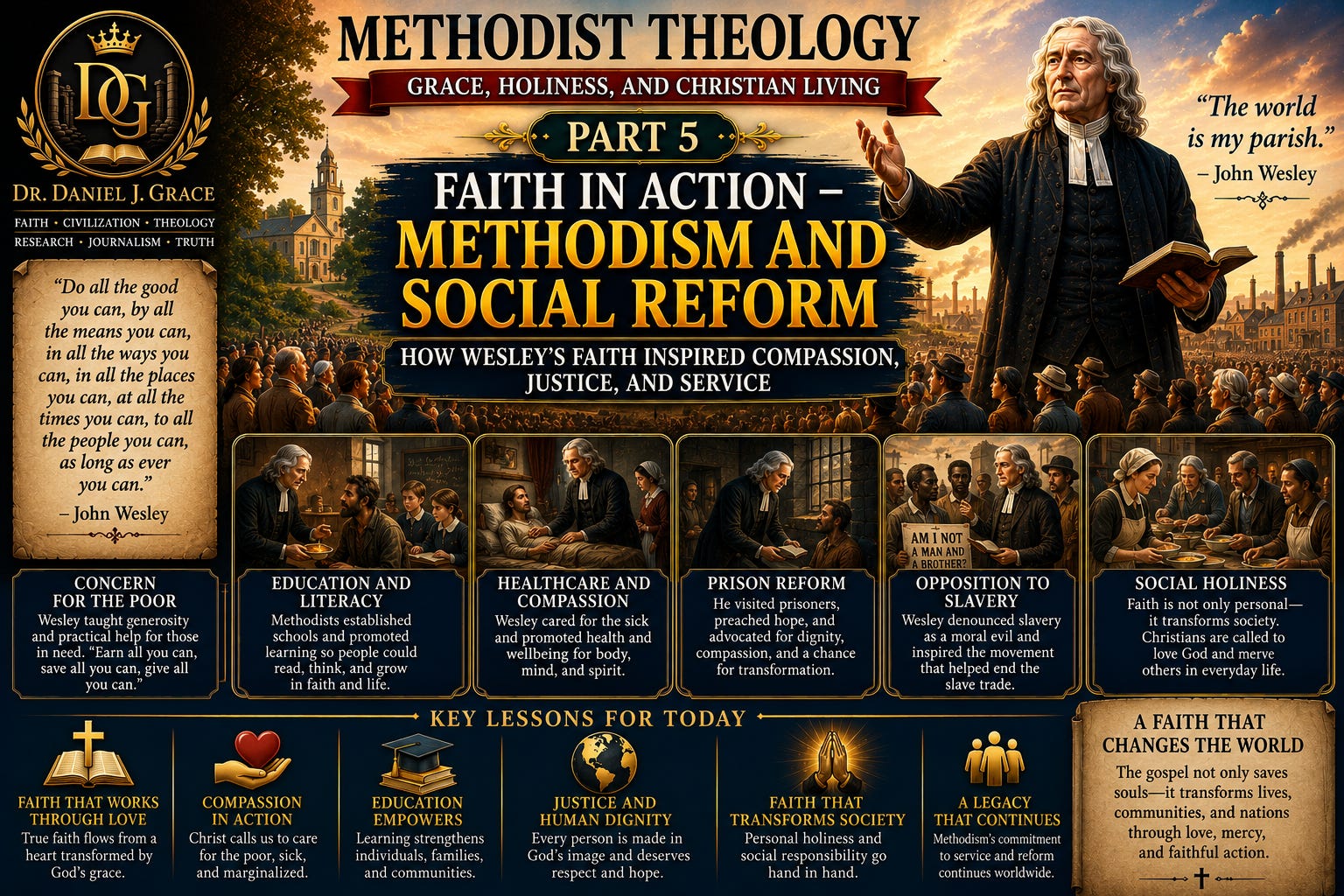
Part 5: Faith in Action – Methodism and Social Reform
How Wesley’s Faith Inspired Compassion, Justice, and Service
The Methodist movement was never intended to be merely a theological system or a collection of church doctrines. From its earliest days, Methodism combined personal faith with practical action. John Wesley believed that a genuine relationship with Jesus Christ should transform not only the individual heart but also society itself.
For Wesley, Christianity was more than attending church services, reading Scripture, and participating in religious activities. True faith produced visible fruit. A believer transformed by God’s grace should demonstrate compassion, mercy, generosity, and concern for others.
This conviction became one of the defining characteristics of Methodist theology and helped shape some of the most significant social reforms of the eighteenth and nineteenth centuries.
Faith That Works Through Love
At the centre of Wesley’s understanding of Christianity stood a simple but powerful principle: faith must express itself through love.
Wesley believed that Christians should care deeply about the spiritual and physical wellbeing of their neighbours. Love for God and love for others could never be separated.
A person who claimed to love God while ignoring the suffering of others had misunderstood the heart of the gospel.
This belief was rooted in the teachings of Jesus Himself.
Christ commanded His followers to love their neighbours, care for the poor, visit the sick, and show mercy to those in need.
Wesley sought to put these commands into practice.
Concern for the Poor
Eighteenth-century England contained enormous wealth but also widespread poverty.
Many families struggled to obtain food, clothing, education, and basic healthcare.
Wesley frequently preached among ordinary working people and witnessed their difficulties firsthand.
Rather than ignoring these problems, he encouraged Methodists to respond with generosity and practical assistance.
He often gave away much of his income and urged believers to use their resources wisely.
His famous principle became:
“Earn all you can, save all you can, give all you can.”
Wesley did not condemn wealth itself.
Instead, he warned against selfishness and encouraged Christians to use their blessings to help others.
This emphasis helped create a culture of generosity within early Methodism.
Education and Literacy
Wesley believed education was an important tool for both spiritual and social development.
Many poor families had limited access to schooling.
As Methodism spread, schools and educational programs were established to improve literacy and provide opportunities for learning.
Wesley published books, pamphlets, and educational materials designed for ordinary people.
He wanted believers to understand Scripture, think carefully about their faith, and participate meaningfully in society.
This commitment to education continues to influence Methodist institutions around the world today.
Many universities, colleges, and schools trace their origins to Methodist efforts to expand educational opportunities.
Healthcare and Compassion
Long before modern healthcare systems existed, Wesley encouraged practical care for the sick.
He visited those suffering from illness and supported efforts to improve public health.
Wesley even wrote a medical handbook intended to provide simple and affordable health advice for ordinary people who could not afford expensive treatment.
While modern medicine has advanced far beyond eighteenth-century practices, Wesley’s concern for physical wellbeing reflected his belief that Christians should care for the whole person.
Body, mind, and spirit all mattered.
This holistic approach influenced many Methodist hospitals, clinics, and healthcare ministries established in later generations.
Prison Reform
One of the most neglected groups in Wesley’s society was prisoners.
Conditions in many prisons were harsh, overcrowded, and dangerous.
Prisoners often received little compassion from society.
Wesley challenged this attitude.
He regularly visited prisons, preached to inmates, and encouraged Methodists to show concern for those behind bars.
He believed every person possessed value because every person was created in the image of God.
Even those who had made serious mistakes deserved dignity, compassion, and the opportunity for spiritual renewal.
This concern helped inspire later prison reform movements throughout Britain and beyond.
Opposition to Slavery
Perhaps one of Wesley’s most significant social contributions was his opposition to slavery.
As the transatlantic slave trade expanded, millions of people were bought and sold as property.
Wesley regarded slavery as a moral evil and spoke strongly against it.
In 1774 he published Thoughts Upon Slavery, condemning the practice and calling for its abolition.
Near the end of his life, Wesley encouraged William Wilberforce in his efforts to end the slave trade in Britain.
Wilberforce later became one of the leading figures in the abolition movement.
Although Wesley did not live to see slavery abolished, his influence contributed to one of the most important humanitarian causes in modern history.
Social Holiness
One of Wesley’s most famous ideas was what he called “social holiness.”
By this, he did not mean political activism in the modern sense.
Rather, he believed Christians were called to live out their faith within society.
Holiness was never intended to be isolated from daily life.
Believers should worship God, study Scripture, pray faithfully, and pursue spiritual growth.
At the same time, they should serve others, show compassion, seek justice, and demonstrate Christ’s love through practical action.
Personal holiness and social responsibility belonged together.
For Wesley, separating the two weakened the Christian witness.
Methodism Around the World
As Methodism spread throughout the world, its commitment to social reform travelled with it.
Methodist churches established schools, hospitals, orphanages, community centres, and charitable ministries.
Missionaries often combined evangelism with education, healthcare, and humanitarian service.
This balanced approach helped Methodism gain influence far beyond its original English context.
Today, Methodist organisations continue serving communities through relief work, education, healthcare, and social support programs.
The movement’s commitment to faith in action remains one of its most enduring legacies.
Lessons for Christians Today
Modern Christians face challenges very different from those of Wesley’s England.
Yet the principles remain remarkably relevant.
Wesley reminds believers that faith should never become merely intellectual.
Christianity is not simply about holding correct beliefs.
It is about allowing God’s grace to transform our hearts and influence the way we treat others.
The gospel calls Christians to worship, discipleship, service, generosity, compassion, and love.
A healthy Christian life combines devotion to God with concern for people.
This balance remains one of Methodism’s greatest contributions to the wider church.
Conclusion
The story of Methodism is not only a story of sermons, theology, and church growth.
It is also a story of compassion in action.
John Wesley believed that a transformed heart should produce transformed lives, transformed communities, and a transformed society.
His vision continues to inspire Christians around the world.
More than two centuries after his death, Methodism’s emphasis on practical faith, social responsibility, and Christian service remains a powerful reminder that the gospel changes not only where people spend eternity but also how they live today.

Dr. Daniel J. Grace
Faith • Civilization • Theology
Research • Journalism • Truth
🌐 danieljamesgrace.com
© 2026 Dr. Daniel J. Grace. All Rights Reserved.
No part of this article may be reproduced, distributed, transmitted, or published in any form or by any means without prior written permission from the author, except for brief quotations used in academic citation, review, or research purposes.