

Methodist Theology: Grace, Holiness, and Christian Living Part Two
How John Wesley Connected Spiritual Growth, Christian Character, and Everyday Faith

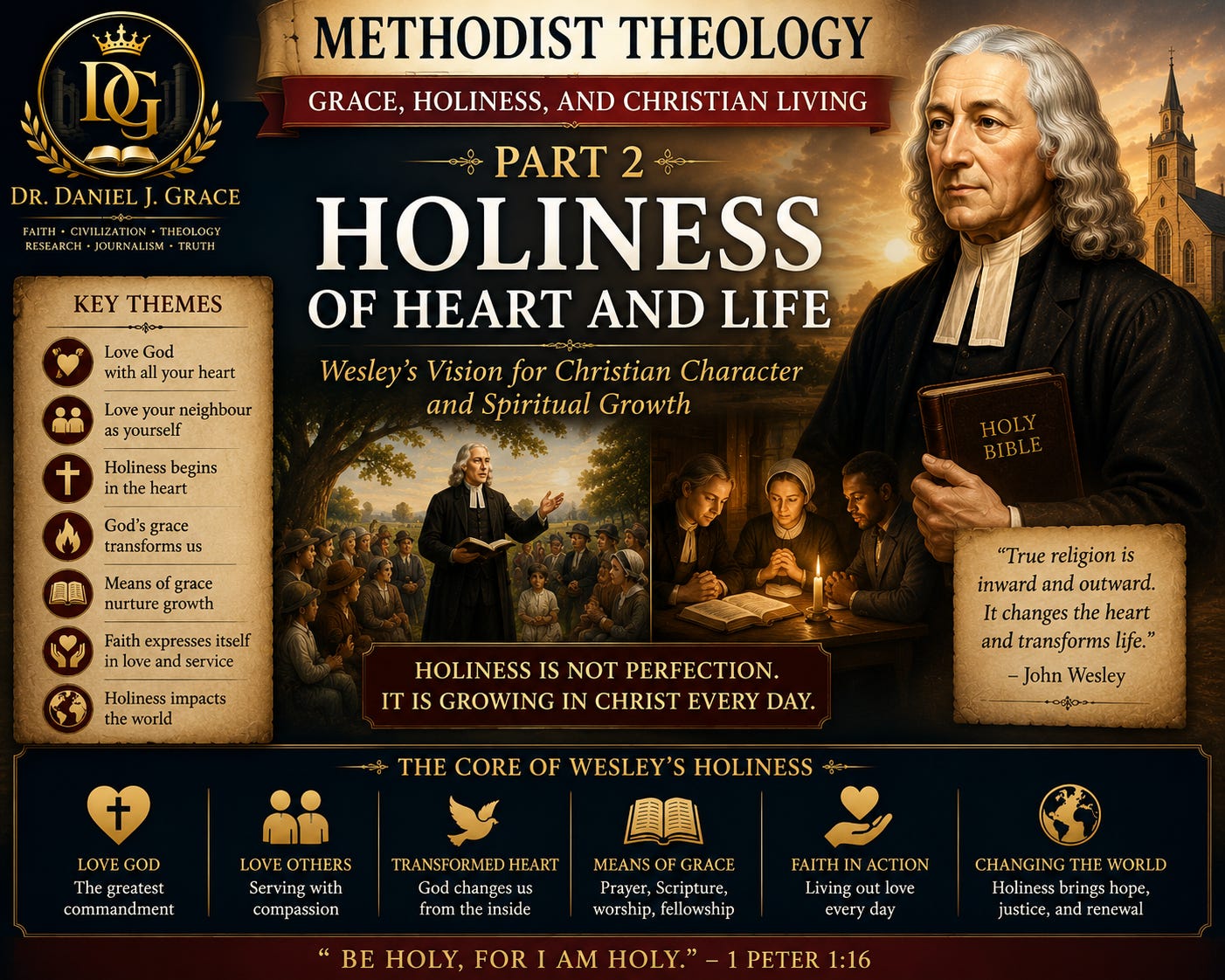
Part 2: Holiness of Heart and Life
Wesley’s Vision for Christian Character and Spiritual Growth
For John Wesley, Christianity was never merely a set of beliefs to be accepted. It was a life to be lived.
While many theological debates of his day focused on doctrine, Wesley continually asked a practical question:
What difference does faith make in the life of a believer?
His answer was clear. True Christianity transforms the heart, renews the mind, and shapes the way a person lives every day.
This conviction became one of the defining characteristics of Methodist theology. Wesley believed that God’s grace not only forgives sin but also changes people from the inside out.
Holiness was not reserved for ministers, monks, or exceptionally gifted Christians.
It was God’s calling for every believer.
Understanding Holiness
The word “holiness” often creates confusion.
Some people associate it with strict rules, outward appearance, or religious traditions. Others view holiness as something unattainable in ordinary life.
Wesley understood holiness differently.
For him, holiness meant becoming more like Christ.
It involved loving God with all one’s heart and loving one’s neighbour as oneself. Holiness was not primarily about external behaviour, although behaviour certainly mattered. It was about a transformed heart that increasingly reflected the character of Jesus.
Wesley believed that genuine holiness always begins within before it becomes visible in outward actions.
A holy life flows from a heart that has been touched and changed by God’s grace.
The Greatest Commandments
Wesley’s understanding of holiness was deeply rooted in the teachings of Jesus.
When asked about the greatest commandment, Jesus replied:
“You shall love the Lord your God with all your heart, with all your soul, and with all your mind.”
He then added:
“You shall love your neighbour as yourself.”
For Wesley, these commands summarised the entire Christian life.
Holiness was not simply avoiding wrongdoing.
It was actively loving God and serving others.
A person could attend church regularly, know Scripture well, and participate in religious activities, yet still fail to display the love that lies at the centre of Christian holiness.
True holiness always expresses itself through love.
Personal and Social Holiness
One of Wesley’s most important contributions was his emphasis on both personal holiness and social holiness.
Personal holiness involves prayer, Bible study, worship, repentance, and obedience to God.
Social holiness involves caring for others, helping the poor, seeking justice, showing compassion, and living out one’s faith within the community.
Wesley rejected the idea that Christianity could be reduced to private spirituality.
He believed faith should influence every aspect of life.
The Christian who genuinely loves God should also care about suffering, poverty, injustice, and human need.
This emphasis later inspired many Methodist efforts in education, healthcare, prison reform, and social welfare.
The Role of Grace
Wesley never taught that people become holy through their own efforts.
Holiness is the work of God’s grace.
Just as salvation begins with grace, spiritual growth also depends upon grace.
God works within believers through the Holy Spirit, gradually shaping them into the image of Christ.
Christians cooperate with this process through prayer, worship, Scripture, fellowship, and obedience.
Wesley often described the Christian life as a journey of growth.
Believers are not instantly perfected.
Instead, they mature over time as God’s grace continues its transforming work.
This understanding gave hope to ordinary Christians.
Holiness was not an impossible ideal. It was a lifelong process of becoming more like Jesus.
The Means of Grace
Wesley encouraged believers to participate regularly in what he called the “means of grace.”
These were practices through which God nurtures spiritual growth.
They included:
Prayer
Bible reading
Worship
Fasting
Holy Communion
Christian fellowship
Acts of mercy
Wesley did not believe these activities earned God’s favour.
Rather, they placed believers in a position where God’s grace could continue shaping their lives.
Just as physical health requires nourishment, spiritual health requires regular engagement with the things that strengthen faith.
Holiness in Everyday Life
Perhaps one of Wesley’s greatest strengths was his ability to connect theology with daily living.
He believed holiness should be visible in ordinary circumstances.
The Christian should demonstrate honesty in business, kindness in relationships, integrity in speech, compassion toward the needy, and faithfulness in family life.
Holiness was not something reserved for Sundays.
It should influence Monday, Tuesday, Wednesday, and every other day of the week.
Wesley challenged believers to examine whether their faith produced genuine spiritual fruit.
The goal was not perfection through human effort but increasing conformity to the character of Christ.
A Transforming Vision
The Methodist revival spread rapidly because people witnessed lives being changed.
Men and women abandoned destructive habits, reconciled broken relationships, developed new purpose, and became active participants in their communities.
Wesley saw these changes as evidence of God’s transforming grace.
Christianity was not merely about preparing for heaven.
It was also about experiencing God’s renewing work in the present.
Holiness offered believers a vision of what life could become when surrendered to God’s purposes.
Why Holiness Still Matters
Modern society often encourages self-centred living, personal success, and individual achievement.
Wesley’s message remains surprisingly relevant.
He reminds Christians that the goal of faith is not simply knowledge but transformation.
God calls believers to become people marked by love, compassion, humility, integrity, and service.
Holiness is not about becoming religious.
It is about becoming Christlike.
For Wesley, this was the very heart of Christian discipleship.
Looking Ahead
In Part 3, we will examine Wesley’s teaching on sanctification. We will explore how believers grow in grace, the role of the Holy Spirit in spiritual transformation, and why Wesley believed Christians should continually pursue deeper maturity in Christ.

Dr. Daniel J. Grace
Faith • Civilization • Theology
Research • Journalism • Truth
🌐 danieljamesgrace.com
© 2026 Dr. Daniel J. Grace. All Rights Reserved.
No part of this article may be reproduced, distributed, transmitted, or published in any form or by any means without prior written permission from the author, except for brief quotations used in academic citation, review, or research purposes.