

Methodist Theology: Grace, Holiness, and Christian Living Part Three
How God's Grace Shapes Believers into the Image of Christ

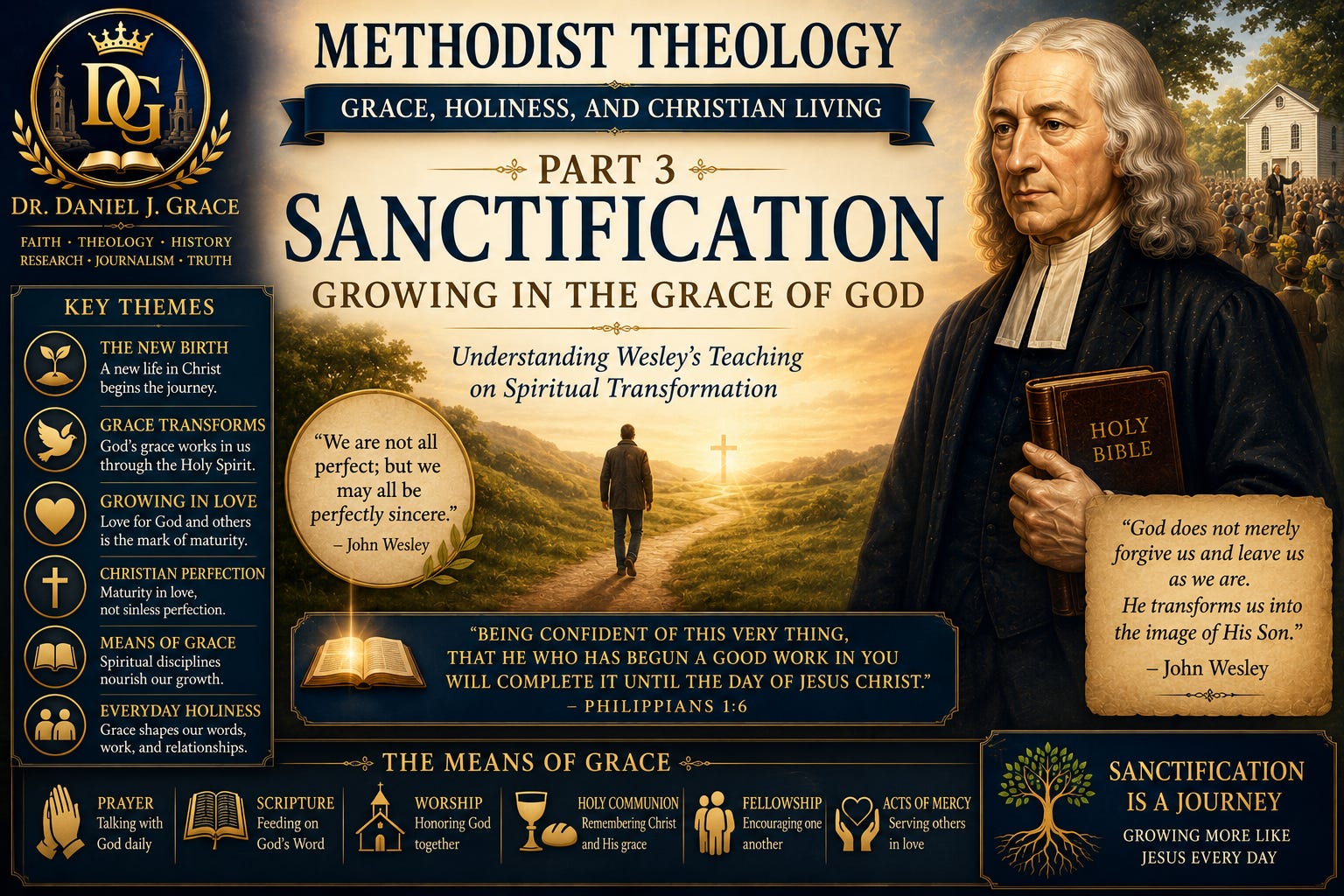
Part 3: Sanctification – Growing in the Grace of God
Understanding Wesley’s Teaching on Spiritual Transformation
For John Wesley, salvation was never merely about escaping judgment or securing a place in heaven. While forgiveness of sins was essential, Wesley believed God’s work in a believer’s life did not end at conversion.
It was only the beginning.
The Christian life, according to Wesley, is a journey of transformation. Through the power of God’s grace and the work of the Holy Spirit, believers are gradually shaped into the likeness of Jesus Christ.
This process is known as sanctification.
Among all of Wesley’s teachings, few were more important than his understanding of spiritual growth. He believed that God not only saves sinners but also transforms them, enabling them to grow in holiness, love, and obedience.
For Wesley, the goal of the Christian life was not simply forgiveness.
It was Christlikeness.
What Is Sanctification?
The word “sanctification” comes from a biblical term meaning “to make holy” or “to set apart for God.”
In Christian theology, sanctification refers to the ongoing work of God in the life of a believer after conversion.
When a person places their faith in Christ, they are justified before God. Their sins are forgiven, and they are reconciled to Him.
However, Christians do not instantly become spiritually mature.
They still struggle with temptation, weakness, and personal shortcomings.
Sanctification is the process through which God gradually changes believers, helping them grow in holiness and spiritual maturity.
Wesley believed this transformation should be visible in both character and conduct.
A growing Christian should increasingly reflect the love, compassion, humility, and purity of Christ.
The New Birth
Wesley often spoke about what he called the “new birth.”
Jesus told Nicodemus:
“You must be born again.” (John 3:7)
For Wesley, conversion was not merely an intellectual decision.
It involved a genuine spiritual transformation.
The Holy Spirit creates new life within the believer.
This new birth marks the beginning of sanctification.
Just as physical birth begins a person’s earthly life, spiritual birth begins a believer’s journey of growth in Christ.
The Christian life does not stand still.
It moves forward.
Grace and Spiritual Growth
One of Wesley’s most important convictions was that sanctification occurs through grace.
Human effort alone cannot produce holiness.
People cannot transform themselves through willpower, determination, or religious activity.
God’s grace remains essential throughout the entire Christian life.
The same grace that saves also sanctifies.
The Holy Spirit works within believers, convicting, guiding, encouraging, and strengthening them.
Christians participate in this process through obedience, prayer, worship, Scripture, and fellowship, but the transforming power belongs to God.
This understanding allowed Wesley to avoid two extremes.
On one hand, he rejected spiritual passivity, the idea that Christians should simply wait for holiness to happen.
On the other hand, he rejected self-reliance, the belief that people can make themselves holy.
Sanctification involves both God’s work and the believer’s willing cooperation.
Growing in Love
At the centre of Wesley’s teaching stood one powerful idea:
Christian maturity is measured by love.
The goal of sanctification is not merely moral improvement.
It is learning to love God and others more fully.
Jesus declared:
“You shall love the Lord your God with all your heart, soul, mind, and strength.”
And:
“You shall love your neighbour as yourself.”
Wesley believed these commands represented the highest expression of holiness.
As believers grow in grace, selfishness gradually gives way to love.
Pride yields to humility.
Bitterness is replaced by forgiveness.
Fear is overcome by trust.
This transformation may be gradual, but it is real.
Christian Perfection
Perhaps no aspect of Wesley’s theology has been more misunderstood than his teaching on Christian perfection.
Many people assume Wesley taught that Christians can become completely sinless.
He did not.
Wesley recognised that believers remain human and continue to make mistakes.
By Christian perfection, Wesley meant maturity in love.
He believed it was possible for a believer’s heart to become so filled with love for God and neighbour that love becomes the dominant motivation of life.
This was not absolute perfection.
It was spiritual maturity.
Wesley saw it as a work of God’s grace rather than a human achievement.
His emphasis was always upon God’s transforming power rather than personal accomplishment.
The Means of Grace
Wesley encouraged believers to make regular use of what he called the “means of grace.”
These were practices through which God nourishes spiritual growth.
Among them were:
Prayer
Bible reading
Worship
Holy Communion
Fasting
Christian fellowship
Acts of mercy
These activities do not earn salvation.
Rather, they place believers in a position where God’s grace can continue shaping their lives.
Wesley compared spiritual growth to physical growth.
Just as healthy food strengthens the body, spiritual disciplines strengthen the soul.
Neglecting them weakens Christian growth.
Sanctification and Everyday Life
Wesley believed theology should always affect daily living.
Sanctification was not confined to church services or religious activities.
It should influence how Christians speak, work, serve, and relate to others.
A sanctified life demonstrates honesty, integrity, compassion, patience, generosity, and humility.
For Wesley, there was no separation between spiritual devotion and practical obedience.
Faith should be visible in everyday actions.
The believer who grows in grace should also become increasingly useful in God’s service.
A Lifelong Journey
Wesley understood that sanctification is not completed overnight.
Christian growth often involves victories and setbacks.
Believers continue learning, repenting, and depending upon God’s grace throughout their lives.
The Christian life is a journey rather than a destination.
Yet Wesley remained optimistic because he believed God is faithful.
The God who begins a good work in His people continues working until that work is complete.
This confidence gave hope to generations of Methodists.
Spiritual growth is possible because God’s grace is active and powerful.
Why Sanctification Still Matters
Modern Christianity sometimes focuses heavily on conversion while paying less attention to spiritual growth.
Wesley’s teaching offers an important reminder.
The Christian life is not simply about beginning well.
It is also about growing well.
God desires believers to mature in faith, deepen in love, and increasingly reflect the character of Christ.
Sanctification remains one of the most practical and encouraging aspects of Methodist theology because it reminds Christians that transformation is possible.
Through God’s grace, ordinary people can become more like Jesus.
Looking Ahead
In Part 4, we will explore the Methodist Revival and Wesley’s passion for evangelism. We will examine how preaching, discipleship, and mission helped Methodism spread across Britain and eventually throughout the world.

Dr. Daniel J. Grace
Faith • Civilization • Theology
Research • Journalism • Truth
🌐 danieljamesgrace.com
© 2026 Dr. Daniel J. Grace. All Rights Reserved.
No part of this article may be reproduced, distributed, transmitted, or published in any form or by any means without prior written permission from the author, except for brief quotations used in academic citation, review, or research purposes.