

Methodist Theology: Grace, Holiness, and Christian Living Part Four
How John Wesley Took the Gospel to Ordinary People and Sparked a Spiritual Awakening

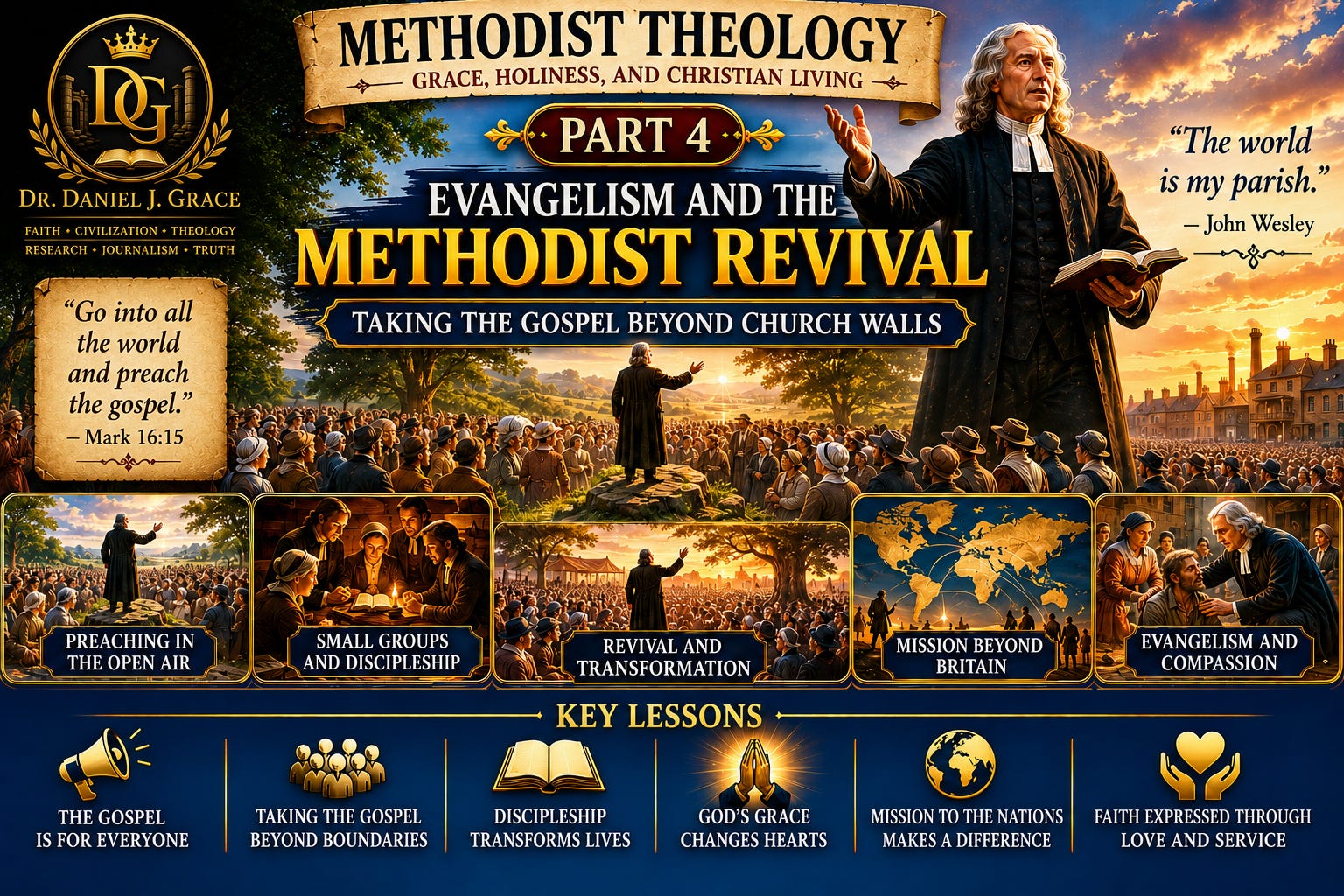
Part 4: Evangelism and the Methodist Revival
Taking the Gospel Beyond Church Walls
When people think about John Wesley, they often remember his preaching, his writings, or the Methodist movement he helped establish. Yet one of the most remarkable aspects of Wesley’s ministry was his commitment to taking the gospel beyond the walls of traditional churches.
Wesley believed the message of Jesus Christ was for everyone.
It was not reserved for the educated, the wealthy, or the socially respected. The gospel belonged to miners, labourers, farmers, prisoners, widows, merchants, and ordinary families. Every person mattered to God, and every person deserved the opportunity to hear the good news of salvation.
This conviction became one of the driving forces behind the Methodist Revival and helped transform Christianity throughout Britain and eventually across the world.
Eighteenth-Century England
To understand the significance of Wesley’s ministry, it is important to understand the condition of England during his lifetime.
The eighteenth century was a period of enormous social change.
Industrialisation was beginning to reshape society. Cities were growing rapidly. Poverty was widespread. Many working-class people had little connection to organised religion. Alcohol abuse, crime, and social inequality affected countless communities.
While churches existed throughout the country, many people rarely attended services or had little understanding of the Christian faith.
Wesley saw a nation in need of spiritual renewal.
He believed God was calling Christians to reach people who had been overlooked or neglected.
Preaching in the Open Air
One of the most revolutionary aspects of Wesley’s ministry was his willingness to preach outdoors.
At first, he was hesitant.
Traditional church practice viewed church buildings as the proper place for preaching. However, Wesley’s friend George Whitefield encouraged him to consider a different approach.
Whitefield had begun preaching in fields and public spaces to large crowds of workers who never entered churches.
Eventually Wesley followed his example.
The results were extraordinary.
Thousands gathered to hear him preach.
Miners covered in coal dust, factory workers, farmers, and labourers listened attentively as Wesley proclaimed God’s grace and the possibility of new life through Christ.
Many experienced profound spiritual transformation.
For Wesley, the decision was simple.
If people would not come to church, the church must go to the people.
“The World Is My Parish”
Perhaps no statement better summarises Wesley’s ministry than his famous declaration:
“The world is my parish.”
As an Anglican priest, Wesley technically served within specific church boundaries.
Yet he believed God’s mission extended far beyond geographical limits.
The needs of people were greater than denominational boundaries.
The call of the gospel reached further than parish lines.
This vision motivated Wesley to travel extensively throughout Britain and Ireland.
Historians estimate that he preached more than forty thousand sermons during his lifetime and travelled hundreds of thousands of miles, much of it on horseback.
His dedication remains one of the most remarkable examples of Christian evangelism in church history.
The Power of Small Groups
Wesley understood that evangelism alone was not enough.
People needed support, encouragement, and discipleship after conversion.
To address this need, he developed a system of Methodist societies, classes, and bands.
These small groups became one of the movement’s greatest strengths.
Members met regularly for prayer, Bible study, accountability, encouragement, and practical support.
They shared struggles, celebrated victories, and helped one another grow spiritually.
Wesley believed Christians were not meant to grow in isolation.
Spiritual growth flourishes within community.
This emphasis on discipleship helped ensure that converts developed into mature believers rather than simply experiencing temporary enthusiasm.
Revival and Transformation
The Methodist Revival was not merely about increasing church attendance.
It was about transformed lives.
People who encountered the gospel often experienced dramatic changes.
Families were restored.
Alcohol addiction was overcome.
Debts were repaid.
Communities became stronger.
Many individuals discovered purpose, dignity, and hope.
Wesley viewed these changes as evidence of God’s grace at work.
Christianity was not simply about preparing for eternity.
It also transformed life in the present.
The revival demonstrated the practical impact of faith upon individuals and society.
Mission Beyond Britain
The Methodist movement did not remain confined to Britain.
As Methodism spread, missionaries carried its message throughout the world.
Methodist churches were established across North America, Africa, Asia, Australia, and the Pacific.
The movement’s emphasis on evangelism, discipleship, and practical service proved effective in diverse cultural settings.
Schools, hospitals, orphanages, and community ministries often accompanied missionary efforts.
The Methodist vision combined proclamation of the gospel with compassionate service to those in need.
This balance became one of the defining characteristics of Methodist mission.
Evangelism and Compassion
Wesley refused to separate evangelism from compassion.
He believed Christians should care for both spiritual and physical needs.
Throughout his ministry, he advocated for the poor, visited prisoners, supported education, and encouraged practical acts of mercy.
For Wesley, preaching and service belonged together.
A gospel that transforms hearts should also inspire love for neighbours.
This understanding continues to influence Methodist ministries around the world today.
Lessons for the Modern Church
The modern church faces challenges very different from those of Wesley’s England.
Yet many of his principles remain surprisingly relevant.
Wesley reminds believers that the gospel is for everyone.
He challenges churches to reach beyond their comfort zones.
He demonstrates the importance of discipleship alongside evangelism.
He shows that authentic Christianity combines truth with compassion.
Most importantly, Wesley teaches that God’s grace has the power to transform individuals, families, and communities.
The message that inspired the Methodist Revival continues to speak to Christians today.
A Legacy That Continues
More than two centuries after Wesley’s death, his commitment to evangelism continues to influence churches around the world.
Millions of believers have encountered Christ through ministries shaped by Methodist principles.
His vision of taking the gospel to ordinary people remains one of the most enduring contributions to Christian history.
The Methodist Revival reminds us that spiritual renewal often begins when believers step beyond familiar boundaries and faithfully share the good news of Jesus Christ.
Looking Ahead
In Part 5, we will explore Methodism’s influence on social reform. We will examine how Wesley’s teachings inspired efforts in education, healthcare, prison reform, poverty relief, and the fight against slavery, leaving a lasting impact on society as well as the church.

Dr. Daniel J. Grace
Faith • Civilization • Theology
Research • Journalism • Truth
🌐 danieljamesgrace.com
© 2026 Dr. Daniel J. Grace. All Rights Reserved.
No part of this article may be reproduced, distributed, transmitted, or published in any form or by any means without prior written permission from the author, except for brief quotations used in academic citation, review, or research purposes.