
Methodist Theology: Grace, Holiness, and Christian Living Part One
The Life, Ministry, and Spiritual Journey of the Anglican Priest Who Founded the Methodist Movement

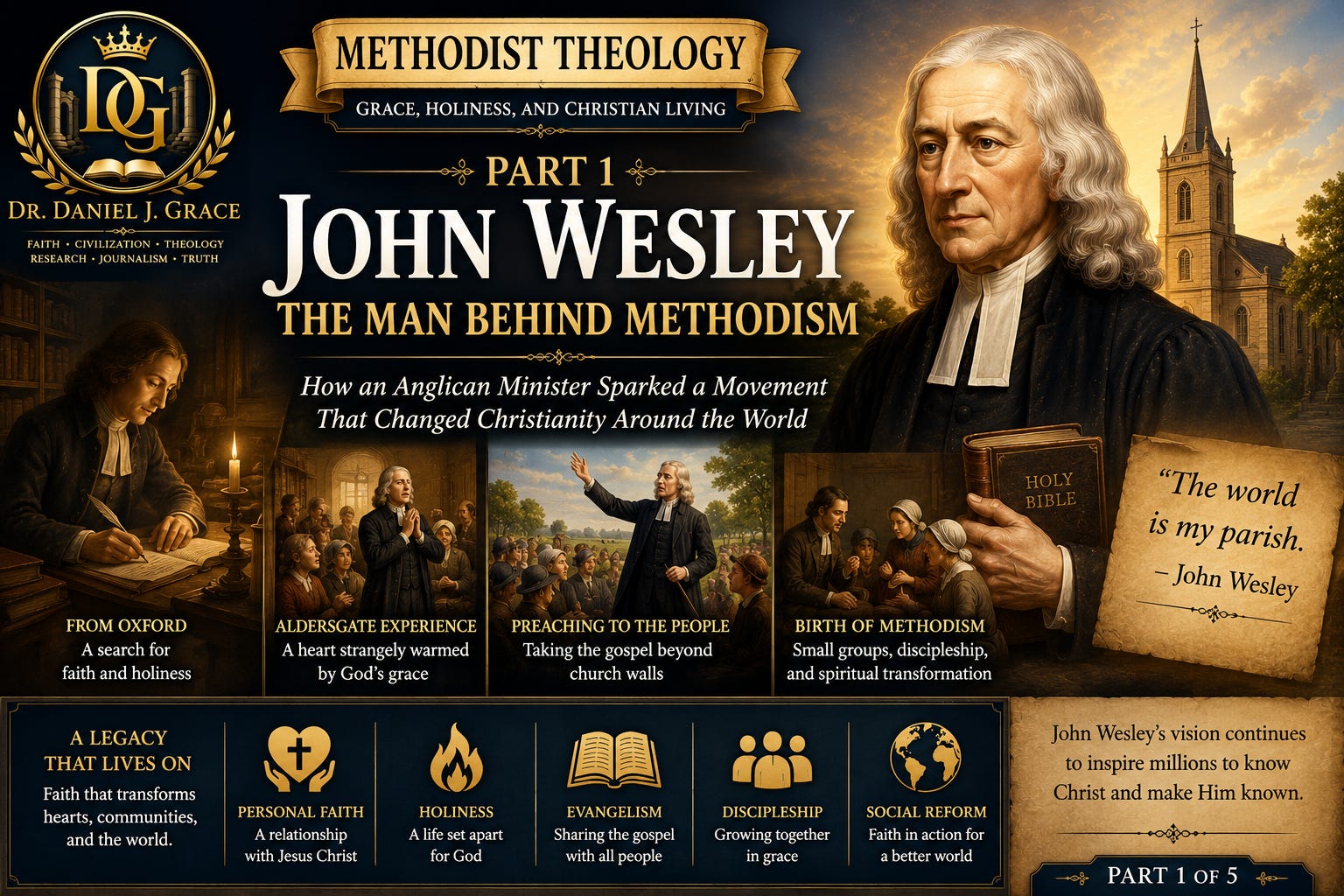
Part 1: John Wesley – The Man Behind Methodism
How an Anglican Minister Sparked a Movement That Changed Christianity Around the World
Few Christian leaders have left a legacy as significant as John Wesley. More than three centuries after his birth, his influence continues to be felt in churches, missionary organisations, educational institutions, and Christian communities across the globe. Millions of believers worship in denominations that trace their spiritual heritage to the movement Wesley helped establish, while countless others have been shaped by his emphasis on personal faith, holiness, evangelism, and practical Christianity.
Yet John Wesley never intended to create a new denomination.
He considered himself a loyal priest of the Church of England throughout his life. His desire was not to divide the church but to renew it. He longed to see Christians move beyond formal religion and experience a living, personal relationship with Jesus Christ.
The movement that became known as Methodism emerged from this simple vision.
Early Life and Family Background
John Wesley was born on 17 June 1703 in Epworth, Lincolnshire, England. He was the fifteenth child of Samuel Wesley, an Anglican rector, and Susanna Wesley, a remarkable woman whose influence on Christian education and spiritual formation would leave a lasting mark on her children.
The Wesley household was deeply religious. Scripture reading, prayer, and Christian instruction formed part of everyday life. Susanna Wesley took a personal interest in the spiritual and educational development of her children, teaching them discipline, responsibility, and devotion to God.
One event from John’s childhood became famous in Methodist history.
When he was five years old, a fire destroyed the family home. John was rescued from an upstairs window moments before the roof collapsed. Later in life, he viewed this dramatic rescue as evidence of God’s providence and often referred to himself as “a brand plucked from the burning.”
The experience left a deep impression upon him and contributed to his sense that God had preserved him for a special purpose.
Oxford and the Holy Club
Wesley received an excellent education and eventually attended Oxford University. There he excelled academically and later became a fellow of Lincoln College.
While at Oxford, John joined with his brother Charles Wesley and several friends in a small group dedicated to serious Christian living. They met regularly for Bible study, prayer, fasting, accountability, and acts of charity.
Their commitment attracted both admiration and ridicule.
Because of their disciplined and methodical approach to spiritual life, fellow students mockingly referred to them as “Methodists.”
The name was originally intended as an insult.
History transformed it into the name of a global Christian movement.
Members of the Holy Club visited prisoners, cared for the poor, taught children, and encouraged one another in spiritual growth. They sought to practise Christianity rather than merely discuss it.
Although Wesley was deeply committed to religion during these years, he later admitted that something was missing.
He possessed knowledge and discipline, but he lacked assurance of salvation.
A Disappointing Mission
In 1735 Wesley travelled to the American colony of Georgia as a missionary.
He hoped the experience would strengthen his faith and expand God’s kingdom.
Instead, the journey became one of the greatest disappointments of his life.
His ministry struggled. Personal relationships became complicated. Expectations were not met. Eventually, Wesley returned to England discouraged and questioning his own spiritual condition.
During the voyage, however, he encountered a group of Moravian Christians whose calm confidence during dangerous storms deeply impressed him.
While Wesley feared death, these believers displayed remarkable peace.
Their faith challenged him.
He began asking difficult questions about his own relationship with God.
The Aldersgate Experience
The turning point came on 24 May 1738.
While attending a meeting on Aldersgate Street in London, Wesley listened as someone read from Martin Luther’s introduction to the Epistle to the Romans.
As he listened, something changed within him.
Wesley later recorded in his journal:
“I felt my heart strangely warmed. I felt I did trust in Christ, Christ alone for salvation.”
This moment became one of the most significant events in Methodist history.
Although Wesley had been a minister for years, he now experienced a deeper assurance of God’s grace and forgiveness.
His theology would continue to develop, but Aldersgate transformed his ministry.
From that point forward, Wesley preached not merely about religion but about a personal relationship with Jesus Christ.
Taking the Gospel to the People
After Aldersgate, Wesley’s ministry expanded dramatically.
Inspired partly by the example of George Whitefield, Wesley began preaching outdoors to people who rarely attended church.
Many clergy criticised the practice.
Churches were considered the proper place for preaching.
Wesley disagreed.
When thousands of miners, labourers, farmers, and ordinary people were unwilling or unable to enter church buildings, he took the gospel to them.
Fields, marketplaces, roadsides, and open spaces became his pulpits.
His famous declaration captured his vision:
“The world is my parish.”
Over the next fifty years, Wesley travelled hundreds of thousands of miles, often on horseback, preaching thousands of sermons throughout Britain and Ireland.
His tireless efforts helped ignite a revival that transformed countless lives.
The Birth of Methodism
As more people responded to Wesley’s preaching, organised groups began to form.
Methodist societies provided fellowship, accountability, discipleship, and spiritual support.
Small groups known as class meetings became a distinctive feature of the movement.
These gatherings encouraged believers to grow in faith and apply biblical teaching to daily life.
Methodism was never intended to be merely a theological system.
It was a movement focused on spiritual transformation.
Wesley believed Christianity should affect every area of life—personal conduct, family relationships, work, community involvement, and service to others.
This practical approach helped Methodism spread rapidly.
Wesley’s Lasting Legacy
When John Wesley died in 1791 at the age of eighty-seven, Methodism had become a powerful force within Christianity.
What began as a small Oxford prayer group had developed into a movement reaching thousands of people.
Yet Wesley’s greatest legacy was not organisational success.
It was his conviction that Christianity must be both deeply personal and actively lived.
He taught that faith should transform hearts, shape character, inspire evangelism, and motivate service.
These principles continue to influence churches around the world today.
Looking Ahead
In Part 2, we will explore one of Wesley’s most important teachings: holiness of heart and life. We will examine why Wesley believed every Christian is called not merely to believe in Christ but to become increasingly like Him through the transforming power of God’s grace.
Dr. Daniel J. Grace
Faith • Civilization • Theology
Research • Journalism • Truth
🌐 danieljamesgrace.com
© 2026 Dr. Daniel J. Grace. All Rights Reserved.
No part of this article may be reproduced, distributed, transmitted, or published in any form or by any means without prior written permission from the author, except for brief quotations used in academic citation, review, or research purposes.