

Lutheran Theology – Part 5
Faith, Worship, and the Continuing Legacy of Martin Luther

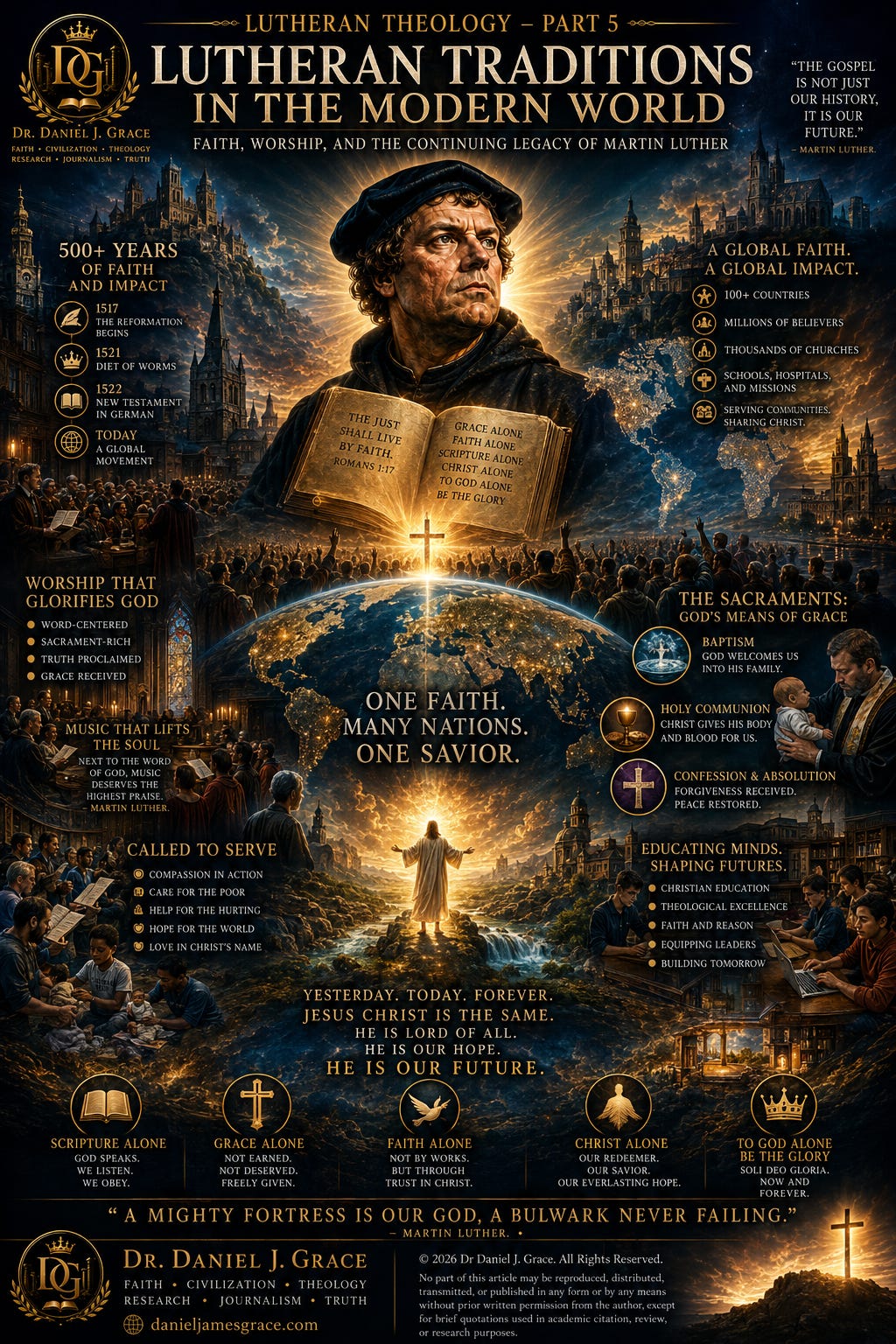
Lutheran Traditions in the Modern World
More than five hundred years after Martin Luther nailed his Ninety-Five Theses to the church door in Wittenberg, Lutheran Christianity remains one of the most influential branches of Protestant Christianity. What began as a movement for reform in sixteenth-century Germany has grown into a global Christian tradition with millions of followers spread across every continent.
Lutheran churches today vary in language, culture, worship style, and organisational structure, yet they remain united by a common theological heritage rooted in Scripture, the teachings of Martin Luther, and the central message of salvation through grace alone, by faith alone, in Christ alone.
The story of modern Lutheranism is one of remarkable continuity and adaptation. While the world has changed dramatically since the Reformation, Lutheran churches continue to proclaim the Gospel, administer the sacraments, educate future generations, and serve communities throughout the world.
The Growth of Lutheran Christianity
Following the Protestant Reformation, Lutheran theology spread rapidly throughout Northern Europe. Germany became the heartland of Lutheranism, but the movement also gained strong support in Scandinavia.
Countries such as Denmark, Norway, Sweden, Finland, and Iceland embraced Lutheran teachings and established national Lutheran churches. These churches became deeply connected to the cultural and religious identity of their nations.
Over time, Lutheran immigrants carried their faith to other parts of the world. Large numbers of Germans and Scandinavians settled in North America, Australia, South America, and Africa. Wherever they travelled, they established congregations, schools, seminaries, and charitable institutions.
Today Lutheran churches can be found in more than one hundred countries. While Europe remains important, some of the fastest-growing Lutheran communities now exist in Africa, Asia, and Latin America.
This global expansion demonstrates the lasting influence of the Reformation and the continuing relevance of Lutheran theology in diverse cultural settings.
Lutheran Worship
One of the most recognisable features of Lutheran Christianity is its worship.
Luther believed worship should be both reverent and accessible. Unlike some reformers who removed many traditional elements from church services, Luther retained much of the historic structure of Christian worship while emphasising biblical teaching and congregational participation.
As a result, Lutheran worship often combines ancient traditions with Reformation principles.
A typical Lutheran service includes:
Confession and absolution
Scripture readings
Sermon or preaching
Congregational hymns
Prayers
The Lord’s Prayer
Holy Communion
The service is centred upon God’s Word and God’s promises rather than human performance or entertainment.
Luther believed that worship should direct attention toward Christ rather than toward personalities or emotional experiences. Consequently, Lutheran worship generally seeks a balance between reverence, theological depth, and active participation.
The Importance of Music
Few reformers valued music as highly as Martin Luther.
Luther considered music one of God’s greatest gifts to humanity. He believed music could teach doctrine, strengthen faith, and encourage believers in their Christian journey.
His famous statement remains widely quoted:
“Next to the Word of God, music deserves the highest praise.”
Unlike mediaeval worship, where much of the singing was performed by clergy or choirs, Luther encouraged congregational singing. He wanted ordinary Christians to participate actively in worship.
To support this goal, Luther wrote numerous hymns, the most famous being:
“A Mighty Fortress Is Our God.”
This hymn became one of the defining songs of the Protestant Reformation and continues to be sung by Christians around the world.
Lutheran churches have produced some of history’s greatest sacred music. The work of composers such as Johann Sebastian Bach reflects the rich musical heritage of Lutheran worship.
Even today, music remains a central feature of Lutheran identity.
Education and Scholarship
The Lutheran tradition has always placed a strong emphasis on education.
Luther believed every Christian should be able to read Scripture and understand the faith personally. As a result, Lutheran churches became active supporters of schools, universities, and theological training.
Throughout history, Lutherans have established educational institutions that promote intellectual development alongside spiritual growth.
This commitment to learning reflects Luther’s conviction that faith and reason are not enemies. Christians are encouraged to study, think critically, and engage thoughtfully with the world around them.
Many Lutheran seminaries continue to produce respected scholars, theologians, historians, and pastors who contribute significantly to Christian thought.
Lutheran Missions Around the World
The missionary movement became an important aspect of Lutheran history.
Early Lutheran churches initially focused on Europe, but by the nineteenth century Lutheran missionaries were travelling throughout Africa, Asia, and the Pacific.
Missionaries established churches, schools, hospitals, orphanages, and community programmes. Their efforts contributed to the growth of Christianity in many regions.
Today, Lutheran mission work continues through:
Church planting
Theological education
Humanitarian assistance
Disaster relief
Medical programs
Community development
Many Lutheran organisations combine evangelism with practical service, reflecting Christ’s concern for both spiritual and physical needs.
Social Responsibility and Service
Lutheran theology has traditionally emphasised serving one’s neighbour.
Because salvation is understood as God’s gift rather than a reward for good works, believers are encouraged to serve others out of gratitude rather than obligation.
This principle has inspired Lutheran involvement in:
Education
Healthcare
Poverty relief
Refugee support
Disaster response
Community welfare
Numerous Lutheran charities operate internationally, providing assistance to vulnerable populations regardless of religious background.
For Lutherans, acts of compassion are not a means of earning salvation but a response to God’s grace.
Lutheran Diversity
Modern Lutheranism is not entirely uniform.
Different Lutheran churches sometimes disagree on issues such as:
Church governance
Worship styles
Ecumenical relationships
Social and ethical questions
Ordination practices
Some Lutheran bodies maintain highly traditional forms of worship and theology, while others adopt more contemporary approaches.
Despite these differences, most Lutheran churches continue to affirm the central teachings of the Reformation:
Salvation by grace
Justification through faith
Authority of Scripture
Importance of Baptism and Holy Communion
Centrality of Jesus Christ
These shared convictions provide a common theological foundation.
Lutheranism and Ecumenical Dialogue
In recent decades, Lutheran churches have participated actively in ecumenical discussions with other Christian traditions.
Conversations have taken place with:
Roman Catholics
Anglicans
Methodists
Reformed churches
Orthodox Christians
Various Protestant communities
The goal of these dialogues is not necessarily organisational unity but greater understanding and cooperation among Christians.
One significant milestone occurred in 1999 when Lutheran and Roman Catholic representatives signed the Joint Declaration on the Doctrine of Justification, acknowledging substantial agreement on key aspects of salvation.
While differences remain, such efforts demonstrate a desire for greater Christian unity.
Challenges in the Twenty-First Century
Like many Christian traditions, Lutheran churches face modern challenges.
These include:
Secularisation
Declining church attendance in some regions
Cultural change
Theological disagreements
Generational shifts
Many churches wrestle with questions concerning how to remain faithful to biblical teaching while engaging effectively with contemporary society.
These challenges require wisdom, humility, and commitment to the Gospel.
At the same time, opportunities exist for renewal, evangelism, and spiritual growth.
The Enduring Legacy of Martin Luther
Five centuries after the Reformation, Martin Luther’s influence remains extraordinary.
His emphasis on Scripture, grace, faith, and Christ continues to shape not only Lutheranism but much of global Protestant Christianity.
Millions of believers who have never attended a Lutheran church nevertheless benefit from theological insights that emerged during the Reformation.
Luther’s greatest contribution may not have been institutional reform but his renewed focus on the Gospel itself.
He reminded Christians that salvation is not achieved through human effort but received through God’s grace in Jesus Christ.
That message continues to inspire believers around the world.
Conclusion
Lutheran traditions in the modern world demonstrate the enduring power of the Reformation’s central message. From Europe to Africa, Asia, the Americas, and Australia, Lutheran churches continue to proclaim Christ, teach Scripture, administer the sacraments, and serve their communities. While the world has changed dramatically since Luther’s time, the heart of Lutheran theology remains unchanged: salvation comes through God’s grace, received by faith, through Jesus Christ alone. The continuing legacy of Martin Luther reminds Christians of the importance of Scripture, the certainty of God’s promises, and the transformative power of the Gospel.
Final Reflection
The Lutheran tradition stands as a testimony to the enduring influence of one reformer’s commitment to biblical truth. Its history, theology, worship, and mission continue to shape Christian life around the world. As believers look to the future, Lutheran theology remains rooted in the same hope that inspired Martin Luther centuries ago: Christ alone is the foundation of faith, and God’s grace remains sufficient for all who trust in Him.

Dr Daniel J. Grace
Faith • Civilization • Theology
Research • Journalism • Truth
🌐 danieljamesgrace.com
© 2026 Dr Daniel J. Grace. All Rights Reserved.
No part of this article may be reproduced, distributed, transmitted, or published in any form or by any means without prior written permission from the author, except for brief quotations used in academic citation, review, or research purposes.