

Lutheran Theology – Part 4
Baptism, Holy Communion, and God’s Means of Grace

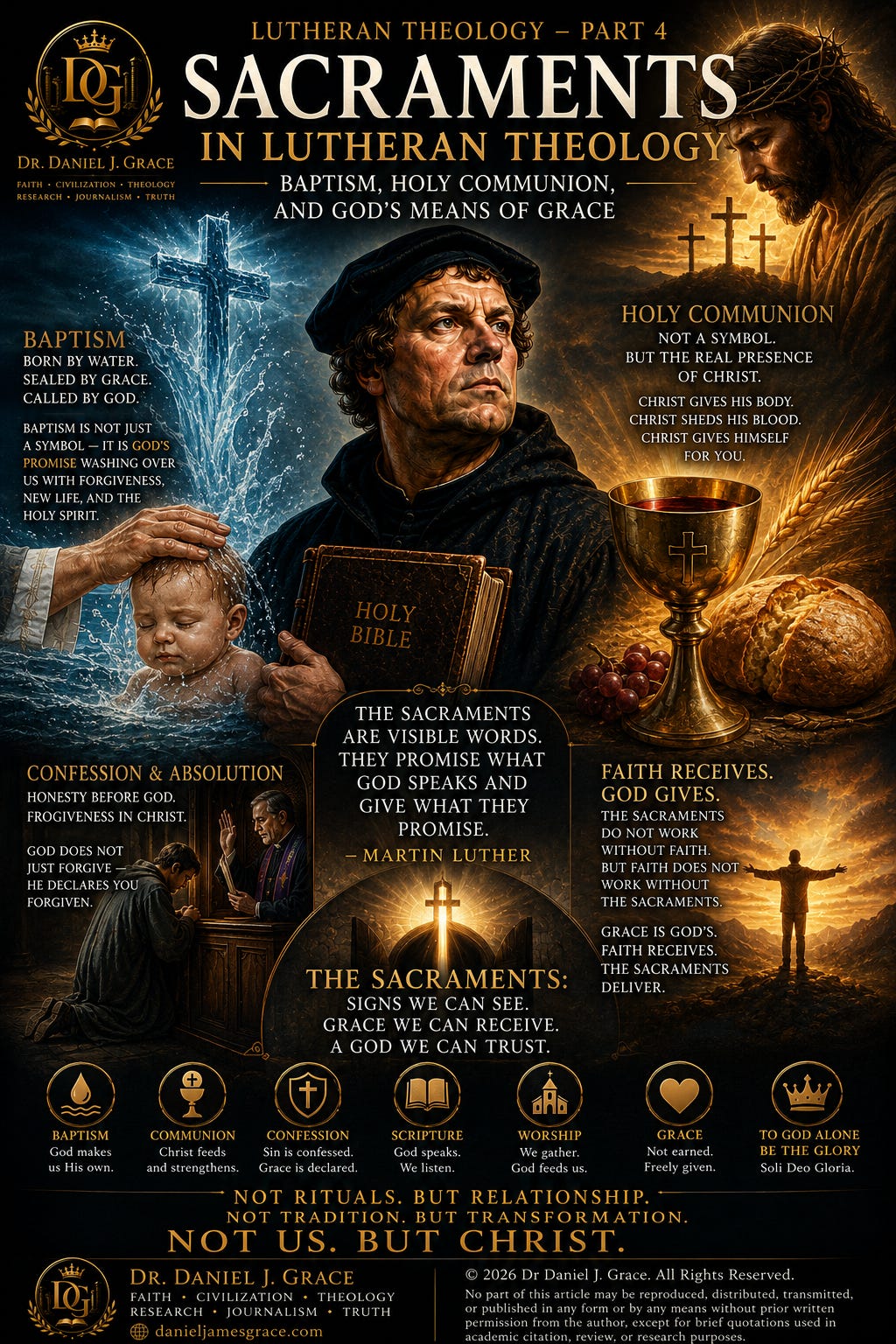
Sacraments in Lutheran Theology
Lutheran theology is fundamentally shaped by its understanding of the sacraments. While Martin Luther strongly challenged many teachings and practices of the mediaeval Church, he did not reject the sacraments themselves. Instead, he sought to restore what he believed was their biblical purpose and meaning.
For Lutherans, the sacraments are not merely symbolic ceremonies or religious traditions. They are sacred acts instituted by Jesus Christ through which God delivers His grace to His people. They serve as visible signs connected to God’s promises and are intended to strengthen faith, assure believers of God’s forgiveness, and deepen their relationship with Christ.
Unlike some Protestant traditions that view the sacraments primarily as acts of obedience or public testimony, Lutheran theology places a great emphasis on God’s action within the sacraments. The focus is not on what believers do for God, but on what God does for them through His Word and promises.
Martin Luther often referred to the sacraments as “means of grace.” This phrase reflects the belief that God uses specific means to communicate His forgiveness, mercy, and salvation. Just as God speaks through Scripture and preaching, He also works through Baptism and Holy Communion to strengthen faith and assure believers of His presence.
Lutherans generally recognise two sacraments: baptism and Holy Communion. These are accepted because they were directly instituted by Christ and include both a physical element and a divine promise.
Some Lutheran traditions also grant special recognition to Confession and Absolution, though it is not usually counted as a sacrament in the same way as Baptism and the Lord’s Supper.
Baptism in Lutheran Theology
Baptism occupies a central place in Lutheran teaching. Luther believed Baptism was far more than a symbolic act of dedication or a public declaration of faith. Instead, he taught that Baptism is a means through which God offers forgiveness, creates faith, and incorporates believers into the body of Christ.
This belief is based upon several biblical passages, including Jesus’ command:
“Go therefore and make disciples of all the nations, baptizing them in the name of the Father and of the Son and of the Holy Spirit.” (Matthew 28:19)
Lutherans understand Baptism as a gift from God rather than a human achievement. The power of Baptism does not come from the water itself, but from God’s Word and the promise attached to the water.
Martin Luther famously asked:
“How can water do such great things?”
His answer was simple:
“Certainly not just water, but the Word of God in and with the water.”
This understanding distinguishes Lutheran theology from purely symbolic interpretations of Baptism. Baptism is viewed as an act through which God works in the life of the believer.
One characteristic of Lutheran practice is infant baptism. Lutherans baptise infants because they believe salvation is entirely dependent upon God’s grace rather than human decision-making. Since faith itself is God’s gift, Lutherans believe infants are capable of receiving God’s grace through Baptism.
Supporters of infant baptism often point to biblical accounts of entire households being baptised and to Jesus’ words welcoming children into God’s kingdom.
At the same time, Lutherans emphasise that baptism is not a magical ritual. Its benefits are received through faith and lived out through lifelong discipleship. Baptism marks the beginning of the Christian life, not its completion.
Luther described the Christian life as a daily return to Baptism. Believers continually repent, trust God’s promises, and live in the forgiveness offered through Christ.
Holy Communion in Lutheran Theology
The second sacrament recognised by Lutherans is Holy Communion, also known as the Lord’s Supper or the Eucharist.
This sacrament commemorates Jesus’ final meal with His disciples before His crucifixion. During that meal, Christ took bread and wine and declared:
“This is My body.”
and
“This is My blood.”
These words became central to Lutheran teaching regarding the Lord’s Supper.
One of the major debates during the Reformation concerned the meaning of Christ’s presence in Communion. Different reformers developed different interpretations.
The Roman Catholic Church taught the doctrine of Transubstantiation, which states that the bread and wine become the actual body and blood of Christ, although their outward appearance remains unchanged.
Some other Protestant reformers viewed Communion primarily as a symbolic memorial that helps believers remember Christ’s sacrifice.
Martin Luther rejected both extremes. He firmly believed that Christ is truly present in Holy Communion, yet he also rejected philosophical explanations that attempted to describe exactly how this phenomenon occurs.
Luther simply accepted Christ’s words:
“This is My body.”
“This is My blood.”
For Lutherans, Christ is truly present “in, with, and under” the bread and wine. This belief is often referred to as the Real Presence.
Lutherans do not claim to explain the mystery fully. Instead, they accept Christ’s promise and trust that He genuinely provides Himself to believers through the sacrament.
Holy Communion therefore becomes more than a memorial. It is a means through which believers receive forgiveness, spiritual strength, encouragement, and fellowship with Christ.
This understanding reflects Luther’s conviction that God continually comes to His people through tangible means. Christianity is not merely a set of ideas but a living relationship with a God who actively ministers to His people.
Confession and Absolution
Although most Lutheran churches recognise only two sacraments, confession and absolution remain important practices.
Luther believed Christians should regularly confess their sins and receive the assurance of God’s forgiveness.
In confession, believers acknowledge their sins before God. In absolution, God’s promise of forgiveness is proclaimed through Christ.
Unlike some mediaeval practices that focused heavily on prescribed acts of penance, Luther emphasised God’s grace and mercy. Forgiveness is received because of Christ’s work, not because of human efforts to earn it.
This emphasis reflects Luther’s broader theology of justification by faith alone.
The Sacraments and Faith
Lutheran theology consistently teaches that the sacraments and faith belong together.
The sacraments are God’s gifts, but they are received through faith. Faith trusts God’s promises and receives what He offers.
This relationship helps avoid two opposite errors.
On one hand, Lutherans reject the idea that sacraments work automatically regardless of faith.
On the other hand, they reject the idea that sacraments are merely human symbols without divine action.
Instead, the sacraments are understood as powerful expressions of God’s grace that strengthen and sustain believers throughout their Christian journey.
Worship and the Sacraments
Because of their importance, Baptism and Holy Communion occupy a central place in Lutheran worship.
Lutheran services typically include Scripture readings, preaching, prayers, hymns, and regular celebration of Holy Communion.
Music also plays a significant role. Luther himself loved music and believed it was one of God’s greatest gifts. Many of the hymns sung in Lutheran churches continue to reflect themes of grace, faith, forgiveness, and Christ’s saving work.
The sacraments are therefore not isolated rituals but part of a broader pattern of worship centred on God’s Word and promises.
Modern Lutheran Perspectives
Today, Lutheran churches around the world continue to affirm the importance of the sacraments.
While cultural expressions may vary from country to country, the essential teachings remain consistent. Baptism and Holy Communion continue to be viewed as means through which God strengthens His people and assures them of His grace.
In an age often focused on personal experience and individual spirituality, Lutheran sacramental theology offers a reminder that God works through tangible means and objective promises.
Rather than relying solely on feelings or emotions, believers are encouraged to trust God’s Word and the gifts He has provided through the Church.
Conclusion
The sacraments occupy a central place within Lutheran theology because they reveal God’s desire to come near to His people through visible signs joined to His Word. Through Baptism, believers are welcomed into God’s family and receive His promises of grace. Through Holy Communion, Christ continues to nourish, strengthen, and encourage His people. Together, these sacraments serve as powerful reminders that salvation is God’s work from beginning to end. They point believers not to themselves but to Christ, whose grace remains the foundation of Christian faith and life.
Next Article
Part 5 – Lutheran Traditions in the Modern World
Faith, Worship, and the Continuing Legacy of Martin Luther
Dr Daniel J. Grace
Faith • Civilization • Theology
Research • Journalism • Truth
🌐 danieljamesgrace.com
© 2026 Dr Daniel J. Grace. All Rights Reserved.
No part of this article may be reproduced, distributed, transmitted, or published in any form or by any means without prior written permission from the author, except for brief quotations used in academic citation, review, or research purposes.