
Lutheran Theology – Part 3
How a Debate Over Indulgences Reshaped Christianity and Changed the Course of History

The Protestant Reformation
The Protestant Reformation stands as one of the most significant events in Christian history. It transformed the religious landscape of Europe, reshaped political and cultural institutions, encouraged the translation of the Bible into local languages, and influenced the development of modern Western civilisation. Although many factors contributed to the Reformation, Martin Luther’s challenge to certain practices within the mediaeval Church became the catalyst for a movement that would permanently alter the course of Christianity.
To understand the Protestant Reformation, it is important to understand the state of Europe in the early sixteenth century. At that time, the Roman Catholic Church was the dominant religious institution throughout Western Europe. The Church exercised enormous influence over spiritual life, education, politics, and society. Most people accepted its authority without question, and few imagined that major reform was possible.
Despite its importance, concerns regarding corruption and abuse had been growing for centuries. Various reformers had previously criticised moral failures among the clergy, the accumulation of wealth, and practices they believed were inconsistent with biblical teaching. However, these earlier efforts generally failed to produce lasting change.
Martin Luther entered this environment as a devoted monk, priest, and professor of theology. His concerns were not initially political or revolutionary. Rather, he was deeply concerned about the spiritual wellbeing of ordinary Christians. He wanted people to understand salvation through faith in Jesus Christ rather than rely upon practices that could obscure the Gospel.
One issue particularly troubled Luther: the sale of indulgences.
Church authorities issued an indulgence, a document connected to the remission of temporal punishment associated with sin. Although official Church teaching regarding indulgences was complex, many ordinary people believed they could purchase spiritual benefits for themselves or deceased relatives through financial contributions.
A preacher named Johann Tetzel became famous for promoting indulgences in German territories. His marketing methods convinced many people that financial payments could help secure spiritual advantages. Luther believed such claims misled believers and shifted attention away from genuine repentance and faith.
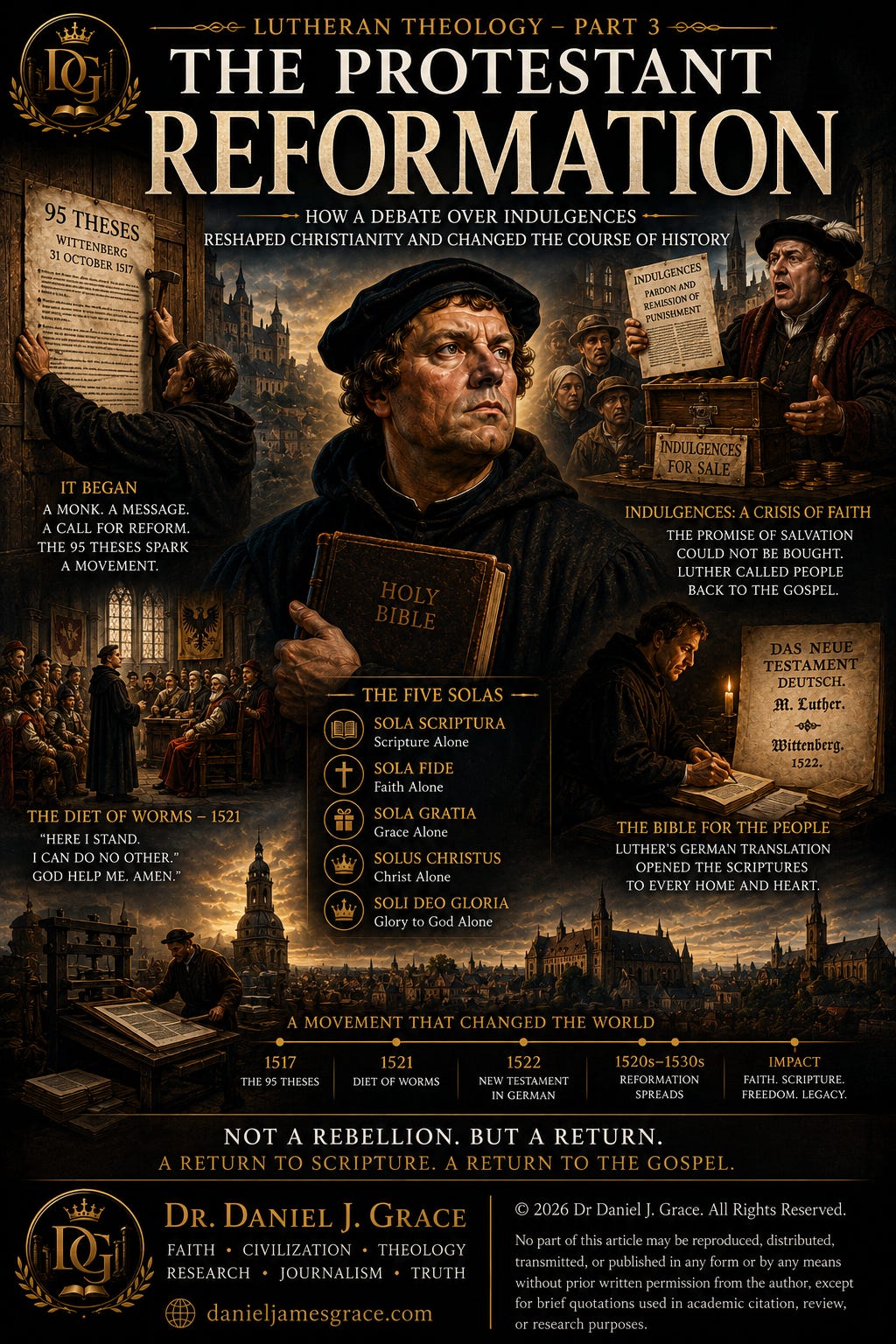
On 31 October 1517, Luther responded by composing a document known as the Ninety-Five Theses. These statements aimed to spark academic debate and questioned various aspects of indulgence practices. According to tradition, Luther posted the theses on the door of the Castle Church in Wittenberg.
At the time, Luther likely expected a scholarly discussion among theologians. Instead, the document spread rapidly throughout Germany and beyond. The recent invention of the printing press enabled people to reproduce and distribute copies on an unprecedented scale.
The printing press became one of the most important tools of the Reformation. For the first time in history, people could communicate ideas quickly across large regions. Luther’s writings reached audiences far beyond university classrooms, and public interest in religious reform grew rapidly.
As debate intensified, Luther’s criticisms expanded beyond indulgences. Through continued study of Scripture, he became convinced that several teachings and practices within the Church required reform. Central to his concerns was the question of authority.
Luther argued that Scripture should hold the highest authority for Christian faith and practice. This principle later became known as Sola Scriptura, meaning “Scripture Alone”. While Luther respected church traditions and historical teachings, he believed they must always remain subject to the authority of God’s Word.
This position brought him into direct conflict with Church leaders. What began as a debate over indulgences gradually developed into a much broader dispute concerning theology, authority, and the nature of salvation.
In 1520, Pope Leo X issued a papal bull condemning Luther’s teachings and demanding that he recant. Luther responded by publicly burning the document, a dramatic act that signalled the growing division between him and Church authorities.
The conflict reached a decisive moment in 1521 at the Diet of Worms, an imperial assembly convened by Emperor Charles V. Luther was summoned to appear before political and religious leaders and was asked whether he would withdraw his writings.
Faced with intense pressure, Luther delivered one of the most famous responses in Christian history. Although the exact wording remains debated, he essentially declared that his conscience was bound by Scripture and that he could not recant unless convinced by biblical evidence.
His refusal placed him in grave danger. He was declared an outlaw, meaning that anyone could potentially arrest or harm him without legal consequences.
Fortunately for Luther, he received protection from Frederick the Wise, Elector of Saxony. Luther was secretly taken to Wartburg Castle, where he spent several months in hiding.
During this period, Luther undertook one of his most important achievements: translating the New Testament into German.
Prior to the Reformation, the Bible was primarily available in Latin, a language many ordinary people could not read. Luther believed every Christian should have direct access to Scripture. His translation made the Bible accessible to common people and helped shape the development of the modern German language.
The translation effort reflected a broader Reformation commitment to biblical literacy. Reformers encouraged education, reading, and personal engagement with Scripture. Schools were established, literacy increased, and the Bible became more widely available than ever before.
As Luther’s ideas spread, reform movements emerged throughout Europe. Leaders such as Ulrich Zwingli in Switzerland and later John Calvin in Geneva developed their own approaches to reform. While they agreed with Luther on many issues, they also differed on certain theological questions.
The Reformation soon expanded beyond theology and began influencing politics, economics, education, and culture. Various rulers adopted Protestant reforms for both religious and political reasons. Entire regions gradually embraced new forms of Christianity.
Not everyone welcomed these changes. Europe experienced significant religious conflict during the sixteenth and seventeenth centuries. Tensions between Protestant and Catholic communities sometimes resulted in persecution, division, and warfare.
Despite these challenges, the Reformation produced lasting benefits. It encouraged greater engagement with Scripture, renewed emphasis on personal faith, expanded educational opportunities, and stimulated theological reflection. It also contributed to the development of religious diversity within Christianity.
For Lutherans, the Reformation was never simply about protesting against the Church. Rather, it was about recovering what Luther believed to be the biblical message of salvation through grace received by faith in Jesus Christ.
The Reformation also produced several important theological principles often referred to as the Five Solas:
Sola Scriptura – Scripture Alone
Sola Fide – Faith Alone
Sola Gratia – Grace Alone
Solus Christus – Christ Alone
Soli Deo Gloria – Glory to God Alone
These principles continue to shape Lutheran theology and much of Protestant Christianity today.
Well over five hundred years later, the Protestant Reformation remains one of the most influential movements in Christian history. You can see its effects in churches, universities, political institutions, and societies throughout the world.
Conclusion
The Protestant Reformation began as a call for reform but ultimately became a movement that transformed Christianity. Martin Luther’s challenge to indulgences sparked a broader discussion about Scripture, salvation, authority, and the Gospel itself. Through courage, scholarship, and commitment to biblical truth, Luther helped shape a movement that continues to influence millions of Christians around the world. The legacy of the Reformation reminds believers of the importance of Scripture, faith, and the ongoing need for renewal within the Church.
Next Article
Part 4 – Sacraments in Lutheran Theology
Baptism, Holy Communion, and God’s Means of Grace

Dr Daniel J. Grace
Faith • Civilization • Theology
Research • Journalism • Truth
🌐 danieljamesgrace.com
© 2026 Dr Daniel J. Grace. All Rights Reserved.
No part of this article may be reproduced, distributed, transmitted, or published in any form or by any means without prior written permission from the author, except for brief quotations used in academic citation, review, or research purposes.