

Lutheran Theology – Part 2
Understanding Luther’s Greatest Theological Discovery

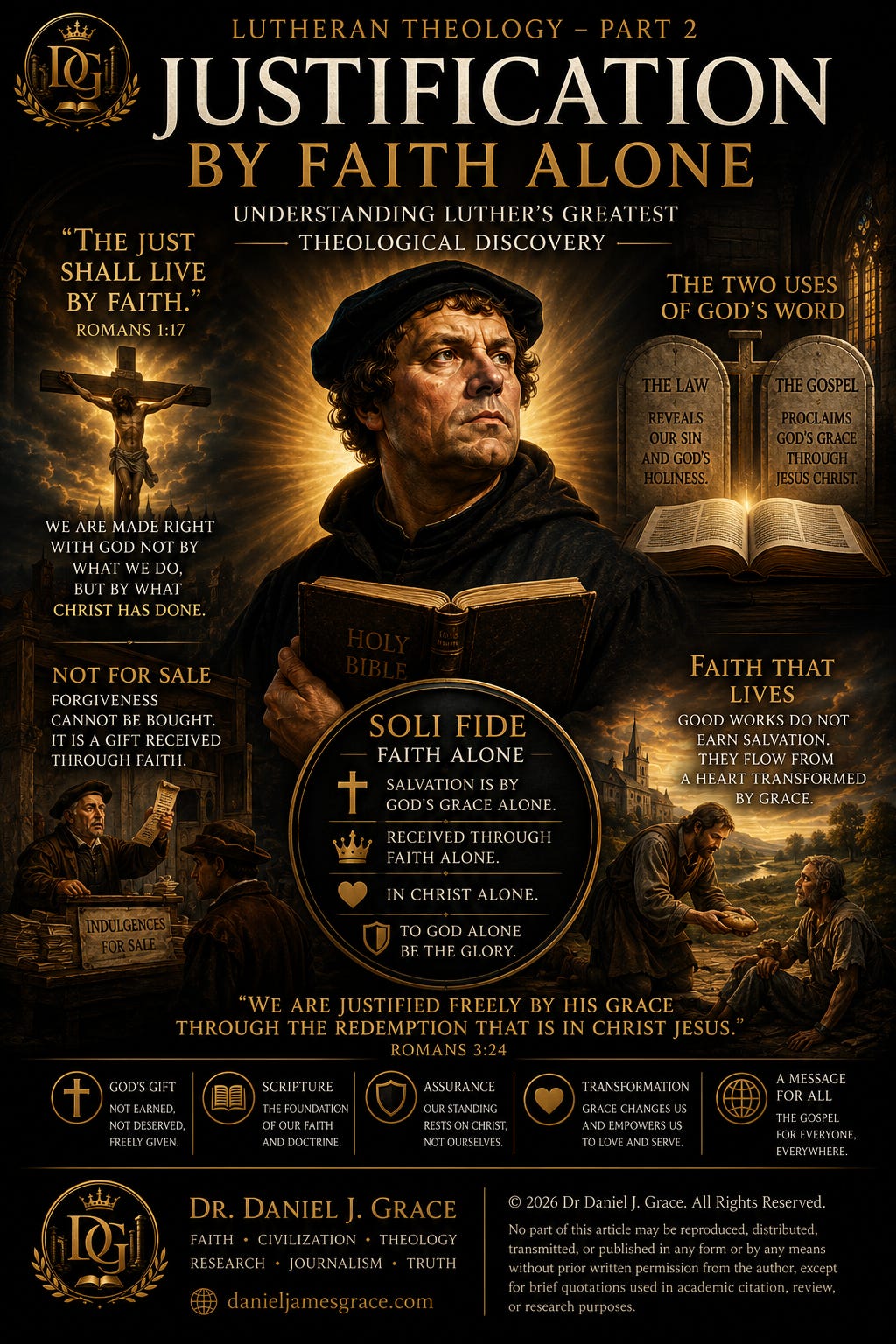
Justification by Faith Alone
The doctrine of justification by faith alone is the most important of all the beliefs that Martin Luther and the Protestant Reformation held. This doctrine became the core of Lutheran theology and continues to be one of the most important beliefs of Lutheran churches around the world today. Luther himself considered it the central truth of Christianity and believed that the church would stand or fall based upon its understanding of this doctrine.
To understand why justification by faith became so important, it is necessary to understand the spiritual struggles that Luther experienced during his years as a monk and theologian. Like many sincere Christians of his time, Luther desperately wanted to know how a sinful person could stand before a holy God and be accepted.
The mediaeval church taught that salvation involved faith, participation in the sacraments, acts of charity, repentance, and cooperation with God’s grace. While these teachings aimed to encourage holy living, Luther felt overwhelmed by guilt and uncertainty. No matter how much he prayed, fasted, confessed his sins, or pursued religious discipline, he could not attain lasting peace.
The more he studied the Bible, the more he became aware of God’s perfect righteousness. Yet instead of finding comfort, he initially found fear. How could a perfectly holy God accept imperfect human beings? How could sinners ever become righteous enough to enter God’s presence?
Luther’s study of Scripture, especially the writings of the Apostle Paul, was the key moment. One verse became especially significant:
“For in it the righteousness of God is revealed from faith to faith; as it is written, ‘The just shall live by faith.’” (Romans 1:17)
For many years Luther interpreted the phrase “righteousness of God” as God’s standard of judgement against sinners. However, as he continued studying, he developed a different understanding. He concluded that the righteousness mentioned by Paul was not merely a standard God demanded but a gift God freely gives to those who trust in Christ.
This discovery transformed Luther’s understanding of salvation. He realised that human beings are not justified before God by their own works, achievements, or religious efforts. Instead, they are justified entirely through God’s grace received by faith.
The word “justify” is a legal term. In biblical theology, it refers to God’s declaration that a sinner is righteous in His sight. Luther taught that this declaration is not based upon human merit but upon the completed work of Jesus Christ.
According to Lutheran theology, Christ lived the perfect life that humanity could never live. He fulfilled God’s law completely and willingly offered Himself as a sacrifice for sin through His death on the cross. Through His resurrection, He conquered death and demonstrated God’s victory over sin and judgement.
Because of Christ’s work, God offers forgiveness and righteousness to all who place their trust in Him. This righteousness is not earned but received. Luther often described it as an “alien righteousness”, meaning that it comes from outside ourselves. It is Christ’s righteousness credited to the believer through faith.
This teaching became known by the Latin phrase Sola Fide, meaning “Faith Alone.” It was one of the famous Five Solas of the Protestant Reformation.
Luther taught that good works were necessary. Rather, he argued that excellent works are the result of salvation, not the cause of it. A person does not perform good works to earn God’s favour. Instead, virtuous works naturally flow from genuine faith.
To illustrate this point, Luther often used the image of a healthy tree. A healthy tree produces good fruit because it is healthy. The fruit does not make the tree healthy; it simply demonstrates the condition of the tree. In the same way, exemplary works demonstrate living faith but do not create salvation.
This distinction became one of the major differences between Lutheran theology and the teachings that Luther believed had developed within the mediaeval church. Luther feared that many people were relying on religious activities rather than trusting completely in Christ.
One practice that particularly troubled him was the sale of indulgences.Church representatives sold indulgences, which were documentss that were said to reduce temporal punishment for sins. Although the official theology surrounding indulgences was complex, many ordinary people believed they could purchase spiritual benefits through financial contributions.
Luther believed such practices distracted people from the true Gospel. In his view, forgiveness could never be bought, earned, or negotiated. It could only be received as a gift through faith in Jesus Christ.
This conviction eventually led to his famous publication of the Ninety-Five Theses in 1517. While the theses addressed several issues, the underlying concern was always the same: people needed to trust Christ rather than human systems for salvation.
Another important aspect of Lutheran teaching on justification is the distinction between law and gospel. Luther believed that both are essential parts of God’s Word, but they serve different purposes.
The Law reveals God’s holiness and exposes human sinfulness. It shows people their need for salvation and demonstrates that no one can achieve righteousness through personal effort alone.
The Gospel, by contrast, announces God’s grace in Jesus Christ. It proclaims forgiveness, reconciliation, and salvation through faith. While the Law diagnoses humanity’s problem, the Gospel provides God’s solution.
This distinction remains a central feature of Lutheran preaching today. Sermons often seek to present both the reality of sin and the hope of grace found in Christ.
Luther’s understanding of justification also brought profound assurance to believers. If salvation depends entirely upon Christ’s work rather than human achievement, Christians can have confidence in God’s promises. Their standing before God rests not upon their fluctuating performance but upon the finished work of Jesus.
At the same time, Lutheran theology does not encourage spiritual laziness. Faith is understood as a living relationship with Christ that produces gratitude, obedience, and service. Genuine faith transforms the believer’s life and inspires acts of love toward others.
The doctrine of justification by faith alone remains influential far beyond Lutheran churches. Many Protestant denominations, including Reformed, Baptist, Methodist, Evangelical, and Pentecostal traditions, have been shaped by Luther’s emphasis on salvation through grace received by faith.
Yet this doctrine continues to hold a uniquely central place in Lutheranism. For Lutherans, justification is not merely one doctrine among many. It is the lens through which the entire Christian message is understood.
Five centuries after the Reformation, Luther’s discovery continues to resonate with millions of Christians around the world. His message remains simple yet profound: salvation is not earned through human effort but received through faith in Jesus Christ.
Conclusion
The doctrine of justification by faith alone stands at the very heart of Lutheran theology. Through his study of Scripture, Martin Luther became convinced that salvation is God’s gift, freely given through Christ and received by faith. This discovery transformed his life, sparked the Protestant Reformation, and continues to shape Christian theology today. By pointing believers away from their efforts and toward the grace of God in Christ, Luther sought to restore the Gospel’s message of hope, assurance, and salvation.
Next Article
Part 3 – The Protestant Reformation
How a Debate Over Indulgences Reshaped Christianity and Changed the Course of History

Dr Daniel J. Grace
Faith • Civilization • Theology
Research • Journalism • Truth
🌐 danieljamesgrace.com
© 2026 Dr Daniel J. Grace. All Rights Reserved.
No part of this article may be reproduced, distributed, transmitted, or published in any form or by any means without prior written permission from the author, except for brief quotations used in academic citation, review, or research purposes.