
Let’s Begin with Jesus

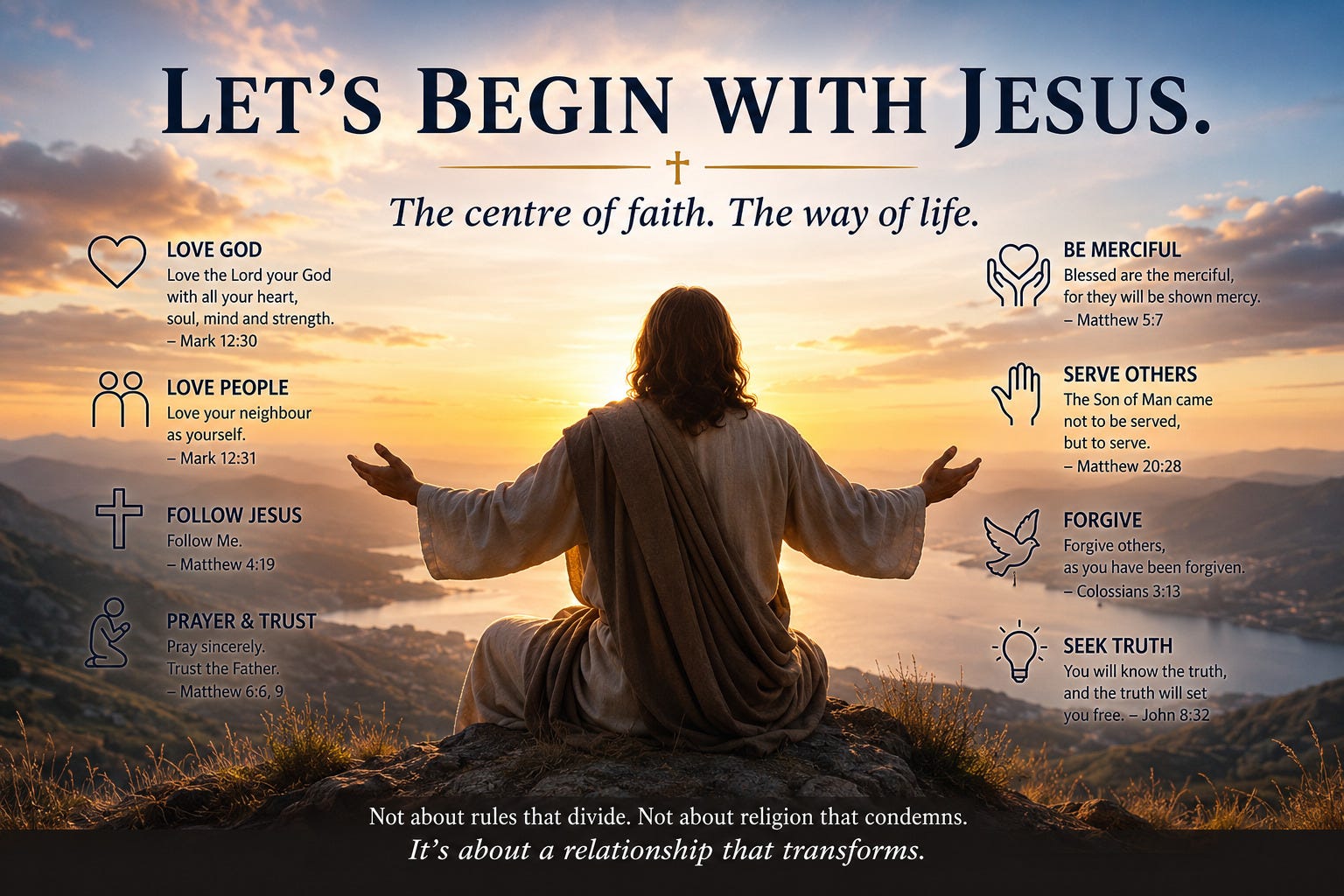
Christianity has often become more complicated than Jesus made it.
Across centuries, churches have developed traditions, institutions, creeds, theological systems, denominational identities, moral codes, liturgical forms, and competing interpretations of Scripture. Many of these have served important purposes. They have preserved memory, shaped communities, defended faith, educated believers, and helped Christians respond to changing historical conditions. Yet they have also created confusion. At times, secondary doctrines have been treated as though they were the heart of the gospel. Customs have become commandments. Denominational boundaries have been mistaken for the boundaries of God’s grace.
The result is familiar. Christians argue over food, clothing, worship days, baptismal formulas, spiritual gifts, church government, music, language, and personal habits. Some communities define faithfulness by avoiding coffee. Others insist that one particular day must be observed in one particular manner. Some make blood transfusion, dress, political loyalty, or a specific doctrinal vocabulary into tests of salvation. Others tell believers that disagreement with their group is equal to rejection of God.
Jesus did not begin there.
He began with a call:
“Follow Me.”
That command is simple, but it is not shallow. It contains an entire way of life. To follow Jesus is to learn His character, receive His teaching, imitate His mercy, confront hypocrisy, love one’s enemies, care for the vulnerable, resist domination, seek truth, forgive freely, and trust God without turning faith into superstition.
A renewed Christianity must therefore begin with Jesus.
This does not mean rejecting the Bible, denying theology, dismissing history, or treating doctrine as irrelevant. It means placing everything in its proper order. Jesus must remain the centre through which Christian belief, interpretation, ethics, worship, and public witness are understood.
The Christian faith loses clarity whenever Jesus becomes secondary to the systems built around Him.
Jesus Before Religious Systems
Jesus entered a world already filled with religious traditions. First-century Judaism was diverse, serious, intellectually active, and deeply shaped by Scripture. Different groups debated purity, resurrection, law, worship, authority, political resistance, and the future of Israel. Jesus did not enter a religious vacuum. He spoke within a living tradition.
Yet He repeatedly challenged the tendency to confuse religious regulation with faithfulness to God.
He criticised leaders who imposed burdens on others while neglecting justice, mercy, and faithfulness. He opposed forms of religion that protected status while overlooking human suffering. He healed on the Sabbath, ate with socially rejected people, touched those considered unclean, and welcomed those whose lives had been morally or socially damaged.
Jesus did not reject holiness. He redefined it around the character of God.
Holiness, in His ministry, was not separation from suffering people. It was the willingness to enter their suffering without becoming corrupted by cruelty. Purity was not maintained by avoiding the wounded. It was expressed through mercy, truth, repentance, and restored relationship.
This is why Jesus’ most severe criticisms were often directed not at obvious sinners but at religious hypocrisy. He challenged those who appeared righteous while using religion to secure power, recognition, or moral superiority.
A Christ-centred Christianity must take this seriously. Religious confidence is not always spiritual maturity. Strictness is not always holiness. Certainty is not always truth. A community may speak constantly about God while becoming unlike Jesus.
That is the danger.
The Core of Jesus’ Teaching
When Jesus was asked about the greatest commandment, He did not present a complicated theological system. He answered with love of God and love of neighbour.
“You shall love the Lord your God with all your heart, with all your soul, and with all your mind.”
He then added:
“You shall love your neighbour as yourself.”
These commands are not sentimental. They are demanding. Love of God involves loyalty, reverence, trust, repentance, and the surrender of self-centred ambition. Love of neighbour requires action. It includes the stranger, the poor, the enemy, the rejected, the sick, and the person whose background or beliefs differ from one’s own.
Jesus did not define neighbour narrowly. In the parable of the Good Samaritan, the morally admirable person was not the religious insider but the outsider who showed mercy.
That teaching remains deeply challenging. It means Christian identity cannot be reduced to belonging to the correct institution. A person may possess religious knowledge and still fail to love. Another may stand outside respected structures and yet act in a way that reflects the mercy of God.
Jesus placed the moral weight on compassion.
He taught forgiveness, not because wrongdoing is unimportant, but because resentment can imprison the soul. He taught humility, not because human dignity should be denied, but because pride distorts relationships. He taught generosity, not because wealth is inherently evil, but because possessions easily become masters. He taught prayer, not as a technique for controlling outcomes, but as honest communion with God.
The Christian life, in Jesus’ teaching, is not a system for obtaining everything one wants. It is a transformation of desire.
God Is Not a Religious Delivery Service
Many people approach God as though divine power exists to fulfil personal wishes. Prayer becomes a transaction.
A person needs a visa and imagines God primarily as the one who must influence the visa officer. Another wants money and treats faith like a spiritual lottery. Someone desires a relationship, a promotion, a healing, or a particular legal outcome and assumes that sincere belief must produce the preferred result.
This understanding reduces God to a service provider.
Jesus did teach people to ask, seek, and knock. He encouraged trust in God. He prayed for healing and responded compassionately to human need. Yet He never promised that discipleship would remove uncertainty, suffering, or disappointment. He Himself prayed in Gethsemane and still went to the cross.
Christian prayer is therefore not the manipulation of divine power. It is the bringing of human need into the presence of God.
A mature faith can ask boldly while remaining open to outcomes beyond personal control. It can pray for healing while respecting medicine. It can pray for employment while submitting applications. It can seek justice while following lawful processes. It can hope for change without claiming that every result is a direct message from heaven.
Faith does not eliminate reality. It teaches people how to live within it.
Jesus and the Natural World
A Christ-centred theology must also speak responsibly about nature.
Earthquakes, tsunamis, storms, fires, diseases, genetic disorders, and cosmic events are often described in religious language as though God personally decided each occurrence. This can become morally troubling. It may imply that every victim was individually selected for suffering or that every disaster was designed as punishment.
Jesus did not encourage this type of explanation.
When people spoke to Him about victims of tragedy, He refused the assumption that their suffering proved greater guilt. He did not teach that every disaster should be interpreted as a specific divine judgment.
The natural world operates through physical processes. Tectonic plates move. Viruses mutate. Stars form and collapse. Forests burn. Organisms evolve. Weather systems develop. Bodies age. These processes are studied through science.
Christian faith should not fear this knowledge.
Science investigates mechanisms, patterns, causes, evidence, and measurable relationships within the natural world. Theology asks different but related questions: Why is there something rather than nothing? What is the meaning of human life? What is the moral responsibility of persons? How should suffering be faced? What does hope mean in the presence of death?
These disciplines need not be enemies.
Scientific explanation does not remove wonder. Understanding the movement of tectonic plates does not answer every philosophical question about existence. At the same time, theological belief must not be used to deny established evidence or replace careful scientific investigation.
A serious Christian faith should be intellectually honest. It should welcome medicine, cosmology, biology, geology, psychology, and historical research. Truth does not become dangerous merely because it was discovered in a laboratory rather than a church.
The God of truth cannot be honoured by the rejection of truth.
Creation, Order, and Chaos
The universe contains both order and instability.
Physical laws display remarkable regularity. Gravity operates consistently. Energy behaves in measurable ways. Matter forms patterns. Life develops through complex biological processes. Yet the universe also contains collision, decay, extinction, entropy, randomness, and destruction.
This combination should not surprise us.
Nature is not a moral person. A storm does not hate. An earthquake does not judge. Fire does not distinguish between the innocent and the guilty. These events may bring terrible consequences, but they do not possess moral intention.
A forest fire illustrates this complexity. Fire may destroy trees, kill animals, damage homes, and cause immense grief. Yet in some ecosystems, fire also clears dead vegetation, releases nutrients, opens certain seeds, and allows new growth.
The good that may emerge does not make the suffering unreal. Nor does it prove that every loss was individually planned. It shows that natural processes can carry both destruction and renewal.
This is an important distinction.
Christians need not claim that God personally chose each tragedy in order to believe that existence ultimately belongs to God. A natural event may arise through natural processes. Human beings may respond with courage, compassion, scientific knowledge, emergency care, rebuilding, and solidarity.
God should not be used to close inquiry.
When a tsunami occurs, the first task is not to invent a theological explanation. It is to rescue, mourn, heal, rebuild, and learn. Reverence does not require ignorance. Compassion does not need speculation.
The Image of God and Human Responsibility
Human beings are part of nature, but they are not merely passive elements within it.
Christianity describes humanity as created in the image of God. This language has been interpreted in many ways. It may refer to moral awareness, rational capacity, relational life, creativity, responsibility, spiritual openness, and the human ability to love.
Whatever interpretation is adopted, the image of God should never become a justification for domination. It should deepen responsibility.
Human beings can reflect mercy or cruelty. They can preserve life or destroy it. They can use intelligence for healing or exploitation. They can create systems of justice or structures of oppression.
Natural disasters are not moral agents, but people are.
A tsunami cannot repent. A government can. A virus cannot act ethically. A medical institution can. A fire does not possess conscience. A person who deliberately starts one may bear responsibility.
This is why the teaching of Jesus remains necessary. The central human problem is not simply that nature is dangerous. It is that human freedom can be turned toward greed, violence, indifference, deception, and domination.
Jesus came to transform the human heart.
Jesus and the Healing of the Soul
To say that Jesus came to “clean the soul” may sound simple, but it expresses a profound Christian truth.
Jesus did not come merely to establish another religious institution. He came to restore human beings to God and to one another. He confronted sin not only as the breaking of rules but as a condition that damages relationship, conscience, desire, and identity.
Sin distorts love. It turns power into domination, possessions into idols, religion into pride, and fear into hatred.
Jesus’ ministry repeatedly addressed this interior disorder.
He forgave sinners. He restored dignity. He challenged self-deception. He called people to repentance. He taught that evil actions arise from within the human heart. He also showed that no person should be reduced to the worst thing they have done.
The healing offered by Christ is therefore moral, spiritual, relational, and existential.
He cleanses not by erasing personality but by restoring it. He does not destroy freedom but redirects it. He does not remove human responsibility but makes renewal possible.
This is why following Jesus cannot be reduced to religious affiliation. A person may identify as Christian while remaining cruel, dishonest, arrogant, or indifferent. Another may possess little formal theological knowledge while sincerely becoming more merciful, truthful, and humble.
Jesus taught that a tree is known by its fruit.
The credibility of Christian faith is therefore visible in the lives it produces.
Why Denominational Rules Become Dangerous
Every religious community develops practices. Communities need structure. They need leadership, teaching, shared worship, ethical boundaries, and forms of accountability.
The problem begins when community rules are treated as though Jesus personally commanded them.
A group may forbid coffee and turn abstinence into a mark of holiness. Another may insist that only one worship day is acceptable. Some may reject medical treatment on theological grounds. Others may declare that one baptismal formula, one political position, one style of worship, or one interpretation of prophecy determines whether a person belongs to Christ.
These claims should be examined carefully.
The proper question is not merely, “Does our group teach this?” It is, “Does this reflect the life, spirit, and teaching of Jesus?”
That question does not eliminate serious moral teaching. Jesus spoke clearly about truthfulness, faithfulness, greed, anger, lust, forgiveness, hypocrisy, justice, and love. He was compassionate, but He was not morally indifferent.
Yet His moral teaching served restoration, not tribal control.
The religious rules that most concern Him are those that produce mercy, integrity, humility, and faithfulness. Rules that create superiority without love have failed. Doctrines that make people cruel have been misunderstood or misused. Institutions that protect themselves while harming the vulnerable have departed from the way of Christ.
A church may possess correct language and still betray Jesus.
Reading the Bible Through Jesus
A Christ-centred approach to Scripture does not discard the rest of the Bible. It reads the whole canon with Jesus as the interpretive centre.
This matters because the Bible is a library, not a single type of book. It contains law, poetry, prophecy, wisdom, narrative, letters, apocalyptic imagery, lament, genealogy, parable, and theological argument. These texts emerged across different periods, cultures, crises, and communities.
They should not all be read in exactly the same way.
Jesus provides the clearest Christian lens.
His life shows how power should be used. His mercy reveals the character of God. His treatment of outsiders exposes religious exclusion. His cross reveals self-giving love. His resurrection grounds hope.
The writings of Paul and the other New Testament authors remain important. They preserve early Christian reflection, pastoral instruction, theological interpretation, and the struggles of the first churches. Yet they should not be used to overshadow Jesus.
Where an interpretation of a later text appears to justify cruelty, domination, contempt, or exclusion, it must be examined in the light of Christ.
This is not disrespect toward Scripture. It is fidelity to the Christian claim that Jesus is the decisive revelation of God.
The Bible should lead believers toward Christ, not away from Him.
Faith Without Hostility to Science
A Jesus-centred Christianity should never build its identity on opposition to science.
Science has transformed human understanding of the universe. It has revealed the age and expansion of the cosmos, the development of life, the structure of matter, the mechanisms of disease, the history of the earth, and the complexity of the human brain.
These discoveries do not automatically disprove God.
They do challenge simplistic interpretations.
The Big Bang theory does not describe God. It describes the early expansion of the observable universe. Evolution does not explain the moral meaning of human life. It explains biological development through natural processes. Neuroscience does not settle every question about consciousness, identity, or the soul, though it provides essential knowledge about the brain.
Theology must not pretend to answer scientific questions without evidence. Science must also recognise the limits of its methods. Scientific inquiry is powerful because it focuses on what can be observed, tested, measured, and revised. It does not, by those methods alone, determine every question of meaning, value, beauty, morality, or transcendence.
Conflict arises when either field exceeds its proper scope.
A scientifically responsible Christian faith can affirm that the universe has developed over immense periods of time. It can accept evolutionary biology. It can value vaccination, mental health treatment, surgery, climate science, and cosmology. It can recognise uncertainty where scientific knowledge remains incomplete.
Faith does not become stronger by denying evidence.
Jesus never taught His followers to fear knowledge. He taught truthfulness.
Miracles and Natural Law
Belief in miracles should also be approached carefully.
For many Christians, miracles express exceptional divine action. Yet miracles should not become an excuse for ignoring ordinary responsibility.
A person may pray for healing and still seek medical treatment. A community may pray during drought and still manage water responsibly. A family may trust God while following scientific guidance. These actions are not evidence of weak faith.
They are expressions of wisdom.
Jesus’ healing ministry displayed compassion, but He did not teach His followers to reject care. The Good Samaritan treated wounds with the resources available to him. The moral force of the story lies in practical mercy.
Claims of miracles should therefore be made humbly. Human beings can misunderstand events, exaggerate experiences, or interpret coincidence through expectation. Genuine faith does not need to manipulate evidence.
God is not honoured by dishonesty.
Prayer After Religious Illusion
Prayer becomes healthier when it is separated from magical thinking.
Jesus taught His disciples to pray for daily bread, forgiveness, protection, and the coming of God’s kingdom. He also taught them to seek God’s will.
Christian prayer may include requests, but it is more than requesting.
It includes silence, gratitude, lament, confession, surrender, praise, and moral self-examination. It changes the person who prays. It may create courage where fear once ruled, forgiveness where resentment had grown, and clarity where desire had become confused.
Prayer is not successful only when circumstances change.
Sometimes prayer changes how suffering is carried. Sometimes it leads to action. Sometimes it exposes selfish motives. Sometimes it produces no emotional certainty at all.
Jesus’ own prayer life contained intimacy, struggle, anguish, and surrender. That should protect Christians from shallow promises.
Faith is not control.
The Cross as the Centre of Christian Power
Jesus redefined power through the cross.
Religious and political systems often understand power as the ability to dominate, compel, punish, or win. Jesus revealed another form of power: truth without violence, authority without exploitation, and love willing to suffer rather than become cruel.
The cross is not a celebration of suffering for its own sake. It is the exposure of what human systems do to innocence, mercy, and truth.
It also reveals that God’s victory is not achieved through the methods of empire.
This is crucial for Christian public life. Whenever churches seek power by fear, coercion, humiliation, or political domination, they move away from the crucified Christ.
Christian influence should be measured by service, not control.
The church is most faithful when it protects the vulnerable, tells the truth, resists corruption, welcomes repentance, and refuses to dehumanise opponents.
A Christianity obsessed with winning may lose Jesus.
Resurrection and the Meaning of Hope
The resurrection gives Christian faith its future direction.
Christian hope is not denial. It does not pretend that suffering is unreal or that death is insignificant. It declares that death does not possess the final word.
This hope should not be used to neglect the present world. Belief in eternal life should deepen care for life now.
Because people matter eternally, their dignity matters presently. Because creation belongs to God, environmental destruction should concern Christians. Because bodies matter, medicine matters. Because truth matters, education matters. Because love endures, injustice must be confronted.
Resurrection hope produces responsibility.
It does not encourage escape from the world. It calls believers to live as signs of renewal within it.
What It Means to Follow Jesus Now
To begin with Jesus is not to avoid difficult questions. It is to establish the right centre from which they can be faced.
A follower of Jesus should be recognisable by mercy, courage, honesty, humility, and love.
This does not mean perfection. The disciples themselves misunderstood, failed, argued, feared, and doubted. Following Jesus includes correction.
A Christ-centred Christian life should therefore remain teachable.
It should be willing to admit error. It should listen to evidence. It should repent when religious language has harmed people. It should welcome scientific knowledge. It should resist conspiracy theories. It should refuse to treat illness as proof of weak faith. It should not blame victims for disasters. It should never make denominational customs more important than compassion.
It should ask simple but demanding questions:
Does this teaching make us more truthful?
Does this practice deepen mercy?
Does this doctrine reflect Jesus?
Does this community protect the vulnerable?
Does this interpretation produce humility or superiority?
Does this belief help us love God and neighbour?
These questions do not solve every theological dispute, but they reveal what matters most.
A Christianity Worth Following
The world does not need a Christianity that adds unnecessary burdens to already wounded people.
It does not need religious competition disguised as faithfulness. It does not need fear-driven preaching, anti-scientific hostility, spiritual manipulation, or promises that God will fulfil every personal desire.
It needs the Christ revealed in the Gospels.
It needs the Jesus who touched the excluded, defended the condemned, welcomed children, confronted hypocrisy, honoured women, ate with sinners, healed the suffering, forgave enemies, and gave Himself without becoming hateful.
This Jesus is neither weak nor simplistic.
His mercy is morally serious. His love demands transformation. His forgiveness does not deny justice. His humility exposes pride. His truth challenges both religious and secular power.
To begin with Jesus is not to reduce Christianity. It is to recover its centre.
The task of the church is not to make people dependent on religious systems. It is to help them encounter Christ, grow in truth, and become capable of love.
The deepest Christian question is therefore not:
Which denomination has every answer?
It is not:
Which group possesses the purest rituals?
It is not:
Which religious rules separate us from everyone else?
The deepest question is:
Are we becoming like Jesus?
That is where Christian faith begins.
That is where doctrine must be tested.
That is where science can be respected without fear.
That is where the wounded can find dignity.
That is where religion becomes discipleship.
Let’s begin with Jesus.
Final Reflection
Christianity has survived empires, persecution, revolutions, scientific discoveries, cultural change, and theological disagreement. Yet every generation faces the same question:
Where does Christianity begin?
For many, it begins with a denomination. For others, with a theological system, a tradition, a pastor, or a set of religious rules.
The Gospels point elsewhere.
Christianity begins with Jesus Christ.
He is the one who reveals the Father, calls people to repentance, welcomes the broken, confronts hypocrisy, heals the wounded, forgives sinners, and invites humanity into the life of God. Before Christians debate secondary questions, they must first listen to His voice.
This does not mean history is unimportant, theology unnecessary, or the rest of Scripture irrelevant. It means every Christian belief should ultimately be measured against the life, character, teaching, death, and resurrection of Jesus Christ.
A faith centred on Christ has nothing to fear from honest questions, careful scholarship, or scientific discovery. Truth cannot contradict truth. The God who created the universe is not threatened by the study of the universe. Scientific investigation helps us understand how the natural world functions, while the gospel reveals why human life has meaning and where true hope is found.
The church’s greatest calling is therefore not to create unnecessary burdens, defend denominational pride, or divide people over secondary matters. Its calling is to help people encounter Christ, grow in truth, and reflect His love in the world.
The Christian life is ultimately measured not by the labels we wear but by the person we become.
Do we love as Jesus loved?
Do we forgive as Jesus forgave?
Do we serve as Jesus served?
Do we seek truth with humility?
Do we walk with mercy toward those who suffer?
These questions remain as urgent today as they were two thousand years ago.
Perhaps the future of Christianity does not depend on discovering something new.
Perhaps it depends on rediscovering the One who has always stood at its centre.
Let’s begin with Jesus.
About the Author
Dr. Daniel J. Grace is an Australian independent researcher, Christian writer, and journalist whose work explores biblical theology, church history, Christian discipleship, religious freedom, and the relationship between faith and contemporary society. His writing seeks to present historic Christianity in a way that is academically responsible, spiritually authentic, Christ-centred, and accessible to both scholars and general readers.
ORCID: https://orcid.org/0000-0002-9259-8032
https://doi.org/10.5281/zenodo.21413138
Originally published on Dr. Daniel J. Grace’s Substack and Faith, Civilization and Theology
For more articles on Christian faith, biblical theology, church history, and discipleship, visit:https://danieljamesgrace.com
https://faithcivilizationtheology.com