
Laodicea’s Prosperity, Confidence, and the Spiritual Warning of Revelation
One of the Richest Cities in Asia Minor Became a Powerful Lesson for the Modern Church

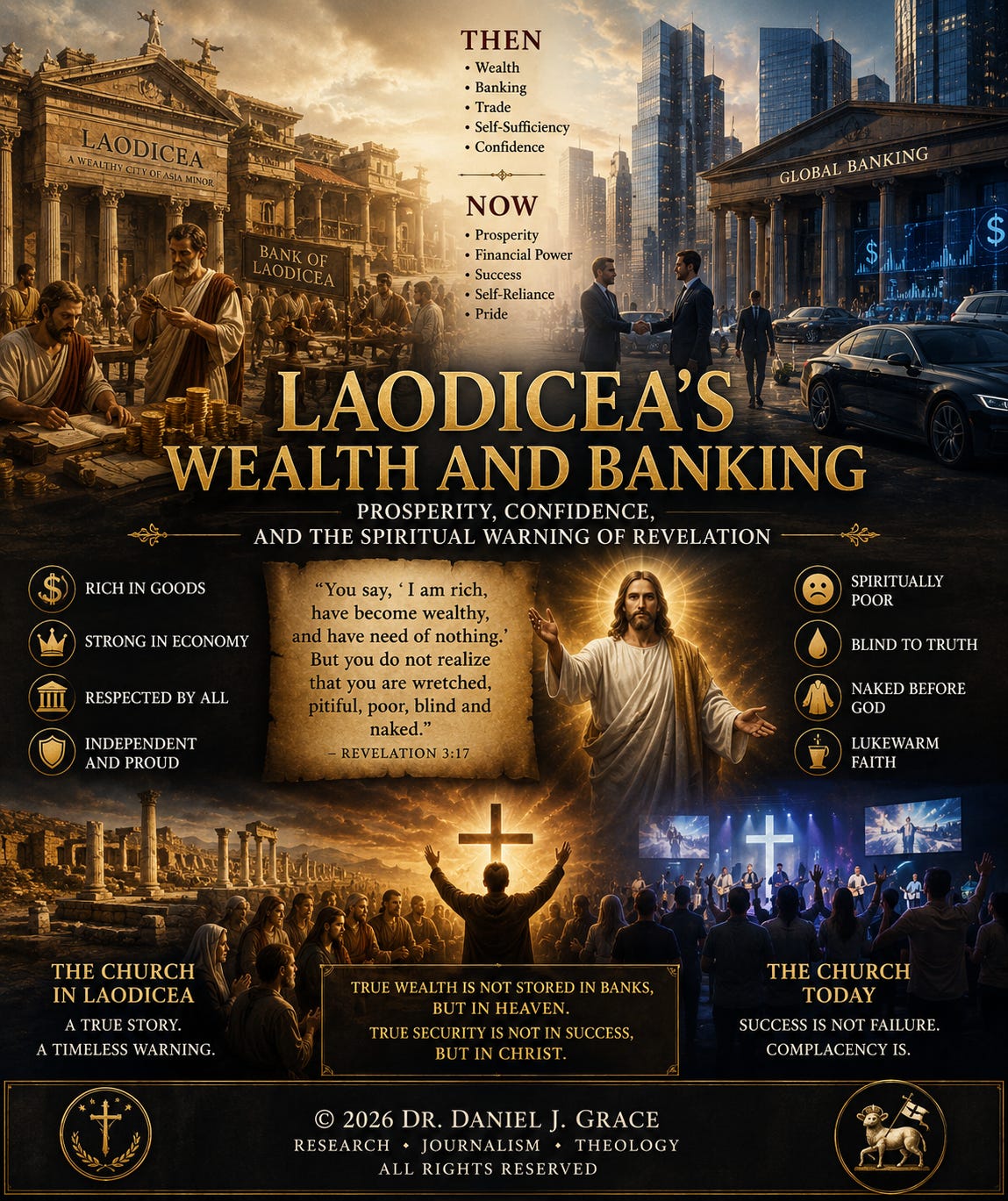
Among the Seven Churches of Revelation, Laodicea occupies a unique position. Unlike Smyrna, which suffered persecution, or Philadelphia, which endured hardship with faithfulness, Laodicea was known for its wealth, banking industry, commercial success, and self-sufficiency. Situated in the fertile Lycus Valley of Asia Minor, the city became one of the most prosperous financial centers in the Roman world. Yet the very prosperity that brought material success also created spiritual complacency. The warning given to the church in Laodicea remains one of the most challenging messages in the Book of Revelation. This article explores the city’s economic importance, banking industry, and commercial influence while examining why Christ used Laodicea’s wealth as a powerful lesson for believers throughout history.
Introduction
In the modern world, success is often measured by wealth, influence, and financial security. Cities compete for economic growth, businesses pursue expansion, and individuals seek stability through material prosperity.
Ancient Laodicea understood these ambitions well.
Located in the Roman province of Asia, Laodicea became one of the wealthiest cities in the eastern Empire. Its banks, trade networks, textile production, and strategic location generated enormous prosperity.
Yet despite its success, the city became the subject of one of the strongest rebukes in the Book of Revelation.
The story of Laodicea demonstrates that material wealth and spiritual health are not always the same thing.
A Financial Center of Asia Minor
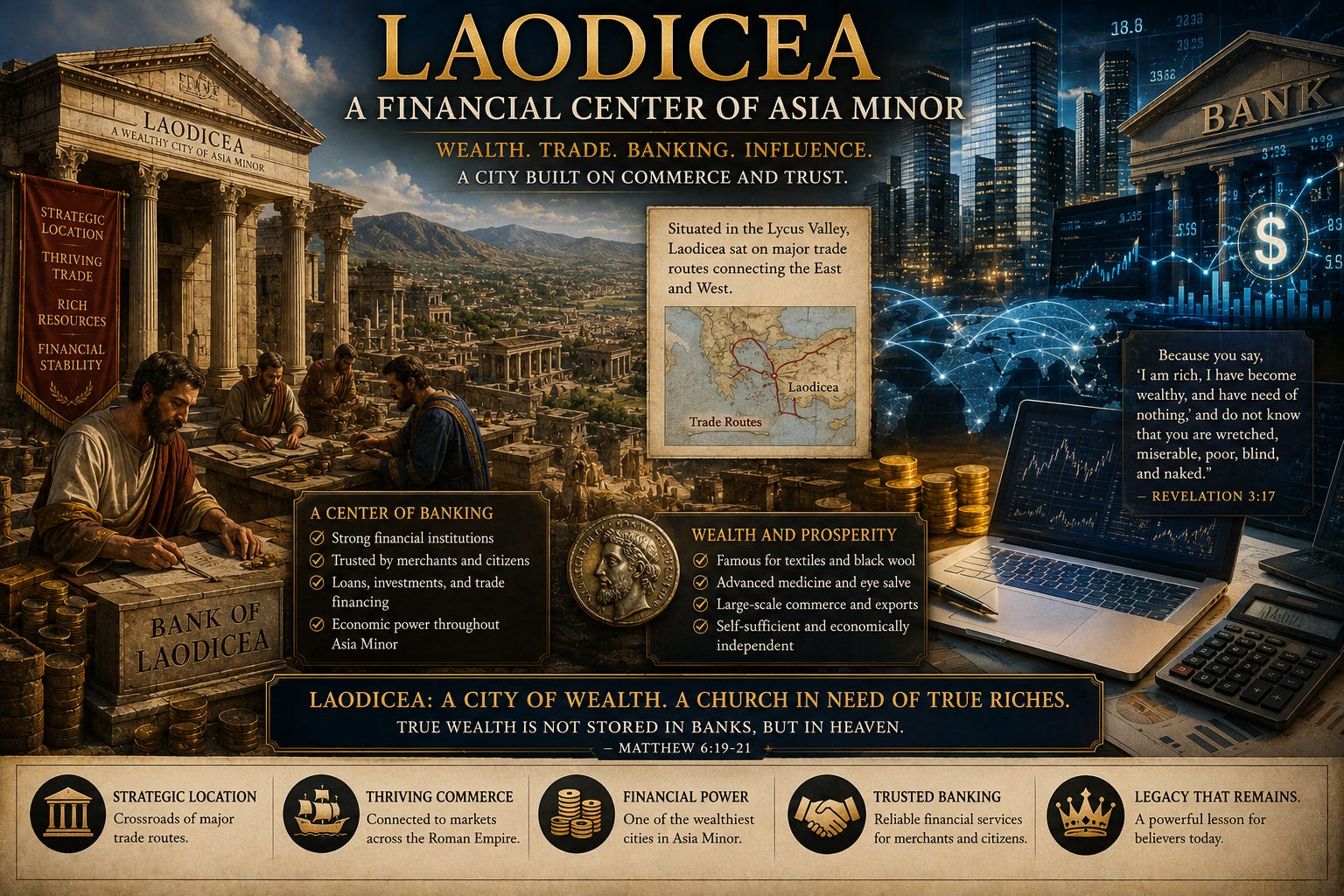
Laodicea’s location made it a natural commercial hub.
Major trade routes connecting the interior of Asia Minor to coastal ports passed through the city. Merchants, travelers, government officials, and traders frequently moved through the region.
As commerce expanded, Laodicea developed into an important banking center.
Ancient sources describe the city as possessing significant financial resources. Wealthy citizens, merchants, and landowners invested in banking activities that supported regional trade and economic growth.
The city became known throughout the Roman world for its prosperity.
Its financial institutions helped establish Laodicea as one of the richest urban centers in Asia Minor.
The Earthquake of AD 60
One event illustrates the city’s wealth more clearly than any other.
Around AD 60, a devastating earthquake struck the region and caused extensive destruction.
Many cities affected by natural disasters relied upon financial assistance from Rome to rebuild.
Laodicea took a different path.
Ancient historian Tacitus records that the city rebuilt itself without imperial aid.
This was a remarkable achievement.
The citizens possessed sufficient resources and confidence to restore their city independently.
Their self-sufficiency became a source of civic pride and demonstrated the extraordinary wealth accumulated within the community.
Yet this same attitude would later become part of the spiritual problem identified in Revelation.
Wealth and Self-Sufficiency
Economic success often creates a sense of independence.
People who possess wealth may begin to believe they no longer need help from others.
This attitude was reflected in Christ’s words to the church:
“You say, ‘I am rich, have become wealthy, and need nothing.’” (Revelation 3:17)
The statement reveals more than financial confidence.
It exposes a spiritual mindset.
The church viewed itself as secure, successful, and lacking nothing. From a worldly perspective, this assessment appeared reasonable.
However, Christ offered a very different evaluation.
Despite its material prosperity, the church was spiritually poor.
Banking and the Message of Revelation
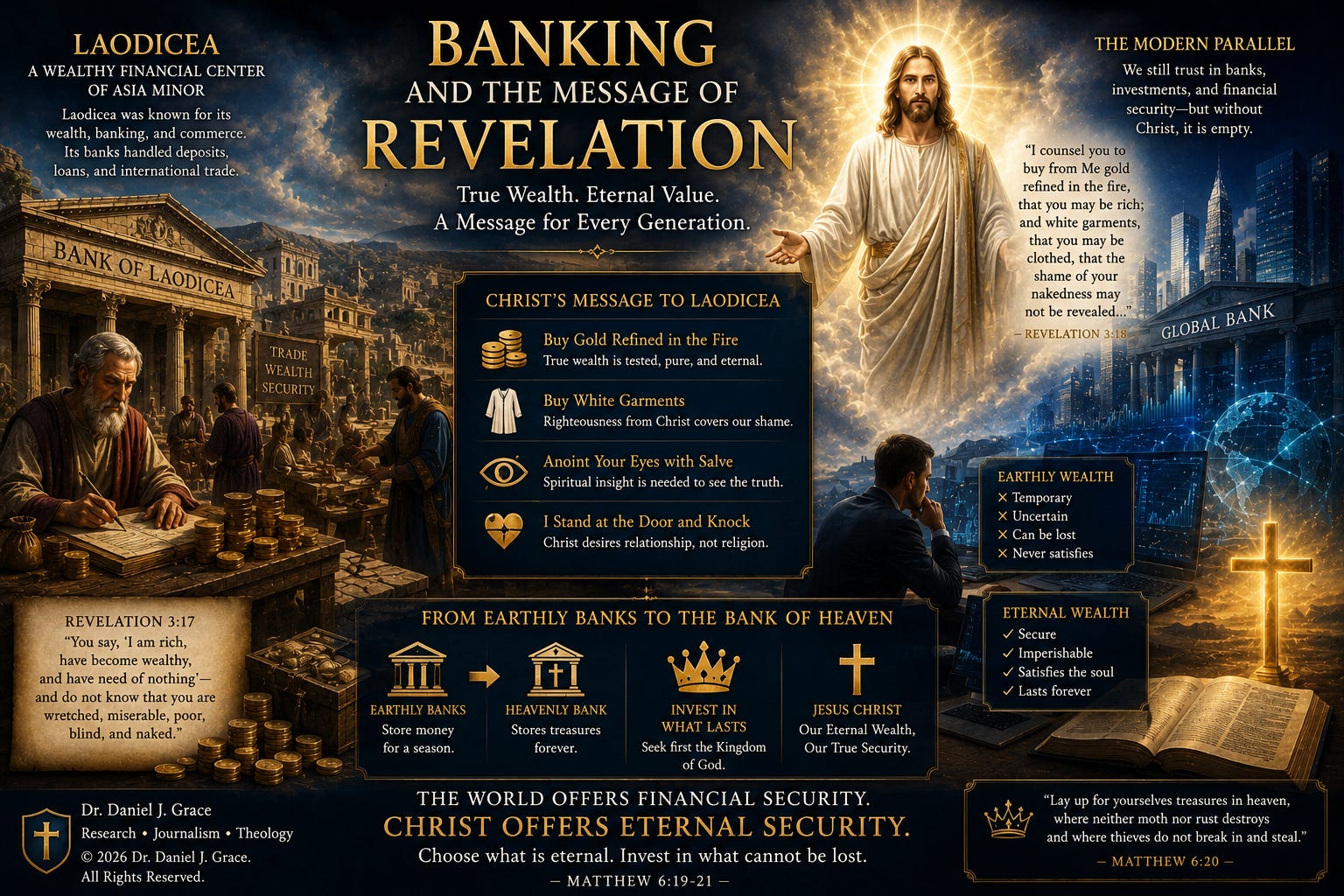
The economic character of Laodicea helps explain several details in Revelation.
Christ counsels the believers to “buy from Me gold refined in the fire.”
This language would have carried special significance in a city famous for banking and finance.
The residents understood wealth.
They understood investments.
They understood financial security.
Yet Christ pointed them toward a different kind of treasure.
Spiritual riches, unlike material wealth, cannot be lost through economic collapse, political change, or natural disaster.
The true wealth offered by Christ was infinitely greater than anything found within the city’s banks.
The Danger of Prosperity
The warning to Laodicea highlights a timeless spiritual danger.
Poverty often reminds people of their dependence upon God.
Prosperity can create the illusion of independence.
When material needs are satisfied, spiritual needs may be ignored.
The believers in Laodicea were not condemned for possessing wealth itself. Scripture contains numerous examples of faithful individuals who were prosperous.
The problem was misplaced confidence.
The church trusted in its resources more than its relationship with Christ.
Its financial success masked a deeper spiritual weakness.
Lessons for the Modern Church
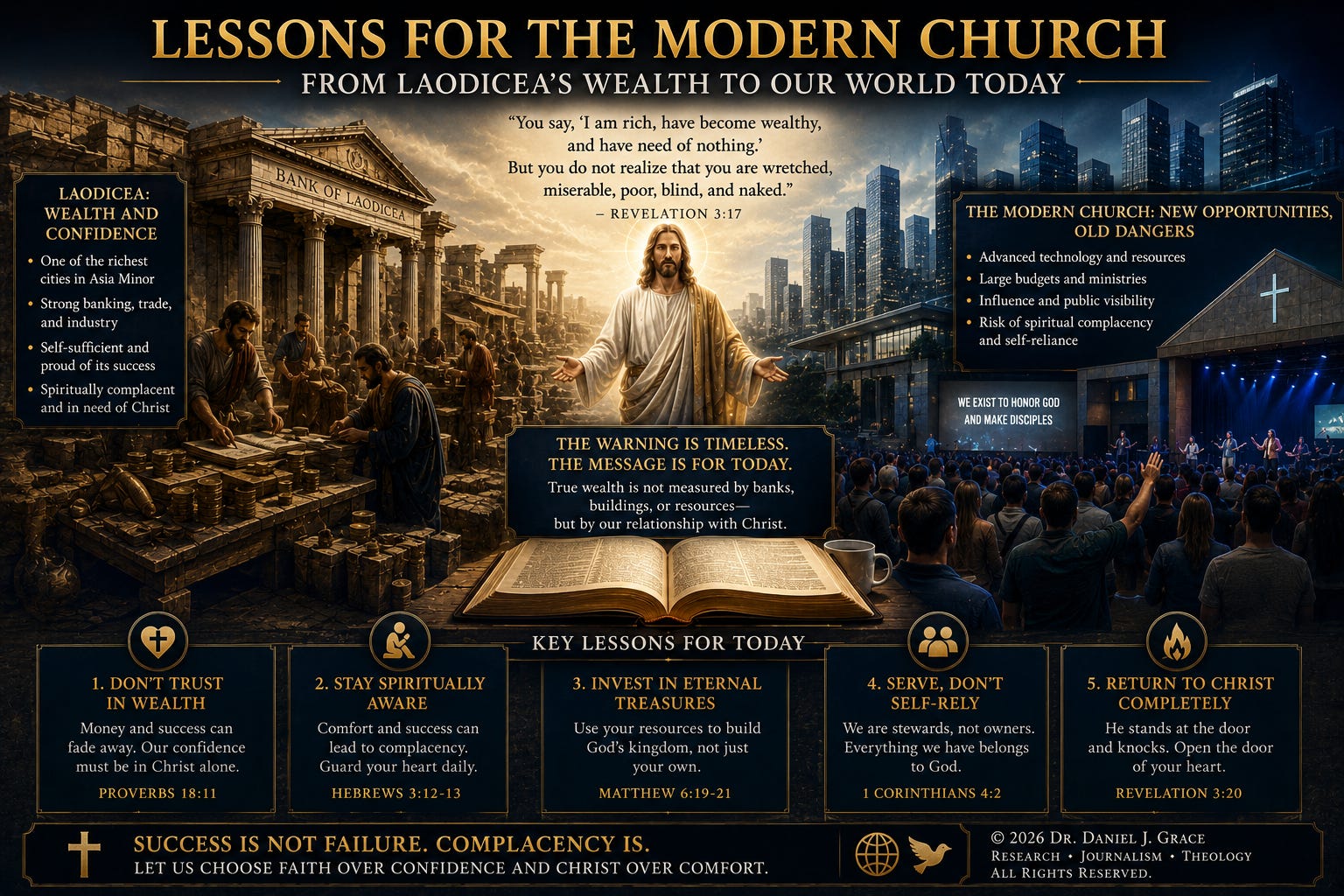
The message of Laodicea remains remarkably relevant.
Many churches today operate in affluent societies with advanced technology, financial resources, and organisational capabilities.
These achievements can be valuable tools for ministry.
However, Revelation warns that success can also create spiritual complacency.
A church may possess impressive buildings, large budgets, and public influence while quietly drifting away from dependence upon God.
The challenge is not wealth itself but the attitude that often accompanies it.
The question facing modern believers is similar to the question confronting Laodicea:
Do we trust our resources, or do we trust Christ?
Wealth as a Tool, Not a Master
The biblical perspective does not condemn responsible stewardship or economic success.
Rather, Scripture consistently teaches that material blessings should serve God’s purposes.
Wealth can support missions, assist the poor, strengthen communities, and advance the Gospel.
The danger arises when prosperity becomes an idol.
When wealth becomes the source of identity, security, or ultimate hope, it begins to occupy a place that belongs only to God.
Laodicea serves as a warning against allowing material success to replace spiritual dependence.
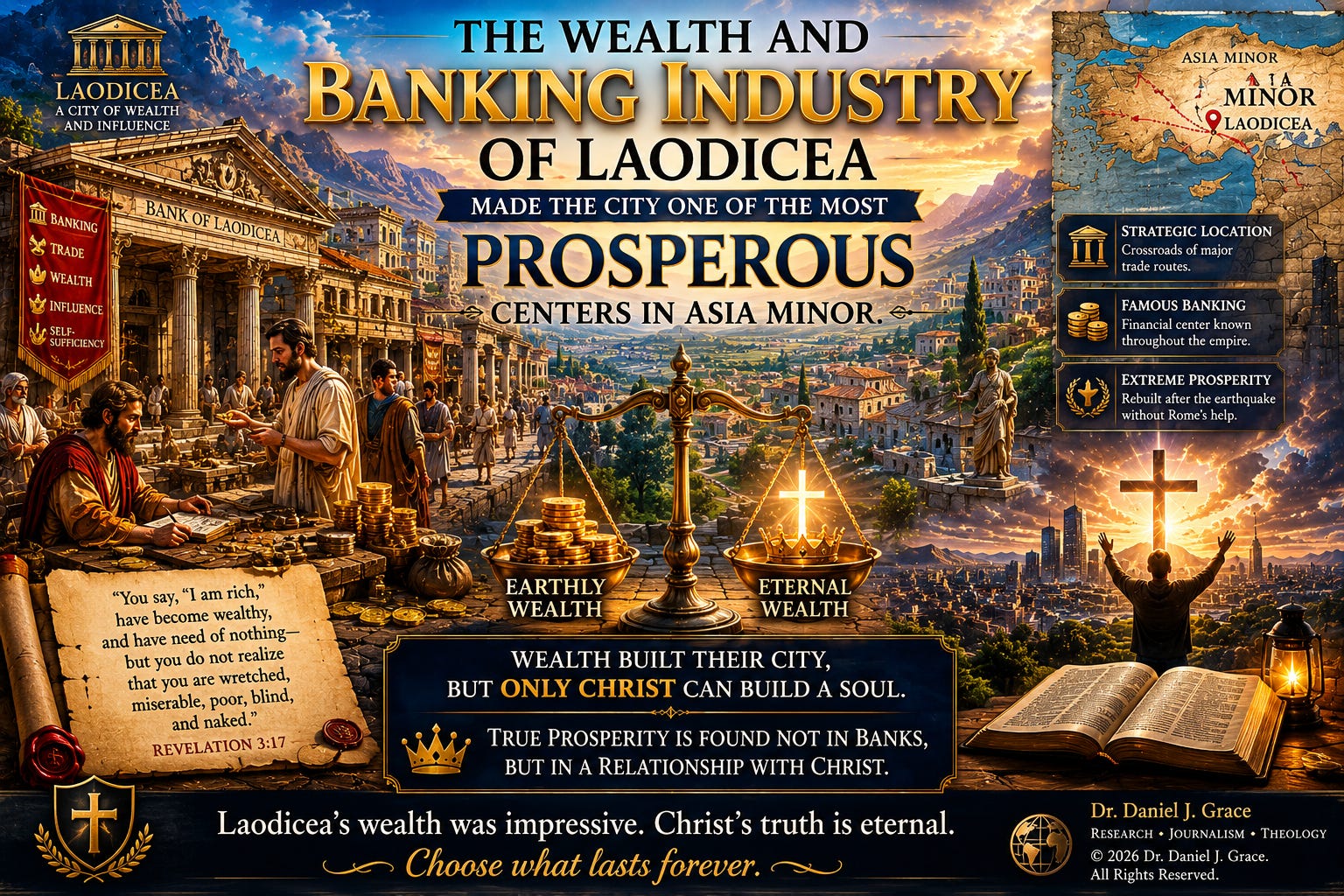
The wealth and banking industry of Laodicea made the city one of the most prosperous centers in Asia Minor. Its financial power, commercial influence, and ability to rebuild after disaster demonstrated remarkable economic strength.
Yet Revelation reveals that prosperity alone could not guarantee spiritual vitality.
The church believed it needed nothing, but Christ exposed its deeper condition.
The story of Laodicea remains profoundly relevant in an age that often equates success with wealth and influence. Its message challenges believers to examine where their confidence truly rests.
The greatest lesson of Laodicea is not that wealth is wrong, but that no amount of wealth can replace a living relationship with Christ.
The banks of Laodicea have long disappeared, its markets have fallen silent, and its prosperity has faded into history.
Yet the warning of Revelation continues to speak across the centuries: true riches are found not in earthly treasure but in the eternal wealth offered by God.
Dr. Daniel J. Grace
Research • Journalism • Theology
© 2026 Dr. Daniel J. Grace. All Rights Reserved.