

Laodicea: Wealth, Comfort, and the Crisis of the Human Soul
A Reflection on Comfort, Consumption, and Spiritual Blindness

Among the Seven Churches described within the Book of Revelation, the Church of Laodicea perhaps speaks most directly to the psychological and spiritual condition of modern civilisation. Unlike Smyrna, marked by suffering and poverty, or Philadelphia, characterised by perseverance despite weakness, Laodicea represents another kind of danger entirely — the danger of comfort without depth, wealth without meaning, and external prosperity masking inner emptiness.
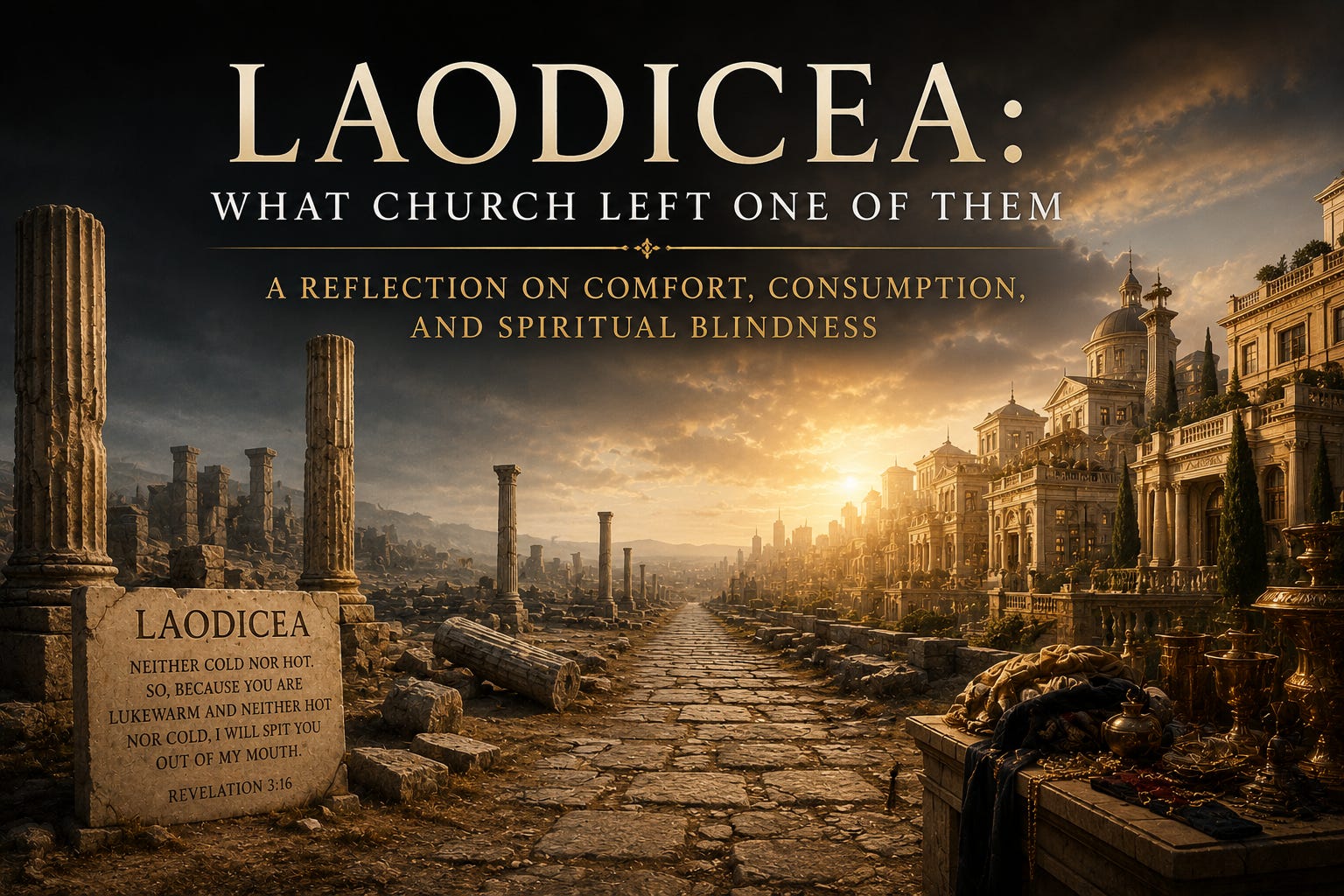
The ancient city of Laodicea was historically known for its wealth, commerce, banking systems, textile industry, and medical influence. It was considered economically successful and materially prosperous. Unlike many cities dependent upon outside aid after a disaster, Laodicea possessed enough financial strength to rebuild itself independently following destructive earthquakes. This self-sufficiency became part of the city’s identity. Wealth created confidence. Stability produced a sense of security. Material success reinforced the belief that external prosperity could guarantee strength.
Yet the message directed toward Laodicea reveals a profound contradiction hidden beneath this appearance of success.
The city believed itself rich, secure, and self-sufficient, while spiritually it had become weak, empty, and unaware of its own condition.
This contradiction forms one of the most psychologically significant themes within the entire Seven Churches narrative because it reflects one of the defining tensions of modern civilisation itself.
Contemporary societies possess extraordinary technological advancement, economic complexity, medical progress, and material development. Human beings today have access to levels of comfort, information, communication, and convenience unimaginable in many previous historical eras. Yet despite these advancements, modern societies continue experiencing widespread anxiety, loneliness, depression, addiction, emotional exhaustion, existential confusion, and spiritual emptiness.
Material progress has not eliminated inner suffering.
This reality stands at the centre of the Laodicean warning.
Modern civilisation frequently assumes that comfort automatically produces fulfilment. Economic systems encourage continuous consumption while cultural narratives equate success with wealth, visibility, luxury, influence, and personal achievement. Human beings become conditioned to pursue external advancement constantly — larger incomes, greater recognition, social validation, professional status, technological convenience, and endless productivity. Yet beneath these systems, many individuals quietly experience emptiness impossible to satisfy through material accumulation alone.
Laodicea symbolises this crisis perfectly.
The problem was not simply wealth itself. Wealth can support education, stability, health, generosity, and human flourishing when used responsibly. Rather, the deeper issue involved self-sufficiency becoming disconnected from spiritual awareness. The city gradually lost recognition of its own deeper condition. External prosperity created internal blindness.
This idea remains profoundly relevant within modern culture.
One of the most unsettling aspects of contemporary society is that emotional and spiritual crises often become hidden beneath outward functionality. A person may appear professionally successful while internally struggling with despair. Societies may appear stable economically while experiencing widespread psychological exhaustion and moral fragmentation. Individuals may possess comfort while lacking meaning. Human beings may become surrounded by entertainment while feeling increasingly disconnected from themselves and from others.
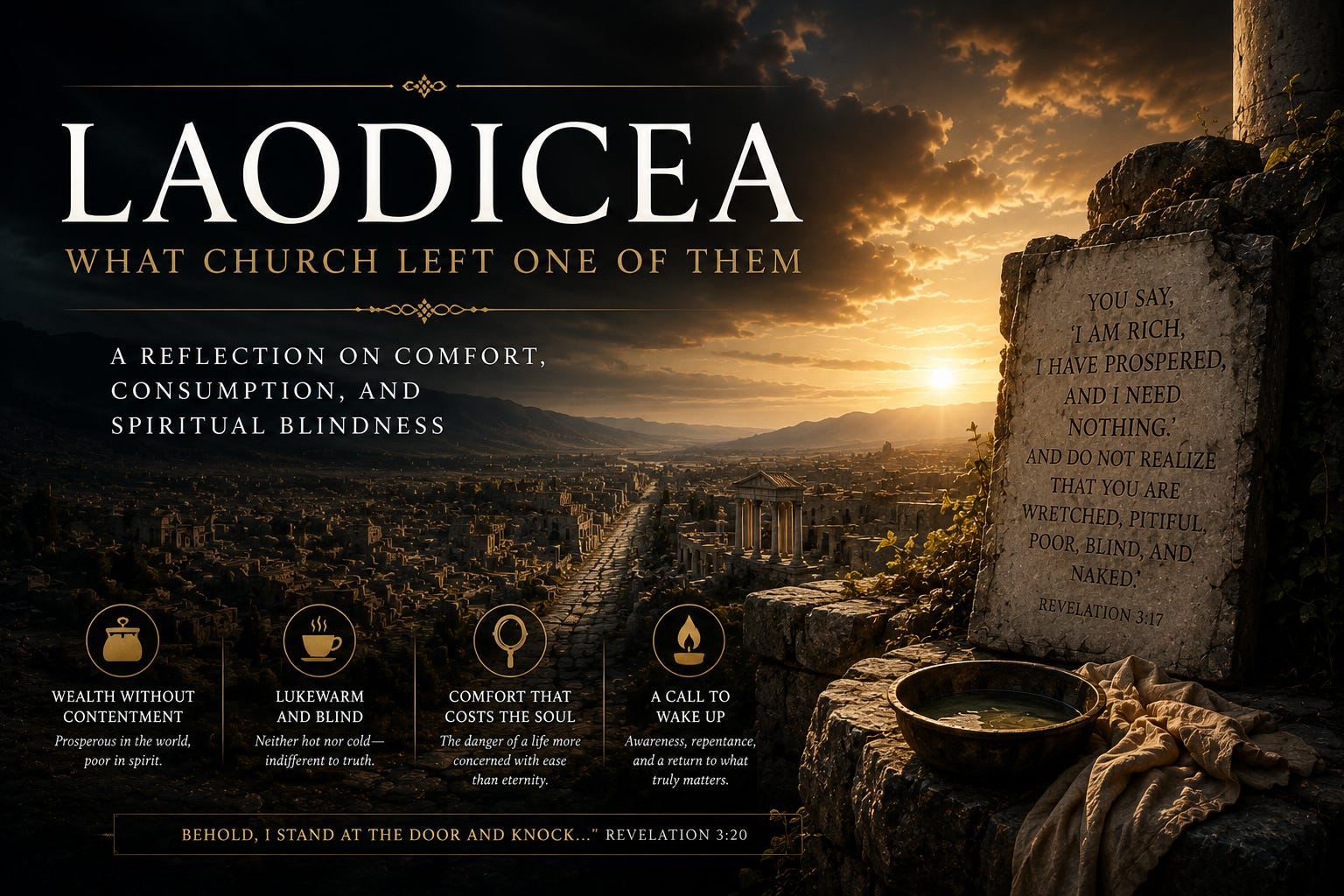
The warning of Laodicea, therefore, addresses more than ancient religion. It addresses the condition of civilisations that become materially advanced while emotionally and spiritually fragile.
Modern culture frequently teaches individuals to seek satisfaction through acquisition. People are encouraged to consume not merely products, but identities, lifestyles, images, and experiences. Entire economies depend upon creating dissatisfaction severe enough to sustain continuous consumption. Under such conditions, human beings can gradually lose the ability to distinguish genuine fulfilment from temporary distraction.
The Laodicean condition emerges precisely within this confusion.
Comfort begins replacing reflection.
Convenience replaces depth.
Entertainment replaces meaning.
External abundance conceals inner poverty.
This spiritual and psychological numbness becomes particularly dangerous because it often develops gradually. Unlike visible suffering or dramatic collapse, complacency rarely announces itself openly. Human beings slowly adapt to superficiality without recognising the deeper erosion occurring beneath routine life. Individuals become accustomed to distraction. Reflection weakens. Silence becomes uncomfortable. Inner life diminishes beneath constant stimulation and productivity.
Laodicea therefore represents not open rebellion or visible catastrophe, but unconscious spiritual drift.
This drift remains one of the greatest dangers of modern civilisation because advanced societies possess an extraordinary capacity to distract individuals from deeper existential questions. Endless information, media, entertainment, consumption, and digital engagement create environments where individuals rarely pause long enough to examine the condition of their inner lives.
What gives life meaning?
What defines genuine fulfilment?
Can material success heal existential emptiness?
Can comfort alone sustain the human spirit?
These questions become increasingly important precisely because modern civilisation often avoids them.
One of the most psychologically significant dimensions of the Laodicean narrative involves self-awareness. The city’s greatest weakness was not merely spiritual emptiness itself, but the inability to recognise it. Self-perception became disconnected from reality. Wealth produced an illusion. External stability concealed deeper vulnerability.
This phenomenon remains widespread within contemporary culture.
Modern societies frequently confuse visibility with significance and success with fulfilment. Public recognition becomes mistaken for personal worth. Economic achievement becomes treated as evidence of inner well-being. Social image becomes carefully managed while emotional exhaustion remains hidden. Under such conditions, individuals may become increasingly disconnected from their own deeper needs, fears, and vulnerabilities.
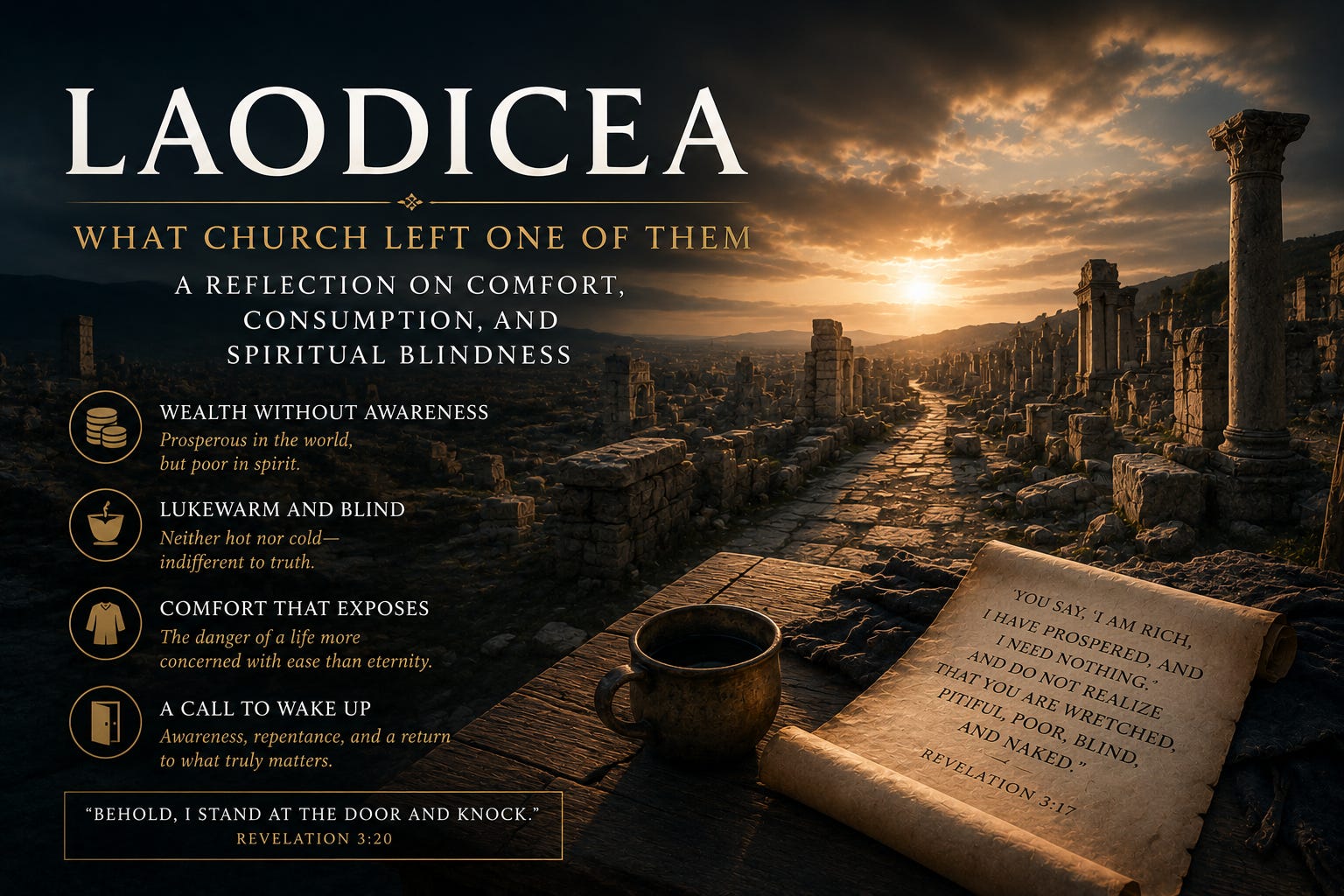
The crisis of Laodicea is therefore fundamentally existential.
It asks whether human beings can remain spiritually alive while becoming emotionally absorbed entirely within systems of comfort, performance, and material success.
This question extends beyond individuals toward civilisation itself. Societies may become technologically powerful while morally confused. Nations may expand economically while weakening psychologically. Entire cultures may prioritise convenience so heavily that resilience, reflection, conscience, and spiritual depth gradually deteriorate.
The symbolism associated with Laodicea also carries remarkable psychological insight. Historically, the city was known for lukewarm water systems — neither refreshingly cold nor usefully hot. This imagery becomes spiritually symbolic because lukewarmness represents indifference, passivity, and the absence of conviction. It reflects a condition where individuals no longer passionately pursue truth, meaning, justice, or spiritual depth, yet also avoid openly rejecting them. Instead, life becomes emotionally neutral, spiritually passive, and psychologically numb.
Modern civilisation increasingly risks normalising this condition.
Many individuals today feel emotionally exhausted rather than passionately engaged with existence. Endless stimulation paradoxically produces emotional fatigue. Constant connectivity weakens attention. Public outrage becomes repetitive and performative. Cynicism expands. Hope becomes fragile. Under such conditions, indifference slowly replaces conviction.
Laodicea warns humanity against this gradual numbness.
Its message insists that human beings require more than comfort in order to flourish fully. The human soul cannot survive indefinitely through distraction alone. Individuals require meaning, conscience, reflection, purpose, community, and authentic connection beyond material consumption.
One of the deepest tragedies of modern life is that societies often recognise material poverty more easily than spiritual emptiness. Economic suffering remains visible. Emotional and existential suffering frequently remains hidden beneath outward functionality. Yet civilisations can become deeply unstable when large populations lose connection to meaning itself.
This is why the Laodicean warning continues to carry extraordinary relevance within contemporary society.
The issue is not whether comfort is inherently evil.
The issue is whether comfort becomes powerful enough to replace awareness.
Modern individuals often pursue security, believing it will eliminate existential anxiety entirely. Yet history repeatedly demonstrates that human beings continue struggling with fear, mortality, loneliness, uncertainty, guilt, and the search for meaning regardless of technological or economic advancement. Material systems may improve external conditions dramatically while remaining unable to answer deeper spiritual and existential questions.
The Church of Laodicea therefore reflects a uniquely modern crisis: the illusion that external success alone can sustain inner life.
This illusion remains psychologically dangerous because it encourages societies to neglect the deeper foundations required for genuine human flourishing. Communities weaken when relationships become transactional. Individuals suffer when identity depends entirely upon performance or status. Civilisations fragment when moral reflection disappears beneath endless consumption and distraction.
Laodicea ultimately confronts humanity with uncomfortable truths concerning modern civilisation itself.
Can societies remain spiritually healthy while obsessively pursuing comfort?
Can individuals remain emotionally alive while constantly distracted?
Can human beings preserve depth within cultures increasingly dominated by speed, convenience, and superficial stimulation?
These questions explain why Laodicea often feels remarkably contemporary despite its ancient setting.
In many ways, the Church of Laodicea speaks directly into the emotional atmosphere of the twenty-first century. Never before has humanity possessed such extensive technological capability combined simultaneously with such widespread emotional exhaustion and existential uncertainty. Modern individuals are surrounded by endless communication while increasingly struggling with loneliness. They possess unlimited entertainment while wrestling with meaninglessness. They achieve unprecedented convenience while losing patience for reflection and inner stillness.
Laodicea recognises this contradiction.
Its warning is not directed against progress itself, but against forgetting the deeper dimensions of human existence beneath material advancement.
Yet despite its severity, the message of Laodicea also contains hope.
Awareness remains possible.
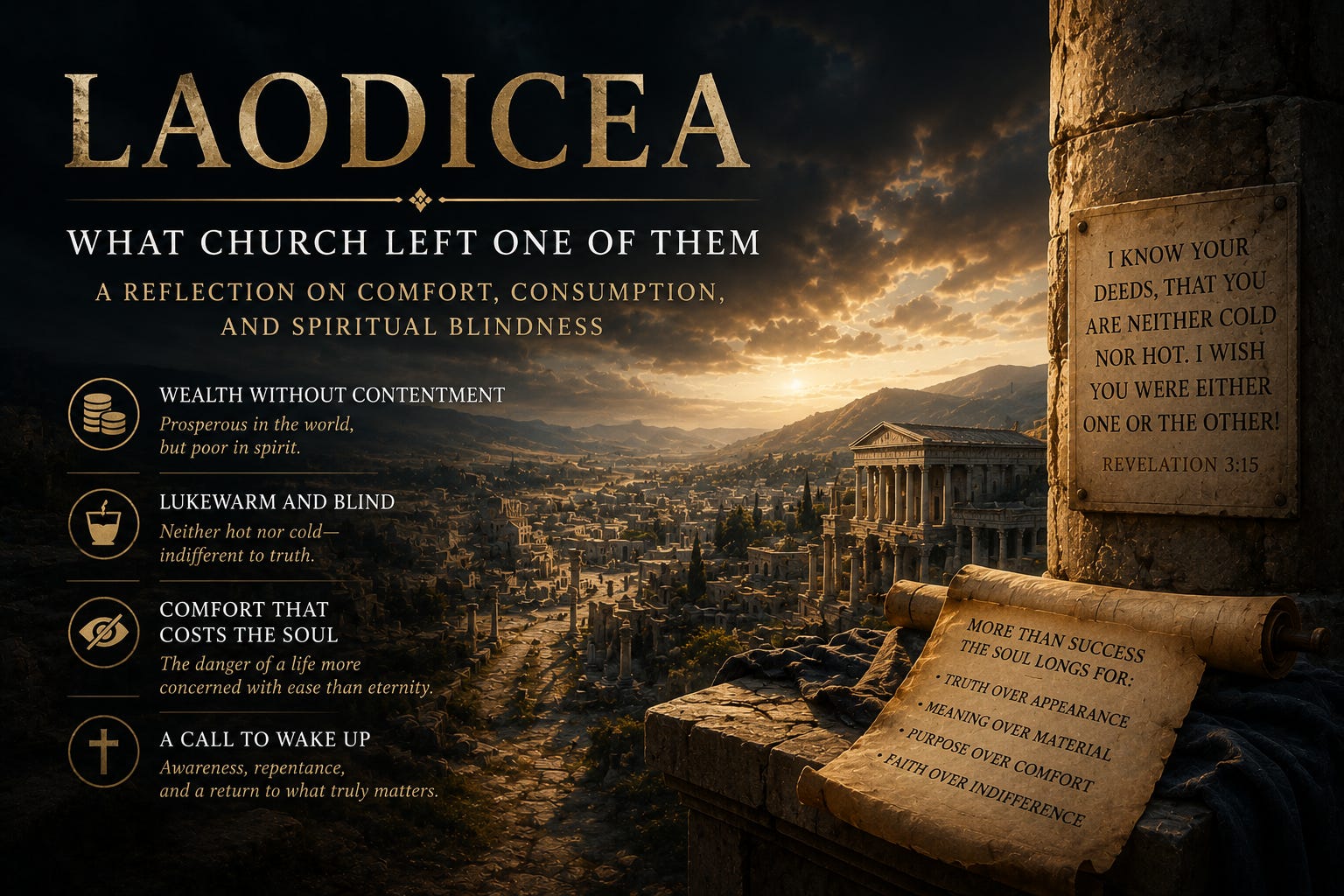
Human beings remain capable of awakening from spiritual numbness. Individuals can still rediscover meaning, conscience, humility, compassion, reflection, and authentic human connection. Civilisations are not condemned permanently to superficiality. The possibility of renewal continues to exist wherever human beings remain willing to confront truth honestly.
This is why the message of Laodicea remains profoundly important.
It challenges humanity not merely to survive materially, but to remain spiritually alive.
Across centuries, the Church of Laodicea continues asking one of the most uncomfortable questions confronting modern civilisation:
What happens when humanity gains the world, yet gradually loses connection to its own soul?
Dr. Daniel J. Grace
Research • Journalism • Theology