

If We Did Not Die, Would We Still Search for God?
Death, Meaning, and the Hope of Jesus Christ

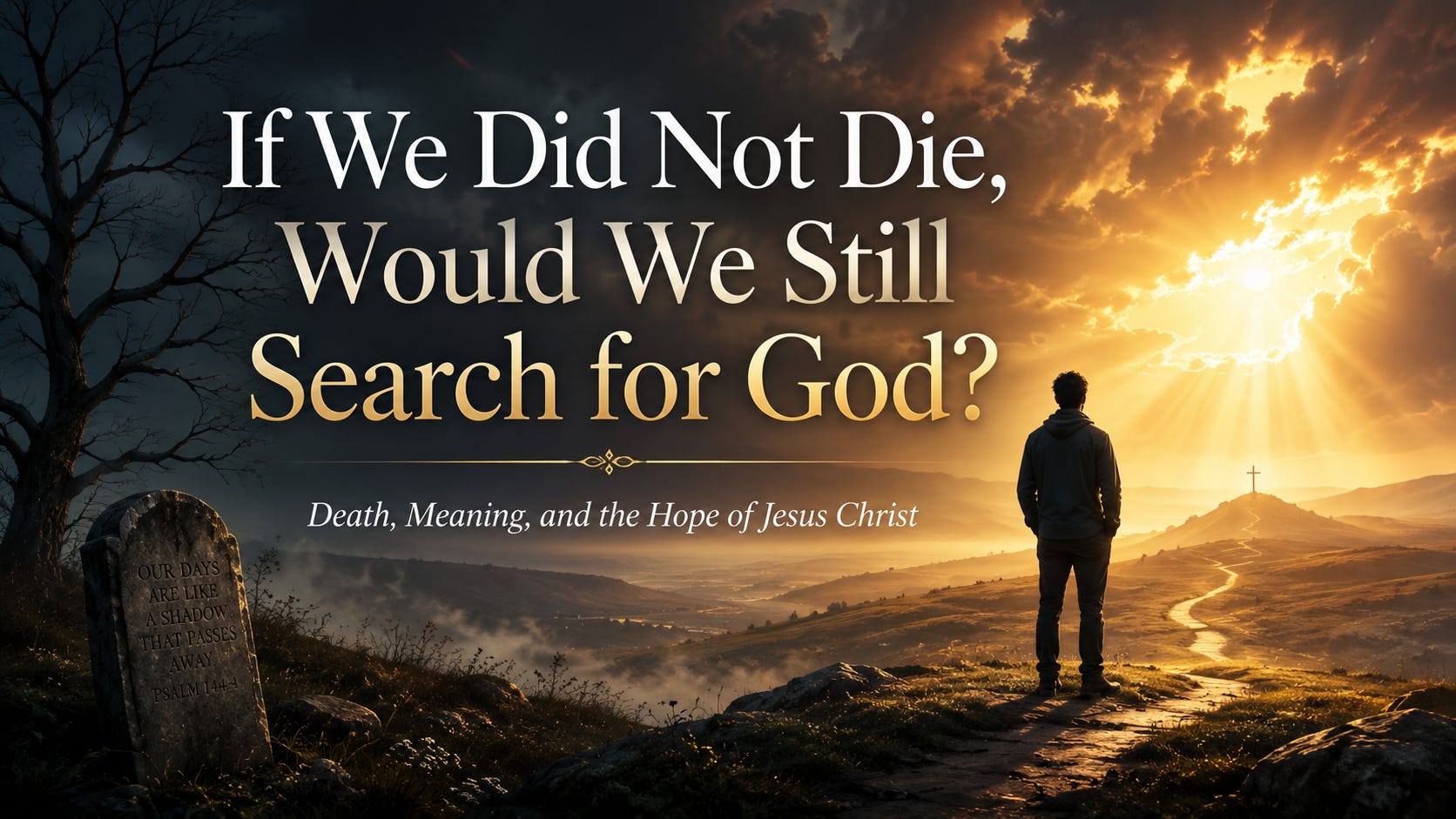
Human beings do many things to avoid thinking about death.
We build cities. We create technology. We chase money, beauty, success, fame, comfort, distraction, pleasure, and control. We fill our days with noise so that silence does not ask us the question we fear most: What happens when everything ends?
Death is the great interruption.
It interrupts childhood dreams. It interrupts family tables. It interrupts careers, arguments, ambitions, and unfinished plans. It does not ask permission. It comes to the rich and the poor, the powerful and the weak, the educated and the simple, the religious and the unbelieving. It stands at the edge of every human life and reminds us that we are not God.
This is why death is so terrifying.
Not only because it ends the body, but because it exposes the soul.
Death forces us to ask questions that ordinary life allows us to postpone. Why am I here? What is the meaning of my life? Am I only flesh and dust? Is love only chemistry? Is justice only a human dream? Will evil escape forever? Will the people I love simply vanish? Is there a God? Is there judgement? Is there mercy? Is there hope beyond the grave?
In this sense, death wakes the human heart.
If no one ever died, perhaps many people would never seriously think about eternity. If the body never weakened, if the grave never opened, if funerals never happened, if tears never fell beside a coffin, perhaps human beings would imagine themselves self-sufficient. We might believe that the world is enough. We might never search for a kingdom beyond this world. We might never lift our eyes above the visible.
But death destroys the illusion that this present life can carry the full weight of human meaning.
The modern world often treats death as an embarrassment. It hides death in hospitals, speaks of it in softer language, pushes grief into private rooms, and encourages people to “move on” quickly. Yet the human soul knows that death is not normal in the deepest sense. We may call death natural because it happens to everyone, but our hearts still protest against it.
Something inside us says: This is not how love should end.
When someone we love dies, we do not merely feel biological loss. We feel a wound in reality. A voice is gone. A chair is empty. A name becomes memory. A hand we once held is no longer warm. The world continues, but something sacred has been broken.
This pain tells us something important. Human beings were not made for nothingness. We were made for life, love, communion, meaning, and God.
Christianity does not ask us to pretend death is small. The Bible does not speak of death as a harmless doorway or a sentimental shadow. Scripture calls death an enemy. Death is connected to the brokenness of creation, the tragedy of sin, the rebellion of humanity, and the deep disorder of a world separated from God.
But Christianity also gives the most astonishing claim in human history:
Jesus Christ entered death and defeated it.
The Christian hope is not vague optimism. It is not simply the idea that “everything will be fine.” It is not denial. It is not positive thinking. It is not pretending that grief does not hurt.
Christian hope stands beside the grave and says:
Christ is risen.
This is the centre of everything.
Jesus did not come into the world as a distant teacher who gave advice about death from a safe place. He entered human weakness. He wept at the tomb of Lazarus. He felt sorrow. He suffered betrayal, injustice, violence, humiliation, blood, nails, darkness, and death. He did not look at human pain from far away. He walked into it.
At the cross, Jesus entered the deepest place of human fear. He entered abandonment. He entered suffering. He entered death itself. The Lord of life allowed Himself to be laid in a tomb.
But the tomb could not hold Him.
The resurrection of Jesus Christ is God’s answer to the grave. It is the declaration that death is real, but it is not final. Evil is real, but it will not win. Suffering is real, but it will not have the last word. The body matters, the soul matters, justice matters, love matters, and every tear matters before God.
This is why Christian hope is different from worldly hope.
Worldly hope often says, “Maybe tomorrow will be better.”
Christian hope says, “Even if tomorrow is painful, Christ is risen.”
Worldly hope says, “Try to stay strong.”
Christian hope says, “When you are weak, Christ holds you.”
Worldly hope says, “Death is part of life.”
Christian hope says, “Death is an enemy, and Jesus has conquered it.”
Worldly hope says, “Keep their memory alive.”
Christian hope says, “Memory is precious, but resurrection is greater.”
This does not remove grief. Christians still cry. Christians still feel loss. Christians still stand at graves with trembling hearts. Faith does not make us less human. Sometimes faith makes us more honest about pain because we no longer need to hide it from God.
Jesus wept.
That short sentence is one of the most beautiful truths in Scripture. The Son of God stood before death and cried. He did not shame tears. He sanctified them. He showed us that grief is not unbelief. Love grieves because love sees the value of the one who is gone.
But Jesus did more than weep.
He said, “I am the resurrection and the life.”
This means that Christian faith is not faith in an idea about life after death. It is faith in a Person. Eternal life is not merely endless time. Eternal life is life with God through Jesus Christ. It begins now in faith and reaches its fullness beyond death in resurrection glory.
For the believer, death is no longer a locked door. It is still painful. It is still serious. It is still an enemy. But it is an enemy that has already been defeated by Christ.
This is why the Christian can face death with trembling honesty and unshakable hope.
We do not say, “Death is nothing.”
We say, “Death is not Lord.”
We do not say, “The grave is harmless.”
We say, “The grave is not final.”
We do not say, “I am not afraid because I am strong.”
We say, “I belong to Jesus Christ.”
The modern world desperately needs this hope. It is surrounded by death but often has no language for eternity. It speaks of legacy, but not resurrection. It speaks of memories, but not judgement. It speaks of personal meaning, but not eternal life. It tries to comfort the grieving with beautiful words, but often cannot answer the deepest ache of the human heart.
Christianity does not offer shallow comfort.
It offers Christ.
Christ for the dying.
Christ for the grieving.
Christ for the frightened.
Christ for the guilty.
Christ for the lonely.
Christ for the wounded.
Christ for the one standing beside the hospital bed.
Christ for the one sitting alone after the funeral.
Christ for the one who wonders whether life has any meaning.
Christ for the one who has lost everything.
Christ for the one who feels death approaching.
Christ for the world.
If we never died, perhaps we would forget how desperately we need God. But because we do die, the question becomes unavoidable. We must ask what kind of hope is strong enough to enter the grave and come out alive.
Only Jesus Christ gives that hope.
He does not merely comfort us about death. He conquers death.
He does not merely tell us to be brave. He becomes our life.
He does not merely promise that souls matter. He promises resurrection.
He does not merely say that God cares. He proves it with wounds in His hands.
And one day, according to the Christian hope, death itself will die. The final future of the people of God is not a ghostly escape from creation, but resurrection, renewal, justice, healing, and new creation. God will wipe away every tear. The broken world will not remain broken forever. The graves of the faithful are not the end of the story.
This is why Christians can live differently now.
Because death is not final, we do not need to worship money.
Because death is not final, we do not need to fear losing status.
Because death is not final, we can forgive.
Because death is not final, we can suffer with hope.
Because death is not final, we can love sacrificially.
Because death is not final, we can tell the truth.
Because death is not final, we can stand with the weak.
Because death is not final, we can live for eternity rather than applause.
Death makes life serious. Resurrection makes life hopeful.
The reality of death teaches humility. The resurrection of Christ gives courage. Together, they show us the truth: human life is fragile, but it is not meaningless. The body is mortal, but it is not worthless. The grave is real, but it is not ultimate. Tears are real, but they are not eternal.
Jesus Christ is Lord over life and death.
So when we ask, “If human beings did not die, would they still search for God?” perhaps the answer is this:
Some might not.
But because we do die, God uses even our mortality to awaken us. He turns the question of death into the doorway of hope. He allows the grave to expose our idols, our pride, our fear, and our need for eternal life. Then He points us not to an abstract idea, but to the risen Christ.
The Christian message is not that death is beautiful.
The Christian message is that Jesus is stronger than death.
And this is the hope humanity needs.
Not fantasy.
Not denial.
Not empty religion.
Not sentimental words.
But reality in Jesus Christ.
The One who died.
The One who rose.
The One who reigns.
The One who will come again.
The One who says to every frightened heart:
Do not be afraid.
I am the resurrection and the life.
Amen.
Dr Daniel J. Grace
Faith • Civilization • Theology
Research • Journalism • Truth
© 2026 Dr Daniel J. Grace. All Rights Reserved.
No part of this article may be reproduced, distributed, transmitted, or published in any form or by any means without prior written permission from the author, except for brief quotations used in academic citation, review, or research purposes.