

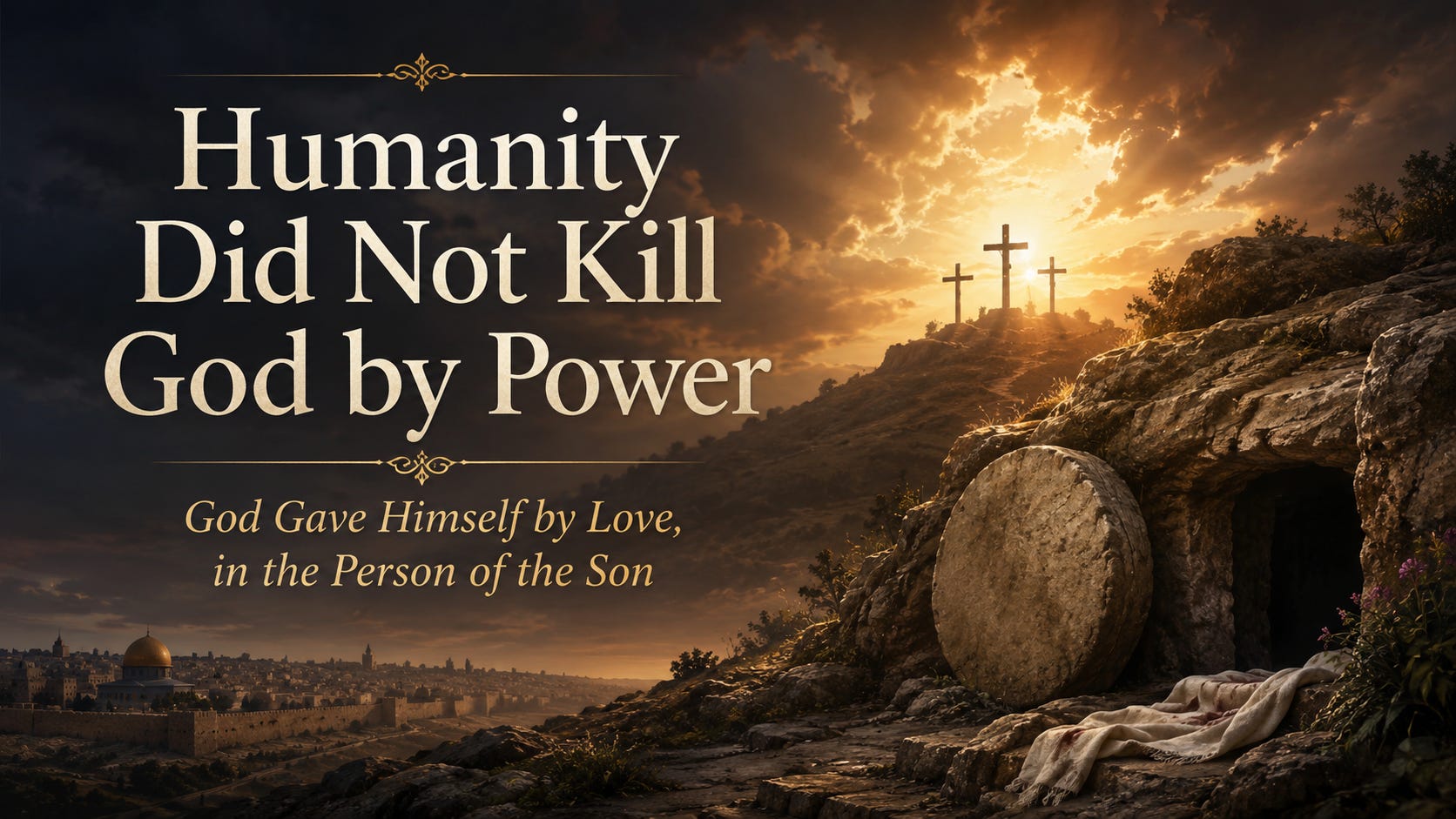
Humanity Did Not Kill God by Power
God Gave Himself by Love, in the Person of the Son

One of the most misunderstood questions about Christianity is this:
How can Christians say that Jesus is God and also say that Jesus was crucified?
Some people ask, “Did human beings kill God?”
Others ask, “If Jesus is the Son of God, does that mean Christians believe in two gods?”
These are serious questions. They deserve a serious but simple answer.
Christianity does not teach that human beings overpowered God. It does not teach that God was defeated by human hands. It does not teach that the Father died on the cross. It does not teach that Jesus was a second god beside God.
The Christian message is deeper and more beautiful than that.
Humanity did not kill God by power; God gave Himself by love, in the person of the Son.
This truth is the heart of the Gospel.
God Did Not Send a Second God
Christians believe in one God. Not two gods. Not three gods. One God.
But Christians also believe that the one God has revealed Himself as Father, Son, and Holy Spirit. This is not straightforward language for every person at first, especially for those coming from outside Christian faith. But this does not mean that there are many gods. The meaning is that God’s own life is richer and deeper than human imagination.
When Christians say “the Son of God”, they do not mean that God had a physical child in a human way. They do not mean that Jesus’ human body existed forever before creation. They do not mean that God created another divine being beside Himself.
The Son is God’s eternal Word. The Son was always with the Father. Then, in history, the eternal Son took real human flesh in Jesus Christ.
This is why John writes:
“In the beginning was the Word, and the Word was with God, and the Word was God.”
John 1:1, NKJV
And then:
“And the Word became flesh and dwelt among us…”
John 1:14, NKJV
The Word was with God.
The Word was God.
The Word became flesh.
This is not the story of a human becoming God. It is the story of God coming near to humanity.
Why Did God Enter the Human Condition?
This is the real question.
Why did God come in Jesus Christ?
The answer is not because humanity only needed additional information. God could have sent a teacher.
The answer is not because humanity only needed more rules. God had already given commandments.
The answer is not because humanity only needed inspiration. God had sent prophets.
The problem was deeper.
Humanity was wounded by sin, guilt, fear, shame, death, corruption, and separation from God. The wound was inside human life. Therefore, redemption had to enter human life.
God created human beings in His image. Human life belongs to Him. Human beings are not divine by nature, but they are God-breathed, God-imaged, God-loved, and accountable to God. Yet sin damaged the relationship between humanity and God.
No ordinary human could redeem the whole human race. A sinner cannot save other sinners. A created being cannot repair all of creation. Humanity could not climb back to God by its own power.
So God came down.
God entered the human condition in Jesus Christ.
The eternal Son took a real human body, a real human soul, real human suffering, and real human death. He did not pretend to be human. He truly became human, without ceasing to be God.
He came into the wound to heal it from within.
The Cross Was Not God Losing Control
The crucifixion was a real human act of violence. Human hands arrested Jesus. Human voices accused Him. Human authorities condemned Him. Human soldiers nailed Him to the cross.
But human beings did not overpower God.
Jesus was not trapped.
Jesus was not defeated.
Jesus was not forced to save.
He gave Himself freely.
Jesus said:
“No one takes it from Me, but I lay it down of Myself.”
John 10:18, NKJV
This verse is crucial. Jesus does not describe the cross as an accident or as a loss of divine control. He lays down His life willingly.
Human sin crucified Him.
Divine love offered Him.
Human violence raised the cross.
Divine mercy turned the cross into redemption.
This is why the cross is not humanity sacrificing God by power. It is God giving Himself by love.
In the Person of the Son
The phrase matters:
God Himself, in the person of the Son.
This protects the truth from two misunderstandings.
First, the Father did not become flesh and die on the cross. The Son became flesh. The Son suffered in His human nature. The Son offered Himself.
Second, Jesus is not a separate god beside the Father. The Son is one with the Father. Jesus said:
“I and My Father are one.”
John 10:30, NKJV
So Christians do not say that one god sent another god. Christians say that the one God came to us in the person of the Son.
This is why Jesus is different from every prophet, teacher, pastor, founder, president, or religious leader. He does not merely point to God from a distance. He reveals God from within God’s own life.
Jesus said:
“He who has seen Me has seen the Father.”
John 14:9, NKJV
To see Jesus is not to see a second god. It is to see the Father revealed through the Son.
God Gave Himself by Love
The Gospel is not that humans reached God.
The Gospel is that God reached humans.
The Gospel is not that humans forced God to forgive.
The Gospel is that God freely chose mercy.
The Gospel is not that Jesus was only a victim of human cruelty.
The Gospel is that Jesus willingly became the sacrifice of divine love.
Paul writes:
“God was in Christ reconciling the world to Himself…”
2 Corinthians 5:19, NKJV
That is the mystery and beauty of redemption.
God was in Christ.
God was not far away from the cross. God was not watching from a safe distance. God was acting in Christ to reconcile the world to Himself.
This means the cross reveals both the seriousness of sin and the greatness of love.
Sin is so serious that redemption required the self-giving of God.
Love is so great that God gave Himself for sinners.
The Simple Meaning
For ordinary people, the Christian message can be said simply:
We could not return to God by ourselves.
So God came to us.
He came in Jesus Christ.
Jesus is not a second god.
Jesus is God Himself in the person of the Son.
His human body began in history, but the Son who became human is eternal.
Humanity did not overpower God at the cross.
God gave Himself willingly.
Jesus truly died in His human nature.
God was not destroyed.
The crucified Christ rose again.
And through Him, sinners are brought back to the Father.
Why This Matters Today
This matters because many people misunderstand Christianity as if it were merely another religion built around another prophet.
But Jesus is not merely another prophet.
He is not only a messenger.
He is not simply a moral teacher.
He is not a religious brand.
He is not the founder of a human institution.
He is the eternal Son made flesh.
He is God coming near.
He is God entering the human condition.
He is God giving Himself by love.
And this also means no human leader can take His place. No pastor, prophet, president, denomination, institution, church brand, or religious system can stand where Christ stands.
Only Jesus reveals the Father perfectly.
Only Jesus redeems humanity.
Only Jesus gives His life freely and takes it up again.
Only Jesus is Lord.
Final Reflection
The cross is not the defeat of God.
It is the humility of God.
It is not humans conquering heaven.
It is heaven entering human suffering.
It is not divine weakness in the sense of helplessness.
It is divine love choosing the path of self-giving mercy.
Humanity did not kill God by power.
God gave Himself by love, in the person of the Son.
And because He gave Himself freely, death could not hold Him.
The crucified One is risen.
The risen One is Lord.
And through Him, the way back to the Father is open.

Dr Daniel J. Grace
Faith • Civilization • Theology
Research • Journalism • Truth
🌐 Official Web Page
🌐 Amazon Books Page
© 2026 Dr Daniel J. Grace. All Rights Reserved.
No part of this article may be reproduced, distributed, transmitted, republished, or adapted in any form or by any means without prior written permission from the author, except for brief quotations used in academic citation, review, or research purposes.