

HOW THE SEVEN CHURCHES HELP US STUDY REVELATION TODAY
A Biblical-Theological and Hermeneutical Study of Revelation 2-3

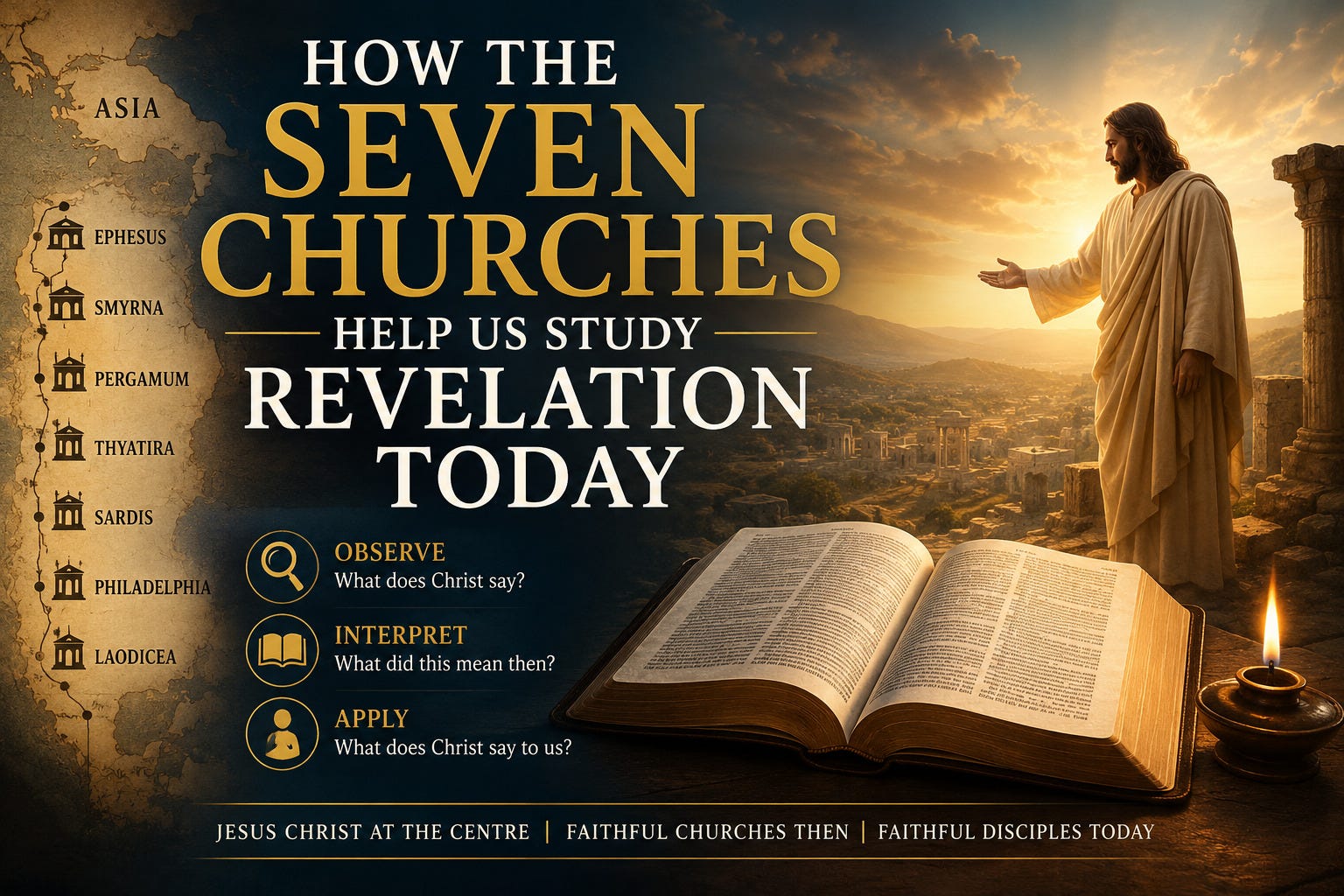
How the Seven Churches Help Us Study and Apply Revelation Today
Scholars often approach the book of Revelation
Daniel J. Grace
Independent Researcher, Australia
ORCID: https://orcid.org/0000-0002-9259-8032
HOW THE SEVEN CHURCHES HELP US STUDY REVELATION TODAY
Abstract
Scholars often approach the book of Revelation through questions about chronology, symbolism, and eschatological prediction. This article argues that Revelation 2-3 provides a more basic hermeneutical entry point: the risen Christ’s addresses to seven historical churches in Roman Asia. Using a qualitative biblical-theological method, the study examines the seven messages as a disciplined pattern of observation, historical interpretation, theological synthesis, and contemporary application. The churches of Ephesus, Smyrna, Pergamum, Thyatira, Sardis, Philadelphia, and Laodicea reveal that Revelation is first a pastoral-prophetic word to concrete Christian communities facing pressure, compromise, suffering, doctrinal conflict, spiritual complacency, and institutional self-deception. The article concludes that responsible application must remain controlled by literary context, first-century setting, Christology, and the repeated summons to hear what the Spirit says to the churches.
Keywords: Revelation; seven churches; biblical interpretation; hermeneutics; ecclesiology; Christology; Asia Minor; application
Introduction
Many Christian readers approach Revelation with a mixture of curiosity and anxiety. Its visions of heavenly worship, beasts, seals, trumpets, bowls, judgement, martyrdom, and new creation can appear difficult to organise. As a result, interpreters often move quickly toward chronology, symbolic identification, or end-times systems before attending to the pastoral structure of the book itself. Yet Revelation does not begin with the beast, Babylon, or Armageddon. After its opening vision of the glorified Christ, it turns immediately to seven historical churches in Roman Asia.
Revelation 2-3 records Christ’s messages to Ephesus, Smyrna, Pergamum, Thyatira, Sardis, Philadelphia, and Laodicea. These congregations were not literary inventions. They were real communities located along a major communications route in Asia Minor, each facing a distinct combination of political pressure, social vulnerability, false teaching, spiritual fatigue, compromise, or complacency (Aune, 1997; Koester, 2014). The seven messages therefore offer more than a preliminary section before the supposedly more important visions of chapters 4-22. They provide a hermeneutical key for the whole book.
The central claim of this article is that the seven churches teach readers how to study Revelation responsibly. They train the interpreter to observe the text carefully, interpret it historically and theologically, and apply it without detaching contemporary conclusions from the world of the first hearers. The recurring formula, ‘Let anyone who has an ear listen to what the Spirit is saying to the churches,’ links the original congregations with the wider church while preserving the specificity of each message. Revelation is therefore both local and catholic; historical and contemporary; pastoral and prophetic.
This approach also places Christ at the centre. The seven messages are not abstract moral lessons. Each begins with a self-description of the risen Jesus drawn from the vision in Revelation 1. Christ walks among the lampstands, knows the condition of his people, judges their works, calls them to repentance or endurance, and promises eschatological reward. Reading Revelation well begins with attending to the Lord who addresses the churches.
Method and Hermeneutical Framework
This study uses a qualitative biblical-theological method. It combines close reading of Revelation 2-3 with historical-contextual interpretation and constructive theological application. The method follows the broad hermeneutical sequence of observation, interpretation, and application, while recognising that these movements are related rather than mechanically separate (Fee & Stuart, 2014; Klein et al., 2017). Observation asks what the text says and how it is structured. Interpretation asks what the text communicated within its literary, historical, social, and canonical setting. The application asks how the theological claims of the passage address contemporary readers without bypassing the meaning of the original text.
This approach resists two opposite errors. The first is antiquarianism, which confines the text to the first century and leaves it with little continuing ecclesial force. The second is uncontrolled contemporisation, which treats the seven churches as blank symbols onto which modern concerns may be projected. Responsible interpretation moves through history rather than around it. The original social setting does not restrict theological significance; it gives that significance shape.
The article also treats Revelation as apocalyptic prophecy and a circular letter. Its symbolism must be read within the scriptural imagination of Israel, the social world of Roman Asia, and the worshipping life of early Christian communities (Bauckham, 1993; Beale, 1999; Thompson, 1990). The seven messages combine prophetic indictment, pastoral encouragement, covenant warning, and eschatological promise. Their genre is therefore inseparable from their function: they unveil the true condition of the churches before Christ.
The Historical and Literary Setting of the Seven Churches
The seven cities formed a recognisable regional network in the Roman province of Asia. Ephesus was a major port and commercial centre. Smyrna was known for civic loyalty and imperial associations. Pergamum held strong political and cultic significance. Thyatira was shaped by trade guilds. Sardis carried the memory of former greatness. Philadelphia was vulnerable to seismic instability and local opposition. Laodicea was prosperous, self-confident, and economically influential (Aune, 1997; Friesen, 2001; Koester, 2014). These local conditions illuminate the metaphors and warnings used in the messages.
The order of the churches also follows a plausible travel route. This supports the view that Revelation circulated among actual congregations rather than presenting a purely symbolic catalogue. At the same time, the use of seven – a number associated with completeness in Revelation – indicates that these messages represent more than seven isolated cases. They address seven churches and, through them, the church in its fullness.
Each message follows a broadly recognisable pattern: an address to the angel of the church, a Christological self-identification, an assertion of knowledge, commendation or rebuke, a command, a call to hear, and a promise to the conqueror. The pattern is flexible. Smyrna and Philadelphia receive no direct rebuke, while Sardis and Laodicea receive severe correction. The variation matters. Christ does not issue generic assessments. He speaks with particularity, naming both fidelity and failure.
Observation: What Does Christ Say?
Careful study begins by observing the repeated structure and distinctive vocabulary of each message. The reader should identify who speaks, what Christ knows, what he commends, what he opposes, what response he commands, and what promise he gives. This discipline prevents premature application.
Ephesus is praised for labour, endurance, and doctrinal discernment, yet rebuked for abandoning its first love. Smyrna is poor and afflicted, yet described as rich and called to fearless endurance. Pergamum holds fast to Christ’s name in a hostile environment but tolerates teaching associated with compromise. Thyatira is commended for love, faith, service, and patient endurance, yet rebuked for tolerating a corrupting prophetic influence. Sardis possesses a reputation for life but is pronounced dead. Philadelphia has little power but remains faithful to Christ’s word. Laodicea claims wealth and self-sufficiency but is exposed as spiritually poor, blind, and naked (Rev. 2:1-3:22).
Several observations emerge. First, Christ’s evaluation is not controlled by public reputation. Sardis appears alive but is dead. Laodicea appears prosperous but is impoverished. Smyrna appears poor but is rich. Philadelphia appears weak but is faithful. Revelation therefore destabilises ordinary measures of success.
Second, commendation and rebuke often coexist. Ephesus is doctrinally alert but relationally diminished. Pergamum is courageous yet compromised. Thyatira grows in love and service while tolerating destructive teaching. The messages refuse simplistic labels. Churches can be strong in one area and endangered in another.
Third, the commands are concrete: remember, repent, hold fast, wake up, strengthen what remains, be faithful, buy refined gold, receive eye salve, and open the door. Application is not left at the level of general inspiration. Christ calls for an identifiable response.
Interpretation: What Did These Messages Mean in Their First Context?
Historical interpretation asks how the words would have functioned within the life of the original congregations. This includes attention to the local economy, civic religion, honour and shame, trade associations, imperial ideology, Jewish-Christian conflict, and the costs of public allegiance to Jesus (deSilva, 2000; Friesen, 2001). The purpose is not to reduce the text to background information but to understand how Christ’s claims confronted actual structures of loyalty.
For example, the language of poverty and wealth in Smyrna and Laodicea gains force within their contrasting local situations. Smyrna’s believers may have experienced material loss or exclusion, yet Christ names them rich. Laodicea’s prosperity becomes the basis of spiritual illusion. Likewise, the imagery of lukewarmness is best understood in relation to Laodicea’s condition rather than as a timeless contrast between emotional enthusiasm and indifference. The metaphor exposes a church whose self-assessment is radically different from Christ’s assessment (Koester, 2014; Osborne, 2002).
The references to food sacrificed to idols, sexual immorality, and the teaching of Balaam or Jezebel point to pressures of accommodation within a religiously plural and economically integrated environment. Participation in guild life, civic festivals, and patronage networks could involve practices incompatible with exclusive allegiance to Christ. The issue was not cultural engagement in the abstract but the point at which participation became compromise.
The promises to the conquerors also belong to the theology of the whole book. The tree of life, the crown of life, hidden manna, authority over the nations, white garments, the temple of God, the New Jerusalem, and a place with Christ on his throne anticipate later visions. The seven messages therefore introduce major themes that Revelation develops: witness, worship, judgement, perseverance, and new creation (Bauckham, 1993; Beale, 1999).
Application: What Does the Spirit Say to the Churches Today?
Application begins only after the text has been observed and interpreted, but it is not optional. The repeated summons to hear what the Spirit says to the churches expands the scope of each message. The contemporary church is not Ephesus, Smyrna, or Laodicea in a one-to-one sense. Yet the theological realities addressed in these communities recur across time: loss of love, pressure under suffering, accommodation to surrounding culture, tolerance of destructive teaching, false reputation, faithful weakness, and self-sufficient complacency.
Ephesus asks whether doctrinal vigilance can continue after love for Christ and neighbour has cooled. Smyrna asks whether the church will measure faithfulness by comfort or by endurance. Pergamum asks where cultural participation has become a compromise. Thyatira asks whether the language of tolerance is being used to avoid moral and doctrinal discernment. Sardis asks whether institutional reputation conceals spiritual death. Philadelphia encourages communities with limited power to remain faithful. Laodicea confronts churches whose resources have produced self-deception rather than dependence.
These applications should not be reduced to slogans. They require communal discernment. A church that identifies another tradition as ‘Laodicean’ while refusing self-examination has missed the rhetorical force of the passage. The messages are first invitations to hear Christ’s judgement upon one’s own community. Their prophetic power begins with repentance, not classification.
Application must also remain Christological. The central question is not simply whether a church resembles one of seven historical profiles, but whether it hears and obeys the risen Christ. The messages do not offer a technique for institutional diagnosis apart from discipleship. They summon churches to renewed fidelity to the one who knows them fully.
The Seven Churches as a Hermeneutical Map for Revelation
The seven messages provide a map for reading the rest of Revelation. They identify the kinds of pressures that later visions symbolically intensify. Babylon embodies seductive economic and political power. The beast represents coercive allegiance. The false prophet represents deceptive religious legitimation. The martyrs embody faithful witness. The New Jerusalem represents the final dwelling of God with a purified people. These later images are not detached from the concrete struggles of the churches; they unveil their deepest theological meaning.
This connection helps readers avoid treating Revelation as a codebook of disconnected future events. The visions address communities already facing questions of worship, loyalty, compromise, suffering, and hope. The cosmic imagery enlarges the moral world of the churches. What appears locally as economic pressure or social exclusion is interpreted apocalyptically as conflict over allegiance to God and the Lamb.
The seven messages also teach that Revelation is meant to form resilient worshipping communities. Its goal is not merely to provide information about the end. It seeks to produce endurance, repentance, courage, discernment, and hope. Reading Revelation responsibly therefore asks not only, ‘What will happen?’ but also, ‘What kind of church must we become in light of Christ’s victory?’
Christ at the Centre of Revelation
The theological centre of Revelation 2-3 is the risen Christ. Each message draws on the opening vision: the one who holds the stars, walks among the lampstands, is the first and the last, possesses the sharp sword, has eyes like fire, holds the seven spirits of God, possesses the key of David, and is the faithful and true witness. These descriptions are not decorative introductions. They establish the authority and relevance of each message.
Christ’s knowledge is comprehensive. He knows works, toil, endurance, affliction, poverty, love, faith, service, reputation, and complacency. He sees what churches cannot see about themselves. This is a major theological claim. The church is not finally evaluated by public image, numerical success, cultural approval, or institutional continuity. It stands under the searching presence of Christ.
The promises also remain centred on Christ’s own victory. The conqueror does not overcome through domination but through faithful witness aligned with the Lamb who was slain. Revelation’s ethics are cruciform. The churches are called to participate in Christ’s victory through truth, endurance, repentance, and worship.
Limits and Responsible Use
The seven churches have sometimes been interpreted as seven successive eras of church history. Although this reading has influenced popular eschatology, it is not required by the literary form of the text and can obscure the first-century setting. The messages are addressed to contemporaneous churches. Their canonical significance does not depend on converting them into a chronological timetable (Mounce, 1997; Smalley, 2005).
Another misuse occurs when the labels become weapons against other Christians. Calling a congregation ‘Sardis’ or ‘Laodicea’ can produce rhetorical force without serious exegesis. The messages are not a licence for casual condemnation. They are prophetic texts that require humility, evidence, and self-implication.
A third danger is selective application. Readers may celebrate Philadelphia’s faithfulness or Smyrna’s endurance while overlooking the demands of repentance addressed elsewhere. The sevenfold collection must be heard as a whole. The church needs doctrinal discernment and love, endurance and holiness, courage and humility, public witness and dependence on Christ.
Conclusion
The seven churches offer one of the clearest ways to study and apply Revelation. They teach readers to begin with close observation, move through historical and literary interpretation, and arrive at application disciplined by the text. They also reveal that Revelation is pastoral before it is speculative. The risen Christ addresses real churches, exposes hidden realities, strengthens the suffering, rebukes compromise, and promises life to those who conquer.
The greatest question in reading Revelation is not whether every symbol can be identified or every sequence placed on a timeline. The greater question is whether the church is hearing the voice of Christ. Revelation begins with Jesus walking among the lampstands because the condition of his people matters to him. If readers learn to hear him in Revelation 2-3, they will be better prepared to read the visions that follow with greater historical care, theological depth, ecclesial humility, and Christian hope.
References
Aune, D. E. (1997). Revelation 1-5 (Word Biblical Commentary, Vol. 52A). Word Books.
Bauckham, R. (1993). The theology of the Book of Revelation. Cambridge University Press.
Beale, G. K. (1999). The Book of Revelation: A commentary on the Greek text. Eerdmans.
Blount, B. K. (2009). Revelation: A commentary. Westminster John Knox Press.
Boring, M. E. (1989). Revelation. John Knox Press.
Boxall, I. (2006). The Revelation of Saint John. Hendrickson.
deSilva, D. A. (2000). Honour, patronage, kinship and purity: Unlocking New Testament culture. InterVarsity Press.
Fee, G. D., & Stuart, D. (2014). How to read the Bible for all its worth (4th ed.). Zondervan.
Friesen, S. J. (2001). Imperial cults and the Apocalypse of John: Reading Revelation in the ruins. Oxford University Press.
Keener, C. S. (2000). Revelation. Zondervan.
Klein, W. W., Blomberg, C. L., & Hubbard, R. L., Jr. (2017). Introduction to biblical interpretation (3rd ed.). Zondervan Academic.
Koester, C. R. (2014). Revelation: A new translation with introduction and commentary. Yale University Press.
Ladd, G. E. (1972). A commentary on the Revelation of John. Eerdmans.
Mounce, R. H. (1997). The Book of Revelation (Rev. ed.). Eerdmans.
Osborne, G. R. (2002). Revelation. Baker Academic.
Osborne, G. R. (2006). The hermeneutical spiral: A comprehensive introduction to biblical interpretation (2nd ed.). InterVarsity Press.
Smalley, S. S. (2005). The Revelation to John: A commentary on the Greek text of the Apocalypse. InterVarsity Press.
Thiselton, A. C. (2009). Hermeneutics: An introduction. Eerdmans.
Thompson, L. L. (1990). The Book of Revelation: Apocalypse and Empire. Oxford University Press.
Yarbro Collins, A. (1984). Crisis and catharsis: the power of the Apocalypse. Westminster Press.
Author Note
Daniel J. Grace is an Australian journalist, independent researcher, Christian writer, and author. His research interests include biblical theology, church history, practical theology, ecclesiology, global Christianity, Christian leadership, digital religion, and the Seven Churches of Revelation. He writes for academic and general audiences and maintains an international public platform through books, Substack, digital media, and research repositories.
ORCID: https://orcid.org/0000-0002-9259-8032
Website: https://danieljamesgrace.com
Substack: https://drdanieljgrace.substack.com
© 2026 Daniel J. Grace. All rights reserved.