
From the Seven Churches to the Throne of God Part Two
How Revelation Reveals Christ’s Eternal Kingdom

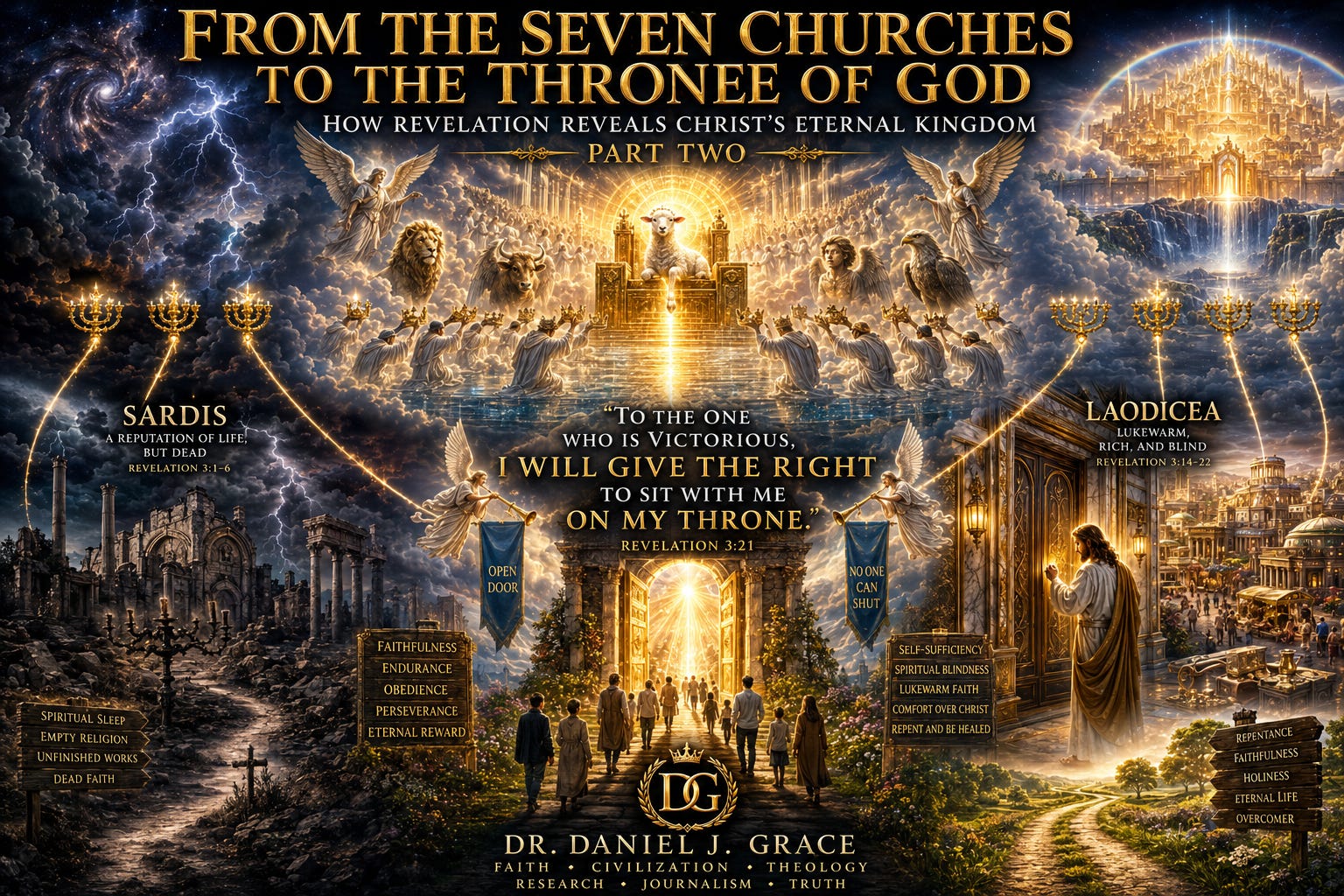
Sardis, Philadelphia, Laodicea, and the Vision of Heaven
In Part One, we examined Ephesus, Smyrna, Pergamum, and Thyatira and discovered a remarkable pattern. Each church faced unique challenges, yet every promise pointed beyond the present toward God’s eternal kingdom.
As Revelation continues, Christ addresses the final three churches before opening the doors of heaven itself. The contrast is profound. The Church on earth remains imperfect, struggling with weakness, complacency, persecution, and temptation. Yet above every earthly challenge stands the throne of God.
The final letters prepare believers for that heavenly vision.
They teach that appearances can be deceptive, faithfulness is never forgotten, and earthly wealth can never replace spiritual riches.
Sardis: The Church That Appeared Alive
Among the seven churches, Sardis received one of Christ’s most sobering warnings.
Jesus declares:
“I know your works; you have a reputation of being alive, but you are dead.” (Revelation 3:1)
Sardis possessed an impressive reputation.
Others viewed it as successful.
It likely appeared active, organised, and influential.
Yet Christ saw beneath the surface.
Spiritual vitality had largely disappeared.
The church possessed outward activity without inward life.
This warning remains deeply relevant today.
A church may have impressive buildings, large attendance, strong finances, and public influence, yet still suffer spiritual decline.
God evaluates churches differently than the world.
Human beings often measure success through numbers, popularity, and visibility.
Christ measures faithfulness.
The danger facing Sardis was not persecution or false teaching.
It was spiritual complacency.
The believers had become comfortable with appearances.
Jesus commands them:
“Wake up! Strengthen what remains and is about to die.”
The call is urgent.
Spiritual sleep is dangerous because those who sleep often do not realise they are asleep.
Yet even in Sardis there remained faithful believers.
Christ always preserves a remnant.
His promise is beautiful:
“They will walk with me, dressed in white, for they are worthy.”
The white garments symbolise purity, victory, and acceptance before God.
The promise reaches beyond Sardis to the final kingdom where God’s people stand before Him clothed in righteousness.
What appeared dead on earth could still experience restoration through repentance and faith.
Philadelphia: The Church of Faithful Endurance
If Sardis represents spiritual complacency, Philadelphia represents steadfast faithfulness.
Philadelphia was not wealthy.
It was not powerful.
It was not influential by worldly standards.
Yet Christ had no words of condemnation.
Instead, He says:
“I know your deeds. See, I have placed before you an open door that no one can shut.”
Philadelphia possessed little strength.
Yet it remained faithful.
This church demonstrates one of Revelation’s most important principles:
God is not impressed by worldly power.
He delights in faithful obedience.
The believers had endured opposition.
They had faced difficulties.
They had limited resources.
Yet they remained loyal to Christ.
Many Christians throughout history have identified with Philadelphia.
Small congregations.
Persecuted believers.
Missionaries in difficult regions.
Ordinary Christians quietly serving God without recognition.
The world may overlook them.
Christ does not.
The promise given to Philadelphia is extraordinary.
Jesus says:
“The one who is victorious I will make a pillar in the temple of my God.”
Ancient Philadelphia experienced frequent earthquakes.
Buildings often collapsed.
Stability was rare.
Against that background, Christ promises permanent security.
God’s people will never again face displacement, uncertainty, or fear.
They will belong permanently in God’s presence.
Christ also promises to write upon them:
The name of God
The name of the New Jerusalem
His own new name
These promises point directly toward Revelation’s final vision of the eternal city.
The church that remained faithful despite weakness will share forever in God’s kingdom.
Laodicea: The Tragedy of Spiritual Self-Deception
The final church receives perhaps the most famous warning in Revelation.
Laodicea was prosperous.
It enjoyed wealth, banking, trade, and commercial success.
The city prided itself on financial independence.
Yet Christ delivers a devastating assessment.
“You say, ‘I am rich; I have acquired wealth and do not need a thing.’ But you do not realise that you are wretched, pitiful, poor, blind and naked.”
Laodicea’s greatest problem was not persecution.
It was self-deception.
The believers believed everything was fine.
They saw no need for repentance.
They measured spiritual health through material success.
The church had become lukewarm.
Neither cold nor hot.
Neither openly rebellious nor passionately devoted.
Comfort had replaced commitment.
Prosperity had replaced dependence upon God.
The warning remains remarkably relevant in modern society.
Many Christians live in cultures of abundance.
The danger is not merely wealth itself.
The danger is trusting wealth.
Material comfort can create spiritual blindness.
People often feel secure while drifting further from God.
Yet even Laodicea receives hope.
One of Revelation’s most beautiful invitations appears here.
Jesus says:
“Here I am! I stand at the door and knock.”
The image is deeply personal.
The church had excluded Christ from its centre.
Yet Christ had not abandoned the church.
He continued calling.
He continued inviting.
He continued offering restoration.
His promise is astonishing:
“To the one who is victorious, I will give the right to sit with me on my throne.”
The church most strongly rebuked receives one of the greatest promises.
Grace remains available.
Repentance remains possible.
Christ still calls His people back to Himself.
The Door Opens in Heaven
After addressing the seven churches, Revelation undergoes a dramatic transition.
John writes:
“After this I looked, and there before me was a door standing open in heaven.” (Revelation 4:1)
The focus shifts.
The churches remain on earth.
Their struggles continue.
Their challenges remain real.
Yet now God reveals the greater reality behind history itself.
John is invited into heaven.
What he sees changes everything.
At the centre stands a throne.
This is Revelation’s most important image.
Not the Beast.
Not Babylon.
Not Armageddon.
The throne.
History is not governed by chaos.
History is governed by God.
Empires rise and fall.
Persecution comes and goes.
Cultures change.
Nations disappear.
Yet the throne remains.
The throne reveals ultimate reality.
The Lamb Who Reigns
In Revelation 5, John sees a scroll sealed with seven seals.
No one appears worthy to open it.
Then comes one of the most powerful moments in Scripture.
John hears of:
“The Lion of the tribe of Judah.”
But when he looks, he sees:
“A Lamb, looking as if it had been slain.”
The Lion is the Lamb.
The conquering King is the crucified Christ.
The victory of God comes through sacrifice.
The throne belongs to the Lamb.
The same Christ who walked among the seven churches now reigns over heaven and earth.
This changes how believers understand suffering.
The Lamb overcame through faithfulness.
His followers are called to do the same.
The path of discipleship may involve hardship.
But the destination is glory.
The Final Victory
As Revelation unfolds, judgments occur.
The seals are opened.
The trumpets sound.
The bowls are poured out.
Babylon falls.
Satan is defeated.
Death itself is destroyed.
Yet the central message remains unchanged.
Christ wins.
The throne never moves.
The kingdom never fails.
The Lamb remains victorious.
Every promise given to the seven churches reaches its fulfilment.
The Tree of Life appears again.
The New Jerusalem descends from heaven.
God dwells with His people.
Tears are wiped away.
Death is no more.
The overcomers inherit all things.
The story that began with seven struggling churches ends with an eternal kingdom.
Conclusion: Seeing Beyond the Present
The seven churches remind believers that spiritual challenges are real.
Some churches lose their first love.
Some suffer persecution.
Some compromise with culture.
Some tolerate false teaching.
Some become spiritually complacent.
Some remain faithful despite weakness.
Some become blinded by prosperity.
Yet Revelation never leaves believers focused solely upon earthly problems.
Again and again it directs attention upward.
Toward the throne.
Toward the Lamb.
Toward the kingdom that is coming.
The Church must never interpret reality solely through present circumstances.
The throne is occupied.
The Lamb reigns.
The kingdom is secure.
And the promises given to the seven churches remain true for every generation.
The final message of Revelation is not fear.
It is hope.
Not defeat.
But victory.
Not uncertainty.
But assurance.
The One who walked among the lampstands now reigns upon the throne.
And His kingdom shall never end.
To Be Continued: The Eternal Kingdom, the New Jerusalem, and the Final Hope of the Church
Dr. Daniel J. Grace
Faith • Civilization • Theology
Research • Journalism • Truth
🌐 danieljamesgrace.com
© 2026 Dr. Daniel J. Grace. All Rights Reserved.
No part of this article may be reproduced, distributed, transmitted, or published in any form or by any means without prior written permission from the author, except for brief quotations used in academic citation, review, or research purposes.