
From the Seven Churches to the Throne of God Part One
How Revelation Presents Christ's EHow Revelation Reveals Christ’s Eternal Kingdom

Why the Seven Churches Matter
Many readers approach the Book of Revelation looking for answers about the future. They focus on the Beast, the Mark of the Beast, Armageddon, the Millennium, or the New Jerusalem. Yet Revelation begins somewhere unexpected—not with the end of the world, but with seven local churches.
These churches were real congregations located in the Roman province of Asia Minor, modern-day Türkiye. They faced challenges remarkably similar to those confronting Christians today. Some struggled with false teaching. Others faced persecution. Some tolerated compromise, while others had become spiritually complacent. One church had lost its first love. Another believed it was rich while remaining spiritually poor.
At first glance, these letters may appear to be isolated messages addressing local problems. However, they serve a much larger purpose within the structure of Revelation.
Immediately after Christ finishes speaking to the seven churches, John is invited into the throne room of heaven. The movement is deliberate. Revelation begins with the struggles of the Church on earth and then reveals the eternal reign of Christ in heaven.
The message is clear:
The Church must never interpret its circumstances apart from the throne of God.
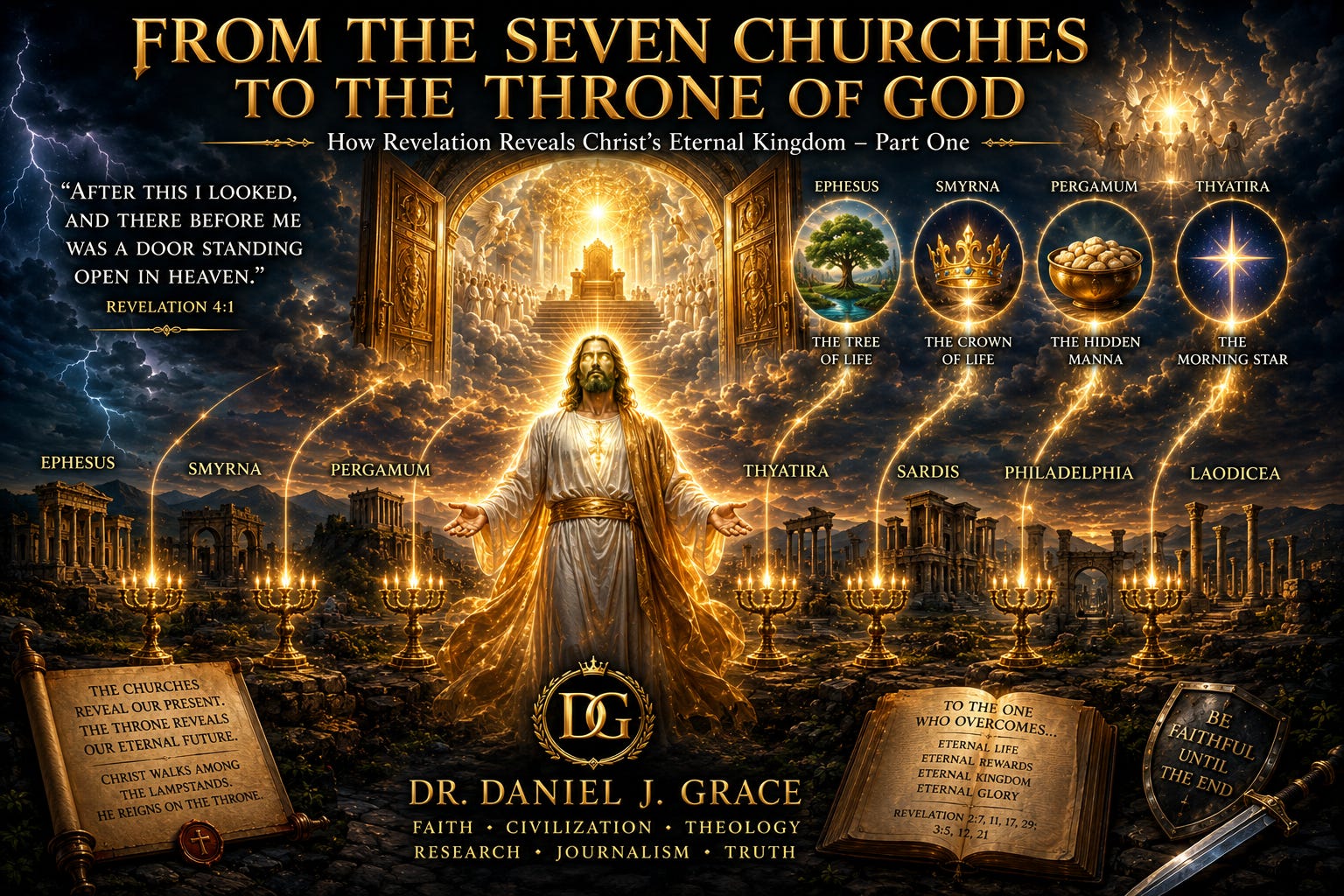
The seven churches represent the challenges faced by believers throughout history. The throne room reveals the ultimate reality behind those challenges. Earthly struggles are temporary. Christ’s kingdom is eternal.
Understanding this connection changes how we read Revelation.
The seven churches are not merely historical examples.
They are the doorway into God’s eternal kingdom.
Christ Among the Lampstands
The Book of Revelation opens with a majestic vision of the risen Christ.
John sees seven golden lampstands and One standing among them “like a son of man” (Revelation 1:13).
His eyes blaze like fire.
His voice sounds like rushing waters.
His feet shine like burnished bronze.
His face shines like the sun in all its brilliance.
The lampstands represent the churches.
Christ is not distant from His people.
He walks among them.
He observes them.
He strengthens them.
He corrects them.
He judges them.
The churches belong to Him.
Before speaking a single word of correction or encouragement, Revelation establishes an essential truth:
The Church is never abandoned.
Christ remains present among His people.
That truth remains just as important today as it was in the first century.
The Pattern of the Seven Letters
Each letter follows a similar structure.
First, Christ identifies Himself using imagery drawn from John’s vision.
Second, He declares:
“I know your works.”
Nothing escapes His attention.
He sees faithfulness.
He sees compromise.
He sees suffering.
He sees hypocrisy.
He sees perseverance.
Third, He offers praise, correction, or both.
Fourth, He calls for repentance or endurance.
Finally, He gives a promise to the one who overcomes.
These promises are among the most remarkable passages in Revelation because every one of them points beyond the local church toward God’s eternal kingdom.
The seven churches reveal present struggles.
The promises reveal future victory.
Ephesus: The Church That Lost Its First Love
Ephesus was a strong church in many respects.
It defended sound doctrine.
It rejected false apostles.
It persevered under pressure.
Yet something essential had been lost.
Jesus says:
“You have forsaken the love you had at first.”
Their theology remained intact.
Their devotion had grown cold.
The danger facing Ephesus was not heresy but spiritual affection fading into routine.
Christ calls them to remember, repent, and return.
The promise given to overcomers is extraordinary:
“To the one who is victorious, I will give the right to eat from the tree of life.”
This promise points beyond Ephesus.
It points all the way to Revelation 22 where the Tree of Life stands in the New Jerusalem.
The church that rediscovers its first love will share in God’s restored paradise.
The local problem is answered by an eternal promise.
Smyrna: Faithfulness Through Suffering
Unlike most of the churches, Smyrna receives no rebuke.
Instead, it receives encouragement.
The believers faced poverty, slander, imprisonment, and persecution.
Yet Christ reminds them:
“I know your afflictions and your poverty—yet you are rich.”
From heaven’s perspective, their circumstances looked very different.
The world saw poverty.
Christ saw treasure.
The world saw weakness.
Christ saw faithfulness.
The promise given to Smyrna reaches far beyond temporary suffering:
“The one who is victorious will not be hurt at all by the second death.”
The second death appears later in Revelation as the final judgment.
Smyrna’s persecuted believers are reminded that earthly suffering is temporary, but eternal life is secure.
Their hope rests not in present comfort but in Christ’s everlasting kingdom.
Pergamum: Faithfulness in a Hostile Culture
Pergamum lived in the shadow of pagan power.
Christ describes it as the place “where Satan has his throne.”
The church remained loyal under pressure.
Yet compromise had begun to enter.
Some believers embraced teachings associated with Balaam and the Nicolaitans.
The temptation was simple:
Compromise with culture in order to gain acceptance.
The challenge facing Pergamum remains familiar today.
Many Christians experience pressure to soften biblical convictions in exchange for social approval.
Christ warns against compromise and offers an unusual promise:
“I will give some of the hidden manna.”
Manna represents heavenly provision.
The world offers temporary satisfaction.
Christ offers eternal nourishment.
The white stone with a new name symbolises acceptance, vindication, and personal fellowship with God.
Those who refuse compromise receive a reward far greater than anything the surrounding culture can offer.
Thyatira: The Danger of Tolerated Corruption
Thyatira was known for love, service, faith, and perseverance.
In many ways it appeared spiritually healthy.
Yet beneath the surface a serious problem existed.
The church tolerated a false prophetess symbolically called Jezebel.
Her influence encouraged compromise with pagan practices and immorality.
Christ’s warning is severe because truth matters.
Love without discernment eventually becomes dangerous.
The church must not only love well.
It must also remain faithful to God’s truth.
Yet even here the promise is remarkable.
To those who remain faithful Christ promises authority over the nations.
This promise echoes Psalm 2 and points toward Christ’s future reign.
The faithful will not merely survive.
They will reign with the King Himself.
The local conflict in Thyatira finds its answer in the coming kingdom.
Every Promise Points Forward
As we examine the first four churches, a clear pattern emerges.
Each congregation faces a unique challenge.
Yet every promise points beyond the immediate situation.
The churches are living in the present.
Christ directs their attention toward eternity.
The Church must never interpret itself solely through earthly circumstances.
The struggling church must remember the throne.
The persecuted church must remember the kingdom.
The faithful church must remember the crown.
The Church’s future is not determined by Rome, culture, politics, wealth, or persecution.
Its future is determined by Christ.
This truth becomes even clearer as Revelation moves beyond the seven churches and opens the doors of heaven itself.
In Part Two, we will explore Sardis, Philadelphia, and Laodicea before following John into the throne room of God, where the Lamb who walks among the lampstands is revealed as the King who reigns forever.
To Be Continued
Dr. Daniel J. Grace
Faith • Civilization • Theology
Research • Journalism • Truth
🌐 danieljamesgrace.com
© 2026 Dr. Daniel J. Grace. All Rights Reserved.
No part of this article may be reproduced, distributed, transmitted, or published in any form or by any means without prior written permission from the author, except for brief quotations used in academic citation, review, or research purposes.