Forgotten Texts: The Theology of Zipporah’s Rite
Why Did God Try to Kill Moses?

Forgotten Texts: The Theology of Zipporah’s Rite
Why Did God Try to Kill Moses?
There are passages in the Bible that Christians know well.
Then there are passages that many believers read quickly because they seem impossible to explain.
Exodus 4:24–26 is one of them.
Just moments after God calls Moses at the burning bush and commissions him to deliver Israel from Egypt, something astonishing happens.
“And it came to pass on the way, at the encampment, that the LORD met him and sought to kill him.” (Exodus 4:24, NKJV)
Why would God suddenly turn against His own chosen prophet?
What changed between the burning bush and Moses’ journey to Egypt?
And why did everything depend upon the quick actions of Moses’ wife, Zipporah?
One of the Bible’s Most Mysterious Moments
The passage is remarkably brief.
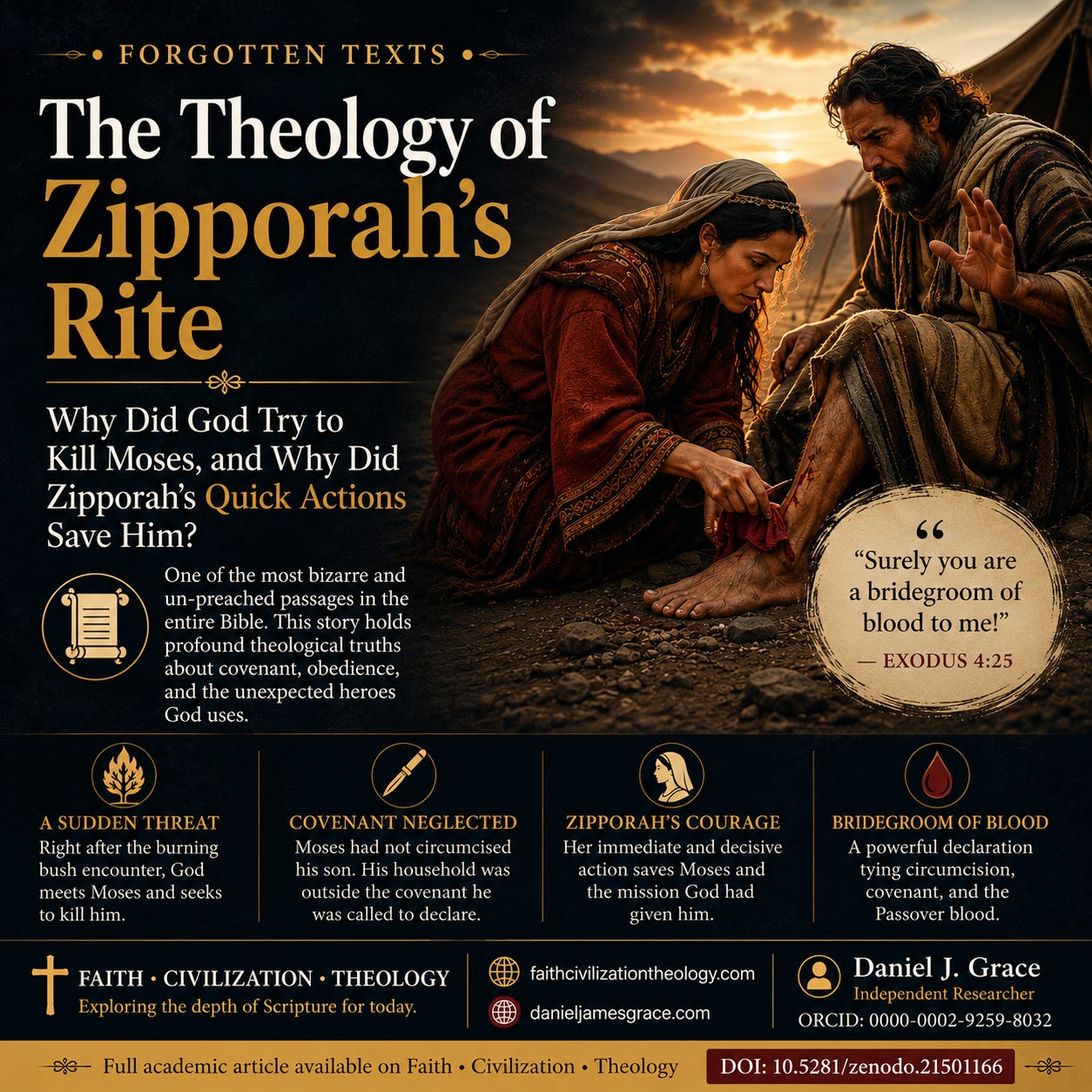
Zipporah immediately circumcises her son, touches Moses’ feet with the foreskin, and declares,
“Surely you are a bridegroom of blood to me!”
Then the Lord withdraws His judgment.
The story ends almost as suddenly as it began.
For centuries, Jewish and Christian interpreters have debated almost every detail.
Who was God about to kill?
Why was circumcision suddenly so urgent?
What does “bridegroom of blood” actually mean?
And why does one of the Bible’s most important prophets appear completely unprepared for this crisis?
Covenant Before Calling
One of the strongest theological insights from this passage is surprisingly simple.
Before Moses could represent God’s covenant publicly, his own household needed to honour that covenant privately.
Circumcision was not merely a cultural tradition.
It was the visible sign of belonging to God’s covenant people.
Moses had been chosen to confront Pharaoh on behalf of Israel, yet his own family appears to have neglected the covenant sign.
God’s messenger could not ignore the very covenant he was sent to proclaim.
Leadership begins with obedience.
Zipporah’s Courage
Perhaps the greatest surprise is that the hero of the story is not Moses.
It is Zipporah.
She immediately understands the seriousness of the situation.
Her decisive action saves Moses and preserves the mission that would eventually lead to Israel’s deliverance from Egypt.
Although she was a Midianite, she recognised the covenant’s importance when Moses himself failed to act.
Her courage reminds us that throughout Scripture God often works through people whom history has overlooked.
A Forgotten Lesson
This strange passage is not about an unpredictable God.
It is about the seriousness of covenant faithfulness.
God’s calling never removes the need for obedience.
Public ministry cannot replace private faithfulness.
The God who called Moses was also the God who expected His covenant to be honoured.
Exodus 4:24–26 remains one of the Bible’s most mysterious texts, but it also reminds us that God is holy, His covenant matters, and sometimes the most overlooked people become the most faithful witnesses.
The full academic article explores the Hebrew text, the theological significance of circumcision, the meaning of “bridegroom of blood,” the relationship between this event and the Passover, and why Zipporah’s actions remain one of the most remarkable yet neglected moments in biblical theology.
Read the complete study on Faith • Civilization • Theology.
DOI: https://doi.org/10.5281/zenodo.21501166
Originally published on Faith • Civilization • Theology.. For more articles on Christian faith, biblical theology, church history, and discipleship, visit:
https://faithcivilizationtheology.com
© 2026 Daniel J. Grace. All rights reserved.