
First Urban Churches in Roman Corinth
Commerce, Conflict, Faith, and the Rise of Early Christianity in a Cosmopolitan Empire

Introduction
Among the celebrated cities of the ancient Mediterranean, few possessed the energy, contradiction, ambition, and moral complexity of Corinth. Positioned upon the narrow isthmus connecting mainland Greece with the Peloponnese, Corinth stood not merely as a geographic crossroads but as a civilizational intersection where merchants, philosophers, sailors, soldiers, freedmen, slaves, pilgrims, athletes, and imperial officials converged in relentless motion. The city breathed commerce. Wealth circulated through its harbours like blood through arteries. Languages mingled in crowded markets. Religious cults flourished beside taverns, baths, theatres, and shrines.
Into this urban furnace emerged one of the earliest and most influential Christian communities in history: the church at Corinth. Unlike isolated rural sects, the Corinthian believers developed within a noisy imperial metropolis shaped by Roman administration, Greek philosophy, social stratification, and spiritual pluralism. The rise of Christianity there reveals how the gospel adapted itself to complex urban realities while simultaneously challenging the very structures upon which Roman civic life depended.
The Corinthian church was not born in comfort. It arose amid corruption, factionalism, social vanity, sexual permissiveness, and economic inequality. Yet paradoxically, these very tensions made Corinth fertile ground for the expansion of Christianity. The city embodied the fragmentation of the Roman world, and the Christian message offered an alternative identity transcending ethnicity, class, and status.
The story of the first urban churches in Roman Corinth is therefore not only theological; it is sociological, political, and cultural. It demonstrates how Christianity transformed from a marginal Jewish movement into an urban transnational faith capable of operating within the infrastructure of empire itself.
Roman Corinth: Rebuilt Power and Imperial Ambition
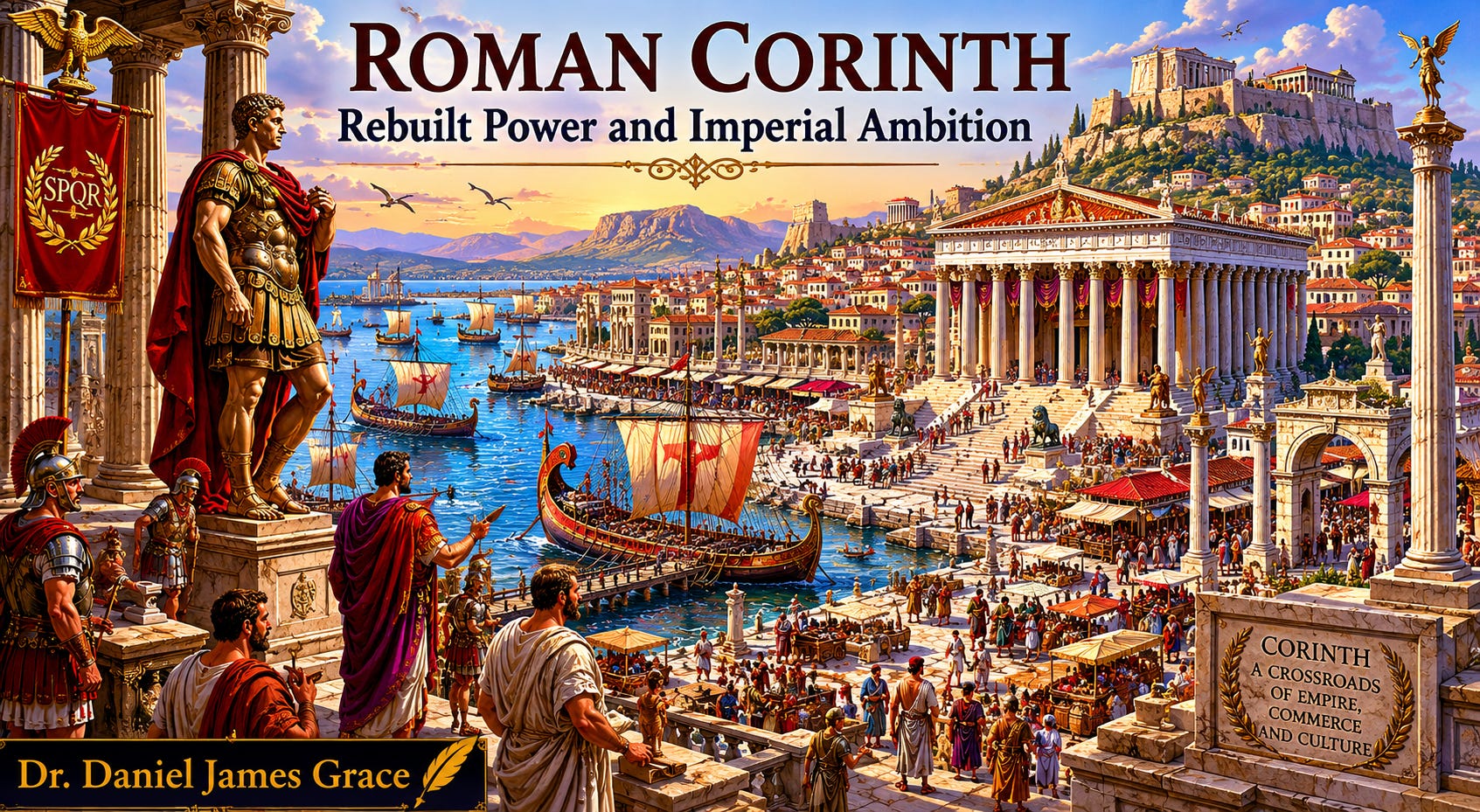
The earlier Greek Corinth had been destroyed in 146 BCE by Roman forces under Lucius Mummius. For approximately a century, the city lay devastated, its memory lingering as a warning against resistance to Roman supremacy. Yet in 44 BCE, Julius Caesar refounded Corinth as a Roman colony. This act was not merely reconstruction; it represented imperial strategy.
Roman Corinth became a carefully designed colonial city populated by freedmen, veterans, traders, and migrants from across the empire. Its renewed prosperity stemmed largely from geography. Two harbours—Lechaion facing the Adriatic and Cenchreae opening toward the Aegean—allowed goods to move efficiently between east and west. Ships avoided the dangerous voyage around southern Greece by transporting cargo across the isthmus.
As trade intensified, Corinth accumulated extraordinary diversity. Syrians, Egyptians, Jews, Greeks, Romans, and Anatolians interacted daily. Unlike Athens, which preserved a reputation for philosophical prestige, Corinth projected economic ambition. Success there depended less upon aristocratic ancestry and more upon adaptability, entrepreneurship, and patronage networks.
This environment mattered profoundly for early Christianity. The gospel entered a city already accustomed to movement, novelty, and ideological exchange. Urban Christianity often flourished where populations were mobile and identities unstable. Corinth represented precisely such a setting.
The Urban Environment and Social Fragmentation
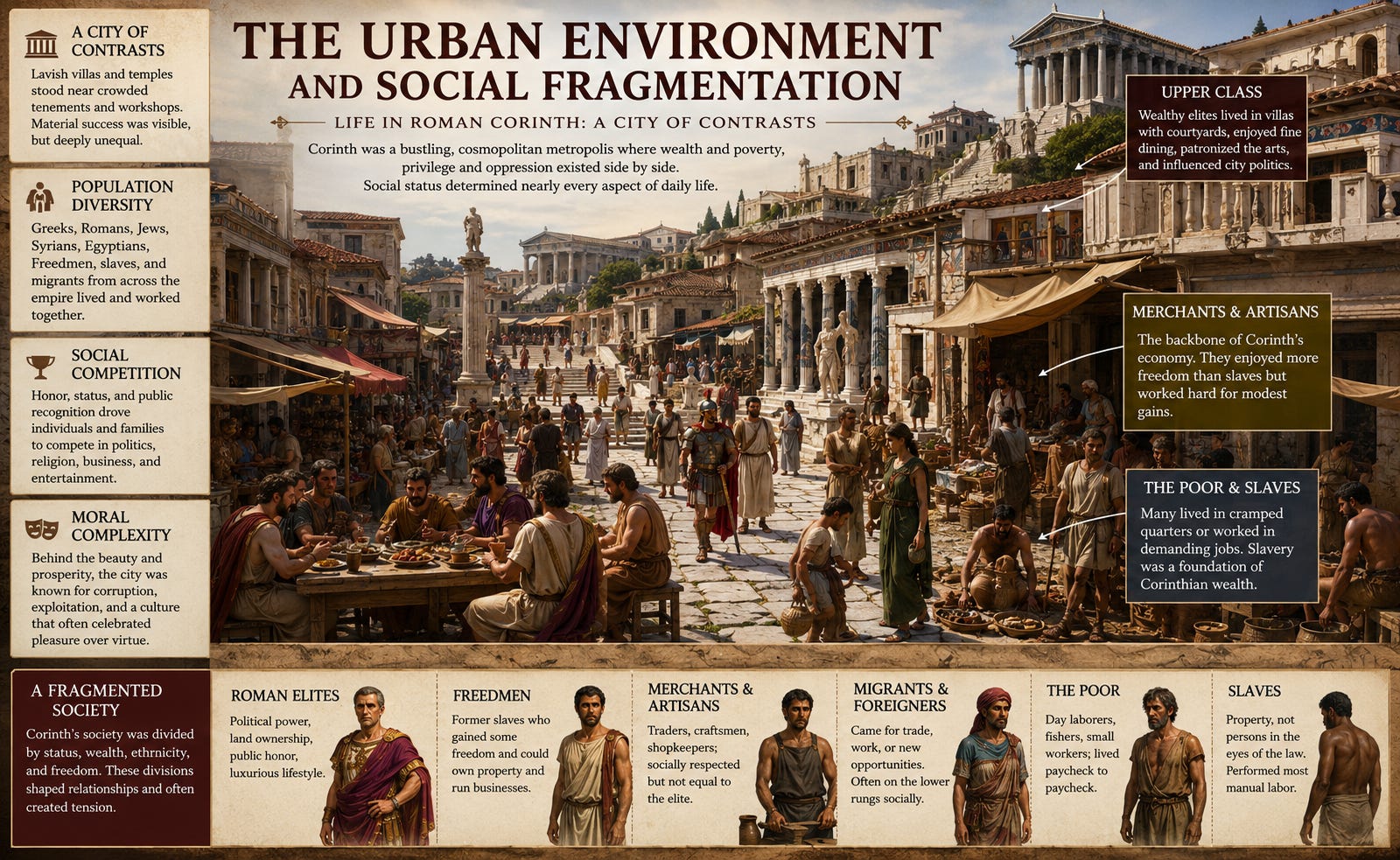
Roman Corinth displayed sharp social contrasts. Wealthy elites occupied lavish villas decorated with imported marble, mosaics, and fountains, while labourers crowded into cramped housing districts near workshops and commercial streets. Social advancement remained possible but uncertain. Freed slaves could acquire wealth, though elite prejudice often persisted against them.
This instability created intense competition for honour. Public recognition governed civic life. Banquets, patronage relationships, political offices, athletic sponsorships, and religious donations functioned as mechanisms for acquiring prestige. To exist in Corinth meant participating in a continuous struggle for status.
The early church entered directly into this environment. Christian assemblies gathered individuals from radically different social backgrounds: artisans, merchants, slaves, women of independent means, migrants, and occasionally members of higher-status households. Such diversity was unusual within traditional Roman associations.
The Christian proclamation that all believers formed “one body” challenged deeply embedded assumptions about hierarchy. The message threatened the symbolic architecture of Roman society by redefining dignity through spiritual belonging rather than public rank.
Yet Corinthian Christians did not immediately abandon cultural habits shaped by urban competition. Many conflicts addressed in early Christian writings reflected continuing struggles over prestige, leadership, knowledge, and privilege. The church became a mirror reflecting the city around it.
Paul and the Founding of the Corinthian Church
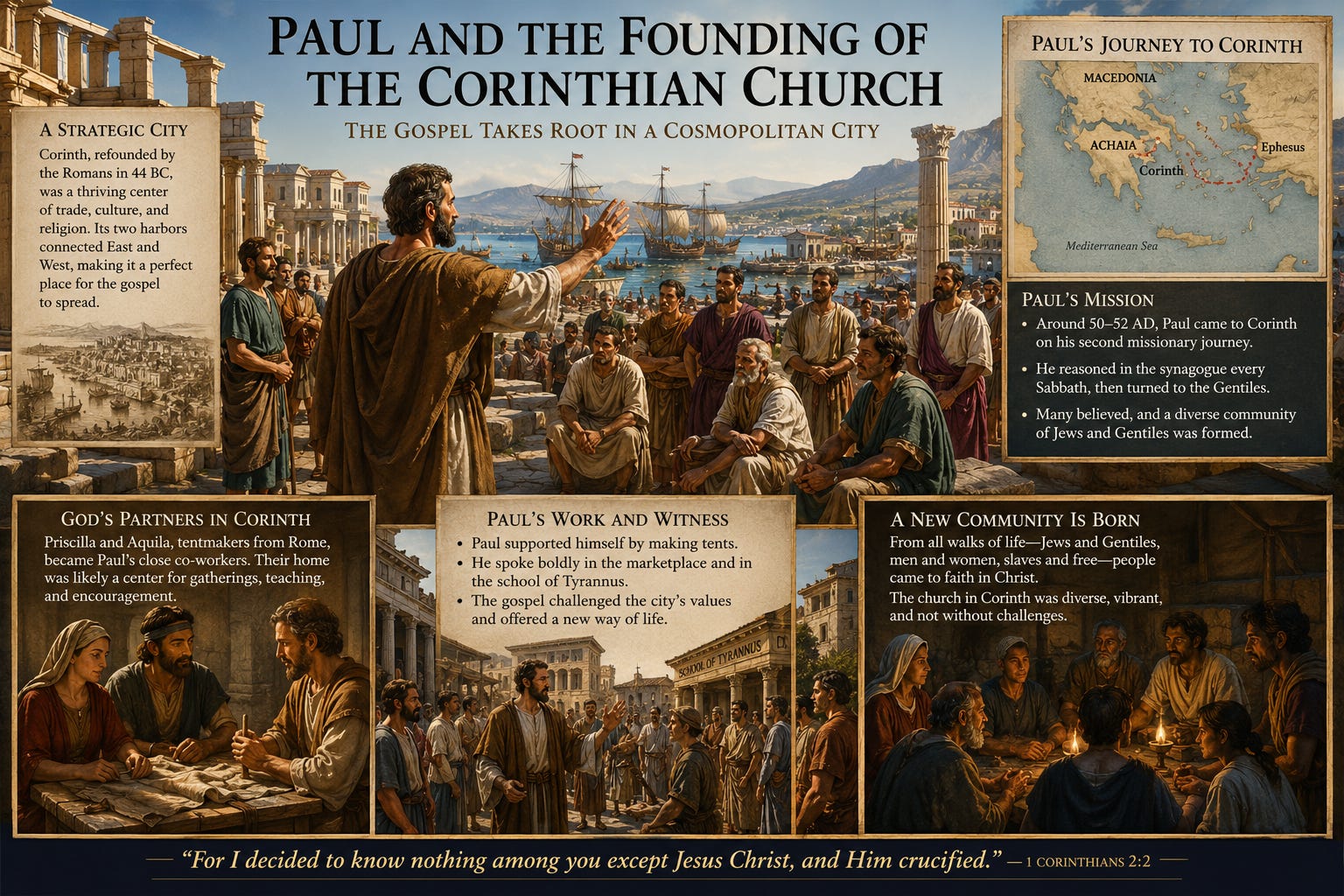
The apostle Paul arrived in Corinth during the middle of the first century CE, likely around 50–52 CE. According to early Christian traditions preserved in the New Testament, Paul remained in the city approximately eighteen months—longer than many of his missionary stays elsewhere.
Corinth suited Paul’s broader strategy. Rather than focusing primarily on isolated villages, he concentrated on influential urban centres connected through trade routes and communication networks. By establishing churches in cities such as Corinth, Ephesus, Antioch, and Thessalonica, Christianity could spread outward through existing systems of mobility.
Paul worked alongside Priscilla and Aquila, Jewish tentmakers who had relocated from Rome. Their presence illustrates how migration patterns contributed to the growth of early Christianity. Diaspora Jewish communities often provided initial contact points for apostolic preaching.
The Corinthian mission initially engaged synagogue audiences before expanding among Gentiles. This transition reflected a broader historical development in which Christianity increasingly attracted non-Jewish adherents throughout the Roman world.
Paul’s labour in Corinth combined manual work, teaching, debate, and pastoral formation. Unlike elite philosophers who depended heavily upon wealthy patronage, Paul frequently emphasised self-support through craftsmanship. This practice likely strengthened his credibility among labouring populations while distinguishing his mission from travelling sophists seeking financial gain.
House Churches and Domestic Worship
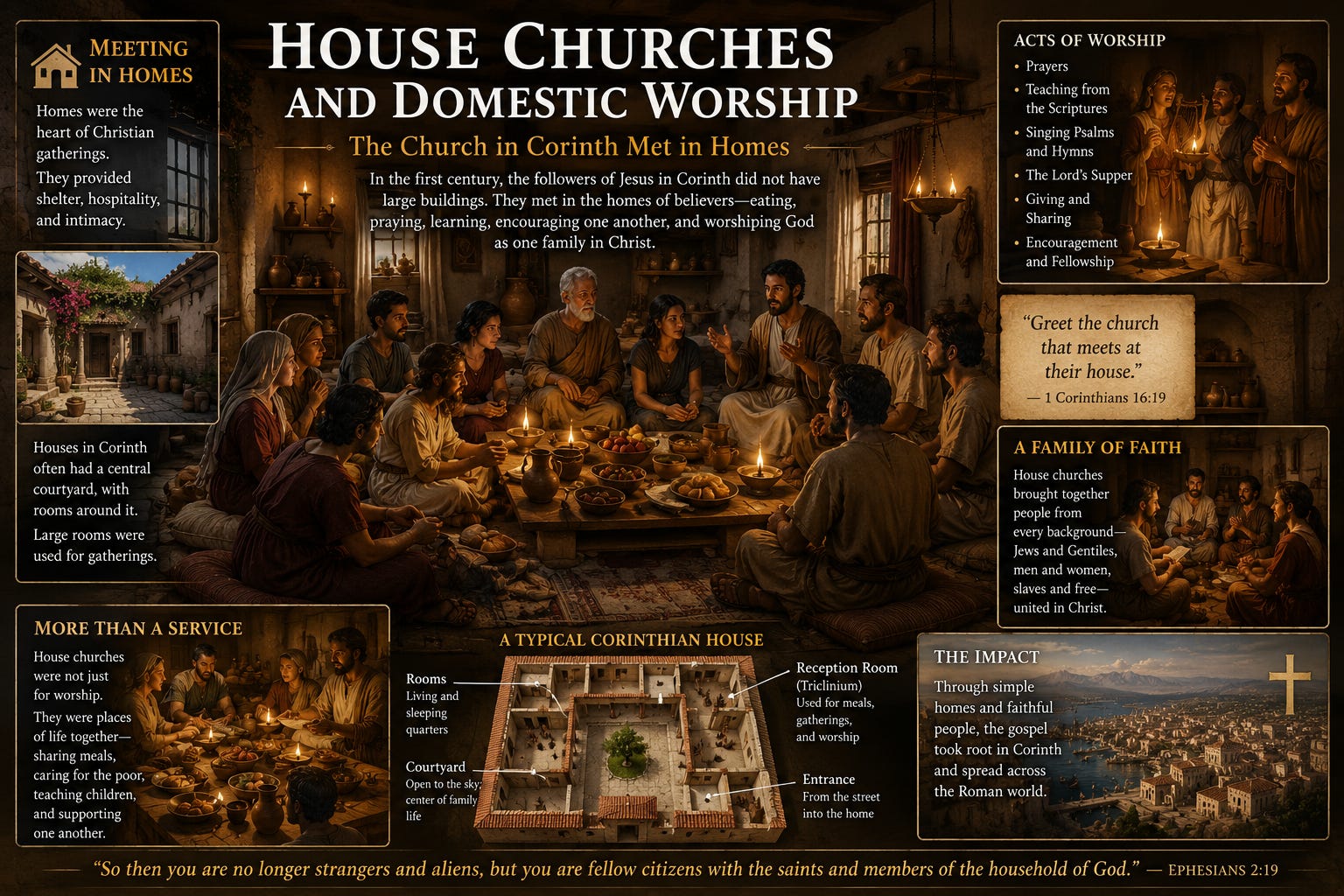
The earliest Corinthian congregations did not possess monumental church buildings. Christian communities assembled primarily in private homes. These domestic gatherings became foundational institutions within urban Christianity.
House churches served multiple functions simultaneously. They were places of worship, teaching, communal meals, charity distribution, theological discussion, and social integration. Domestic spaces blurred distinctions between private and public life. In Roman culture, households represented centres of authority and economic organisation. Christianity transformed these environments into sacred communal spaces.
Certain households likely acted as important hubs for Christian activity. Wealthier believers who owned larger homes could host gatherings with dozens of participants. Yet even within such settings, tensions emerged concerning social inequality.
Early Christian texts suggest that some affluent believers humiliated poorer members during communal meals by displaying abundance while others remained hungry. Such behaviour contradicted the Christian vision of unity and revealed the difficulty of constructing egalitarian fellowship within a hierarchical society.
The urban church therefore became an experiment in social reconfiguration. Christians attempted to build communities transcending ethnic divisions, economic disparities, and gender boundaries while still operating within Roman domestic structures.
Corinthian Religion and Spiritual Competition
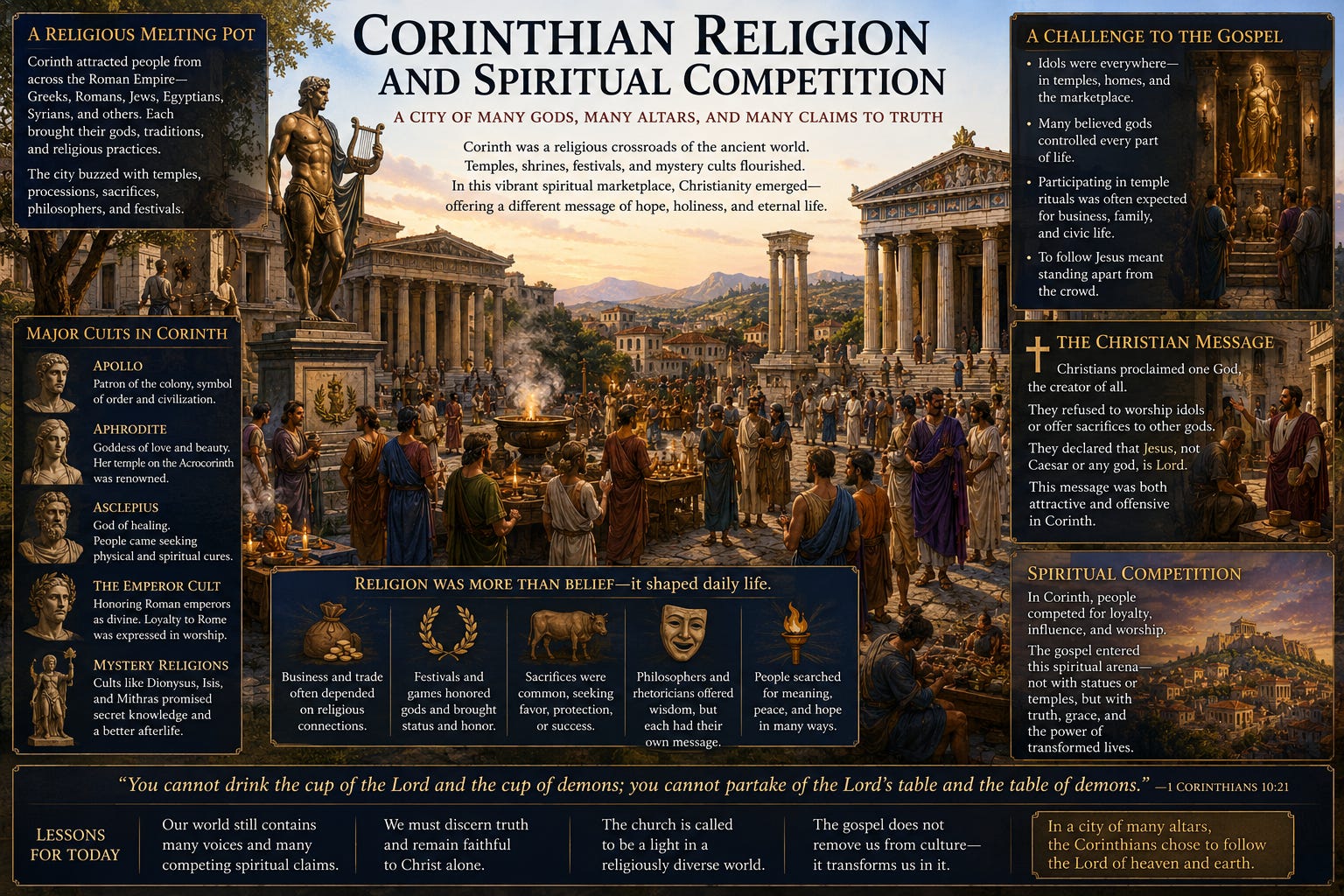
Religion saturated public life in Corinth. Temples, shrines, sacrifices, festivals, and mystery cults shaped civic identity. Devotion to Roman imperial power intertwined with traditional Greek deities and eastern religious influences.
Among the city’s prominent sanctuaries stood the Temple of Apollo. The cult of Aphrodite also contributed to Corinth’s later reputation for sensuality, though hostile commentators likely exaggerated some ancient descriptions.
Religious participation in Roman cities extended beyond personal spirituality. Sacrificial rituals reinforced social cohesion, political loyalty, and economic relationships. Trade guilds often maintained patron deities. Civic festivals honoured imperial authority. Banquets connected worship with networking and status.
Christian refusal to participate fully in these systems generated suspicion. Abstaining from sacrifices or rejecting idols could appear antisocial or politically subversive. Converts, therefore, faced difficult questions regarding business relationships, family obligations, and public identity.
The Corinthian correspondence preserved in the New Testament reflects these dilemmas vividly. Believers debated whether eating food associated with idol temples constituted a compromise. Some argued for freedom based upon theological knowledge, while others feared spiritual contamination.
These disputes reveal that Christianity in Corinth did not emerge in isolation from the surrounding culture. The church continuously negotiated boundaries between engagement and separation within an intensely religious urban world.
Sexual Ethics and Moral Transformation
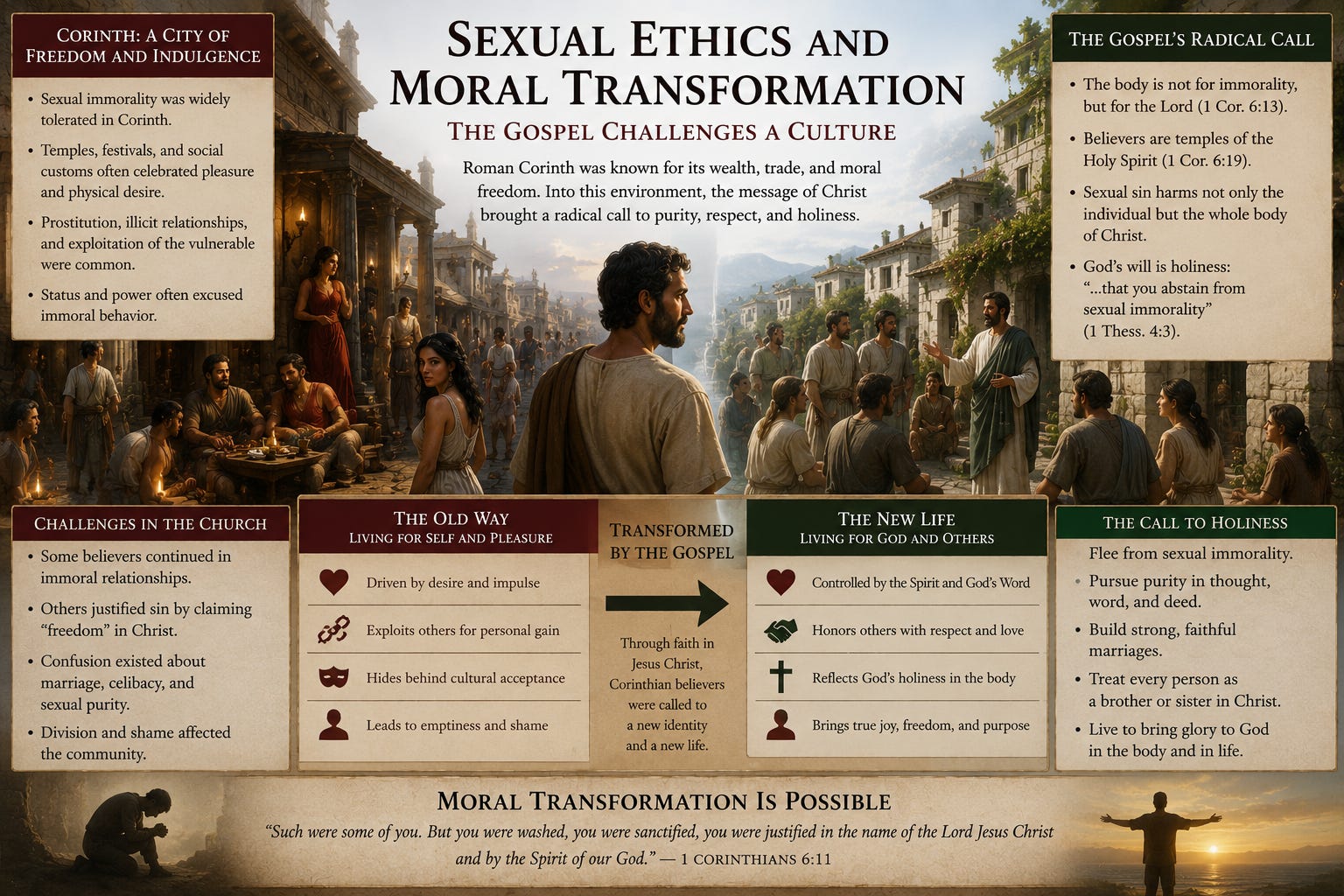
Ancient Corinth possessed a widespread reputation for indulgence. Whether entirely deserved or partially rhetorical, the city symbolised moral permissiveness in the imagination of many ancient writers.
Roman urban centres generally tolerated behaviours that early Christians considered incompatible with holiness. Sexual relationships involving slaves, prostitution, concubinage, and exploitative arrangements existed openly within many segments of society. Masculine status often mattered more than mutual ethical accountability.
Christian teaching introduced radically different moral expectations. Believers were urged to practice fidelity, self-control, mutual respect, and bodily sanctity. These principles challenged not only individual conduct but broader assumptions concerning power and desire.
The Corinthian church struggled deeply with these issues. Reports of sexual misconduct, disputes over marriage, and confusion regarding celibacy indicate a community attempting to redefine identity amid conflicting cultural norms.
Paul’s responses emphasised that Christianity involved transformation extending beyond intellectual belief. The body itself became understood as spiritually significant. Such teaching contrasted sharply with philosophical traditions that treated physical existence as morally secondary or temporary.
The urban church therefore became a site where competing visions of humanity confronted one another directly.
Economic Realities and Christian Community
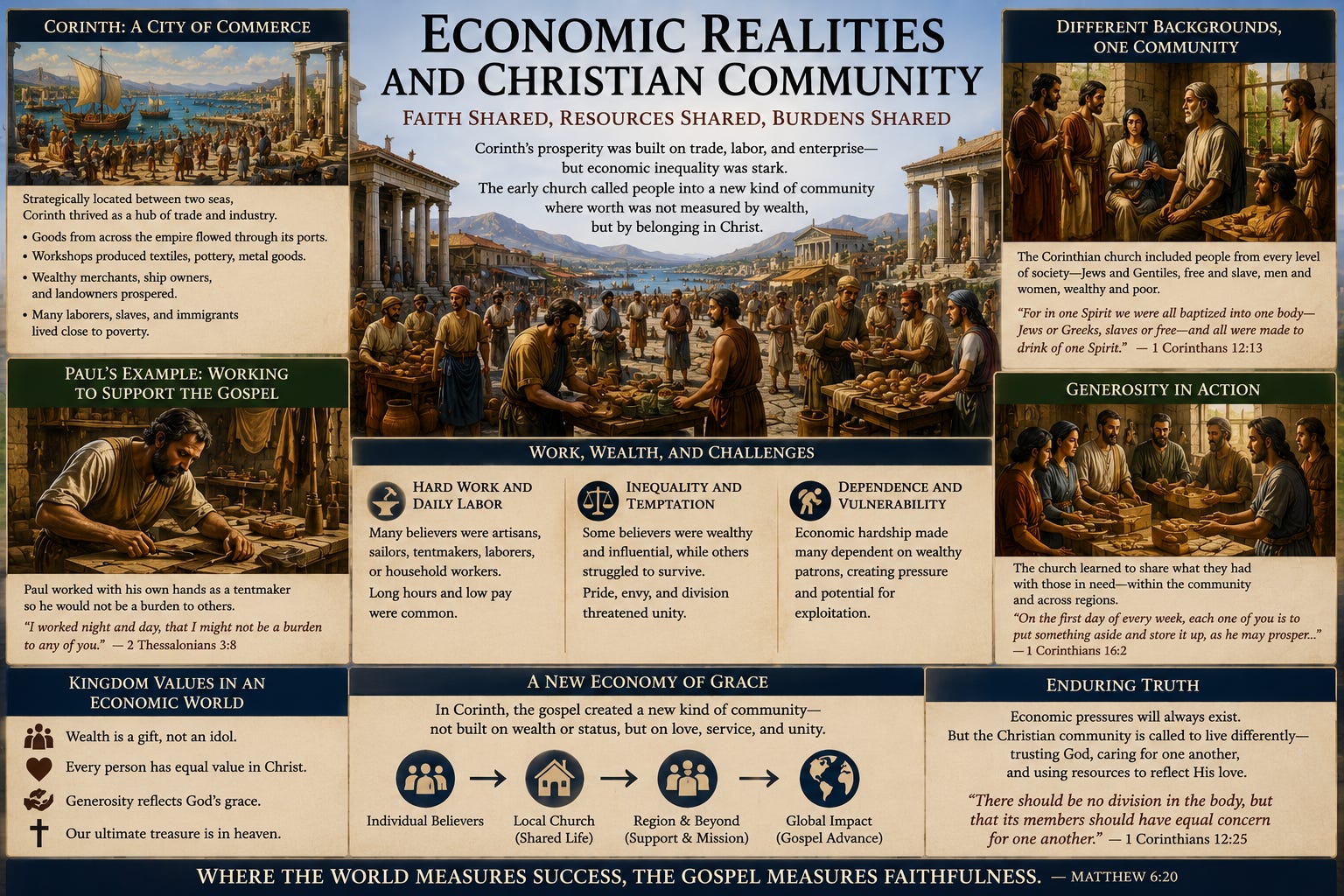
Corinth’s economy depended upon trade, manufacturing, shipping, and service industries. Artisans occupied an important social layer within the city. Tentmakers, metalworkers, pottery producers, merchants, dock labourers, and textile workers contributed to commercial vitality.
Many early Christians likely emerged from these working populations. Christianity spread effectively through occupational and relational networks. Urban tradespeople travelled, exchanged information, and maintained connections across regions.
Economic pressures nevertheless shaped church life. Poverty affected many believers. Patronage relationships created dependency. Wealthier Christians possessed greater social influence and educational opportunity.
The Christian ideal of mutual care attempted to address these disparities. Collections for struggling believers elsewhere demonstrate an early commitment to translocal solidarity. Churches in different cities increasingly perceived themselves as participants within a broader spiritual family.
This emerging network proved historically significant. Christianity developed organisational coherence across urban centres connected by roads, ports, correspondence, and missionary travel. Corinth became one node within a growing Mediterranean movement.
Public Reputation and External Criticism
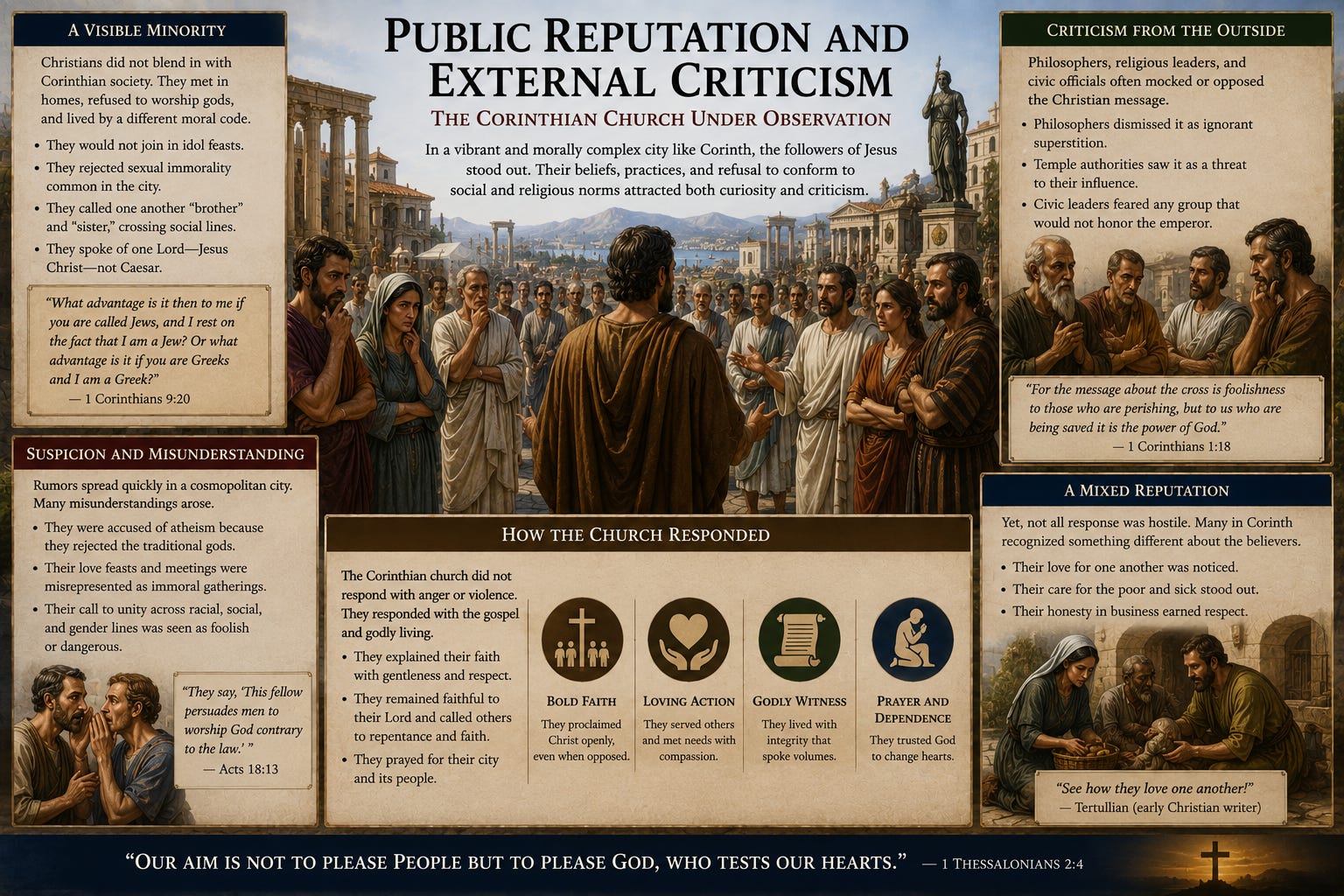
The first urban churches existed under observation. Neighbours, officials, philosophers, and religious leaders evaluated Christian behaviour constantly. Rumours circulated easily within densely populated cities.
Christians faced accusations of atheism because they rejected traditional gods. Their private gatherings sometimes generated suspicion. Misunderstandings concerning communal meals and familial language fueled hostile speculation.
At the same time, Christian ethics occasionally attracted admiration. Care for the poor, support for widows, mutual aid, and cross-class fellowship distinguished believers from many contemporary associations.
Corinthian Christians therefore occupied an ambiguous social position. They were neither fully underground nor publicly dominant. They represented a visible minority navigating imperial society carefully.
The urban church’s survival depended partly upon adaptability. Christianity spread not through military power or state sponsorship but through persuasion, relationships, endurance, and organizational resilience.
Rhetoric, Wisdom, and Intellectual Conflict
Corinth valued rhetoric. Public speaking functioned as entertainment, education, and political performance. Sophists and philosophers attracted audiences through eloquence and intellectual display.
Some Corinthian Christians apparently evaluated Christian leaders according to these cultural expectations. Charismatic speech carried prestige. Sophisticated argumentation impressed audiences.
Paul responded critically to excessive fascination with rhetorical brilliance. He feared that Christian faith might become reduced to competitive intellectual performance resembling the city’s existing honor culture.
This does not mean Christianity rejected learning. Rather, the movement questioned forms of wisdom disconnected from humility and moral transformation. Paul emphasized paradox: divine strength revealed through apparent weakness; wisdom emerging through humility rather than social superiority.
These themes resonated powerfully within an urban environment obsessed with status. Christianity proposed an alternative anthropology in which value derived not from civic acclaim but spiritual reconciliation.
Women in the Corinthian Churches
Women played substantial roles within early Christian communities. In Roman Corinth, women of varying social backgrounds participated in household religion, commerce, and social patronage. Christianity expanded opportunities for spiritual involvement in important ways.
Female believers hosted gatherings, supported missionary activity, prayed publicly, and contributed to communal leadership. Although ancient patriarchal structures remained influential, Christian assemblies often provided women with forms of participation less accessible elsewhere.
This development occasionally generated controversy. Debates concerning authority, modesty, prophecy, and worship practices reflect broader negotiations regarding gender and communal order.
The urban setting amplified these tensions because Corinth exposed believers continually to competing cultural expectations. Elite Roman ideals concerning femininity differed from Jewish customs and local Greek traditions.
The church therefore became a contested arena where social norms were renegotiated within theological frameworks emphasizing spiritual equality before God.
Persecution, Pressure, and Persistence
The Corinthian church did not initially experience systematic empire-wide persecution comparable to later centuries. Nevertheless, believers encountered localized hostility, ridicule, exclusion, and legal vulnerability.
Religious nonconformity carried social consequences. Refusal to participate in civic rituals could damage commercial relationships and communal trust. Converts sometimes faced opposition from family members or local authorities.
Despite these pressures, Christianity continued expanding. Urban churches proved remarkably durable because they operated through relational networks rather than centralized institutions alone. Leadership could shift. Gatherings could relocate. Correspondence sustained cohesion across distances.
Corinth’s strategic location enhanced this resilience. Travelers carried ideas and teachings between cities continually. Maritime routes accelerated communication. Christian identity gradually transcended local boundaries.
Corinth as a Prototype of Urban Christianity
The importance of Corinth extends far beyond local history. The city became an early prototype for Christianity’s encounter with metropolitan civilization.
Many themes later defining Christian history appeared there in embryonic form:
Conflict between wealth and equality
Tension between spiritual ideals and social ambition
Debates concerning sexuality and morality
Questions of leadership and authority
Ethnic integration within worship
Negotiation between faith and empire
Urban pluralism and theological identity
Corinth demonstrated both the possibilities and fragilities of Christian urban life. The church achieved remarkable diversity while remaining vulnerable to division. It embodied spiritual aspiration alongside human weakness.
Yet precisely because of its imperfections, Corinth provides historians with unusually realistic insight into early Christianity. The community was not mythologically idealized. Its struggles reveal authentic social complexity.
Archaeology and Historical Memory
Modern archaeological work in Ancient Corinth has illuminated aspects of the city’s urban structure, religious life, and commercial activity. Excavations reveal temples, marketplaces, fountains, roads, inscriptions, and domestic spaces that help contextualize early Christian existence.
The Bema, often associated with Roman judicial proceedings, remains particularly significant within Christian historical memory due to references connecting Paul with appearances before local authorities.
Archaeology cannot fully reconstruct church life itself, yet it demonstrates the scale and sophistication of Roman Corinth. Christianity did not emerge in a primitive environment detached from civilization. Rather, it developed amid monumental architecture, imperial administration, and globalized commerce.
This realization challenges simplistic assumptions regarding early Christianity as merely rural or anti-urban. In reality, the movement expanded most dynamically within cities integrated into Roman infrastructure.
Theological Legacy of the Corinthian Churches
The theological influence of Corinthian Christianity proved immense. Letters addressed to the church became foundational Christian texts shaping doctrine, ethics, worship, and ecclesiology for centuries.
Themes associated with Corinth continue influencing global Christianity:
The church as the “body” composed of many members
Spiritual gifts and communal diversity
Love as supreme ethical principle
Resurrection theology
Sacramental fellowship
Reconciliation amid division
Holiness within secular environments
These concepts emerged not in abstraction but through engagement with concrete urban realities.
Corinth therefore symbolizes Christianity’s transition from regional movement to international faith. The church learned there how to survive amid pluralism, prosperity, moral ambiguity, and cultural fragmentation—conditions strikingly familiar to modern metropolitan societies.
Conclusion
The first urban churches in Roman Corinth emerged within one of the most dynamic cities of the ancient Mediterranean world. Surrounded by commerce, religious multiplicity, social ambition, and moral contradiction, the Corinthian believers attempted to construct an alternative community grounded in spiritual unity rather than imperial hierarchy.
Their journey was neither simple nor flawless. Conflict repeatedly threatened cohesion. Old habits persisted. Cultural pressures remained intense. Yet the church endured and expanded because it addressed profound human needs within urban civilization: belonging, dignity, hope, reconciliation, and transcendent purpose.
Corinth reveals that Christianity’s growth depended not upon isolation from the world but engagement with it. The gospel entered crowded ports, noisy marketplaces, elite households, artisan workshops, and contested public spaces. It spread through conversation, hospitality, labor, correspondence, and perseverance.
The legacy of Corinth continues to resonate because modern cities resemble ancient Corinth more than many realize. Contemporary urban life still wrestles with inequality, identity, consumerism, fragmentation, and spiritual searching. The early Corinthian church therefore remains historically distant yet intellectually familiar.
Within the stones of Roman Corinth arose communities attempting to redefine humanity itself—not through conquest or wealth, but through fellowship, sacrifice, and faith. Their story stands as one of the most important chapters in the history of urban religion and the transformation of the ancient world.
Dr. Daniel James Grace
Research • Journalism • Theology