

False Teachers in the Seven Churches
The Nicolaitans, Jezebel, Balaam, and Spiritual Deception

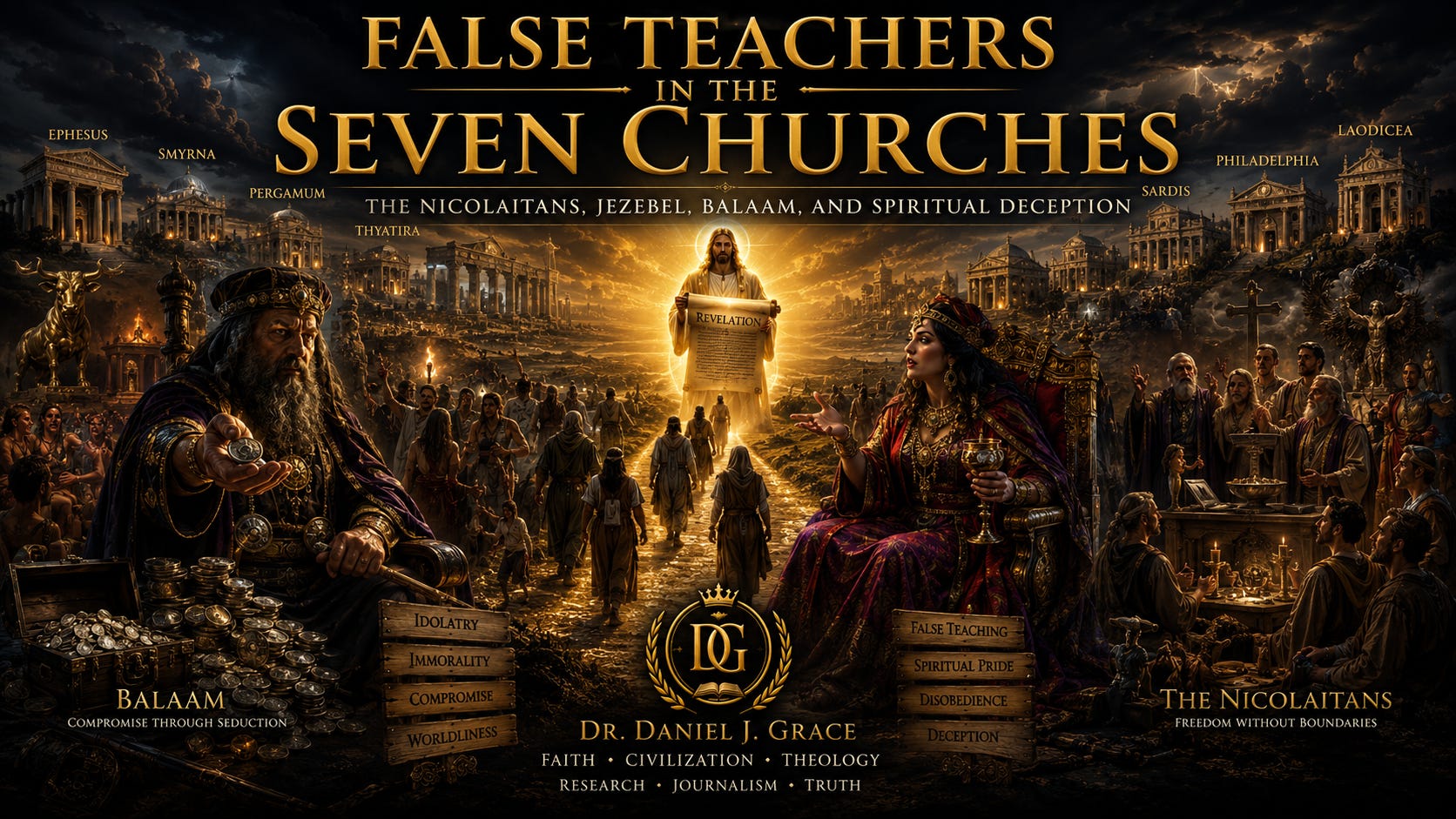
Throughout Christian history, believers have often focused on threats coming from outside the Church. Persecution, political opposition, cultural hostility, and social pressure have all challenged Christian faith. Yet the Book of Revelation reveals a different danger—one that Christ repeatedly identifies as even more destructive. That danger is spiritual deception arising from within the Church itself.
Among the seven churches of Asia Minor, Jesus repeatedly warns about false teachers, corrupt influences, compromised leaders, and deceptive doctrines. While Rome could imprison Christians and pagan society could tempt them, false teaching had the potential to corrupt the Church from the inside. The messages to Pergamum and Thyatira particularly highlight this concern, but traces of the problem appear throughout the seven churches.
The figures of Balaam, the Nicolaitans, and Jezebel represent different forms of spiritual compromise. Although separated by centuries, they shared a common characteristic: they encouraged God’s people to blend faithfulness to Christ with the values and practices of the surrounding culture.
Their stories remain relevant today because the greatest threats to Christianity rarely announce themselves as obvious enemies. More often, they appear as attractive alternatives, partial truths, cultural accommodations, or teachings that make discipleship easier while quietly removing its demands.
The Pattern of Spiritual Deception
One of the remarkable features of Revelation is that false teaching rarely appears as outright denial of Christ. Instead, it appears as compromise.
The churches addressed in Revelation existed within prosperous commercial cities filled with temples, trade guilds, emperor worship, and pagan festivals. Christians faced immense pressure to participate in social and economic activities connected to idol worship.
False teachers often presented compromise as practical wisdom.
Rather than encouraging believers to remain separate from pagan practices, they taught accommodation. Instead of calling Christians to endurance, they promoted comfort. Rather than emphasizing holiness, they emphasized acceptance.
The result was a gradual blending of Christian faith with surrounding culture.
This pattern has repeated throughout church history.
Balaam: Compromise Through Seduction
In Revelation 2:14, Jesus warns the church in Pergamum:
“You have there those who hold the doctrine of Balaam.”
To understand this warning, we must return to the Old Testament.
Balaam appears in the Book of Numbers as a prophet hired by King Balak to curse Israel. Unable to curse God’s people directly, Balaam eventually encouraged a different strategy. Instead of attacking Israel from outside, he persuaded them to compromise from within.
The Israelites were enticed into idolatry and sexual immorality through their relationships with surrounding pagan communities.
This became one of the most devastating spiritual failures in Israel’s history.
By referencing Balaam, Jesus was warning Pergamum that similar influences had entered the church.
The danger was not open persecution.
The danger was accommodation.
Christians were being encouraged to participate in practices incompatible with their faith while convincing themselves that such participation was harmless.
Balaam therefore represents every teaching that invites believers to exchange holiness for convenience.
The Nicolaitans: Freedom Without Boundaries
The Nicolaitans appear twice in Revelation.
The church in Ephesus is praised because it rejects their practices:
“You hate the deeds of the Nicolaitans, which I also hate.” (Revelation 2:6)
Pergamum, however, is criticized because some believers accepted their teachings.
The exact identity of the Nicolaitans remains uncertain. Early Christian writers offered various explanations, but most scholars agree they promoted some form of compromise with pagan society.
They appear to have argued that Christians could participate in idolatrous feasts and morally questionable activities without spiritual consequences.
In essence, they separated faith from conduct.
Their teaching transformed Christian freedom into moral permissiveness.
The New Testament repeatedly teaches that salvation is by grace. Yet grace was never intended to remove the call to holiness.
The Nicolaitan error seems to have been the belief that because believers are saved, personal conduct becomes secondary.
This remains a temptation in every generation.
Whenever Christians minimize obedience, dismiss holiness, or treat sin as insignificant, the spirit of Nicolaitan thinking reappears.
Jezebel: Corruption Within Leadership
Among all the warnings in Revelation, perhaps none is stronger than Christ’s rebuke of Thyatira.
Jesus declares:
“You allow that woman Jezebel, who calls herself a prophetess, to teach and seduce My servants.” (Revelation 2:20)
The Jezebel mentioned here was probably not literally the Old Testament queen. More likely, Christ used the name symbolically because her influence resembled that of the infamous queen who promoted Baal worship in ancient Israel.
The original Jezebel sought to blend pagan religion with the worship of God.
The woman in Thyatira apparently encouraged a similar compromise.
What makes this warning particularly significant is that Jezebel operated from within the church.
She claimed spiritual authority.
She presented herself as a teacher.
She influenced believers.
The problem was not merely personal sin but institutional influence.
Her teaching normalized practices that Christ condemned.
This warning reminds Christians that leadership alone does not guarantee truth.
A person may possess charisma, influence, popularity, or authority and still lead others away from faithfulness.
Spiritual discernment must always be exercised, regardless of who presents a teaching.
Why False Teaching Was So Dangerous
False teaching threatened more than doctrinal accuracy.
It threatened the identity of the Church.
The seven churches were called to be distinct communities living under Christ’s authority.
Compromise blurred that distinction.
If Christians worshipped like pagans, lived like pagans, and adopted pagan values, the Church would cease to function as a witness to the world.
The issue was therefore not merely theological.
It was practical.
False teaching changed behavior.
It altered priorities.
It reshaped values.
Eventually, it transformed entire communities.
Throughout history, the greatest doctrinal crises have often begun with seemingly small compromises that gradually expanded over time.
Modern Forms of Spiritual Deception
Although the Nicolaitans and Jezebel belong to the first century, the underlying dangers remain.
Modern deception rarely takes the form of ancient idol worship.
Instead, it often appears as:
Prosperity without discipleship.
Grace without repentance.
Faith without obedience.
Spirituality without truth.
Popularity without conviction.
Inclusion without discernment.
The cultural pressures faced by Christians today differ from those of ancient Asia Minor, but the principle remains unchanged.
Believers continue to face pressure to redefine morality, dilute doctrine, and adapt Christian teaching to cultural expectations.
The challenge is not whether culture changes.
Culture always changes.
The challenge is whether the Church remains faithful while living within changing cultures.
Discernment as a Christian Responsibility
One of the recurring themes of Revelation is discernment.
Christ expects believers to evaluate teachings, test claims, and remain anchored in truth.
The churches are not condemned merely because false teachers existed.
They are condemned because some tolerated them.
This distinction is important.
Every generation will encounter error.
The question is how believers respond.
Discernment requires biblical literacy, spiritual maturity, humility, and a commitment to truth.
It also requires courage.
False teaching often gains influence because confronting it is uncomfortable.
Yet the churches that received Christ’s approval were those willing to stand firm despite pressure.
The Victory of Truth
The warnings against Balaam, Jezebel, and the Nicolaitans are not merely condemnations.
They are invitations.
Christ continually calls believers to repentance, renewal, and faithfulness.
The purpose of these warnings is restoration.
Even in churches facing serious spiritual problems, Jesus extends opportunities for change.
This demonstrates both His holiness and His mercy.
Truth and grace are never enemies.
The same Christ who exposes deception also offers forgiveness.
The same Lord who rebukes compromise also promises victory.
Conclusion
The stories of Balaam, the Nicolaitans, and Jezebel reveal that the greatest threats to the Church are not always external enemies. More often, they arise through compromise, distortion, and spiritual deception from within.
The seven churches remind believers that faithfulness requires discernment. Christianity cannot be preserved merely through tradition, popularity, or institutional strength. It must continually be anchored in the truth of Christ.
The challenge facing the Church today is remarkably similar to that faced by the churches of Asia Minor. Christians must live within culture without surrendering to it, engage society without becoming indistinguishable from it, and extend grace without abandoning truth.
The message of Revelation remains clear: spiritual deception is real, compromise is dangerous, and Christ calls His people to faithful endurance. The churches that overcame were not those that adapted most successfully to the world around them, but those that remained loyal to Christ above all else.

Dr. Daniel J. Grace
Faith • Civilization • Theology
Research • Journalism • Truth
🌐 danieljamesgrace.com
© 2026 Dr. Daniel J. Grace. All Rights Reserved.
No part of this article may be reproduced, distributed, transmitted, or published in any form or by any means without prior written permission from the author, except for brief quotations used in academic citation, review, or research purposes.