

Faithful Presence: Living Where God Planted You
Staying rooted, loving well, and finding God in the ordinary places of life

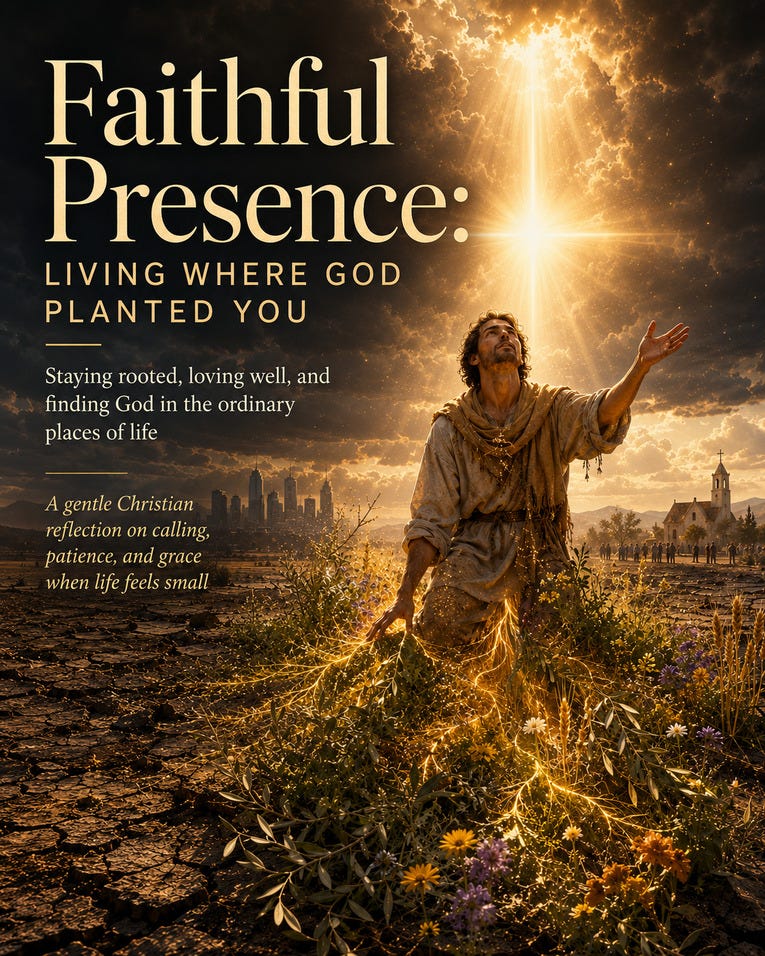
A gentle Christian reflection on calling, patience, and grace when life feels small
There is a way we can put so much of ourselves into the effort of getting to some other place that we are blind to what God is up to right where we stand.
I understand it.
You have your moments when a room is too quiet, a job is dull, or a town seems to have been left behind. A season drags on. A family matter is heavy. The church feels worn out. And the thought comes: “God has to have something more for me over there.”
Perhaps He does.
But then again, maybe His question to you is, “Will you be faithful here first?”
It is not an easy thing to hear in a culture as enamoured with movement as ours. We are surrounded by people who are off to a new city, a new project, a new identity, leaving something in their wake and building something in its place. Everyone is becoming someone.
And you? You are still here.
The same street, the same bills, the same health struggles and prayers at the table. It is just an ordinary Tuesday. You could be forgiven for thinking nothing is going on.
Ordinary does not have to be empty, though. Some of God’s best work is done out of sight. A kindness offered quietly. A prayer said through pain. Being the one who shows up. Helping a neighbour. Loving a child. Having a patient word when you would rather be angry. That is what I call faithful presence. It is no flash in the pan and it won’t excite you, but it is of consequence.
It is living with God in your actual circumstances and asking, “Lord, how do I love in this house, in this town, in this hard season?” Not in some far off future. Here.
We don’t find peace because we are at odds with our place. We tell ourselves we will be of use to God once we have moved, or made more money, or have the confidence for it. But God has a habit of starting before we are ready.
He did with Moses in the wilderness. With David in the field. With Mary in her village. Jesus Himself passed most of His time on earth in a small corner of the world, doing normal things with normal folk. There was no shame in those hidden years for the Son of God. He didn’t hover above life; he was in it, in the dust and the synagogue and the tired bodies.
So let that be some comfort. Your ordinary spot is not a prison. It can be an altar.
You may not have the stage or the ministry you wanted, but you have someone who needs mercy. You can offer patience where your church lacks it. You have this day to love your neighbour. Don’t let the big words like destiny and impact fool you. Sometimes calling is as simple as making the meal, telling the truth, forgiving the person, or being gentle.
It is not dramatic, but holiness has a way of growing there.
Faithfulness is as much about repeated love as it is about any grand decision. You put in the work even if the soil is dry and no one is clapping. You choose Christ when you are weary. Heaven takes note of that kind of power even if the world doesn’t see it right away.
We make it hard on ourselves by looking at another man’s success. Their book is selling, their photos are bright, their family is at peace. Ours doesn’t measure up and the heart sinks. Comparison will make your own field seem like nothing.
But God put you in your field, not his.
Now, I am not saying you must never leave. Sometimes a place is unsafe or the season is done and obedience is to go. But don’t confuse restlessness with a calling. There is a world of difference between running from discomfort and being led by God. Between escape and growth.
Pray about it. Before you make a move, ask what God is making of you in your current spot. He may be after your humility or your compassion. Hard places have a way of making deep people.
Though not without a fight. There is a way pain can make us bitter. Yet if we are willing to lay our situation before God, even the hardest ground can be made into soil for grace.
Consider what Jeremiah said to those in exile. They were longing for home, as one would expect. And yet God’s instruction was to put down roots: build houses, tend your gardens, pray for the city and its welfare. It is a stunning thing. They were not where they wanted to be, but He called them to live faithfully in their present circumstances. I think that resonates with a lot of us.
You might feel exiled in your own life. By illness or grief or loneliness. By a disappointment or some season you had no say in. But God can meet you there. A faithful presence does not put on airs about how easy things are, nor does it deny the hurt. It just won’t be convinced that God has left because life is difficult. We do not find Him only when times have turned around; He is in the middle of it. That is what Christian hope is all about.
Christ is Emmanuel. Not some distant deity or one who is only at the finish line, but God with us in the dust and the waiting room, in the kitchen and the hospital, in the small church and the lonely evening.
So there is no need to hold your place in contempt. Ask God to open your eyes and see who is near you, what needs tending, where love is lacking. What is the small good you can put in the world today? Who could use some encouragement? Such simple questions have the power to change a life.
Being faithful also means coming to terms with your limits. If you are the type who wants to do it all, this is hard. But you cannot be in every room, love everyone the same, or mend every wound. You are human. No insult intended, it is the truth. God did not put you here to save the world; someone else has that covered. He asks you to be true to what is in your hands. Be it one conversation, one prayer, one neighbour or customer who happens to cross your path. Do not write one off. Jesus never did. He saw the woman at the well, the tax collector up in the tree, the thief on the cross, the doubting disciple. The kingdom often comes near when one person is loved well. There is something beautiful and freeing in that. You don’t have to prove your life is of consequence, you can just live it before God.
Now, I am not saying you should give up on your dreams. Wanting a better future is no sin and planning is wise. But don’t let the future rob you of the present. If you are always after the next door or a grander calling, you will overlook the person beside you and the small obedience God has set before you for the day. And that matters. A kind word, a cup of water, a quiet prayer – these are of a piece with a faithful life.
We like to want the whole map from God, but He gives us the next step. Some may find that irritating, but it is mercy too. Show us the whole road and we would likely panic. So He gives us daily bread and strength and light. Enough for the day.
I would say faithful presence is born when you stop thinking “this is beneath me” and start to ask, “Lord, how do I love You in this spot?” It is a prayer that can soften you. It can make a sickbed a chapel, a workplace a witness, a house a ministry. Not by changing the place, but by letting us see God in it.
Some of us are put down in spots we would never pick for ourselves. I won’t pretend that is easy. But being planted is not being buried. A seed goes into the dark and for a time nothing is to be seen. Then the roots come, hidden and strong, and later the fruit. Perhaps this is root work. Perhaps in this small place you are being formed in ways success never could.
So be awake to it. Pray and love those at hand. Don’t let noise or numbers be your measure of a life. Trust Him with the rest. For you are in a place where God can meet you, and where He is, there is holiness.
© 2026 Daniel J. Grace. All rights reserved.
Written by Daniel J. Grace
Faith • Civilization • Theology
Independent Researcher and Author/MEAA Member
Official Website: https://www.danieljamesgrace.com
Amazon Book: https://www.amazon.com/dp/B0H4DG8C98

This is a needed word, especially for those of us tempted to imagine that faithfulness will finally begin somewhere else.
I appreciate that you do not confuse being planted with being trapped. There are times when obedience requires leaving. But there are also times when our restlessness is less a calling than an unwillingness to receive the place where God is trying to form us.
The deeper beauty of faithful presence, I think, is that it is not mere resignation. It is incarnational. God does not ask us to endure ordinary life from a distance. In Christ, He comes near to the kitchen, the waiting room, the worn-out church, the difficult neighbor, and the quiet work no one applauds.
Even exile is never the final word for God’s people. But while we wait for the fullness of home, love becomes one of the ways the kingdom takes root where we are.