
Faith Hidden in Stone
Christian Epigraphy, Discreet Identity, and Material Resistance before Constantine

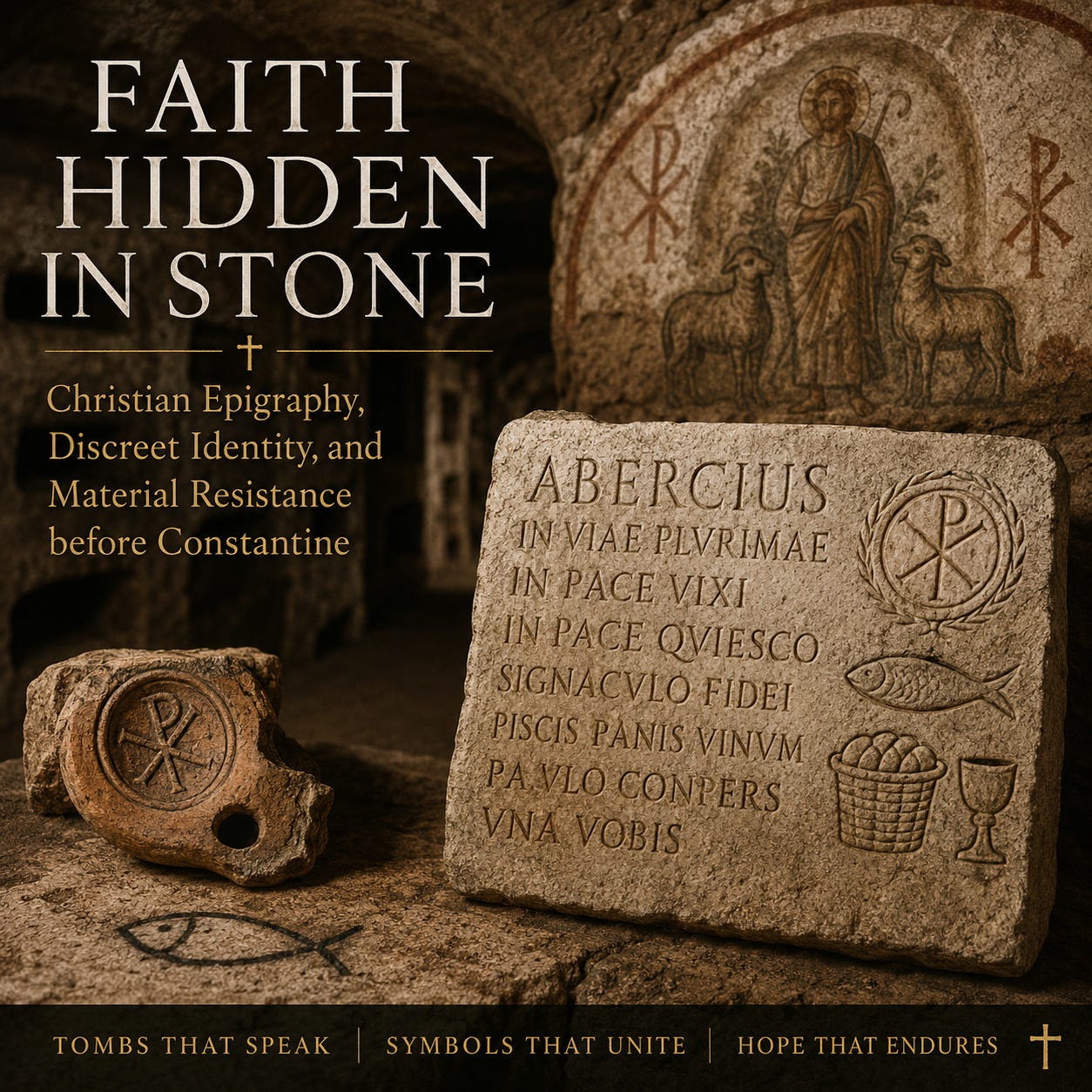
Before Constantine, Christians didn’t always announce themselves openly.
Sometimes their faith appeared in a symbol.
A fish.
A shepherd.
An anchor.
A short phrase carved into a tomb.
These inscriptions weren’t usually a secret code in the modern sense. There was no central Christian system of cryptography. But the language was often layered. A Roman passer-by might see an ordinary burial inscription. A Christian reader might see resurrection, baptism, Eucharistic fellowship, peace in Christ, and hope beyond death.
That difference matters.
Early Christians lived inside the Roman world. They used its roads, language, burial customs, and artistic forms. But they quietly redirected their meaning. Death became sleep. The grave became a place of hope. Peace was no longer simply civic order. It became peace in Christ.
The Abercius Inscription is one of the clearest examples. Its references to the Shepherd, the fish, bread, wine, the seal, and Paul formed a symbolic Christian world. It didn’t need to explain everything. Believers already knew the language.
This was not political conspiracy. It was theological resistance.
Rome could control public life. It could punish bodies. It could regulate burial and honour. But Christian inscriptions declared that the empire did not have the final word.
A believer could die and still be called alive.
A martyr could be executed and still be remembered as victorious.
A tomb could speak of peace rather than defeat.
That is why early Christian epigraphy matters. It gives us access to ordinary believers, not only bishops and theologians. Families, artisans, mourners, pilgrims, and local communities all helped shape this material language of faith.
Their words were often brief.
But they carried an entire world.
Faith was hidden in stone, yet it was never silent.
Daniel J. Grace
Faith • Civilization • Theology
Zenodo DOI: 10.5281/zenodo.21532118
Published: 24 July 2026
Article Type: Research Article
Originally published in Faith • Civilization • Theology.
For more articles, books, and research by Daniel J. Grace, visit: https://faithcivilizationtheology.com
https://danieljamesgrace.com