
Digital and Virtual Sacraments: Can Technology Replace the Church?

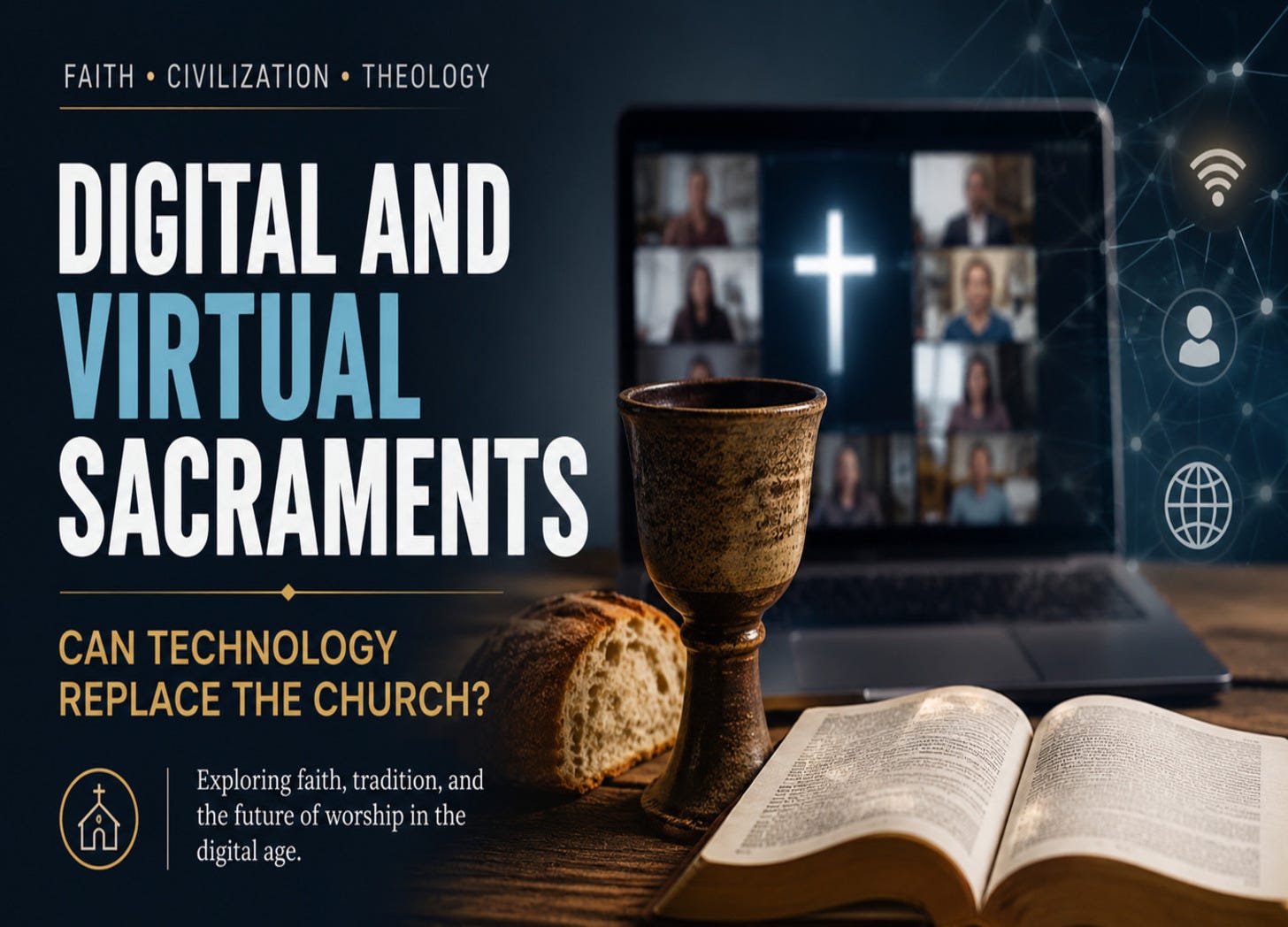
By Daniel J. Grace
For centuries, Christians have gathered around the Lord’s Table, witnessed baptisms, and shared in the ordinary yet extraordinary life of the Church. These moments have never been merely symbolic events. They have been acts of worship, fellowship, remembrance, and obedience to Jesus Christ.
Then came the digital age.
Livestream worship, online prayer meetings, virtual Bible studies, and church apps have become part of everyday Christian life. During the COVID-19 pandemic, many churches had little choice but to worship through screens. Christians around the world asked questions that previous generations could scarcely imagine.
Can communion be celebrated online?
Can someone be baptized through a video call?
Can technology replace physical gathering?
These are no longer theoretical questions. They are questions facing the global Church today.
Technology is one of the greatest tools ever developed for spreading the gospel. Every day millions of people hear biblical teaching through podcasts, YouTube, social media, and online churches. Someone living in a remote village can listen to faithful preaching. A believer confined to a hospital bed can worship with fellow Christians. Missionaries can disciple people across continents without boarding an airplane.
These developments should not be dismissed. They are remarkable gifts that God can use for His purposes.
Yet technology also has limits.
Christianity is not simply a religion of information. It is a faith lived within a community.
Jesus did not merely send teachings from heaven. “The Word became flesh and dwelt among us” (John 1:14, NKJV). God entered history physically, walked among people, touched the sick, embraced children, and broke bread with His disciples.
The incarnation reminds us that physical presence matters.
The sacraments—or ordinances, depending on one’s Christian tradition—also involve physical reality.
Baptism uses water.
The Lord’s Supper uses bread and the cup.
These visible signs point to invisible spiritual truths. They remind believers that God works not only through words but also through embodied acts of faith within the gathered community.
This raises an important question.
Can a livestream truly replace standing together around the Lord’s Table?
Can clicking a button become the equivalent of receiving baptism within the fellowship of the Church?
Different Christian traditions answer these questions differently.
Some churches accepted online communion during extraordinary circumstances. Others argued that the Lord’s Supper requires the gathered congregation under pastoral oversight. Similar debates continue regarding baptism, confession, confirmation, and other sacramental practices.
Whatever position one takes, one truth remains clear.
Technology is an instrument.
It is not the Church.
Watching a sermon online can nourish faith, but it does not fully replace life together with other believers. The New Testament consistently presents Christians as members of one body who encourage one another, bear one another’s burdens, worship together, and share life together.
The Church has always been more than content.
It is communion.
It is fellowship.
It is shared worship.
It is mutual care.
Digital ministry should therefore be viewed as an extension of the Church’s mission rather than a replacement for the Church itself.
The future will almost certainly bring even more difficult questions.
Artificial intelligence may generate sermons.
Virtual reality may create immersive worship environments.
Digital avatars may one day attend church meetings.
These technologies may offer genuine opportunities for teaching, evangelism, and pastoral care. Yet they also invite the Church to think carefully about what cannot be digitised.
Faith itself cannot be automated.
Repentance cannot be programmed.
Love cannot be downloaded.
Discipleship cannot be reduced to an algorithm.
The Christian life remains deeply relational because God Himself is relational.
Perhaps the greatest challenge is not whether technology changes the Church.
It certainly will.
The greater question is whether the Church will continue allowing Scripture to define worship rather than allowing technology to define it.
Innovation is valuable.
Mission requires creativity.
But faithfulness requires wisdom.
As Christians embrace the opportunities of the digital age, we should gladly use every faithful tool available to proclaim Christ. At the same time, we must remember that no screen can replace the beauty of believers gathering together, worshipping together, praying together, and sharing the visible signs Christ entrusted to His Church.
Technology may carry the gospel across the world.
Only the Church can live it together.
© 2026 Daniel J. Grace. All rights reserved.
Faith • Civilization • Theology
Originally published on Daniel J. Grace’s Substack. Also, for more articles on Christian faith, biblical theology, church history, and discipleship, visit: