
Death, the Soul, and the Hope of Jesus Christ
Why science, human will, and technology cannot replace the eternal life found in God

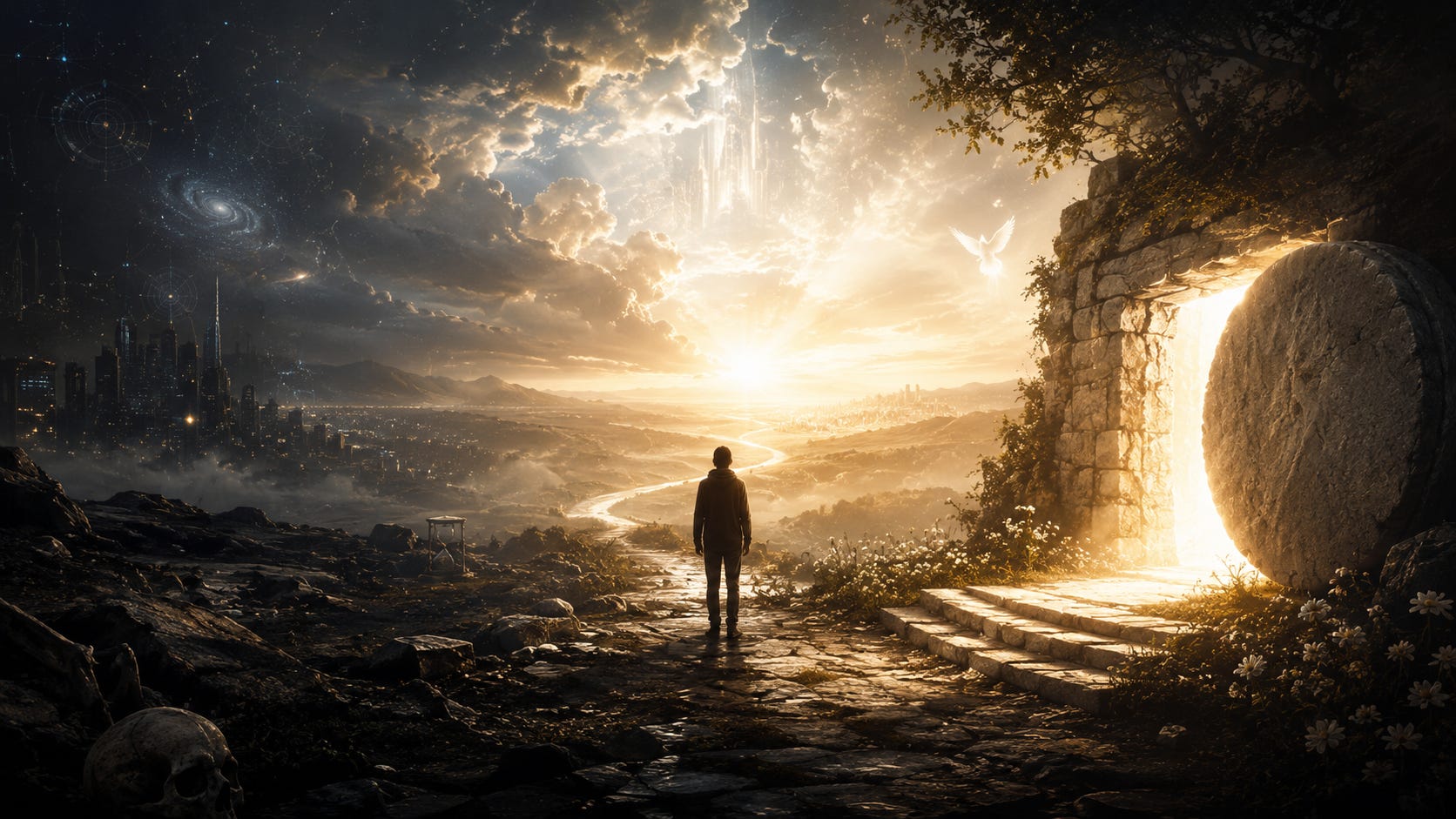
Human beings have always stood before the mystery of life and death.
We can study the body. We can examine blood, bones, DNA, cells, organs, and the brain. We can explain many biological processes. We can describe how an embryo develops, how genes are expressed, how fingerprints form, how eyes become unique, and how living creatures grow within the created order of nature.
But when we ask the deepest question — why there is life at all — science reaches the edge of mystery.
Science can describe what happens after life exists. It can study living cells, genetic code, reproduction, development, evolution, disease, healing, and death. But the first movement from non-life to life remains one of humanity’s greatest questions. How does “nothing” become “something”? How does chemistry become life? How does matter become consciousness? How does dust become a person who loves, grieves, prays, hopes, forgives, and fears eternity?
This is where faith begins to speak.
The human body is made from the earth. It is physical, biological, fragile, and mortal. But the human person is more than elements. The soul cannot be placed under a microscope like blood or tissue, yet the human person cannot be reduced to chemistry alone. Love is more than chemical reaction. Conscience is more than survival instinct. Sacrifice is more than biology. Grief is more than brain activity. The human cry for eternity points beyond the body.
Christian faith teaches that humanity is made in the image of God.
This does not mean human beings are God. It means humanity reflects something of God in a limited way. God sees, knows, creates, speaks, loves, judges, forgives, and gives life without limit. Human beings can see, know, create, speak, love, judge, forgive, and give life in limited ways. We are not the Creator, but we reflect the Creator.
That is why human life is sacred.
The body belongs to the earth, but the soul belongs to God. The world may wound the body, disease may weaken the body, violence may destroy the body, and death may take the body, but death does not own the soul. The soul comes from God and returns to God.
This truth gives hope, especially when we face the death of the innocent.
When a child dies, the human heart cries out, “Where is God?” This is not a small question. It is not a question to answer with cold religion. A child’s death is a wound in the human world. It breaks families, silences rooms, and leaves grief that words cannot repair.
But Christian hope does not say that God is cruel. Christian hope says that the world is broken, death is an enemy, and God’s mercy is greater than tragedy. A child is not judged like a hardened adult who has chosen cruelty, violence, deception, and rebellion. God sees the soul, the age, the innocence, the suffering, the intention, and the whole story.
The broken world may take the body, but God receives the soul.
This does not remove grief, but it gives hope. Death may touch the flesh, but it cannot steal the child from the Creator. The innocent soul is not abandoned in the accident, the hospital, the violence, or the grave. The soul belongs to God.
This is why death makes life serious.
If human beings never died, perhaps few would search for God. If our bodies stayed strong, if funerals didn’t happen, if graves stayed closed, perhaps humanity would imagine that this world is enough. But death exposes the truth. We are not unlimited. We are not gods. We cannot save ourselves by pride, money, science, politics, fame, beauty, or technology.
Death asks every human being: What is life? What is the soul? What is the meaning of love? What happens after the body returns to dust?
The modern world is trying to answer death with technology. Humanity now studies artificial intelligence, genetic engineering, biotechnology, digital consciousness, longevity science, and the possibility of extending life. These things can be used for good when they heal suffering, protect life, and serve human dignity. Medicine is not evil. Science is not evil. Technology is not evil when it serves truth, mercy, and life.
But there is a spiritual danger.
Humanity may one day try not only to heal disease, but to seize immortality without God. Humanity may try to say, “We will become our own gods. We will conquer death by our own power. We will not need the Creator.”
This is the old temptation in modern clothes.
The danger is not that humanity wants to live. Life is good. Healing is good. The desire for life is not wrong. The danger is that humanity wants eternal life without the Eternal One. The danger is the image of God trying to replace God.
Human beings can extend life, but only God gives eternal life. Human beings can repair the body, but only Christ restores the soul. Human beings can study DNA, edit DNA, and use the code of life, but humanity did not create life from nothing. We can touch the code, but we did not speak the first life into existence.
Science studies the widening angle of creation. Faith asks who opened the first angle.
The more we go backward, the closer we come to the mystery of origin: life, order, law, time, matter, consciousness, and existence itself. The more we come forward, the more we see expansion: human thought, language, civilisation, science, technology, and artificial intelligence. Yet all of this still points to the same question: why is there something rather than nothing?
Some call the source nature. Some call it chance. Some call it force. Some call it mystery. I call Him God.
For the Christian, God is not merely an impersonal force. God is the living Creator: holy, personal, loving, just, merciful, and revealed in Jesus Christ.
This moment is where Christianity becomes more than religion.
Christianity may be called a religion from the outside. It has Scripture, worship, prayer, church, baptism, communion, teaching, history, and community. But from the inside, Christianity is deeper than religious structure. Christianity is a relationship: God restoring His own image in humanity through Jesus Christ.
Religion often becomes a human effort to reach God. Christianity begins with God reaching humanity.
Humanity was made in the image of God, but sin damaged that image. Sin is not merely a children’s story about forbidden fruit. The Bible does not even say “apple”. The deeper meaning is that humanity used freedom against God. Humanity tried to become God without God. The image of God turned inward and became pride, control, deception, violence, selfishness, and self-worship.
Sin is the image of God misused.
This reality is why blaming Satan for everything is spiritually dangerous. Satan may be understood as deceiver, accuser, rebel, or spiritual enemy, but Satan cannot become an excuse for human responsibility. Human beings cannot run away from guilt by saying, “Satan made me do it.” The human will matters.
The tragedy of sin is not only that evil exists. The tragedy is that the human will can agree with evil, protect evil, excuse evil, and then blame Satan instead of repenting before God.
God created freedom for love, not for evil. But when the human will turns away from God, freedom becomes darkness. Evil becomes real in the world when the human will cooperates with pride, hatred, violence, greed, cruelty, and deception.
“The answer is not empty religion.”. The answer is restoration.
Jesus Christ is the perfect image of the invisible God. Humanity reflects God partly, but Jesus reveals God fully. In Jesus, God comes near. God does not save humanity from a distance. He enters human life, human body, human suffering, human grief, human death, and human resurrection hope.
Jesus is not a magician. His miracles are not entertainment. At the tomb of Lazarus, Jesus does not perform a trick. He reveals the heart of God before the face of death. In His human body, He stands with grief. In His divine authority, He speaks life. The Father is not absent. The Holy Spirit is not separate. One God acts in perfect unity.
The Father sends.
The Son comes in human flesh.
The Holy Spirit gives life and power.
Yet God is one.
Jesus Christ does not merely explain death. He defeats it. He does not merely comfort mourners. He reveals resurrection. He does not merely improve religion. He restores our relationship with God.
This is why Christianity remains the only true answer to the deepest human question.
Not because denominations are perfect. They are not. Not because pastors, priests, teachers, or churches are always faithful. They are not. Not because religious institutions never fail. They often do.
Christianity is true because Christ is true.
Pastors may help when they point people to Jesus. Churches may help when they remain humble, biblical, merciful, and Christ-centred. Denominations may help when they serve the gospel. But when pastors, priests, churches, and religious systems replace Jesus with their own power, ego, money, control, or false theology, they become dangerous.
Do not lose Christ inside religion.
The way is not a denomination.
The truth is not a religious title.
The life is not found in human power.
Jesus Christ is the way, the truth, and the life.
This is the final conclusion: humanity is made in the image of God, but humanity is broken. Science can study the body, but it cannot exhaust the soul. Technology can extend life, but it cannot give eternal life. Religion can speak about God, but only Jesus brings us to the Father. Human will can create darkness, but Christ restores the will. Death is real, but resurrection is greater.
The hope of humanity is not artificial immortality.
The hope of humanity is not fake religion.
The hope of humanity is not human pride pretending to become God.
The hope of humanity is Jesus Christ.
The body returns to dust.
The soul belongs to God.
The image is restored in Christ.
Death is defeated by resurrection.
And eternal life is not seized by technology — it is received through the living God.
Amen.
Dr Daniel J. Grace
Faith • Civilization • Theology
Research • Journalism • Truth
🌐 Official Web Page
🌐 Amazon Books Page
© 2026 Dr Daniel J. Grace. All Rights Reserved.
No part of this article may be reproduced, distributed, transmitted, republished, or adapted in any form or by any means without prior written permission from the author, except for brief quotations used in academic citation, review, or research purposes.