

Daily Life in Ephesus: Society, Commerce, Religion, and the World of Early Christianity
Exploring the Social, Economic, Religious, and Cultural Landscape of First-Century Ephesus

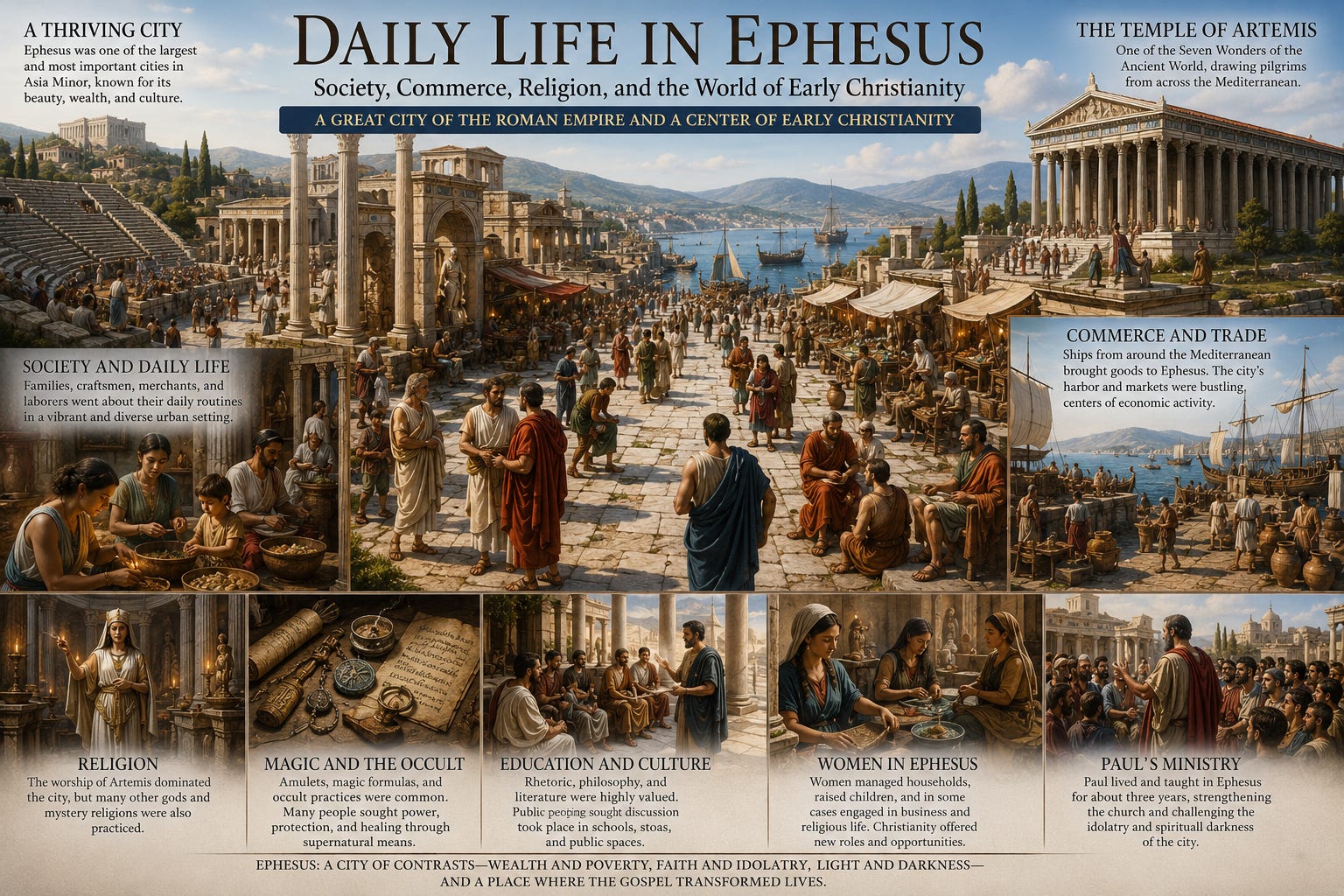
Ephesus was one of the most influential cities of the Roman Empire and served as a major centre of commerce, culture, religion, and politics in Asia Minor. As the capital of the Roman province of Asia, it attracted merchants, pilgrims, sailors, government officials, craftsmen, and travellers from across the Mediterranean world. The city was famous for its magnificent harbour, its bustling marketplace, and above all for the Temple of Artemis, one of the Seven Wonders of the Ancient World. Ephesus also played a crucial role in the development of early Christianity, becoming one of the most significant Christian centres of the first century. This article explores the daily life of ordinary inhabitants of Ephesus, examining their homes, occupations, religious practices, social structures, economic activities, and cultural environment. By reconstructing the everyday experiences of Ephesian citizens, we gain valuable insight into the world encountered by the Apostle Paul, the Apostle John, and the early Christian community.
Introduction
To understand the New Testament church in Ephesus, it is necessary first to understand the city itself. Modern readers often encounter Ephesus primarily through biblical texts, particularly the Book of Acts, the Epistle to the Ephesians, and the Book of Revelation. Yet Ephesus was far more than a backdrop for Christian history. It was a vibrant and complex urban centre whose influence extended throughout the eastern Mediterranean.
At its height during the first century AD, Ephesus was home to approximately 200,000 to 250,000 inhabitants, making it one of the largest cities of the Roman Empire. Its strategic location near the Aegean coast allowed it to serve as a gateway between East and West. Goods from Egypt, Greece, Italy, Syria, and Asia flowed through its markets, creating immense wealth and cultural diversity.
The daily life of the Ephesian population was shaped by this unique combination of commercial prosperity, religious devotion, Roman administration, and Greek culture. Every aspect of life—from work and family relationships to entertainment and religious practice—reflected the city’s position as one of antiquity’s great metropolitan centres.
Ephesus as a Commercial Hub
Commerce formed the foundation of Ephesian life. The city’s harbour connected Asia Minor to major trade routes across the Mediterranean. Merchant ships arrived daily carrying grain, wine, olive oil, textiles, spices, precious metals, and luxury goods.
The Agora, or marketplace, served as the economic heart of the city. Here merchants negotiated contracts, exchanged currencies, sold imported products, and conducted business transactions. Local craftsmen maintained workshops producing pottery, leather goods, jewellery, clothing, and religious souvenirs.
Many residents earned their living through occupations connected to trade. Sailors, dock workers, transporters, accountants, money changers, and warehouse operators formed a significant part of the urban workforce. Wealthy merchants often accumulated considerable fortunes through international commerce.
Homes and Family Life
The contrast between rich and poor was evident throughout Ephesus. Wealthy families occupied spacious homes decorated with mosaics, marble floors, courtyards, fountains, and elaborate artwork. Archaeological excavations of the Terrace Houses reveal impressive residences equipped with sophisticated plumbing and heating systems.
Ordinary citizens typically lived in smaller dwellings situated within densely populated neighbourhoods. These homes often consisted of several rooms surrounding a central courtyard where cooking, household activities, and family gatherings occurred.
Family life was structured according to Roman and Greek traditions. Fathers exercised significant authority within the household, while women managed domestic responsibilities. Children were educated according to the family’s social status, and extended family relationships played an important role in social stability.
Food and Daily Routine
Daily life began early in Ephesus. Markets opened shortly after sunrise, and workers travelled to workshops, docks, farms, and public offices.
The Ephesian diet consisted primarily of bread, olives, vegetables, fish, fruits, cheese, and wine. Wealthier citizens enjoyed greater access to imported foods and meat products. Public fountains provided water throughout the city, while bakeries, taverns, and food vendors supplied meals for those away from home.
Meals also served important social functions. Families gathered together, business relationships were cultivated, and religious celebrations often included communal feasts.
Religion and the Cult of Artemis
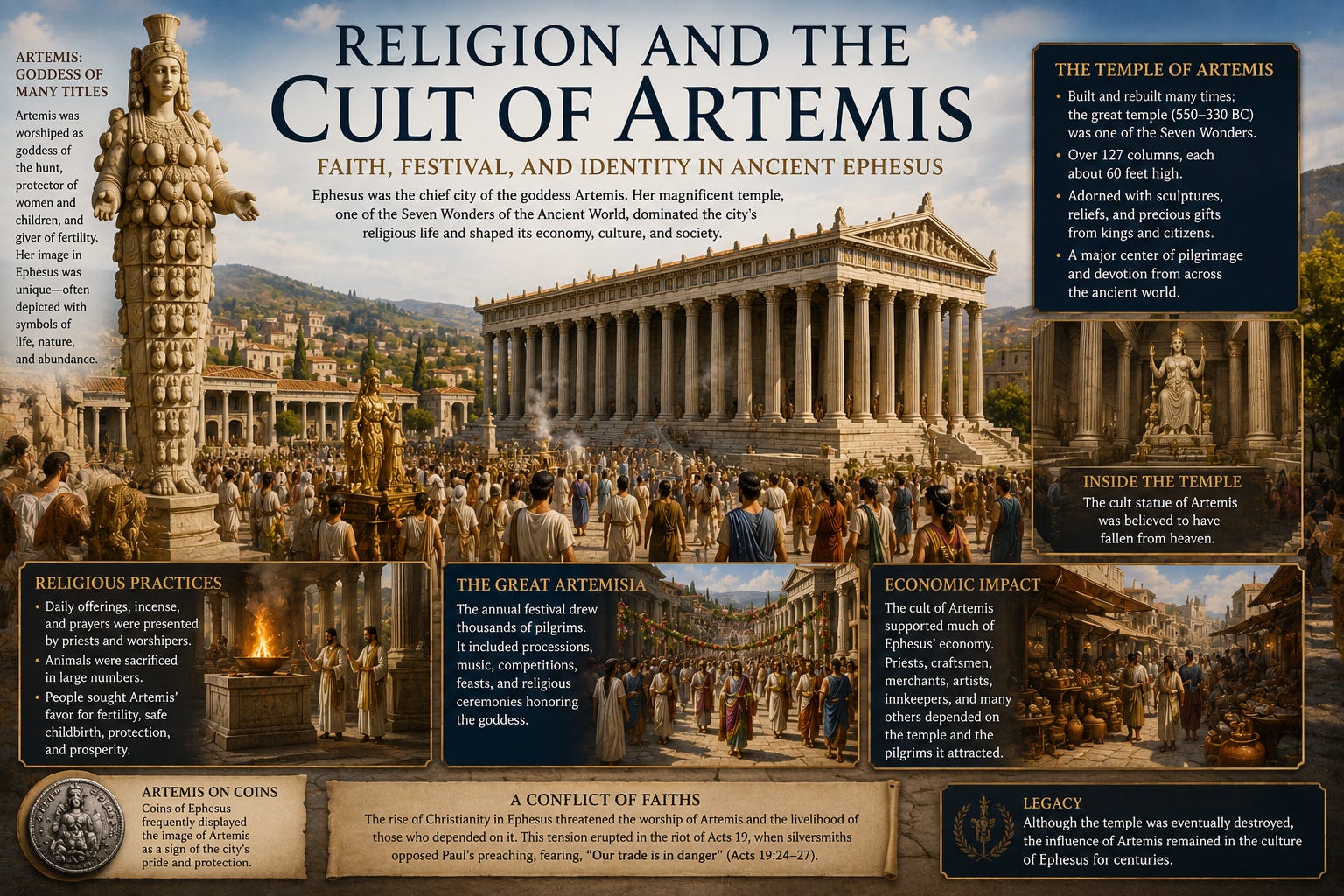
Religion permeated every aspect of Ephesian life. The city was dominated by the worship of Artemis, whose magnificent temple attracted pilgrims from throughout the Roman world.
The Temple of Artemis was not merely a religious institution; it functioned as an economic, social, and political centre. Festivals honouring the goddess drew thousands of visitors and generated substantial income for local merchants and craftsmen.
Many citizens purchased religious objects associated with Artemis. Silversmiths produced shrines and statues for pilgrims, creating an industry so significant that the spread of Christianity eventually threatened their livelihood, as recorded in Acts 19.
Beyond Artemis, Ephesus contained temples dedicated to Roman emperors, traditional Greek gods, and various mystery religions. Religious diversity characterised the city, exposing residents to numerous spiritual beliefs and practices.
Entertainment and Public Life
Public entertainment occupied an important place in Ephesian society. The city’s massive theatre could accommodate approximately 25,000 spectators and hosted dramatic performances, political gatherings, and public ceremonies.
Athletic competitions, musical performances, festivals, and public celebrations attracted large crowds. Bathhouses provided opportunities for relaxation, exercise, social interaction, and business discussions.
For many citizens, public spaces served as centres of social life where friendships were formed, information was exchanged, and community identity was reinforced.
Education and Intellectual Life
Ephesus was not only a commercial centre but also an important center of learning and culture. Influenced by both Greek and Roman traditions, the city valued education as a means of social advancement and civic participation. Wealthier families often employed private tutors to educate their children in reading, writing, rhetoric, philosophy, mathematics, and literature.
Public speakers, philosophers, and teachers regularly gathered in public spaces, attracting audiences interested in intellectual discussion. Knowledge of the Greek language and literature was considered a mark of refinement and social status. Citizens who mastered rhetoric often pursued careers in government, law, or commerce.
The intellectual atmosphere of Ephesus created opportunities for the spread of new ideas, including Christianity. The Apostle Paul frequently engaged audiences through public teaching and debate, presenting the Christian message within a society accustomed to philosophical and religious discussion.
Women in Ephesian Society
The lives of women in Ephesus varied considerably according to social status. Wealthy women often exercised influence through family connections, business interests, and religious patronage. Some contributed financially to public projects, temples, and charitable activities.
Most women, however, were primarily responsible for managing households, raising children, preparing food, and supervising domestic servants. Despite legal limitations, women often played significant roles within family businesses and local commerce.
The rise of Christianity introduced important changes to the status of women. Early Christian communities welcomed women as active participants in worship, ministry, hospitality, and charitable work. The New Testament itself reflects the presence of influential Christian women who supported the growth of the church.
For many Ephesian women, Christianity offered a sense of dignity and spiritual equality that contrasted with some aspects of traditional Roman society.
Slavery and Social Hierarchy
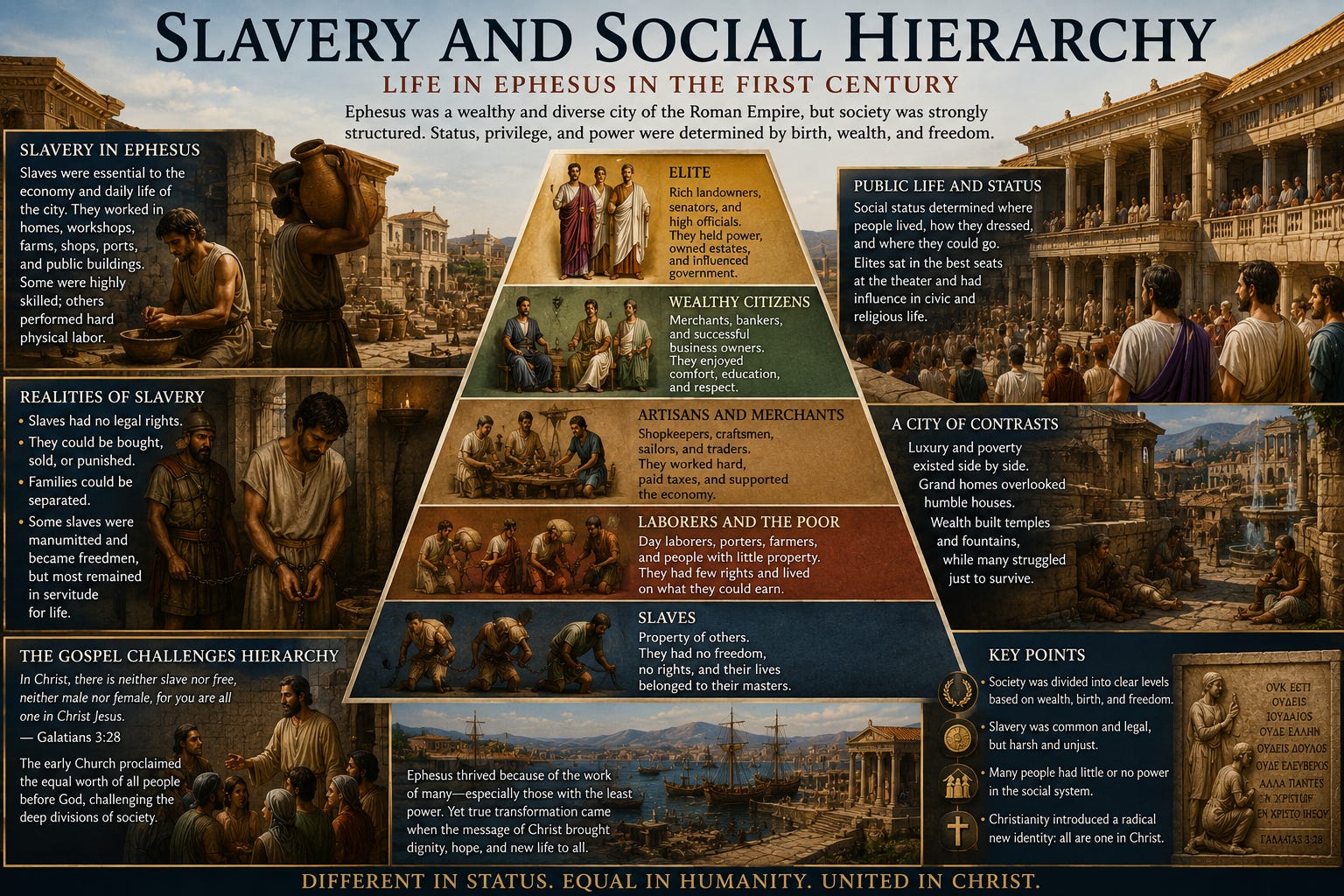
Like most major cities of the Roman Empire, Ephesus depended heavily upon slave labour. Slaves worked in households, workshops, farms, warehouses, government offices, and commercial enterprises.
Some slaves performed difficult physical labour under harsh conditions, while others occupied positions of considerable responsibility as teachers, accountants, administrators, and managers. Their experiences varied significantly depending on their owners and occupations.
The social structure of Ephesus was highly stratified. Wealthy landowners, merchants, and government officials occupied the highest levels of society, while artisans, labourers, and slaves formed the majority of the population.
The Christian message challenged many assumptions underlying this hierarchy. Although Christianity did not immediately abolish slavery, it proclaimed the spiritual equality of all believers before God. Paul’s teachings emphasised the shared humanity of masters and slaves, introducing principles that would later influence Christian opposition to slavery.
Roman Administration and Civic Government
As the capital of the Roman province of Asia, Ephesus served as an important administrative center. Roman officials maintained law and order, supervised taxation, managed public works, and ensured loyalty to the Empire.
The city was governed by local magistrates who worked within the broader framework of Roman authority. Public officials oversaw legal disputes, organised festivals, maintained infrastructure, and represented the interests of the city before imperial authorities.
Roman influence was visible throughout Ephesus. Public buildings, roads, baths, monuments, and administrative offices reflected the power and prestige of the Empire. Citizens were expected to demonstrate loyalty to Rome and participate in civic ceremonies honouring the emperor.
This political environment often created tensions for Christians, whose ultimate allegiance belonged to Christ rather than Caesar.
Harbor Trade and Economic Prosperity
The harbour of Ephesus served as the economic lifeline of the city. Merchant vessels arrived daily carrying goods from every corner of the Mediterranean world. Egyptian grain, Syrian spices, Greek wine, Italian luxury products, and Asian textiles all passed through Ephesian markets.
The harbour generated employment for sailors, dockworkers, merchants, warehouse operators, craftsmen, transporters, and traders. Economic prosperity attracted immigrants seeking opportunity and contributed to the city’s cosmopolitan character.
The wealth generated through maritime commerce funded public buildings, religious institutions, entertainment venues, and civic projects. Many of the impressive structures visible in Ephesus today were made possible by the city’s commercial success.
The bustling harbour also exposed residents to diverse cultures, languages, religions, and philosophies, making Ephesus one of the most international cities of the Roman world.
Magic, Superstition, and the Occult
One of the most distinctive features of Ephesian religious life was the widespread practice of magic and occult arts. Ancient sources and archaeological discoveries reveal that many inhabitants relied upon charms, amulets, magical formulas, and spiritual rituals for protection, healing, prosperity, and guidance.
The so-called “Ephesian Letters” were famous magical inscriptions believed to possess supernatural power. Amulets bearing these formulas circulated throughout the ancient world.
The Book of Acts records a remarkable event following Paul’s ministry in Ephesus. Many converts publicly renounced magical practices and burned valuable scrolls containing occult formulas. The total value of these scrolls was enormous, demonstrating both the popularity and profitability of magical practices within the city.
This dramatic rejection of occultism illustrates the transformative impact of Christianity upon Ephesian society. The gospel challenged not only idolatry but also widespread dependence upon magical and superstitious practices.
The Ministry of Paul in Ephesus
No individual influenced the development of Christianity in Ephesus more than the Apostle Paul. During his extended ministry in the city, he preached in synagogues, taught publicly, and established a thriving Christian community.
According to Acts 19, Paul remained in Ephesus for approximately three years, making it one of the longest periods spent in any single location during his missionary journeys. From Ephesus, the gospel spread throughout the surrounding region of Asia Minor.
Paul’s ministry included public teaching, discipleship, evangelism, and pastoral leadership. His message challenged established religious systems and ultimately threatened economic interests connected to the worship of Artemis.
The resulting conflict culminated in the famous riot led by silversmiths who feared the decline of their trade. The incident demonstrates the profound social and economic impact Christianity was beginning to exert within the city.
The church established through Paul’s ministry would later become one of the most significant Christian communities of the early church. Tradition associates Ephesus not only with Paul but also with the Apostle John and other important Christian leaders.
The city’s importance in Christian history continued long after the apostolic period, making Ephesus one of the most influential centers of early Christianity.
Christianity in Daily Ephesian Life
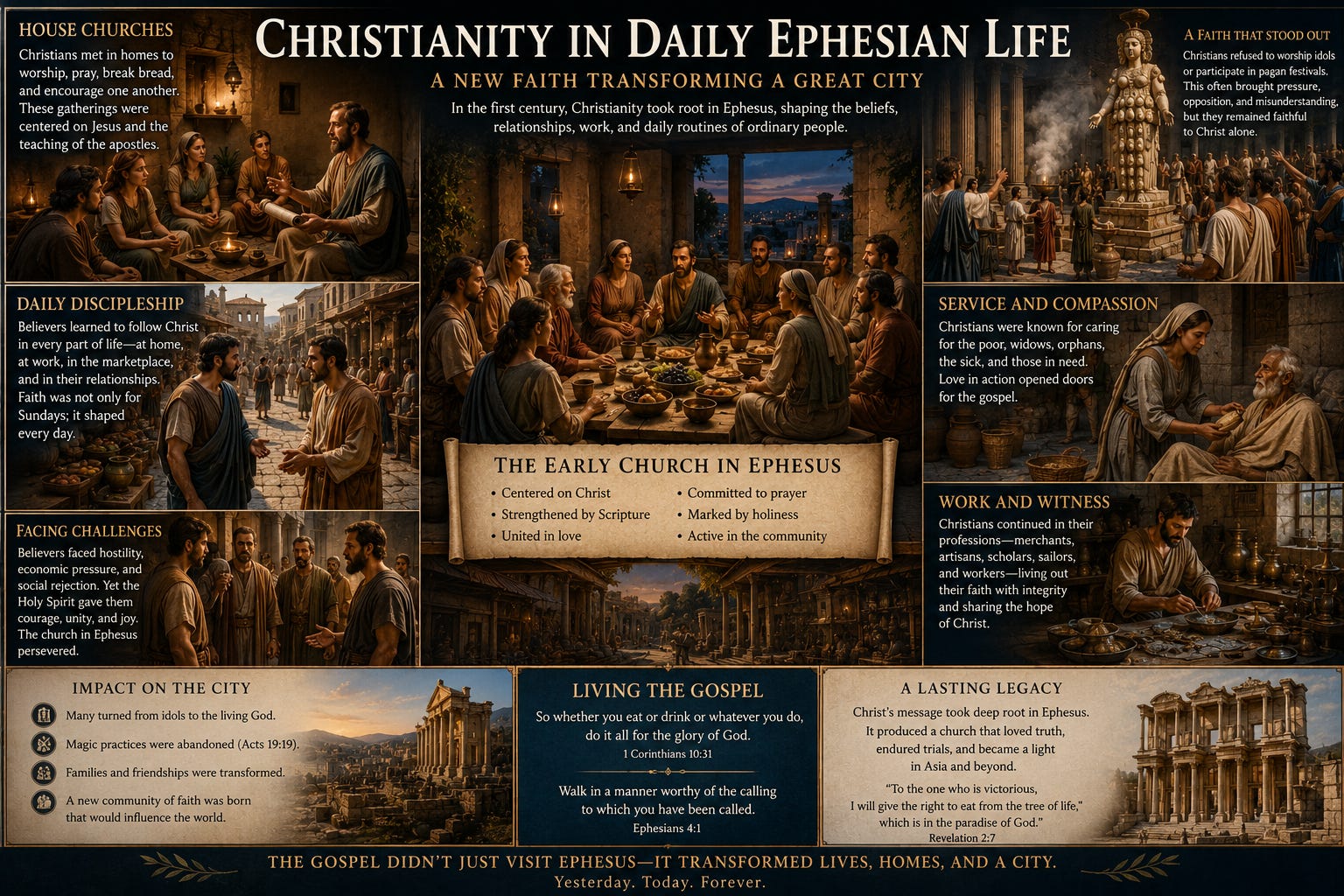
The arrival of Christianity introduced a new worldview into Ephesian society. Converts often found themselves navigating tensions between their new faith and established cultural practices.
Christian merchants faced challenges regarding participation in pagan festivals. Craftsmen connected to idol production confronted ethical questions concerning their occupations. Families sometimes experienced division when members adopted Christian beliefs while others remained committed to traditional religions.
The Apostle Paul’s ministry transformed many lives in Ephesus. House churches emerged throughout the city, offering believers a community centred upon worship, prayer, fellowship, and mutual support.
The Christian message challenged many assumptions of Ephesian culture. Instead of devotion to Artemis, believers worshipped Christ. Instead of seeking spiritual protection through magic and idols, they placed their trust in God. Instead of defining identity through social status, they embraced a new identity as members of the body of Christ.
Daily life in Ephesus was shaped by wealth, commerce, religion, culture, and social complexity. As one of the great cities of the Roman Empire, it offered opportunities for prosperity while exposing its inhabitants to powerful spiritual influences. Understanding this environment provides valuable insight into the challenges faced by the early church and the significance of Christianity’s growth within the city.
The story of Ephesus is ultimately more than an account of ancient urban life. It is a reminder that the Christian faith emerged within real historical communities whose members navigated the pressures of culture, economics, politics, and religion. By examining their daily experiences, modern readers gain a richer understanding of both the New Testament world and the enduring relevance of its message.
Dr. Daniel James Grace.
Research • Journalism • Theology
© 2026 All rights reserved.