
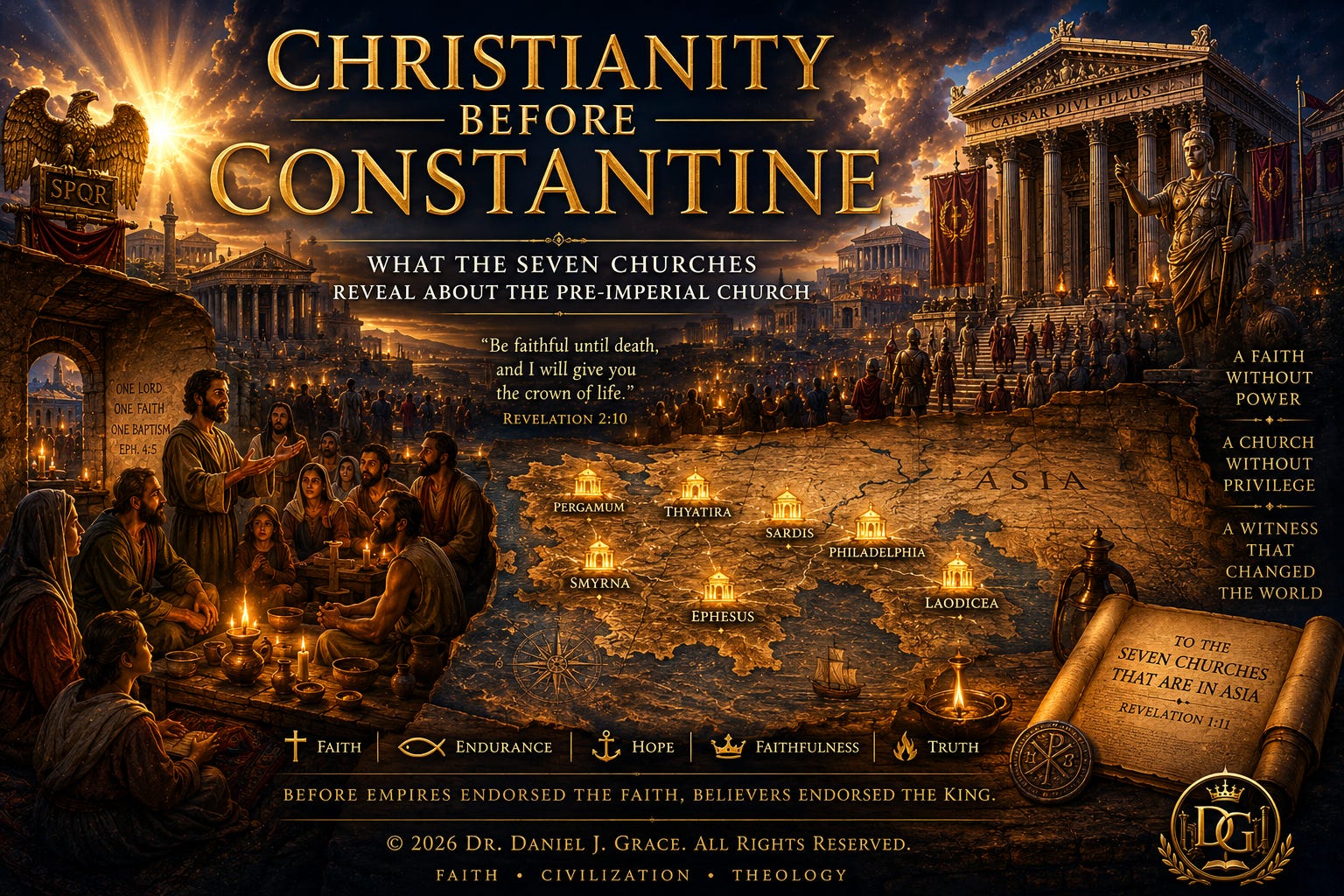
Christianity Before Constantine
What the Seven Churches Reveal About the Pre-Imperial Church

The Forgotten World of Christianity Before Power, Privilege, and Empire
When many people imagine Christian history, they think of grand cathedrals, powerful bishops, theological councils, and the Christian Roman Empire. The image of Christianity that often comes to mind is one associated with influence, institutions, and political recognition.
Yet for nearly three centuries Christianity existed without any of these things.
Before Emperor Constantine legalized Christianity in AD 313 through the Edict of Milan, the Church lived as a minority movement scattered across the Roman world. Christians possessed no state protection. They controlled no governments. They built no massive cathedrals. They held no privileged position within society.
And yet the Church grew.
The Seven Churches of Revelation provide one of the clearest windows into this remarkable period of Christian history. Through Ephesus, Smyrna, Pergamum, Thyatira, Sardis, Philadelphia, and Laodicea, we glimpse a Church that existed before imperial favor, before political power, and before Christianity became intertwined with the Roman state.
Their experience raises an important question:
What can modern Christians learn from the Church before Constantine?
The World Before Constantine
The Roman Empire dominated the Mediterranean world during the first centuries of Christianity.
Roman roads connected vast territories.
Trade linked distant cities.
Military power maintained order.
Emperor worship reinforced political loyalty.
Religion was woven into public life.
Within this environment Christianity emerged as a small and often misunderstood movement.
Unlike traditional Roman religions, Christians worshipped only one God.
Unlike many religious groups, they refused participation in pagan sacrifices.
Unlike emperor cults, they rejected worship of Caesar.
These convictions frequently placed believers at odds with society.
The Church was not born in a position of strength.
It was born in a position of vulnerability.
The Seven Churches as Historical Witnesses
The churches addressed in Revelation existed during this pre-imperial period.
Their world was very different from later Christian history.
These congregations met before Christianity became legal.
They worshipped before church buildings dominated city skylines.
They practiced their faith without government support.
The messages of Revelation therefore provide invaluable insight into what Christianity looked like before Constantine.
The churches reveal both strengths and weaknesses, victories and failures, courage and compromise.
Most importantly, they reveal what mattered most to Christ.
A Church Without Political Power
One of the most striking characteristics of the Seven Churches is their complete lack of political influence.
None of the churches controlled local government.
None possessed legal authority.
None enjoyed state protection.
They could not rely upon legislation to advance their mission.
They could not appeal to political power for security.
Their influence depended entirely upon witness, character, and faithfulness.
This reality challenges many modern assumptions.
Today Christians often debate political strategies, legislation, and cultural influence.
The pre-Constantinian Church possessed none of these advantages.
Yet it transformed the ancient world.
Its power came from conviction rather than coercion.
Ephesus and Doctrinal Faithfulness
The church at Ephesus demonstrated remarkable commitment to doctrinal truth.
Christ praised them for testing false teachers and rejecting error.
They defended the faith carefully.
Yet they also faced a serious problem.
They had abandoned their first love.
This combination reveals an important characteristic of the early Church.
The pre-imperial Christians cared deeply about truth.
Doctrine mattered.
Yet Christ reminded them that orthodoxy without love was incomplete.
The lesson remains relevant today.
The Church must preserve both truth and devotion.
Smyrna and the Theology of Suffering
No church receives greater praise in Revelation than Smyrna.
The believers there faced hardship, poverty, and persecution.
Yet Christ described them as spiritually rich.
Smyrna reveals something often forgotten in modern Christianity.
The early Church expected suffering.
Following Christ was not viewed as a pathway to comfort or prosperity.
Faithfulness often involved sacrifice.
The Christians of Smyrna understood that discipleship carried a cost.
Their example challenges contemporary assumptions that spiritual success should always produce material success.
Pergamum and Cultural Pressure
Pergamum stood at the center of emperor worship in Asia Minor.
The city embodied political and religious power.
Christ described it as the place “where Satan has his throne.”
Believers faced enormous pressure to compromise.
Participation in civic life often required engagement with practices incompatible with Christian convictions.
The church’s struggle demonstrates that cultural pressure is not a modern phenomenon.
The earliest Christians also wrestled with questions of accommodation and resistance.
Their experience reminds believers that faithfulness sometimes requires standing apart from prevailing cultural expectations.
Thyatira and Economic Compromise
The church in Thyatira confronted challenges linked to commerce and trade guilds.
Economic participation often involved pagan religious activities.
Believers had to choose between financial opportunities and spiritual integrity.
This reveals another feature of the pre-imperial Church.
Faith was not merely private.
Christian convictions affected business decisions, professional relationships, and economic choices.
The Gospel carried practical consequences.
Following Christ sometimes required costly sacrifices.
Sardis and Spiritual Appearance
Sardis possessed a reputation for vitality.
Yet Christ declared the church spiritually dead.
This warning demonstrates that appearances can be deceptive.
Even before Christianity gained political influence, churches could become complacent.
Institutional success did not guarantee spiritual health.
The message to Sardis reminds believers that Christ evaluates realities hidden beneath public reputation.
Philadelphia and Faithful Endurance
Philadelphia was neither wealthy nor influential.
Yet Christ commended its faithfulness.
The church possessed limited resources but remained devoted to Him.
The example of Philadelphia highlights a recurring theme within pre-Constantinian Christianity.
Faithfulness mattered more than size.
Obedience mattered more than influence.
The Church’s strength did not depend upon political power, financial resources, or social prestige.
It depended upon loyalty to Christ.
Laodicea and the Danger of Prosperity
Laodicea presents one of the most sobering warnings in Revelation.
The city was wealthy and self-sufficient.
Unfortunately, these attitudes influenced the church.
Believers became spiritually complacent.
The message demonstrates that the greatest threat to Christianity is not always persecution.
Sometimes prosperity proves equally dangerous.
The Church before Constantine faced both extremes.
Some congregations suffered intensely.
Others became comfortable.
Both situations tested faithfulness.
Worship Before Cathedrals
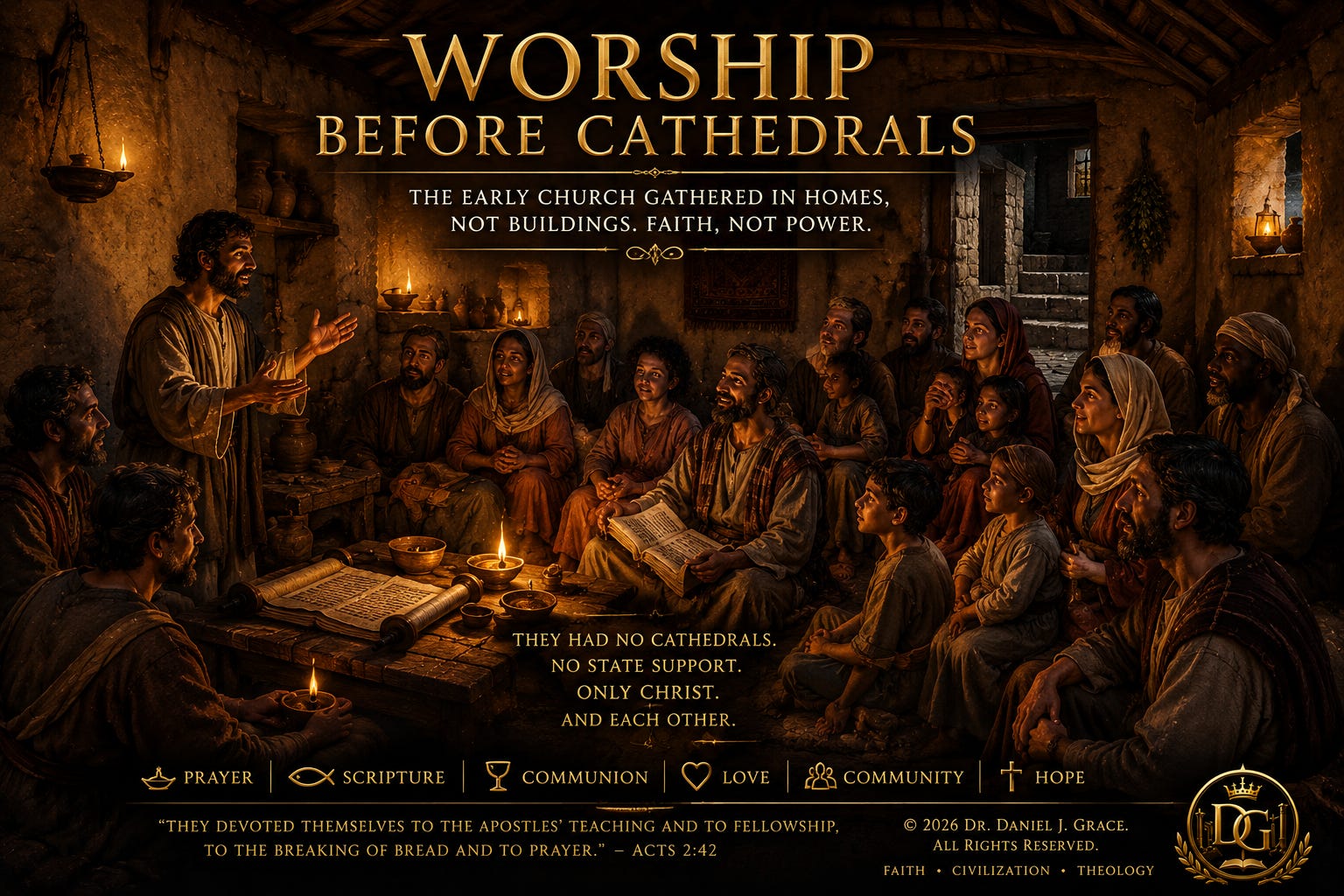
One fascinating aspect of pre-imperial Christianity is the absence of monumental church buildings.
The earliest believers met in homes, workshops, courtyards, and rented spaces.
Worship centered upon community rather than architecture.
The Church was understood primarily as people rather than buildings.
This does not mean buildings are unimportant.
Rather, it reminds us that Christian identity transcends physical structures.
The Church existed and flourished long before cathedrals appeared.
Mission Before Privilege
The growth of Christianity before Constantine remains one of history’s most remarkable developments.
Without political support, without wealth, and without military protection, the faith expanded across the Roman Empire.
How?
Believers shared the Gospel.
Families passed on the faith.
Merchants carried Christian ideas along trade routes.
Missionaries traveled Roman roads.
Communities demonstrated compassion, generosity, and hope.
The Church grew through witness rather than force.
Its expansion resulted from persuasion rather than power.
The Turning Point of Constantine
The conversion of Constantine transformed Christian history.
The Edict of Milan legalized Christianity.
Persecution largely ended.
Churches could own property.
Christian leaders gained influence.
The relationship between Church and state changed dramatically.
Many positive developments followed.
Christianity could operate openly.
Theological education expanded.
Church construction flourished.
Yet some historians note that legalization introduced new challenges.
The Church now had to navigate questions of privilege, influence, and political power.
The Seven Churches belong to the period before these transformations occurred.
They provide a glimpse into Christianity before empire.
Lessons for the Modern Church
The pre-imperial Church offers several important lessons.
First, Christian faith does not require political power to thrive.
Second, spiritual vitality matters more than public influence.
Third, faithfulness often involves sacrifice.
Fourth, cultural pressure is not new.
Fifth, prosperity can be as dangerous as persecution.
Most importantly, the Seven Churches remind believers that Christ’s priorities remain unchanged.
He values truth, love, endurance, holiness, faithfulness, and dependence upon God.
These qualities mattered before Constantine.
They still matter today.
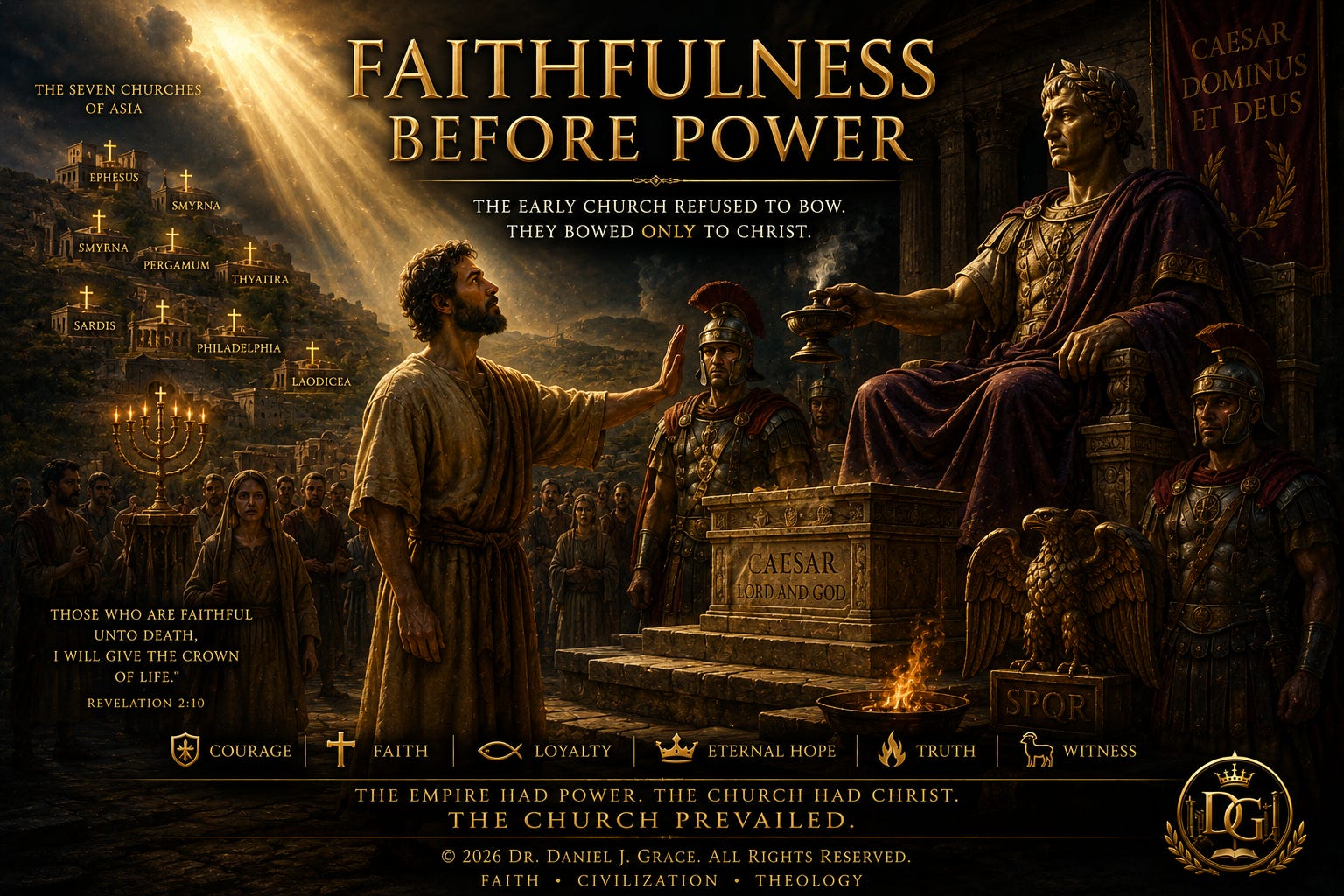
The Seven Churches of Revelation provide a remarkable portrait of Christianity before Constantine and before imperial favor transformed the Church’s public position.
These congregations lived in a world where Christianity possessed little power, few resources, and no legal protection.
Yet they demonstrated extraordinary courage, perseverance, and commitment.
Their story reminds modern believers that the strength of Christianity has never depended upon political influence, cultural dominance, or institutional privilege.
The Church’s true foundation has always been Christ.
Before Constantine, the Church changed the world through faithfulness.
The challenge facing believers today is not whether they possess influence.
The challenge is whether they possess the same faithfulness.
Nearly two thousand years later, the voices of Ephesus, Smyrna, Pergamum, Thyatira, Sardis, Philadelphia, and Laodicea continue to speak.
And their message remains remarkably relevant.
Dr. Daniel J. Grace
Research • Journalism • Theology
© 2026 Dr. Daniel J. Grace. All Rights Reserved. First published via Zenodo Digital Repository, 2026.