
Calvinism: Sovereignty, Predestination, and the Reformed Tradition
How Calvinism Shaped Worship, Church Leadership, Education, Work, and Christian Society

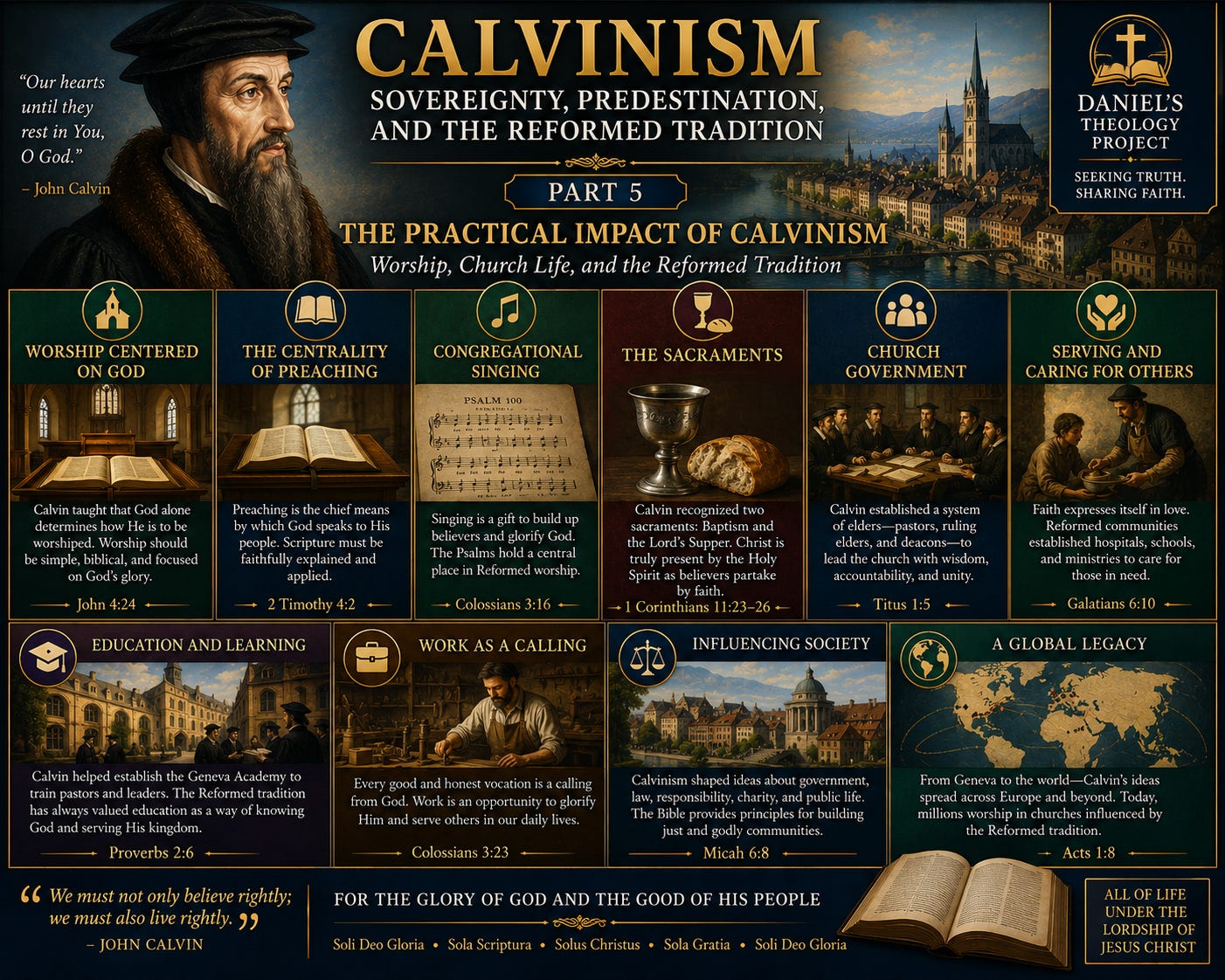
Part 5: The Practical Impact of Calvinism
Worship, Church Life, and the Reformed Tradition
When many people hear the word Calvinism, they immediately think of predestination. Discussions often focus on election, sovereignty, and the Five Points of Calvinism. Yet for John Calvin, theology was never merely an intellectual exercise. Doctrine was meant to shape how Christians worshipped, lived, worked, governed their churches, and served society.
In many ways, Calvin’s greatest legacy was not simply a theological system but a way of life rooted in the conviction that all of life belongs to God.
The practical influence of Calvinism can still be seen today in churches, schools, universities, missions organisations, and Christian communities around the world.
Worship Centered on God
One of Calvin’s most important principles was that Scripture should govern worship.
Calvin believed that God alone determines how He is to be worshipped.
This conviction led to what became known as the Regulative Principle of Worship.
According to this principle, churches should include in worship only those practices that are clearly supported by Scripture.
As a result, Reformed worship became simpler than the elaborate ceremonies common in many medieval churches.
Calvin removed practices he believed lacked biblical support and emphasised:
Prayer
Scripture reading
Congregational singing
Preaching
The sacraments
The focus shifted away from ritual and toward the proclamation of God’s Word.
For Calvin, worship existed primarily to glorify God rather than entertain people.
This emphasis continues to influence many Reformed churches today.
The Centrality of Preaching
Perhaps no aspect of Calvin’s ministry was more important than preaching.
Calvin believed God speaks through His Word when Scripture is faithfully proclaimed.
As a result, preaching became the centerpiece of Reformed worship.
Unlike many medieval sermons, Calvin’s preaching followed a systematic approach.
He typically worked verse by verse through entire books of the Bible.
This method, often called expository preaching, remains a hallmark of many Reformed churches.
Calvin preached hundreds of sermons every year.
His commitment to biblical teaching inspired generations of pastors to prioritise Scripture above personal opinion or popular trends.
Even today, many churches influenced by Calvinism place the sermon at the center of their worship services.
Congregational Singing
Calvin loved music but approached it carefully.
He believed music should help believers focus on God rather than distract from worship.
As a result, the early Reformed tradition emphasised congregational singing rather than elaborate performances.
The Psalms held a special place.
Calvin encouraged believers to sing Scripture itself.
This led to the creation of the famous Genevan Psalter, a collection of metrical psalms designed for congregational use.
For centuries, Psalm singing became a defining characteristic of many Reformed churches.
Although modern Reformed congregations often sing hymns and contemporary worship songs, the tradition’s love for biblical lyrics remains strong.
The Sacraments
Calvin recognised two sacraments:
Baptism
The Lord’s Supper
Like other Reformers, he rejected the medieval Catholic understanding of multiple sacraments.
However, Calvin’s view of the Lord’s Supper differed from both Martin Luther and Ulrich Zwingli.
Luther taught that Christ was truly present in a unique way during Communion.
Zwingli viewed Communion primarily as a memorial.
Calvin sought a middle position.
He taught that Christ is spiritually present through the Holy Spirit when believers participate in the Lord’s Supper by faith.
For Calvin, Communion was more than a symbol.
It was a genuine means by which believers experienced fellowship with Christ.
This understanding continues to influence Reformed theology today.
Church Government
Another major contribution of Calvinism involves church leadership.
Calvin developed a model often called Presbyterian church government.
Rather than concentrating authority in a single bishop, leadership was shared among elders.
This system typically included:
Teaching elders (pastors)
Ruling elders
Deacons
Groups of elders worked together to oversee the church.
Local congregations were connected through regional and national assemblies.
The goal was accountability, cooperation, and biblical leadership.
This model spread throughout Scotland, North America, the Netherlands, and many other parts of the world.
Today, Presbyterian and many Reformed churches continue using variations of this structure.
Education and Learning
Calvin believed that Christians should love truth and pursue knowledge.
As a result, education became a major emphasis within the Reformed tradition.
In 1559, Calvin helped establish the Geneva Academy.
Its purpose was to train pastors, scholars, and future leaders.
Students from across Europe travelled to Geneva for education and theological training.
This commitment to learning became a lasting feature of Calvinism.
Many of the world’s oldest universities and educational institutions were influenced by Reformed Christianity.
Calvinists viewed education as a way of serving God and understanding His creation.
This passion for learning contributed significantly to the development of schools, colleges, and seminaries throughout the world.
Work as a Calling
One of Calvin’s most influential ideas involved the concept of vocation.
In the medieval world, religious work was often viewed as more spiritual than ordinary occupations.
Calvin challenged this assumption.
He taught that every legitimate profession could be a calling from God.
Farmers, merchants, teachers, craftsmen, and government officials all served God through faithful work.
This perspective transformed how many Christians viewed daily life.
Work became more than a means of earning money.
It became an opportunity to glorify God.
Historians have often linked this outlook to what became known as the “Protestant work ethic.”
Although scholars debate the details, there is little doubt that Calvinism encouraged diligence, responsibility, and stewardship.
Calvinism and Society
Calvin never believed Christianity should remain confined to private spirituality.
He taught that biblical principles should influence society.
This conviction inspired Christians to engage in:
Education
Charity
Government
Law
Social reform
Many Reformed communities established hospitals, schools, orphanages, and relief programs.
They viewed service to neighbors as an important expression of faith.
Over time, Calvinist ideas contributed to discussions about constitutional government, individual responsibility, and the rule of law.
While historians continue debating the extent of this influence, Calvinism undeniably played a significant role in shaping Western civilization.
Global Expansion
From Geneva, Calvin’s ideas spread rapidly.
Missionaries, pastors, and refugees carried Reformed theology throughout Europe.
Eventually it reached:
Scotland
England
The Netherlands
Germany
Hungary
South Africa
North America
South Korea
Latin America
Today millions of Christians belong to churches influenced by Calvin’s teachings.
Major branches include:
Presbyterian Churches
Reformed Churches
Dutch Reformed Churches
Many Baptist Churches
Various Evangelical movements
Although these groups differ on secondary issues, they share a common theological heritage rooted in the Reformation.
Strengths of the Reformed Tradition
Supporters of Calvinism often point to several strengths:
A high view of God’s sovereignty
Strong emphasis on Scripture
Serious commitment to theology
Deep appreciation for grace
Robust church leadership structures
Commitment to education
A comprehensive Christian worldview
For many believers, Calvinism provides a coherent and intellectually satisfying understanding of the Christian faith.
Criticisms and Challenges
Like every theological tradition, Calvinism has faced criticism.
Some critics argue that:
It overemphasizes predestination.
It can appear overly intellectual.
Certain interpretations may discourage evangelism.
Questions remain concerning free will and divine justice.
Calvinists generally respond that true Reformed theology encourages both evangelism and missions because God works through the proclamation of the Gospel.
The debates continue today.
Yet even critics often acknowledge Calvinism’s enormous contribution to Christian thought and church history.
Why Calvinism Still Matters
More than four centuries after John Calvin’s death, his influence remains remarkable.
His ideas continue shaping:
Churches
Seminaries
Christian publishing
Mission organizations
Academic theology
Whether one fully agrees with Calvinism or not, understanding its practical impact helps explain why it remains one of the most influential traditions within Protestant Christianity.
Calvin’s vision extended beyond abstract doctrines.
He believed every aspect of life should be lived under the lordship of Christ.
That conviction shaped worship, education, work, church government, and society itself.
The result was a movement that transformed nations and continues influencing millions of believers around the world.
Looking Ahead
In the next part of this series, we will examine the strengths and criticisms of Calvinism more closely, exploring both the admiration and controversy that have surrounded the Reformed tradition for more than four hundred years.
To be continued...

Dr. Daniel J. Grace
Faith • Civilization • Theology
Research • Journalism • Truth
🌐 danieljamesgrace.com
© 2026 Dr. Daniel J. Grace. All Rights Reserved.
No part of this article may be reproduced, distributed, transmitted, or published in any form or by any means without prior written permission from the author, except for brief quotations used in academic citation, review, or research purposes.