

Calvinism: Sovereignty, Predestination, and the Reformed Tradition
The Enduring Appeal and Ongoing Debate Surrounding the Reformed Tradition

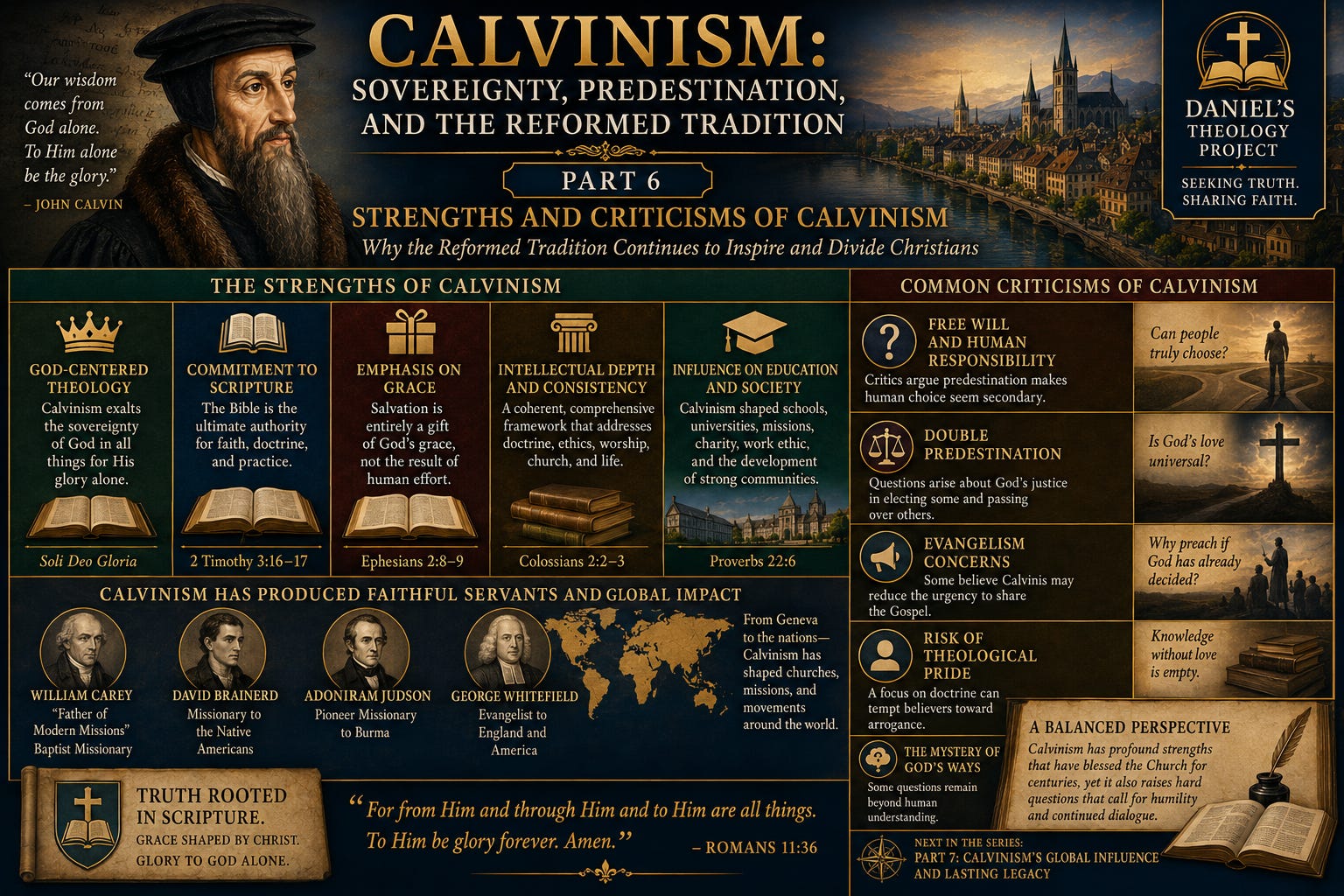
Part 6: Strengths and Criticisms of Calvinism
Why the Reformed Tradition Continues to Inspire and Divide Christians
More than five centuries after John Calvin walked the streets of Geneva, his theological legacy continues to generate passionate discussion. Few Christian traditions have been as influential—or as controversial—as Calvinism.
Supporters regard it as one of the most biblically consistent and intellectually coherent systems of theology ever developed. Critics argue that some of its conclusions create difficult questions about free will, divine justice, and the character of God.
Yet regardless of where one stands, Calvinism has profoundly shaped Protestant Christianity and remains one of the most significant theological traditions in church history.
To understand its continuing influence, we must examine both its strengths and the criticisms frequently directed against it.
A Theology Centered on God
Perhaps the greatest strength of Calvinism is its unwavering focus on God.
Throughout Calvin’s writings, one theme appears repeatedly:
God is sovereign.
Everything begins with God.
Everything exists through God.
Everything ultimately points back to God.
This God-centered vision has inspired generations of believers.
Rather than emphasizing human achievement, Calvinism places God’s glory at the center of Christian life.
The famous Reformation phrase:
Soli Deo Gloria — “To God Alone Be the Glory”
captures the heart of the Reformed tradition.
Supporters argue that this perspective protects Christianity from becoming overly focused on human effort, success, or personal accomplishment.
A Strong Commitment to Scripture
Another major strength is Calvinism’s commitment to biblical authority.
The Reformers believed that Scripture should be the ultimate standard for faith and practice.
Calvin devoted enormous energy to studying, teaching, and explaining the Bible.
His commentaries remain respected centuries later because of their careful attention to the biblical text.
Many Reformed churches continue emphasizing:
Expository preaching
Bible study
Theological education
Biblical literacy
As a result, Calvinism has often produced Christians deeply engaged with Scripture.
Even critics frequently acknowledge the Reformed tradition’s serious commitment to biblical scholarship.
The Emphasis on Grace
Calvinism strongly emphasizes salvation by grace.
According to Reformed theology, salvation is entirely the work of God.
Human beings do not earn redemption.
They receive it as a gift.
Supporters believe this perspective magnifies God’s mercy and eliminates any basis for spiritual pride.
The believer’s confidence rests not in personal performance but in God’s faithfulness.
For many Christians, this provides profound comfort.
Their salvation depends on God’s grace rather than their own imperfect efforts.
Intellectual Depth and Theological Consistency
Calvinism is often admired for its intellectual rigor.
The system presents a comprehensive worldview connecting:
Theology
Worship
Church life
Ethics
Education
Society
Supporters appreciate the logical consistency of the Reformed tradition.
Questions concerning salvation, providence, human nature, and divine sovereignty are addressed within a coherent theological framework.
This intellectual depth has attracted scholars, pastors, and thoughtful Christians for centuries.
Many leading seminaries and theological institutions continue drawing heavily from the Reformed tradition.
Influence on Education and Society
The impact of Calvinism extends far beyond church walls.
Historically, Reformed Christians founded schools, colleges, universities, and charitable institutions throughout Europe and North America.
Calvin believed education was a gift from God.
This conviction encouraged generations of Christians to pursue learning, science, literature, and public service.
Historians continue debating the exact extent of Calvinism’s influence on Western civilization, but few deny its importance.
Its emphasis on personal responsibility, vocation, literacy, and disciplined living helped shape entire cultures.
Common Criticisms of Calvinism
Despite its strengths, Calvinism has never been without critics.
Some objections have existed since Calvin’s own lifetime.
Others emerged in later centuries.
Let us consider several of the most common concerns.
The Question of Free Will
Perhaps the most frequent criticism concerns human freedom.
Critics argue that if God predestines every aspect of salvation, human choice appears diminished.
Questions naturally arise:
Can people genuinely choose?
Are individuals truly responsible for their actions?
How can God hold people accountable if their destiny has already been determined?
Arminians, Methodists, many Pentecostals, and other Christians often emphasize human response more strongly than Calvinists.
Supporters of Calvinism respond that Scripture teaches both divine sovereignty and human responsibility.
They argue that these truths coexist even when human reason struggles to explain how.
The Problem of Double Predestination
Another major criticism concerns the doctrine often called double predestination.
Some critics believe it portrays God as arbitrarily choosing some people for salvation while excluding others.
This raises difficult questions concerning:
Divine justice
God’s love
Human responsibility
Critics sometimes ask:
“If God desires all people to be saved, why would He predestine only some?”
Calvinists generally respond that God’s mercy is undeserved.
Because all humanity stands guilty before God, salvation remains an act of grace rather than entitlement.
The debate remains one of the most significant divisions within Protestant theology.
Concerns About Evangelism
Some critics worry that Calvinism could reduce motivation for evangelism.
Their reasoning is straightforward:
If God has already determined who will be saved, why evangelize?
Historically, however, this criticism is difficult to sustain.
Many of Christianity’s greatest missionaries were Calvinists.
Examples include:
William Carey
David Brainerd
Adoniram Judson
George Whitefield
Calvinists generally argue that God not only ordains the ends but also the means.
Evangelism becomes one of the instruments God uses to bring people to faith.
The Risk of Theological Pride
Some observers have noted another potential danger.
Because Calvinism values theological precision, there can sometimes be a temptation toward intellectual pride.
Knowledge is important.
Sound doctrine matters.
Yet Scripture repeatedly warns against pride.
Critics argue that any theological system can become problematic if knowledge is valued more highly than humility and love.
Many Calvinist leaders acknowledge this concern.
They emphasize that theology should produce worship rather than arrogance.
The Mystery of God’s Ways
Perhaps the deepest criticism involves mystery itself.
Many believers struggle with the tension between God’s sovereignty and human freedom.
Certain questions remain difficult:
Why are some saved while others are not?
How does divine election operate?
How should Christians understand God’s justice and mercy?
Calvin himself admitted that not every mystery can be fully explained.
Some truths, he believed, must ultimately be approached with humility.
For both supporters and critics, these questions continue inviting reflection and debate.
Why the Discussion Continues
One reason Calvinism remains influential is that it addresses questions every Christian eventually encounters.
Questions such as:
Who is God?
How does salvation work?
What role does grace play?
How should Christians understand human freedom?
Can believers be assured of salvation?
Different traditions answer these questions differently.
Yet the conversation continues because the questions themselves are so important.
A Balanced Perspective
Whether one embraces Calvinism completely, partially, or not at all, its historical significance cannot be denied.
It has:
Produced influential theologians.
Inspired missionaries.
Shaped educational institutions.
Contributed to biblical scholarship.
Influenced global Christianity.
At the same time, thoughtful Christians continue debating aspects of its theology.
The existence of these debates reminds us that Christians often seek to understand profound mysteries that extend beyond human comprehension.
Humility remains essential.
Why Calvinism Still Matters Today
In an age increasingly focused on individual autonomy and personal achievement, Calvinism continues to challenge believers with a different perspective.
It reminds Christians that:
God is sovereign.
Grace is essential.
Scripture is authoritative.
Worship belongs to God.
Salvation is ultimately God’s work.
For supporters, these truths provide confidence and assurance.
For critics, they raise important questions that deserve careful consideration.
Either way, Calvinism remains one of the most influential and enduring traditions in Christian history.
Looking Ahead
In the final part of this series, we will examine Calvinism’s global influence and lasting legacy, exploring how a movement that began in sixteenth-century Geneva helped shape churches, nations, missions, education, and modern Christianity around the world.
To be continued...

Dr. Daniel J. Grace
Faith • Civilization • Theology
Research • Journalism • Truth
🌐 danieljamesgrace.com
© 2026 Dr. Daniel J. Grace. All Rights Reserved.
No part of this article may be reproduced, distributed, transmitted, or published in any form or by any means without prior written permission from the author, except for brief quotations used in academic citation, review, or research purposes.