
Calvinism: Sovereignty, Predestination, and the Reformed Tradition
The Five Points of Calvinism and the Debate That Shaped Protestant Theology

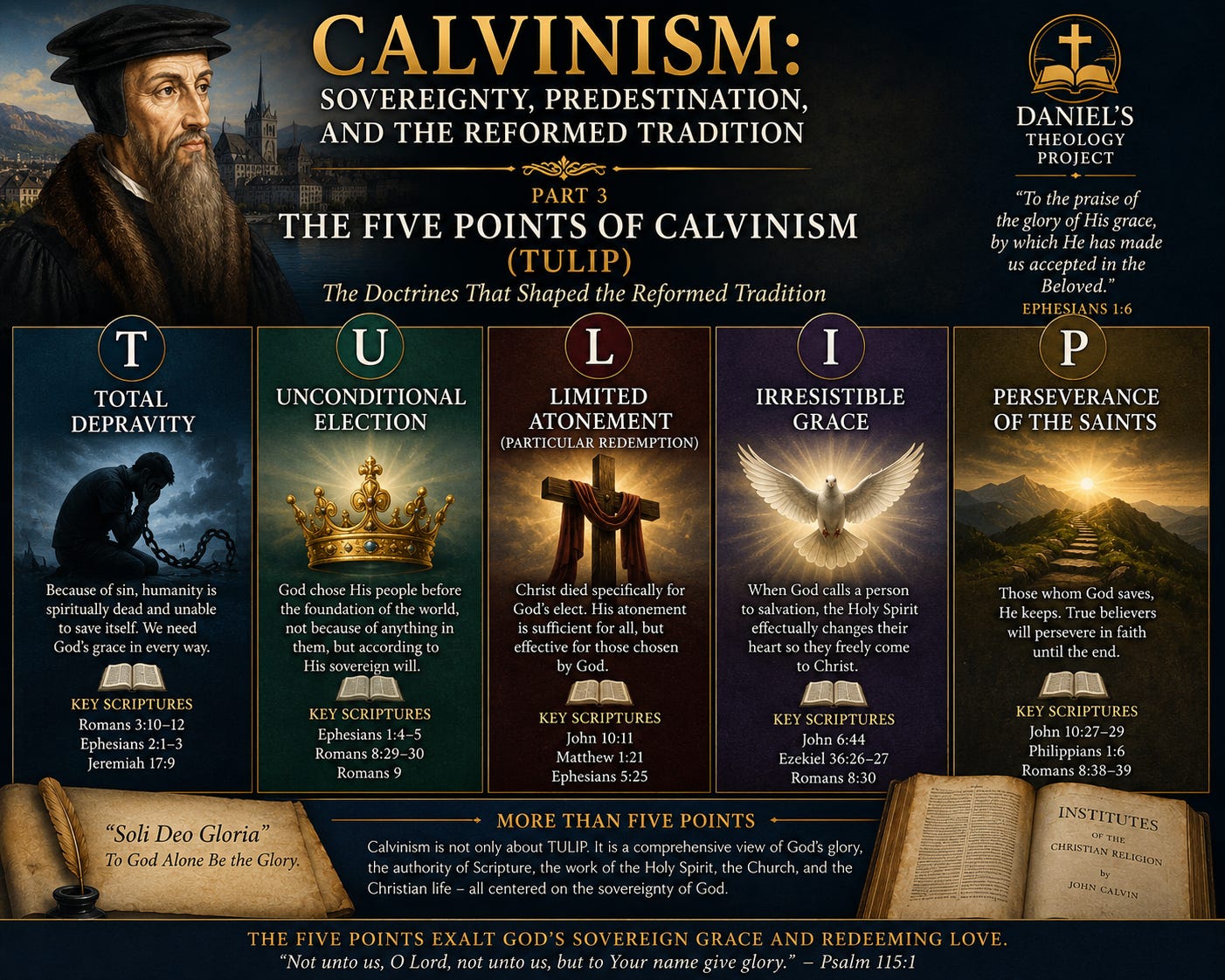
Part 3: The Five Points of Calvinism (TULIP)
Understanding the Doctrines That Shaped the Reformed Tradition
Few theological systems have generated as much discussion, admiration, controversy, and debate as the Five Points of Calvinism. Even among Christians who have never read John Calvin, many have encountered the famous acronym: TULIP.
These five doctrines emerged during a period of intense theological conflict in the early seventeenth century. Contrary to popular belief, Calvin himself did not create the acronym. Rather, the Five Points were formulated by Calvin’s followers in response to challenges raised by supporters of Dutch theologian Jacobus Arminius.
The resulting debate would shape Protestant Christianity for centuries.
Supporters argue that TULIP presents a biblical understanding of salvation that exalts God’s sovereignty and grace. Critics contend that some of its conclusions diminish human freedom and responsibility. Regardless of where one stands, understanding these doctrines is essential for understanding Calvinism itself.
The Historical Context
After John Calvin died in 1564, Reformed theology continued spreading throughout Europe. However, not everyone agreed with every aspect of Calvin’s teachings.
In the Netherlands, followers of Jacobus Arminius challenged certain Calvinist doctrines, particularly those related to election and predestination.
In 1618–1619, church leaders gathered at the Synod of Dort to address these controversies.
The Synod ultimately rejected the Arminian position and affirmed what later became known as the Five Points of Calvinism.
The acronym TULIP provides a convenient summary:
Total Depravity
Unconditional Election
Limited Atonement
Irresistible Grace
Perseverance of the Saints
Together, these doctrines form a coherent understanding of salvation centered on God’s initiative and sovereignty.
T — Total Depravity
The first point teaches that humanity is profoundly affected by sin.
Calvinists do not mean that every person is as evil as possible. Rather, they believe sin has touched every aspect of human nature—mind, will, emotions, and desires.
According to this doctrine, people are spiritually unable to save themselves.
Passages often cited include:
Romans 3:10–12
Ephesians 2:1–3
Jeremiah 17:9
The doctrine emphasizes humanity’s need for divine grace.
If salvation depended solely upon human effort, Calvinists argue, no one could be saved.
Critics sometimes misunderstand Total Depravity as teaching that people cannot perform acts of kindness or moral goodness. Calvinists generally reject that interpretation.
Instead, they argue that humanity’s fundamental relationship with God has been corrupted by sin and requires divine intervention.
The practical message is simple:
Salvation begins with God, not with us.
U — Unconditional Election
The second point is perhaps one of the most debated doctrines in Christian theology.
Unconditional Election teaches that before the foundation of the world, God chose those who would be saved.
According to Calvinism, this choice was not based on foreseen faith, good works, or future decisions.
Instead, it was based entirely upon God’s sovereign will and grace.
Key biblical texts include:
Ephesians 1:4–5
Romans 8:29–30
Romans 9
John 6:37
Calvinists argue that election demonstrates God’s mercy.
Since all humanity stands guilty before God, salvation is never earned or deserved.
Therefore, election is viewed as an act of grace rather than injustice.
Critics respond that this doctrine raises questions concerning human freedom and fairness.
These debates have continued for more than four hundred years.
Yet for Calvinists, election provides profound assurance.
Believers trust not in their own strength but in God’s eternal purpose.
L — Limited Atonement
Among the Five Points, Limited Atonement is often the most controversial.
Many Calvinists prefer the term Particular Redemption.
The doctrine teaches that Christ’s death was specifically intended to save God’s elect.
Calvinists affirm that Christ’s sacrifice possesses infinite value and is sufficient for all people.
However, they argue that its saving purpose was directed toward those whom God intended to redeem.
Commonly cited passages include:
John 10:11
Matthew 1:21
Ephesians 5:25
Supporters argue that Christ’s death effectively accomplishes salvation rather than merely making salvation possible.
Critics counter that Scripture frequently speaks of Christ dying for the world and for all people.
As a result, this remains one of the most significant areas of disagreement between Calvinists and non-Calvinists.
Despite the controversy, Calvinists emphasize that Christ’s atonement fully secures the salvation of those He came to save.
I — Irresistible Grace
The fourth point focuses on God’s work in conversion.
Irresistible Grace teaches that when God calls a person to salvation through the Holy Spirit, that call ultimately succeeds.
This does not mean people are dragged unwillingly into the kingdom.
Rather, the Holy Spirit transforms the heart so that the individual freely and willingly responds to Christ.
Passages often referenced include:
John 6:44
Ezekiel 36:26–27
Romans 8:30
Calvinists distinguish between the general call of the Gospel and the effective call of the Spirit.
Many people hear the Gospel externally.
But when God acts internally through the Holy Spirit, salvation follows.
Critics argue that Scripture contains examples of people resisting God’s grace.
Calvinists respond that the doctrine concerns God’s saving call, not every interaction between God and humanity.
The doctrine highlights God’s power to bring spiritual life where none existed before.
P — Perseverance of the Saints
The final point teaches that those truly saved by God’s grace will persevere in faith until the end.
Because salvation originates with God, Calvinists believe God preserves His people throughout their lives.
This doctrine is often summarized by the phrase:
“Once saved, always saved.”
However, classical Calvinism presents a more nuanced position.
True believers continue in faith because God sustains them.
Passages frequently cited include:
John 10:27–29
Philippians 1:6
Romans 8:38–39
Calvinists acknowledge that Christians may stumble, struggle, or fall into sin.
Yet they believe God ultimately restores and preserves His people.
Critics point to biblical warnings about apostasy and falling away.
This debate remains one of the central differences between Calvinist and Arminian theology.
For Calvinists, however, perseverance provides comfort and assurance.
The God who begins salvation also completes it.
More Than an Acronym
Although TULIP is useful, Calvinism cannot be reduced to five doctrines.
John Calvin wrote extensively about:
The glory of God
The authority of Scripture
The work of the Holy Spirit
Christian discipleship
Church government
Worship
The sacraments
At its heart, Calvinism seeks to emphasize God’s sovereignty over every aspect of life.
The Five Points simply summarize its understanding of salvation.
Why TULIP Still Matters
More than four centuries after the Synod of Dort, the Five Points continue shaping Christian theology.
They influence:
Reformed Churches
Presbyterian Churches
Many Baptist Churches
Evangelical seminaries
Christian scholarship worldwide
For supporters, TULIP magnifies God’s grace and glory.
For critics, it raises difficult questions about free will and human responsibility.
Either way, the discussion remains alive because it touches some of Christianity’s deepest questions:
How are sinners saved?
What role does grace play?
How does God’s sovereignty relate to human choice?
Can salvation be lost?
These questions continue challenging believers today just as they did in the seventeenth century.
Looking Ahead
The Five Points explain how Calvinism understands salvation, but they naturally lead to an even larger question:
If God is sovereign over salvation, what exactly does Calvinism teach about predestination?
In the next part of this series, we will examine one of the most discussed and controversial doctrines in Christian history: Predestination, Divine Sovereignty, and Human Freedom.
Dr. Daniel J. Grace
Faith • Civilization • Theology
Research • Journalism • Truth
🌐 danieljamesgrace.com
© 2026 Dr. Daniel J. Grace. All Rights Reserved.
No part of this article may be reproduced, distributed, transmitted, or published in any form or by any means without prior written permission from the author, except for brief quotations used in academic citation, review, or research purposes.