
Calvinism: Sovereignty, Predestination, and the Reformed Tradition
Part 2: The Historical Background

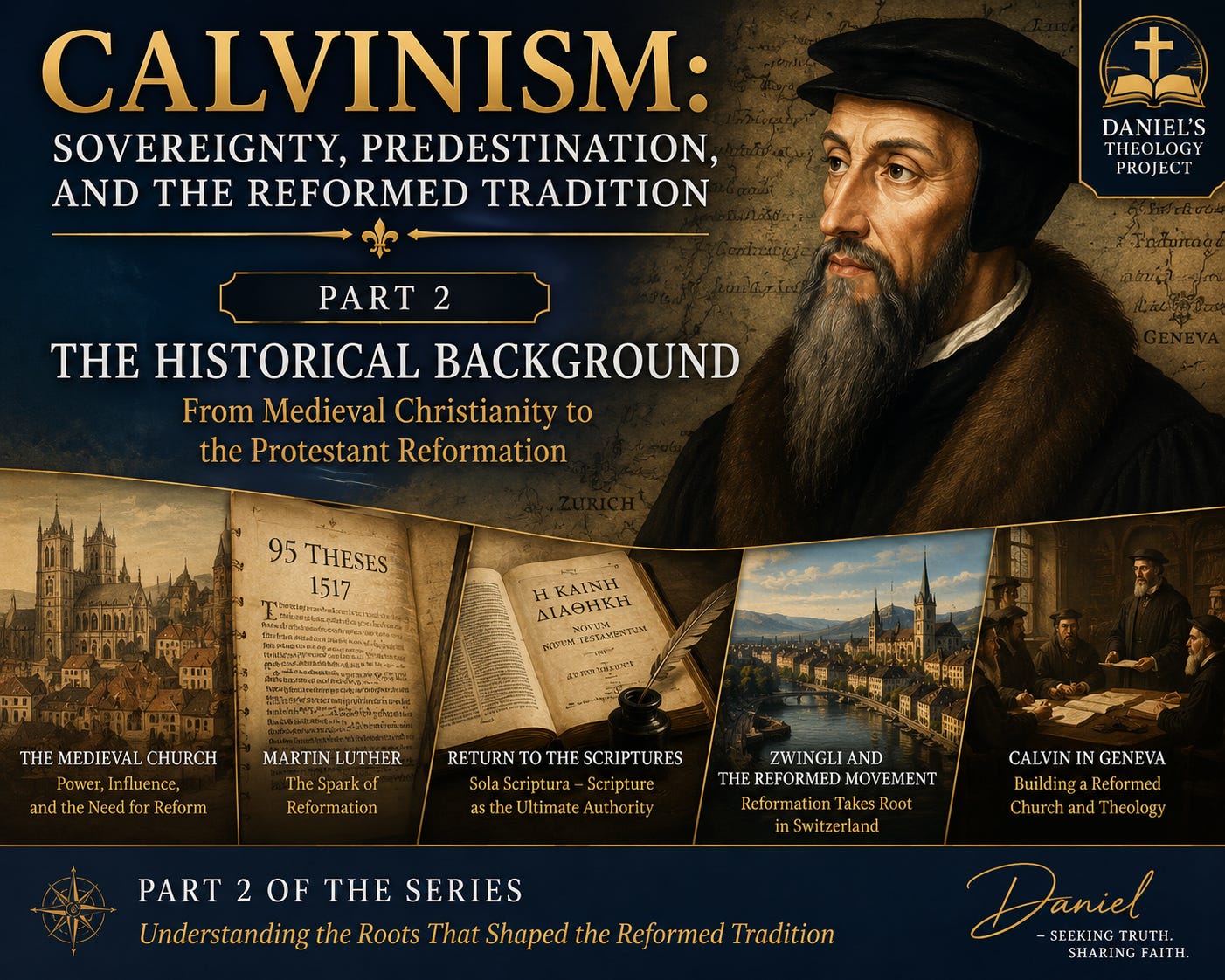
From Medieval Christianity to the Protestant Reformation
No theological movement emerges in a vacuum. Calvinism did not suddenly appear when John Calvin began writing in sixteenth-century Geneva. The ideas that would later become known as Calvinism were shaped by centuries of Christian history, theological debate, political upheaval, and spiritual renewal.
To understand Calvinism, we must first understand the world that produced it.
The story begins long before John Calvin was born. It begins with the medieval church, a powerful institution that shaped nearly every aspect of European life for over a thousand years.
The Medieval Church
By the beginning of the sixteenth century, the Roman Catholic Church was the most influential institution in Western Europe.
Kings sought its blessing.
Nations respected its authority.
Universities taught its theology.
Ordinary people depended upon its priests for baptisms, marriages, and funerals.
The church was not merely a religious organization. It was a social, political, educational, and cultural force that touched every area of life.
Many faithful Christians sincerely loved Christ and sought to serve God through the church. Monasteries preserved learning, missionaries spread the Gospel, and countless believers demonstrated genuine faith.
Yet alongside these achievements, serious problems developed.
Corruption became increasingly common among church leaders.
Some bishops gained their positions through political influence rather than spiritual qualifications.
Certain clergy lived luxurious lifestyles while ordinary people struggled with poverty.
Many believers felt disconnected from the Scriptures because the Bible remained largely inaccessible to the common population.
Calls for reform gradually grew louder.
The Desire for Renewal
Long before Luther and Calvin appeared, voices within Christianity were already calling for change.
John Wycliffe in England argued that Scripture should have greater authority than church traditions.
Jan Hus in Bohemia challenged corruption and emphasized biblical preaching.
Both men faced strong opposition.
Yet their ideas continued influencing future generations.
Many Christians longed for a return to the simplicity of the New Testament church.
They desired worship centered on Christ, preaching grounded in Scripture, and spiritual leaders characterized by humility rather than power.
The stage was being prepared for a dramatic transformation.
The Renaissance and Humanism
At the same time, Europe experienced a cultural movement known as the Renaissance.
Scholars rediscovered ancient Greek and Roman literature.
Universities flourished.
Education expanded.
Humanist thinkers encouraged people to return “to the sources.”
Rather than relying solely on later commentaries, they studied original texts.
For Christians, this meant renewed interest in the Hebrew and Greek Scriptures.
One of the most influential figures of this movement was Desiderius Erasmus.
Although Erasmus remained within the Catholic Church, his work helped prepare the way for the Reformation.
His Greek New Testament allowed scholars to study Scripture more accurately.
Both Luther and Calvin benefited from this renewed emphasis on original biblical languages.
Humanism taught scholars how to examine texts carefully.
The Reformers would apply those tools to the Bible.
Martin Luther and the Spark of Reformation
The Protestant Reformation officially began in 1517.
An Augustinian monk named Martin Luther became increasingly troubled by certain practices within the church, particularly the sale of indulgences.
Indulgences were promoted as a means of reducing punishment for sin.
Many ordinary believers believed they could purchase spiritual benefits for themselves or deceased relatives.
Luther believed this practice distorted the Gospel.
On 31 October 1517, he published his famous Ninety-Five Theses.
What began as an academic debate quickly became a movement that transformed Europe.
Luther emphasized several revolutionary ideas:
Salvation by faith alone.
Scripture as the ultimate authority.
Christ as the sole mediator between God and humanity.
The priesthood of all believers.
These teachings challenged centuries of established practice.
As printing technology spread his writings throughout Europe, support for reform grew rapidly.
The Authority of Scripture
One of the most important foundations of Calvinism emerged during this period.
The Reformers insisted that Scripture must stand above human traditions.
This principle became known as Sola Scriptura—Scripture alone.
The Reformers did not reject all tradition.
They respected the Church Fathers and early Christian councils.
However, they believed that every teaching must ultimately be tested by the Bible.
For Calvin, this conviction became central.
Throughout his life he argued that Scripture was God’s inspired Word and the final authority for faith and practice.
The Reformed tradition continues to hold this principle today.
Switzerland and the Reformed Movement
While Luther led reform efforts in Germany, another movement emerged in Switzerland.
A reformer named Ulrich Zwingli began preaching directly from Scripture in Zurich.
Like Luther, he called for significant changes.
However, Zwingli developed several ideas differently.
He advocated a simpler style of worship and placed strong emphasis on the authority of the Bible.
The Swiss Reformation developed its own identity.
After Zwingli’s death in battle in 1531, leadership gradually passed to a younger generation of reformers.
Among them was John Calvin.
Calvin Arrives in Geneva
When Calvin arrived in Geneva in 1536, the Reformation was still developing.
Many Protestant churches agreed on basic principles but differed on important details.
Questions remained concerning:
Church government.
Worship.
The sacraments.
Predestination.
The relationship between church and state.
Calvin sought to provide systematic answers.
Drawing upon Scripture, the Church Fathers, and earlier Reformers, he developed a theological framework that would become known as Reformed Theology.
His influence extended far beyond Geneva.
Pastors and students trained there carried Reformed ideas across Europe.
The Spread of Calvinism
During the sixteenth century, Calvin’s teachings spread rapidly.
In France, followers became known as Huguenots.
In Scotland, the reformer John Knox established a Presbyterian tradition heavily influenced by Calvin.
In the Netherlands, Reformed churches became a major force.
In England, Puritans adopted many Calvinist ideas.
Eventually Reformed Christianity crossed oceans and continents.
Missionaries, settlers, pastors, and theologians carried Calvinist theology throughout North America, Africa, Asia, and beyond.
Today, millions of Christians worship in churches influenced by Calvin’s teachings.
Why Calvinism Emerged
Calvinism emerged because believers sought answers to profound questions.
Questions such as:
How are sinners saved?
What role does God’s grace play in salvation?
Can human beings earn God’s favor?
How should Christians understand God’s sovereignty?
What authority should Scripture have in the life of the church?
The Reformed tradition attempted to answer these questions by emphasizing God’s initiative in salvation and His sovereign rule over all creation.
Whether one agrees with Calvin’s conclusions or not, his system offered a coherent and deeply biblical vision that shaped generations of Christians.
The Foundation for the Reformed Tradition
By the middle of the sixteenth century, the major foundations of Calvinism were in place.
The movement inherited:
The biblical focus of the Reformers.
The scholarship of Renaissance Humanism.
The spiritual concerns of medieval renewal movements.
The theological legacy of earlier Christian thinkers such as Augustine.
From these influences emerged one of the most significant traditions in Christian history.
The story was only beginning.
In the next part of this series, we will explore the doctrines that made Calvinism famous around the world: the Five Points of Calvinism, often summarised by the acronym TULIP.

Dr. Daniel J. Grace
Faith • Civilization • Theology
Research • Journalism • Truth
🌐 danieljamesgrace.com
© 2026 Dr. Daniel J. Grace. All Rights Reserved.
No part of this article may be reproduced, distributed, transmitted, or published in any form or by any means without prior written permission from the author, except for brief quotations used in academic citation, review, or research purposes.