

Calvinism: Sovereignty, Predestination, and the Reformed Tradition
From Geneva to the Nations: The Worldwide Impact of the Reformed Tradition

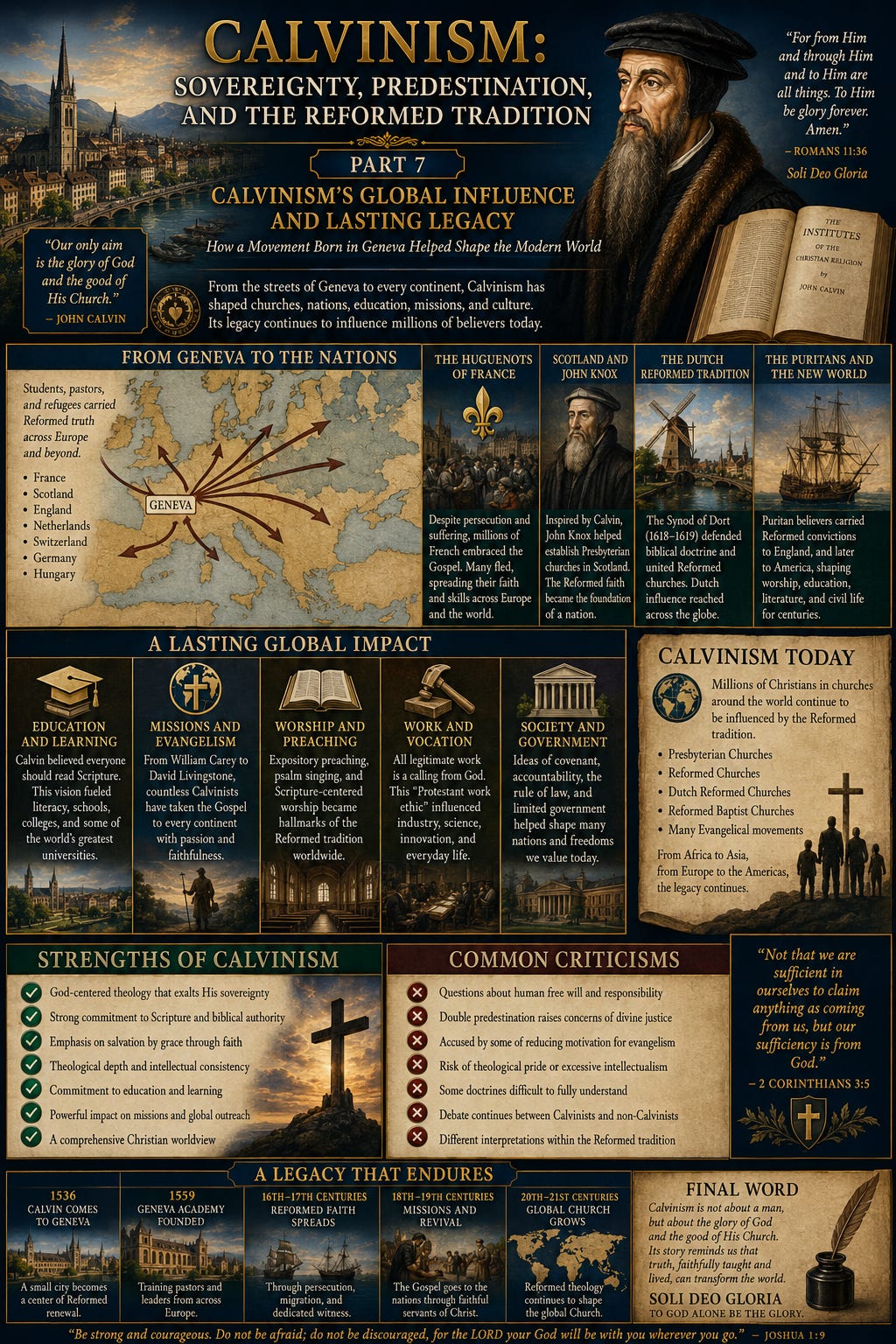
Part 7: Calvinism’s Global Influence and Lasting Legacy
How a Movement Born in Geneva Helped Shape the Modern World
When John Calvin arrived in Geneva in 1536, few could have imagined the long-term impact of his work. The city was relatively small. The Protestant Reformation was still young. Europe was divided by religious conflict, political uncertainty, and social upheaval.
Yet from this unlikely setting emerged a movement that would influence churches, nations, educational institutions, missionary organisations, and entire civilisations.
Today, more than four centuries after Calvin’s death, his theological legacy remains visible across the globe.
Whether one agrees with Calvinism or not, its historical influence is undeniable.
The story of Calvinism is not merely the story of a theological system.
It is the story of how ideas can transform societies.
From Geneva to Europe
Calvin’s Geneva quickly became one of the most important centers of Protestant Christianity.
Students, pastors, and refugees travelled there from across Europe.
Many came seeking theological training.
Others came fleeing persecution in their home countries.
After studying in Geneva, they returned home carrying Reformed ideas with them.
As a result, Calvinism spread rapidly throughout:
France
Scotland
England
The Netherlands
Hungary
Switzerland
Germany
Geneva became known as the “Protestant Rome.”
Just as Rome had once served as a center of influence for Western Christianity, Geneva became a hub for the growing Reformed movement.
The Huguenots of France
One of the earliest and most dramatic examples of Calvinism’s expansion occurred in France.
French Calvinists became known as Huguenots.
Despite severe persecution, the movement grew rapidly during the sixteenth century.
At its height, millions of French citizens embraced Reformed theology.
However, conflict between Catholics and Protestants eventually led to a series of religious wars.
One of the darkest moments occurred during the St. Bartholomew’s Day Massacre in 1572.
Thousands of Huguenots were killed in Paris and throughout France.
Yet even persecution could not eliminate the movement.
Many Huguenots fled to other nations, carrying their faith, skills, and culture with them.
Their influence would be felt throughout Europe and beyond.
Scotland and John Knox
Perhaps nowhere outside Geneva did Calvin’s ideas take root more deeply than in Scotland.
The Scottish reformer John Knox spent time in Geneva and greatly admired Calvin’s work.
Returning to Scotland, Knox helped establish the Presbyterian Church.
Presbyterianism adopted many of Calvin’s teachings and church structures.
Elders governed congregations.
Scripture occupied a central place in worship.
Education became a major priority.
Over time, Presbyterian churches spread throughout the British Isles and later across the world.
Millions of Christians today trace their spiritual heritage to this tradition.
The Dutch Reformed Tradition
The Netherlands became another major center of Calvinist influence.
Dutch churches embraced Reformed theology and played a crucial role in preserving and developing Calvinist thought.
The Synod of Dort (1618–1619) formally articulated many doctrines associated with Calvinism.
Dutch Calvinists also became leaders in:
Trade
Education
Science
Exploration
As Dutch influence expanded globally, Reformed Christianity spread with it.
South Africa, Indonesia, and parts of the Americas all experienced significant Dutch Reformed influence.
The Puritans and the English-Speaking World
In England, many Protestants sought further reform of the Church of England.
These believers became known as Puritans.
Although not identical to continental Calvinists, many Puritans embraced Reformed theology.
The Puritans profoundly influenced:
English Christianity
American colonial society
Education
Literature
Political thought
Their emphasis on Scripture, personal holiness, and disciplined living left a lasting mark on English-speaking cultures.
Many early American settlers carried Calvinist ideas across the Atlantic.
As a result, Calvinism became deeply woven into the religious history of North America.
Calvinism and Education
One of Calvinism’s greatest contributions has been its commitment to education.
Calvin believed every Christian should be able to read and understand Scripture.
This conviction encouraged widespread literacy.
Schools were established.
Universities were founded.
Seminaries were developed.
The Reformed tradition viewed learning as a means of glorifying God.
This educational emphasis helped produce generations of pastors, scholars, scientists, and leaders.
Many prestigious institutions throughout Europe and North America have roots connected to Protestant and Reformed educational ideals.
Missions and Global Christianity
A common misconception claims that Calvinism discourages missions.
History tells a different story.
Many influential missionaries emerged from the Reformed tradition.
Among them were:
William Carey
David Livingstone
Adoniram Judson
George Whitefield
Calvinists often argue that God’s sovereignty provides confidence for evangelism.
Because God is at work, missionaries can proclaim the Gospel with hope and assurance.
Today, Reformed churches and organizations continue supporting missionary efforts worldwide.
Influence on Politics and Society
Calvinism has also shaped political thought.
Reformed Christians emphasized concepts such as:
Accountability
Covenant
Rule of law
Limited government
Moral responsibility
Some historians argue these ideas contributed to the development of constitutional government and democratic institutions.
While scholars debate the extent of this influence, Calvinism undeniably played a role in shaping public life in many nations.
Its emphasis on vocation encouraged believers to engage society rather than withdraw from it.
Politics, education, business, and culture were all viewed as areas where Christians could serve God.
Modern Reformed Christianity
Today, Calvinism continues influencing millions of Christians around the world.
Major expressions include:
Presbyterian Churches
Reformed Churches
Dutch Reformed Churches
Reformed Baptist Churches
Various Evangelical movements
In recent decades, a renewed interest in Reformed theology has emerged among younger Christians.
Books, conferences, seminaries, podcasts, and online ministries have introduced new audiences to Calvinist thought.
This movement is sometimes called the “New Calvinism.”
While opinions differ regarding its strengths and weaknesses, it demonstrates the continuing relevance of Reformed theology.
Beyond Calvinism
One of Calvinism’s most remarkable achievements is that its influence often extends beyond explicitly Calvinist churches.
Many Christian traditions have adopted ideas that were strengthened by the Reformation:
Serious Bible study
Expository preaching
Congregational participation
The importance of grace
The authority of Scripture
As a result, even Christians who reject certain Calvinist doctrines often benefit from contributions made by the Reformed tradition.
The legacy is broader than any single denomination.
A Balanced Assessment
Like every major movement in church history, Calvinism has strengths and weaknesses.
It has inspired great scholarship, missionary work, educational achievement, and spiritual devotion.
It has also generated debate concerning predestination, freedom, and divine sovereignty.
Yet its enduring influence demonstrates the power of ideas rooted in deep theological conviction.
Whether one embraces Calvinism wholeheartedly or approaches it critically, understanding its history is essential for understanding Protestant Christianity itself.
Why Calvinism Still Matters
Five hundred years after the Reformation, Calvinism remains relevant because it addresses enduring questions:
Who is God?
How does salvation work?
What is the role of grace?
How should Christians live?
What authority does Scripture possess?
These questions remain just as important today as they were in Calvin’s Geneva.
The answers offered by the Reformed tradition continue challenging, encouraging, and shaping believers around the world.
Final Reflections
John Calvin never intended to create a movement bearing his own name.
He sought to glorify God, teach Scripture, and build faithful churches.
Yet his influence spread far beyond Geneva.
From the Huguenots of France to the Presbyterians of Scotland, from the Puritans of England to missionaries carrying the Gospel around the world, Calvinism became one of Christianity’s most influential traditions.
Its story is ultimately not about one man.
It is about the enduring power of ideas centered on God’s sovereignty, grace, and glory.
Whether praised or criticized, Calvinism remains one of the most significant chapters in the history of the Christian faith.
Soli Deo Gloria — To God Alone Be the Glory.
End of Series

Dr. Daniel J. Grace
Faith • Civilization • Theology
Research • Journalism • Truth
🌐 danieljamesgrace.com
© 2026 Dr. Daniel J. Grace. All Rights Reserved.
No part of this article may be reproduced, distributed, transmitted, or published in any form or by any means without prior written permission from the author, except for brief quotations used in academic citation, review, or research purposes.