
Calvinism: Sovereignty, Predestination, and the Reformed Tradition
How Calvinism Understands God's Sovereignty, Human Choice, and the Mystery of Salvation

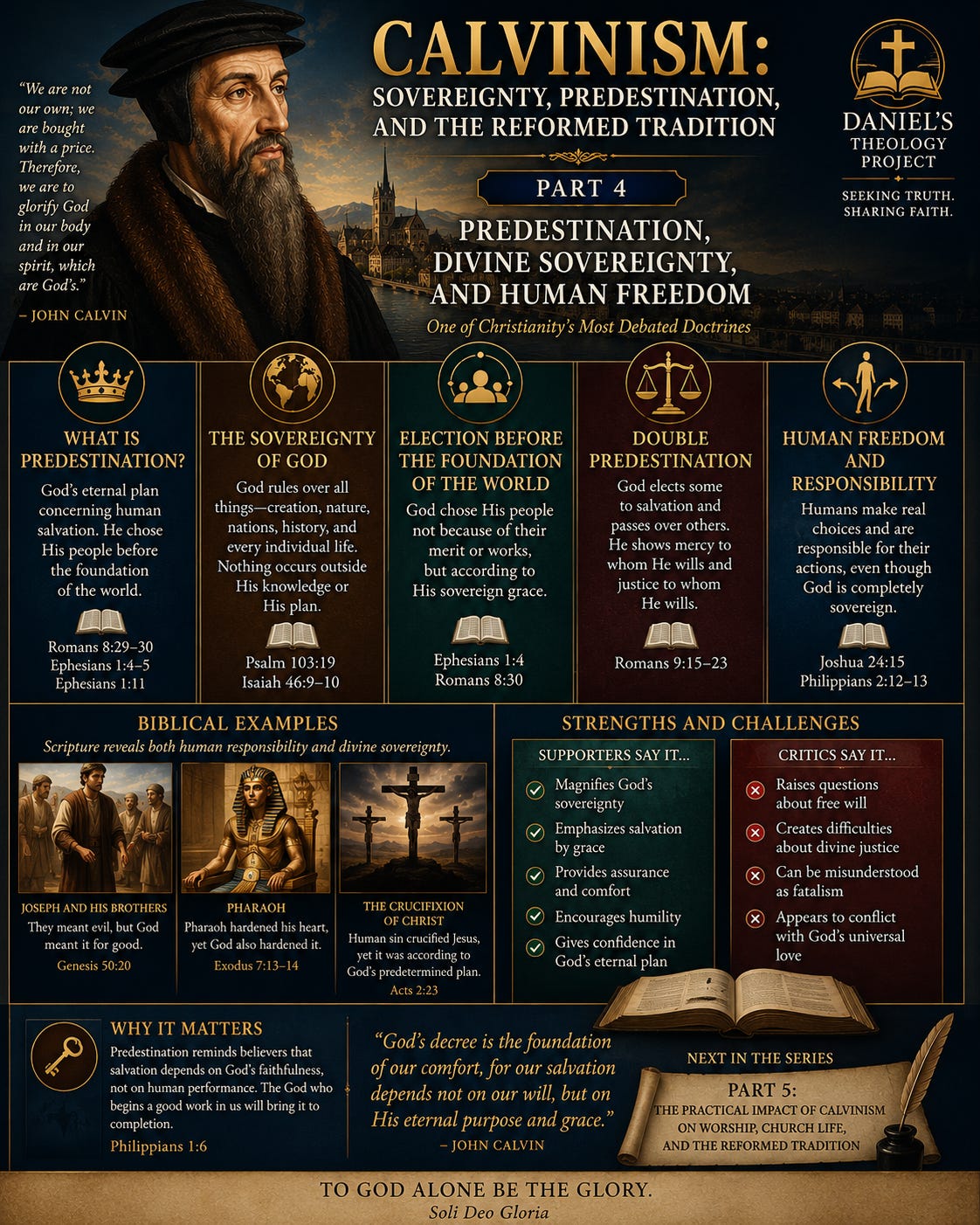
Part 4: Predestination, Divine Sovereignty, and Human Freedom
One of Christianity’s Most Debated Doctrines
Few theological subjects have generated more discussion than predestination.
For some Christians, the doctrine provides profound comfort and assurance. For others, it raises difficult questions about human freedom, justice, and responsibility. Entire libraries have been written on the subject, and debates continue more than five hundred years after the Protestant Reformation.
Yet predestination did not begin with John Calvin.
Nor did Calvin invent the doctrine.
Long before the Reformation, Christian theologians wrestled with the relationship between God’s sovereignty and human choice. Augustine discussed it in the fifth century. Medieval scholars debated it. The Apostle Paul addressed it in the New Testament.
What Calvin did was place the doctrine within a broader theological system that emphasized the absolute sovereignty of God over creation, history, and salvation.
To understand Calvinism, we must understand predestination.
What Is Predestination?
In its simplest form, predestination refers to God’s eternal plan regarding human salvation.
The term comes from the Latin praedestinatio, meaning “determined beforehand.”
The doctrine is based on passages such as:
Romans 8:29–30
Ephesians 1:4–5
Ephesians 1:11
Acts 13:48
John 6:37–44
Calvinists argue that these texts teach that God chose His people before the foundation of the world.
According to this view, salvation is not an accident of history or a result of human effort.
It is part of God’s eternal purpose.
The doctrine seeks to answer a fundamental question:
Why are some people saved while others remain unbelieving?
Calvin’s answer was clear:
Ultimately, salvation begins with God’s sovereign choice.
The Sovereignty of God
At the heart of Calvinism lies a conviction that God rules over all things.
Nothing occurs outside His knowledge.
Nothing surprises Him.
Nothing defeats His purposes.
For Calvin, God’s sovereignty extended far beyond salvation.
God governs:
Creation
Nature
Nations
Human history
Individual lives
This belief provided enormous comfort during the uncertainty of the sixteenth century.
Europe faced wars, political upheaval, religious conflict, and social instability.
Calvin taught that believers could trust God because history remained firmly in His hands.
Even suffering and adversity existed within God’s providential plan.
The doctrine of predestination grew naturally from this larger vision of divine sovereignty.
If God governs everything, Calvin reasoned, then salvation itself must ultimately depend upon Him.
Election Before the Foundation of the World
Calvin taught that before creation, God chose certain individuals for salvation.
This choice was not based upon:
Good works
Human merit
Future faith
Moral achievement
Rather, election rested entirely upon God’s grace.
Ephesians 1:4 became one of the key texts:
“He chose us in Him before the foundation of the world.”
According to Calvin, if election depended on human actions, grace would no longer be truly grace.
Salvation would become partly a human accomplishment.
Instead, Calvin emphasized that salvation is entirely God’s gift.
This perspective was intended to magnify God’s mercy rather than human achievement.
Believers could never boast in themselves.
All glory belonged to God alone.
Double Predestination
One of the most controversial aspects of Calvin’s theology is often called “double predestination.”
Calvin taught that God actively elects some people to salvation.
He also taught that God passes over others, leaving them in their sin and condemnation.
Critics argue that this makes God responsible for human destiny.
Supporters respond that Scripture clearly teaches both election and divine judgment.
For Calvin, God’s justice and mercy operated together.
No one deserved salvation.
Therefore, God showed mercy to some without being unjust to others.
Romans 9 became one of Calvin’s primary biblical foundations:
“I will have mercy on whom I have mercy.”
The doctrine remains one of the most debated aspects of Reformed theology.
Even among Calvinists, different interpretations exist regarding how predestination should be understood.
Human Freedom and Responsibility
A common question immediately arises:
If God predestines everything, do human choices matter?
Calvin answered yes.
Human beings make real decisions.
People think, choose, act, love, hate, obey, and rebel.
The Bible consistently holds individuals responsible for their actions.
Calvin did not believe people were robots.
Instead, he argued that human choices operate within God’s sovereign plan.
From a Calvinist perspective, divine sovereignty and human responsibility are not contradictory.
They exist together, even if the relationship remains mysterious.
Many Reformed theologians describe this as a paradox rather than a contradiction.
God is completely sovereign.
Humans are genuinely responsible.
Scripture teaches both truths.
Biblical Examples Often Cited
Calvinists frequently point to biblical narratives that appear to support divine sovereignty.
Joseph and His Brothers
Joseph’s brothers sold him into slavery.
Their actions were evil.
Yet Joseph later declared:
“You meant evil against me, but God meant it for good.”
The same event involved both human responsibility and divine purpose.
Pharaoh
In Exodus, Pharaoh repeatedly hardens his heart.
Yet Scripture also says God hardened Pharaoh’s heart.
Calvinists view this as evidence that God can work through human decisions while remaining sovereign.
The Crucifixion of Christ
Perhaps the greatest example appears in the death of Jesus.
The crucifixion resulted from human sin and wickedness.
Yet Acts 2:23 states that Christ was delivered according to God’s predetermined plan.
Human responsibility and divine sovereignty operate simultaneously.
Alternative Christian Views
Not all Christians agree with Calvin’s interpretation.
Arminians argue that God desires all people to be saved and grants every person sufficient grace to respond freely.
Many Methodists, Pentecostals, and other Protestant traditions emphasize human freedom more strongly than Calvinists.
Eastern Orthodox Christianity generally approaches the issue differently, stressing cooperation between divine grace and human response.
Roman Catholic theology also rejects several aspects of classical Calvinist predestination.
These differences have produced centuries of theological discussion.
Yet despite disagreements, most Christian traditions affirm two truths:
God is sovereign.
Human beings are responsible for their choices.
The debate centers on how these truths relate to one another.
Why Predestination Matters
For Calvin, predestination was never merely an abstract doctrine.
It served a pastoral purpose.
Believers often struggle with fear, doubt, and uncertainty.
Calvin believed predestination offered assurance.
Salvation depends upon God’s faithfulness rather than human performance.
If God begins salvation, He will complete it.
This conviction gave comfort to countless believers facing persecution, suffering, and hardship.
Many Calvinists today continue to find confidence in the belief that God’s purposes cannot fail.
Their salvation rests not upon fluctuating emotions or personal achievements but upon God’s eternal grace.
Strengths and Challenges
Supporters of predestination argue that it:
Magnifies God’s sovereignty.
Emphasizes salvation by grace.
Provides assurance.
Encourages humility.
Gives confidence in God’s plan.
Critics argue that it:
Raises questions about free will.
Creates difficulties concerning divine justice.
Can be misunderstood as fatalism.
Appears to conflict with God’s universal love.
These concerns explain why predestination remains one of Christianity’s most discussed doctrines.
Looking Ahead
Predestination is often the doctrine people associate most strongly with Calvinism.
Yet Calvin’s influence extended far beyond election and sovereignty.
His ideas shaped worship, church government, preaching, education, missions, and Christian culture across the world.
In the next part of this series, we will explore the practical impact of Calvinism on church life, examining Reformed worship, preaching, sacraments, and the development of Presbyterian and Reformed traditions throughout history.
To be continued...
Dr. Daniel J. Grace
Faith • Civilization • Theology
Research • Journalism • Truth
🌐 danieljamesgrace.com
© 2026 Dr. Daniel J. Grace. All Rights Reserved.
No part of this article may be reproduced, distributed, transmitted, or published in any form or by any means without prior written permission from the author, except for brief quotations used in academic citation, review, or research purposes.