
Calvinism: Sovereignty, Predestination, and the Reformed Tradition
The French Reformer Who Helped Shape Protestant Christianity

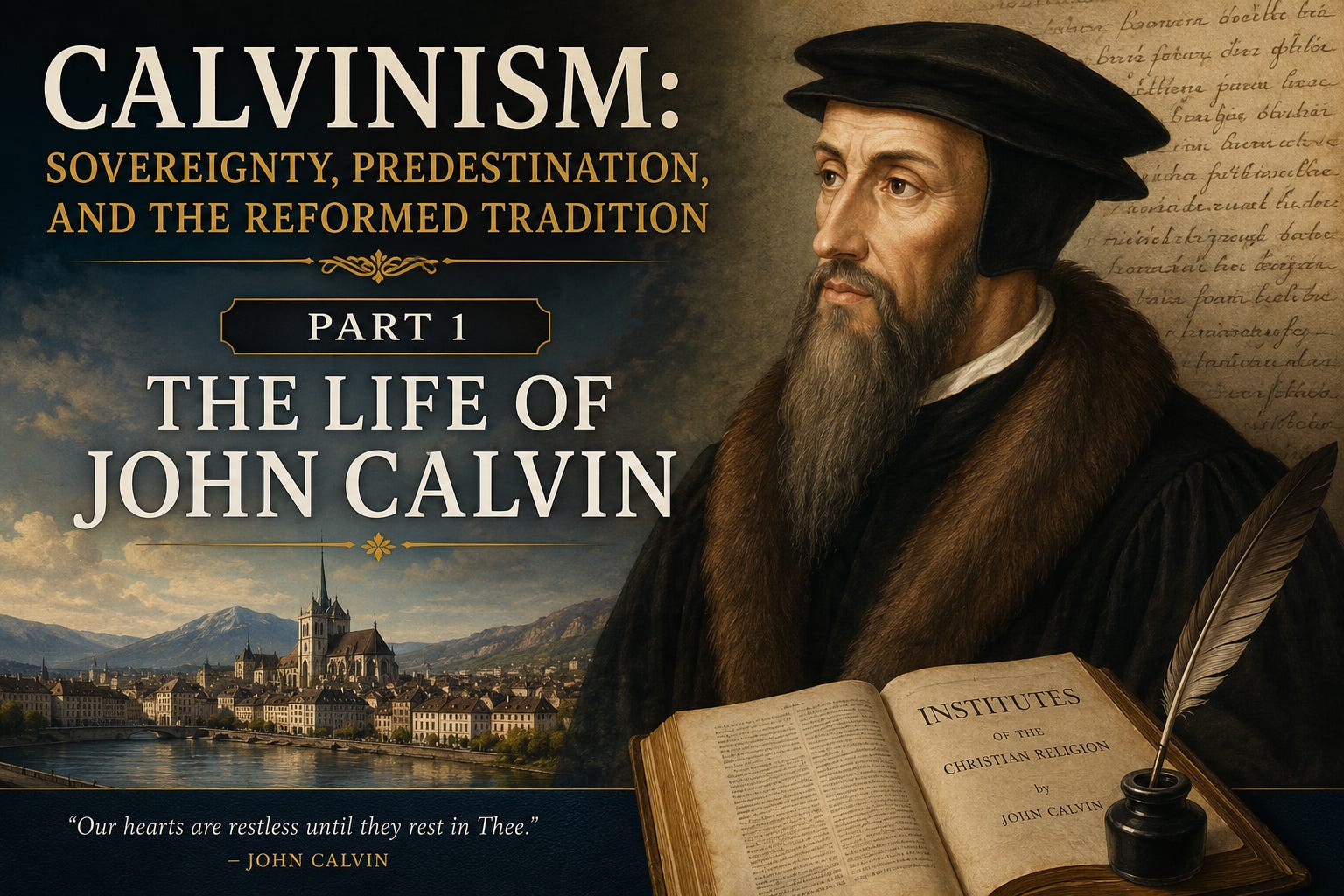
Part 1: The Life of John Calvin
Few figures in Christian history have influenced theology as profoundly as John Calvin. More than four centuries after his death, churches around the world continue to debate, defend, and discuss his teachings. Whether admired as one of the greatest theologians of the Reformation or criticised for his views on predestination, Calvin’s impact on Christianity is impossible to ignore.
His name became attached to an entire theological tradition—Calvinism—a system of belief emphasising the sovereignty of God, the authority of Scripture, and the conviction that salvation is ultimately the work of divine grace rather than human effort. Yet Calvin himself did not set out to create a movement bearing his name. He considered himself first and foremost a servant of Christ, a pastor, and a student of Scripture.
To understand Calvinism, we must first understand the man behind it.
A Child of France
John Calvin was born on 10 July 1509 in the town of Noyon in northern France. His birth occurred during a period of enormous change in Europe. The Renaissance was flourishing, rediscovering the literature, philosophy, and languages of the ancient world. At the same time, growing dissatisfaction with corruption in the medieval church was creating the conditions that would soon lead to the Protestant Reformation.
Calvin’s father, Gérard Cauvin, worked as an administrator for the local cathedral and intended his son for a career in the church. As a result, Calvin received an excellent education from an early age.
He demonstrated exceptional intelligence and quickly distinguished himself as a gifted student. Unlike many of his contemporaries, Calvin mastered Latin while still young and developed a passion for scholarship that would remain with him throughout his life.
His education would eventually take him to some of the finest institutions in France, where he studied theology, philosophy, and classical literature.
Humanism and Education
The intellectual climate of Calvin’s youth was shaped by Renaissance Humanism. Humanists encouraged a return to original sources rather than relying solely on later interpretations.
This movement had a profound influence on Calvin.
He studied Greek and Latin extensively, enabling him to read ancient texts in their original languages. Humanist scholars believed that understanding original sources led to a clearer understanding of truth.
The same principle later guided Calvin’s approach to Scripture.
Rather than depending entirely on church traditions, he sought to understand the Bible through careful study of its original context and languages.
This commitment to Scripture would become one of the defining features of the Reformed tradition.
From Law Student to Reformer
At his father’s request, Calvin left theological studies and pursued law. He attended universities in Orléans and Bourges, where he received rigorous training in legal reasoning and argumentation.
Although he may have found law intellectually stimulating, God’s providence was leading him in another direction.
During these years, Martin Luther’s ideas were spreading throughout Europe. Luther’s challenge to the authority of the medieval church, his emphasis on justification by faith, and his call for reform generated intense debate.
Calvin encountered these ideas while studying and gradually became convinced that many Protestant criticisms of the church were valid.
He later described his conversion as a sudden and unexpected work of God that transformed his understanding of faith.
Although Calvin rarely spoke about his personal experiences, he believed that God had humbled his heart and brought him into a deeper understanding of the Gospel.
This experience changed the course of his life forever.
Forced into Exile
As Protestant ideas gained support in France, opposition from church and state authorities intensified.
By the early 1530s, open support for reform had become increasingly dangerous.
Calvin’s association with Protestant thinkers attracted attention, and he was eventually forced to flee France.
Exile became a recurring theme throughout his life.
Like many reformers, he discovered that following his convictions often carried a personal cost.
Leaving his homeland behind, Calvin began a journey that would eventually lead him to the Swiss city of Geneva.
At the time, he had no intention of becoming one of the most influential church leaders in history.
He simply hoped to live quietly and continue his studies.
God had other plans.
The Institutes of the Christian Religion
In 1536, at just twenty-six years of age, Calvin published the first edition of what would become his most famous work: The Institutes of the Christian Religion.
Originally intended as a brief introduction to Protestant beliefs, the work expanded throughout his lifetime into one of the most important theological books ever written.
The Institutes presented Christian doctrine in a systematic and accessible way. Calvin explained topics such as:
The knowledge of God
Human sinfulness
Salvation through Christ
The work of the Holy Spirit
The authority of Scripture
The nature of the Church
The book quickly gained recognition across Europe.
Its clarity, organization, and depth established Calvin as one of the leading intellectual voices of the Reformation.
Even today, many historians regard the Institutes as one of the greatest works of Christian theology ever produced.
Geneva: The City of Reform
Shortly after publishing the Institutes, Calvin arrived in Geneva.
His original intention was merely to spend a single night there.
However, William Farel, a fiery reformer already working in the city, persuaded Calvin to remain and assist the Protestant cause.
Reluctantly, Calvin agreed.
Geneva would become the center of his life’s work.
The city was attempting to establish a reformed church independent of Roman Catholic control. Calvin helped organize church structures, develop educational programs, and promote biblical teaching.
His reforms were not always welcomed.
Conflicts with local authorities eventually led to his expulsion from the city in 1538.
Yet only three years later, Geneva invited him back.
Upon his return, Calvin remained there until his death.
Over time, Geneva became known as the “Protestant Rome.”
Students, pastors, and refugees traveled from across Europe to study under Calvin and carry Reformed ideas back to their homelands.
Pastor, Teacher, and Preacher
Although remembered primarily as a theologian, Calvin considered himself a pastor.
He preached multiple times each week, taught Scripture, trained ministers, and provided pastoral care to members of his congregation.
His commitment to biblical exposition was remarkable.
Rather than selecting isolated topics, Calvin typically preached through entire books of the Bible verse by verse.
This method influenced generations of Protestant preachers.
His commentaries on Scripture remain respected today for their balance of scholarship, clarity, and practical application.
Calvin believed that faithful preaching was one of the primary ways God nurtured His people.
Controversy and Criticism
Like many influential historical figures, Calvin remains controversial.
Supporters admire his commitment to Scripture, theological depth, and emphasis on God’s sovereignty.
Critics question some of his teachings and actions.
One of the most famous controversies involved Michael Servetus, a Spanish theologian who rejected the doctrine of the Trinity.
Servetus was arrested and executed in Geneva in 1553.
Although historians continue debating Calvin’s exact role, the incident remains a significant point of criticism.
It also reminds us that the Reformation occurred in a very different world from our own—a world where religious and political authority were often closely connected.
Understanding Calvin requires recognizing both his achievements and his limitations as a historical figure.
Calvin’s Final Years
Despite constant illness throughout much of his life, Calvin continued working tirelessly.
He suffered from migraines, respiratory problems, kidney stones, and numerous other health difficulties.
Yet he remained committed to preaching, teaching, and writing.
His influence continued growing as missionaries trained in Geneva carried Reformed theology across Europe.
Churches inspired by his teachings emerged in France, Scotland, the Netherlands, England, Hungary, and beyond.
When Calvin died on 27 May 1564, he requested a simple burial without elaborate monuments.
He wanted the focus to remain on God rather than himself.
Today, the exact location of his grave is unknown.
Perhaps that is fitting for a man who consistently sought to direct attention away from himself and toward Scripture.
The Legacy of John Calvin
John Calvin did not invent Protestantism.
Martin Luther had launched the Reformation years earlier.
Yet Calvin gave Protestant theology one of its most systematic and enduring expressions.
His ideas shaped:
Reformed Churches
Presbyterian Churches
Congregational Churches
Many Baptist traditions
Large sections of modern evangelicalism
His emphasis on God’s sovereignty, the authority of Scripture, and salvation by grace continues to influence millions of Christians worldwide.
Whether one agrees with all of his conclusions or not, Calvin’s contribution to Christian thought remains immense.
More than four hundred years after his death, believers continue to study his writings, debate his doctrines, and wrestle with the questions he sought to answer.
In the next part of this series, we will explore the historical background that gave rise to Calvinism, examining the medieval church, the Protestant Reformation, and the events that shaped the Reformed tradition.

Dr. Daniel J. Grace
Faith • Civilization • Theology
Research • Journalism • Truth
🌐 danieljamesgrace.com
© 2026 Dr. Daniel J. Grace. All Rights Reserved.
No part of this article may be reproduced, distributed, transmitted, or published in any form or by any means without prior written permission from the author, except for brief quotations used in academic citation, review, or research purposes.