
Arminianism: The Life and Legacy of Jacobus Arminius Part One
Exploring the History, Theology, and Lasting Influence of a Movement That Shaped Modern Christianity

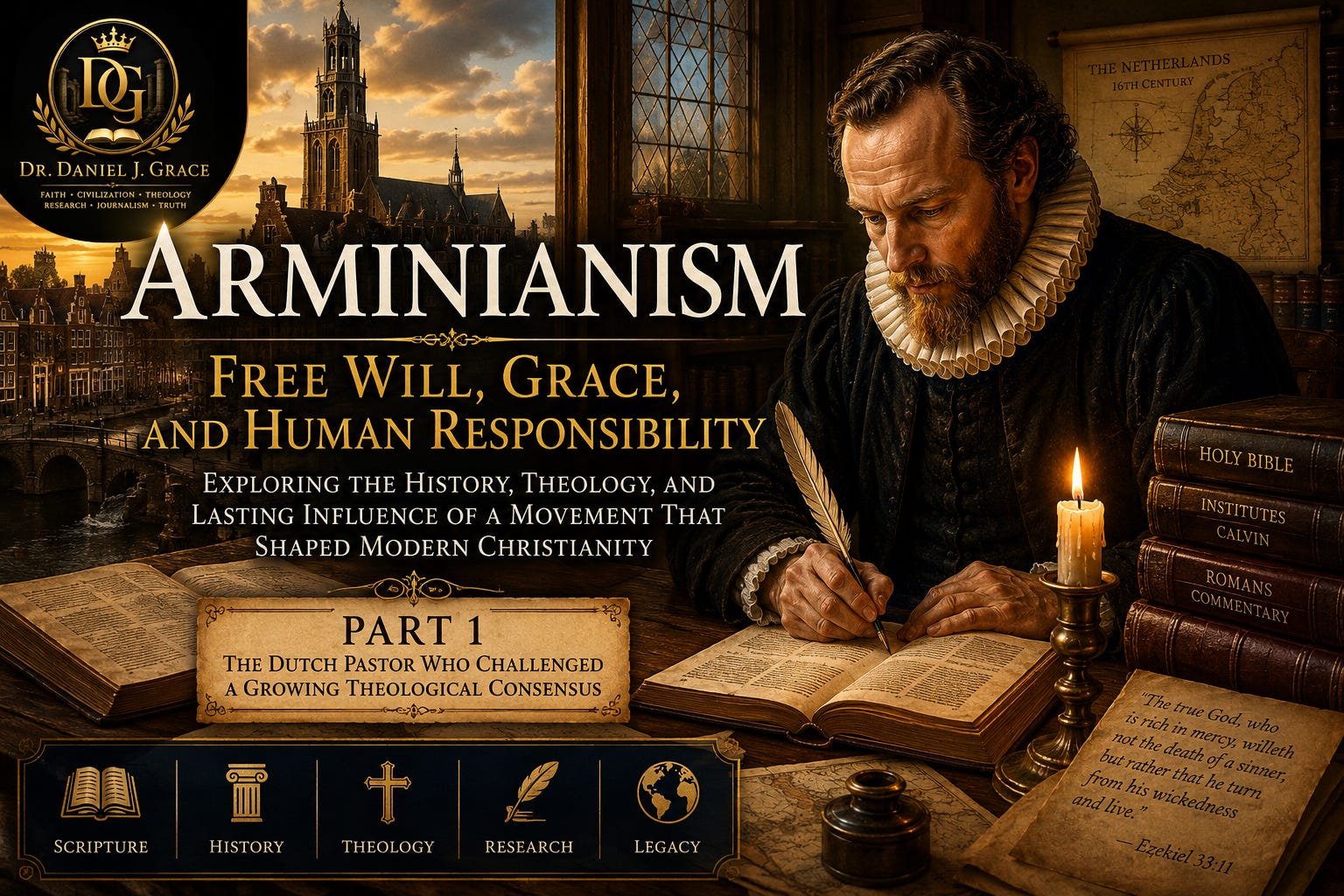
The Dutch Pastor Who Challenged a Growing Theological Consensus
Few figures in Christian history have generated as much discussion as Jacobus Arminius. More than four centuries after his death, debates surrounding grace, free will, predestination, and salvation continue to divide theologians, pastors, and ordinary believers. Yet behind the theological controversies stood a man who never intended to start a movement or create a new branch of Protestant thought.
Jacobus Arminius was first and foremost a pastor, a teacher, and a student of Scripture.
His life unfolded during one of the most turbulent periods in European history. The Protestant Reformation had transformed much of northern Europe, religious conflicts divided nations, and the Dutch people were fighting for independence from Spanish rule. It was in this world of political uncertainty and religious upheaval that Arminius emerged as one of the most influential voices in Protestant theology.
Although the movement that later bore his name would become known as Arminianism, Arminius himself saw his work differently. He believed he was simply seeking to understand the Bible faithfully and to explain the character of God in a way that reflected both divine sovereignty and divine love.
To understand the movement, we must first understand the man.
A Childhood Marked by Tragedy
Jacobus Arminius was born as Jakob Hermanszoon in the Dutch town of Oudewater on 10 October 1560.
His early years were marked by hardship and loss. His father died while he was still very young, leaving the family in difficult circumstances. Yet despite these challenges, Arminius demonstrated remarkable intellectual ability from an early age.
Several patrons and teachers recognised his potential and helped support his education. Their generosity would change the course of his life.
The Netherlands of Arminius’s childhood was a dangerous place. Religious tensions between Protestants and Catholics were increasing, and conflict with Spanish authorities was becoming more severe. These struggles were not distant political events but realities that affected ordinary families every day.
The greatest tragedy came when Arminius was still a teenager. During the violence that accompanied the Dutch revolt against Spain, his hometown suffered terribly. Many residents were killed, including members of his own family.
For a young man already familiar with loss, these events left a deep impression.
While we must be careful not to read later theology back into childhood experiences, it is difficult to ignore how suffering, injustice, and human tragedy may have shaped his pastoral sensitivity. Throughout his later ministry, Arminius displayed a concern for ordinary believers and a desire to present God as both just and compassionate.
A Brilliant Student
Despite personal hardship, Arminius excelled academically.
He enrolled at the newly established University of Leiden, one of the most important centres of Protestant learning in Europe. Leiden had become a symbol of Dutch resilience and intellectual freedom. Students from across Europe travelled there to study theology, philosophy, languages, and the classical disciplines.
At Leiden, Arminius immersed himself in biblical languages, theology, and the writings of the early church fathers.
His intellectual gifts soon attracted attention.
Church leaders and civic authorities recognised his potential and arranged further studies abroad. This support eventually led him to Geneva, the city most closely associated with John Calvin and the Reformed tradition.
For any aspiring Protestant theologian of the period, Geneva represented one of the most prestigious places of study in the Christian world.
Studying Under Theodore Beza
When Arminius arrived in Geneva, John Calvin had already died, but his influence remained strong.
The leading theologian was Theodore Beza, Calvin’s successor and one of the most respected defenders of Reformed theology.
Arminius studied diligently under Beza and initially embraced many of the theological positions associated with the Reformed tradition.
Contrary to some modern assumptions, Arminius did not begin his career as an opponent of Calvinism.
In fact, he was trained within the Reformed tradition and admired much of Calvin’s work.
Yet education often raises questions as well as answers.
As Arminius continued studying Scripture and theology, he encountered certain doctrines that troubled him. These concerns did not appear overnight. They developed gradually through years of study, reflection, and pastoral experience.
At this stage of his life, however, he remained a respected student preparing for ministry within the Dutch Reformed Church.
No one could have predicted the controversy that lay ahead.
Returning Home
After completing his studies, Arminius returned to the Netherlands and entered pastoral ministry.
In 1588 he became pastor of the Oude Kerk, the Old Church of Amsterdam.
The city was growing rapidly and becoming one of Europe’s most important commercial centres. It was also a place where theological debates often flourished.
Arminius quickly earned a reputation as a capable preacher and caring pastor.
Those who knew him described him as intelligent, thoughtful, and moderate in temperament. He was not known for seeking conflict or provoking controversy. Instead, he focused on preaching Scripture, caring for his congregation, and helping believers grow in their faith.
His ministry would eventually place him at the centre of one of the most significant theological debates in Protestant history.
Yet at this point, he was simply a pastor seeking to serve God faithfully.
The Beginning of Difficult Questions
The turning point in Arminius’s life did not come through rebellion against the church.
It came through the careful study of Scripture.
As he preached through biblical texts and engaged with theological questions, he became increasingly concerned about certain interpretations of predestination that were becoming influential within some Reformed circles.
Arminius believed that God’s sovereignty was essential.
He believed salvation was impossible without God’s grace.
He believed humanity was deeply affected by sin.
Yet he also believed that Scripture presented God as loving, merciful, and genuinely calling people to respond to the gospel.
How could these truths fit together?
The search for answers would define the remainder of his life.
It would also shape a theological movement that continues to influence millions of Christians around the world today.
Looking Ahead
In the next article, we will examine the growing conflict between Arminius and the defenders of strict Calvinism. We will explore the debates over predestination, election, grace, and human responsibility that eventually transformed a respected Dutch pastor into one of the most discussed theologians in Protestant history.

Dr. Daniel J. Grace
Faith • Civilization • Theology
Research • Journalism • Truth
🌐 danieljamesgrace.com
© 2026 Dr. Daniel J. Grace. All Rights Reserved.
No part of this article may be reproduced, distributed, transmitted, or published in any form or by any means without prior written permission from the author, except for brief quotations used in academic citation, review, or research purposes.