
Arminianism: Free Will, Grace, and Human Responsibility Part Five
How Arminian Theology Continues to Shape Churches, Missions, and Christian Thought Around the World

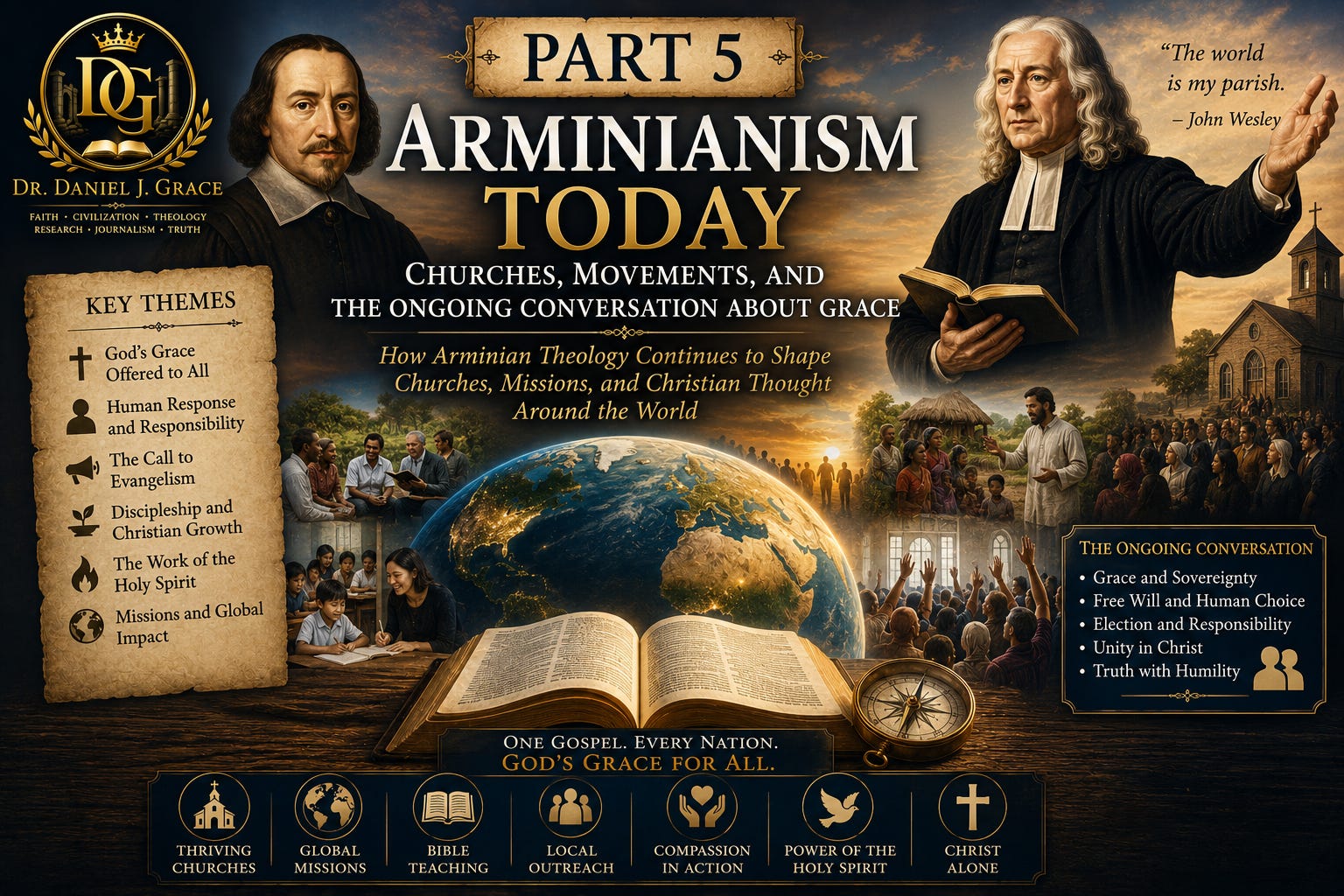
Part 5: Arminianism Today
Churches, Movements, and the Ongoing Conversation About Grace
More than four centuries have passed since Jacobus Arminius first raised questions about predestination, grace, and human responsibility. The world has changed dramatically since then. Empires have risen and fallen, denominations have formed, and Christianity has spread to every continent.
Yet the questions that concerned Arminius remain part of theological discussions today.
How does God’s grace work in salvation?
What role does human response play?
Can divine sovereignty and human responsibility exist together?
These questions continue to shape the beliefs and practices of millions of Christians around the world.
Whether one agrees with Arminian theology or not, its influence on modern Christianity is impossible to ignore.
A Global Influence
Today, Arminian theology is represented in numerous Christian traditions and denominations.
Many Methodist, Wesleyan, Nazarene, Holiness, Pentecostal, and independent evangelical churches hold beliefs that reflect Arminian principles.
In various forms, Arminian theology can be found throughout North America, Europe, Africa, Asia, Latin America, and Australia.
Its influence extends beyond denominational labels.
Many Christians who have never heard the term “Arminianism” nevertheless embrace ideas associated with it, particularly the belief that God’s saving grace is available to all people and that individuals are responsible for responding to the gospel.
As Christianity has expanded globally, these convictions have often played an important role in evangelism and missionary work.
The Importance of Evangelism
One of the most visible features of Arminian-influenced Christianity is its emphasis on evangelism.
If Christ died for all people and God’s grace is extended to all, then the gospel should be proclaimed to all.
This conviction has motivated countless missionaries, pastors, evangelists, and ordinary believers.
Throughout history, many missionary movements have been inspired by the belief that every person deserves the opportunity to hear the message of salvation.
This emphasis helped fuel the great missionary expansion of the eighteenth, nineteenth, and twentieth centuries.
Across the world, churches established schools, hospitals, orphanages, and mission stations while sharing the gospel message.
For many Arminian Christians, evangelism is not merely a church activity.
It is a natural expression of God’s love for humanity.
Discipleship and Christian Growth
Arminian theology has also contributed significantly to Christian discipleship.
Many churches influenced by Wesleyan and Arminian traditions place strong emphasis on spiritual growth, holy living, and personal transformation.
Salvation is understood not only as forgiveness of sins but also as the beginning of a lifelong journey of discipleship.
Believers are encouraged to grow in faith, prayer, obedience, and Christlike character.
This emphasis has shaped countless Bible studies, discipleship programs, youth ministries, and small groups around the world.
The goal is not merely conversion but spiritual maturity.
The Growth of Pentecostalism
One of the most remarkable developments in modern Christianity has been the rise of Pentecostal and Charismatic movements.
Many Pentecostal denominations have adopted theological positions that are broadly Arminian in nature.
They generally affirm:
Human responsibility.
The universal offer of salvation.
The necessity of personal faith.
The importance of evangelism.
The ongoing work of the Holy Spirit.
As Pentecostal Christianity has grown rapidly throughout Africa, Latin America, and Asia, Arminian theological ideas have become increasingly influential within global Christianity.
Today, Pentecostal and Charismatic believers represent one of the largest and fastest-growing segments of the Christian world.
Ongoing Theological Debate
The debate between Calvinism and Arminianism has never completely disappeared.
Books, conferences, seminaries, churches, and online discussions continue to explore these questions.
At times, the debate has generated unnecessary division.
At other times, it has encouraged Christians to examine Scripture more carefully and think more deeply about the nature of salvation.
The reality is that sincere believers can arrive at different conclusions while remaining committed to the authority of Scripture and the lordship of Christ.
This recognition should encourage humility.
Theological discussions are important, but they should never overshadow our shared faith in Jesus Christ.
Strengths of the Arminian Tradition
Supporters of Arminian theology often point to several strengths.
They appreciate its emphasis on:
God’s love for all people.
Human responsibility.
The universal offer of salvation.
Evangelism and missionary work.
Spiritual growth and discipleship.
Many believers find these themes both biblically compelling and pastorally encouraging.
For them, Arminian theology provides a framework that highlights both God’s initiative and humanity’s response.
Criticisms and Challenges
Like every theological system, Arminianism has also faced criticism.
Some theologians argue that it places too much emphasis on human choice.
Others question whether its understanding of election and grace adequately reflects certain biblical passages.
These debates have continued for centuries and are unlikely to disappear anytime soon.
Yet even critics generally acknowledge the significant historical impact of Arminian theology on global Christianity.
The Legacy of Jacobus Arminius
Perhaps the most surprising aspect of this story is that Jacobus Arminius never intended to establish a movement bearing his name.
He was a pastor, teacher, and scholar seeking to understand Scripture faithfully.
His questions sparked discussions that continue to this day.
His influence can be seen in churches, mission organisations, seminaries, and Christian ministries around the world.
Whether one ultimately agrees with his conclusions or not, Arminius remains one of the most important figures in the history of Protestant theology.
Final Reflections
The story of Arminianism is not merely a story about theological controversy.
It is a story about Christians wrestling with profound questions concerning God’s grace, human responsibility, and the mystery of salvation.
For more than four hundred years, believers have studied these issues with passion and conviction.
Yet beyond every theological debate stands a greater truth.
Christians of many traditions confess that salvation is found through Jesus Christ alone.
While disagreements remain, our ultimate hope rests not in theological systems but in the grace of God revealed through His Son.
As the Apostle Paul wrote:
“Now we see in a mirror, dimly, but then face to face.” (1 Corinthians 13:12)
Until that day, Christians will continue studying, discussing, and seeking to understand the wonderful mystery of God’s saving grace.

Dr. Daniel J. Grace
Faith • Civilization • Theology
Research • Journalism • Truth
🌐 danieljamesgrace.com
© 2026 Dr. Daniel J. Grace. All Rights Reserved.
No part of this article may be reproduced, distributed, transmitted, or published in any form or by any means without prior written permission from the author, except for brief quotations used in academic citation, review, or research purposes.