

Arminianism: Free Will, Grace, and Human Responsibility Part Four
How the Teachings of Arminius Influenced John Wesley, Methodism, and the Spread of Global Christianity

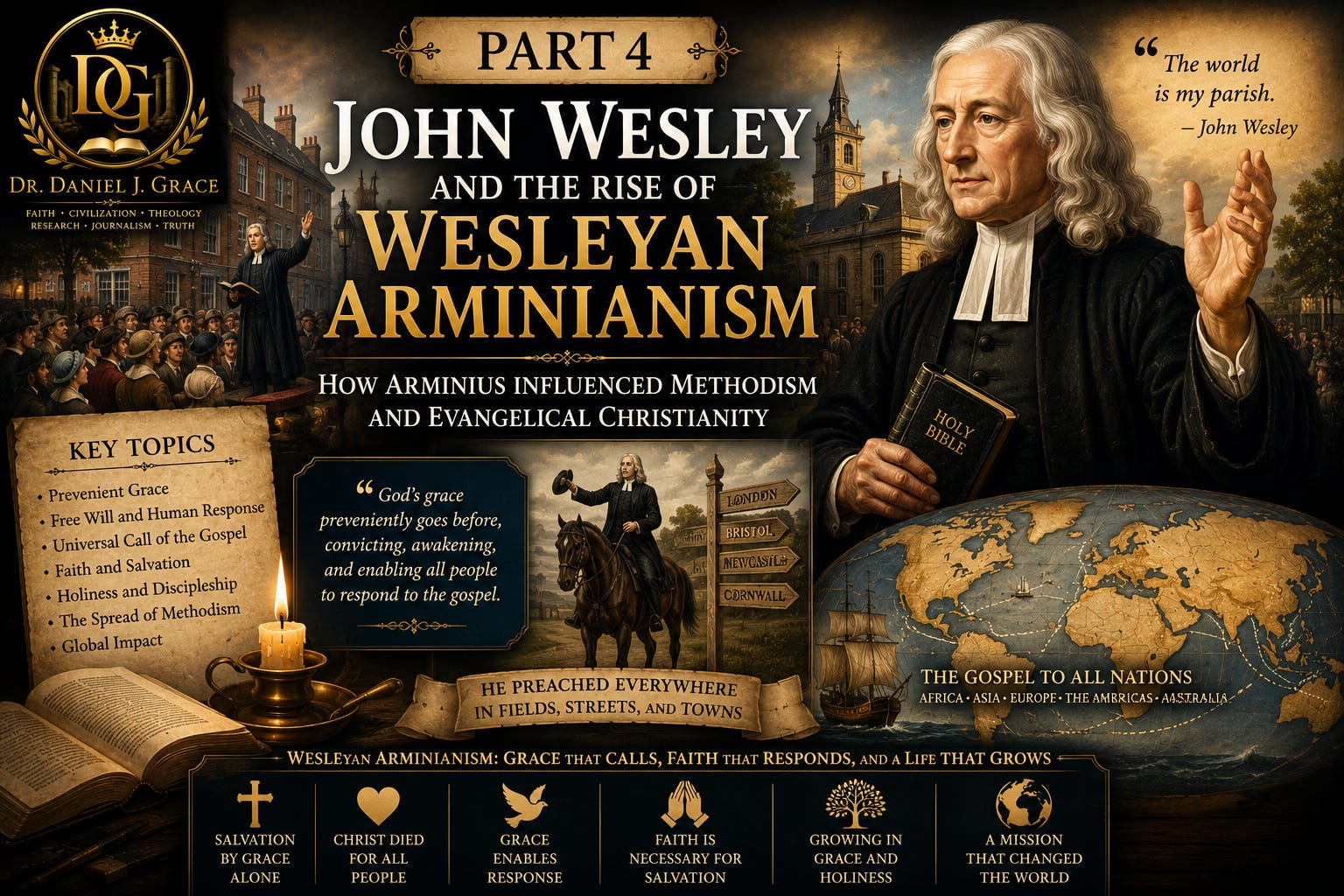
Part 4: John Wesley and the Rise of Wesleyan Arminianism
How Arminius Influenced Methodism and Evangelical Christianity
When Jacobus Arminius died in 1609, his theological ideas continued to be discussed throughout Europe. Although the Synod of Dort rejected the teachings of the Remonstrants, Arminian theology did not disappear. Instead, it survived, developed, and eventually found new life through one of the most influential Christian leaders in history: John Wesley.
Today, millions of Christians around the world belong to churches that have been influenced by Wesleyan theology. Yet many are unaware that some of the ideas they embrace concerning grace, salvation, and Christian living can be traced back to the work of Jacobus Arminius.
The story of Wesleyan Arminianism is not merely a story about theological debate. It is the story of revival, evangelism, discipleship, and the spread of Christianity across the globe.
The Life of John Wesley
John Wesley was born in England in 1703, almost a century after the death of Arminius.
Raised in a Christian home, Wesley received an excellent education and later became an Anglican minister. Along with his brother Charles Wesley and a small group of believers at Oxford University, he pursued a disciplined Christian life centred on prayer, Bible study, fasting, and service.
Because of their methodical approach to spiritual disciplines, they became known as “Methodists.”
Despite his religious devotion, Wesley later admitted that he lacked assurance of salvation. His famous spiritual experience at Aldersgate Street in London in 1738 transformed his understanding of faith and grace.
Wesley described his heart as being “strangely warmed” as he came to a deeper trust in Christ.
This experience would shape the remainder of his ministry.
Wesley’s Understanding of Grace
Like Arminius, Wesley believed that salvation begins with God’s grace.
He rejected the idea that human beings could earn salvation through works or religious effort. Salvation, he taught, was entirely dependent upon God’s initiative.
However, Wesley also believed that God graciously enables people to respond to the gospel.
He embraced the doctrine of prevenient grace, teaching that God’s grace works in the hearts of all people before conversion, drawing them toward Christ and making a genuine response possible.
For Wesley, grace was not limited to a select group of individuals.
It was offered to all.
This conviction became a defining characteristic of Methodist theology and preaching.
The Universal Call of the Gospel
One of Wesley’s greatest concerns was the proclamation of the gospel to everyone.
If Christ died for all people, then the message of salvation should be offered to all people.
Wesley preached tirelessly throughout England, often travelling thousands of miles on horseback to reach people who rarely attended church.
He preached in fields, marketplaces, streets, and villages.
His message was simple:
God loves sinners.
Christ died for sinners.
The gospel is available to sinners.
Anyone who repents and believes can be saved.
This emphasis on evangelism would become one of the greatest strengths of the Methodist movement.
Holiness and the Christian Life
Another distinctive feature of Wesleyan Arminianism was its focus on holy living.
Wesley believed that salvation involved more than forgiveness.
It also involved transformation.
Christians were called not merely to receive grace but to grow in grace.
He encouraged believers to pursue spiritual maturity, Christlike character, and practical obedience.
For Wesley, faith and discipleship could never be separated.
A genuine relationship with Christ should produce visible changes in a person’s life.
This emphasis later contributed to the development of the Holiness Movement, which encouraged believers to pursue deeper spiritual growth and devotion.
The Growth of Methodism
The Methodist movement expanded rapidly during Wesley’s lifetime.
Thousands responded to the gospel message, and Methodist societies appeared throughout Britain and beyond.
After Wesley’s death, Methodism spread to North America, Africa, Asia, Australia, and many other parts of the world.
Its influence extended far beyond denominational boundaries.
Many evangelical churches adopted Wesley’s emphasis on personal conversion, evangelism, discipleship, and mission.
Today, the impact of Wesley’s ministry can be seen in countless churches and Christian organisations around the world.
Wesleyan Arminianism and Global Missions
The belief that God’s saving grace is available to all people provided strong motivation for missionary work.
If every person has the opportunity to respond to the gospel, then every person deserves the opportunity to hear it.
This conviction inspired generations of missionaries.
Methodist missionaries carried the gospel throughout Africa, Asia, the Pacific Islands, and the Americas.
Many later evangelical missionary movements were influenced by similar convictions.
The result was one of the most significant periods of Christian expansion in history.
Similarities and Differences
Although Wesley was deeply influenced by Arminian theology, he was not simply repeating Arminius.
Wesley placed greater emphasis on personal holiness, spiritual growth, and practical discipleship.
He also developed ideas concerning Christian perfection and sanctification that went beyond the original writings of Arminius.
For this reason, historians often distinguish between Classical Arminianism and Wesleyan Arminianism.
Yet both share important convictions:
Salvation is by grace alone.
Christ died for all people.
God’s grace enables human response.
Faith is necessary for salvation.
Christians are responsible for responding to God’s call.
A Lasting Legacy
Today, the influence of Wesleyan Arminianism can be found in Methodist, Wesleyan, Nazarene, Holiness, Pentecostal, and many evangelical churches.
Its impact reaches far beyond any single denomination.
Perhaps the greatest legacy of Wesleyan Arminianism is its emphasis on God’s love for all people and the universal call of the gospel.
For generations of believers, this message has inspired evangelism, missionary work, discipleship, and faithful Christian living.
Looking Ahead
In Part 5, we will explore Arminianism in the modern world and examine how its teachings continue to influence churches, ministries, and theological discussions across the globe.

Dr. Daniel J. Grace
Faith • Civilization • Theology
Research • Journalism • Truth
🌐 danieljamesgrace.com
© 2026 Dr. Daniel J. Grace. All Rights Reserved.
No part of this article may be reproduced, distributed, transmitted, or published in any form or by any means without prior written permission from the author, except for brief quotations used in academic citation, review, or research purposes.