
Arminianism: Free Will, Grace, and Human Responsibility Part Two
How Two Different Understandings of Grace, Election, and Salvation Shaped Protestant Christianity

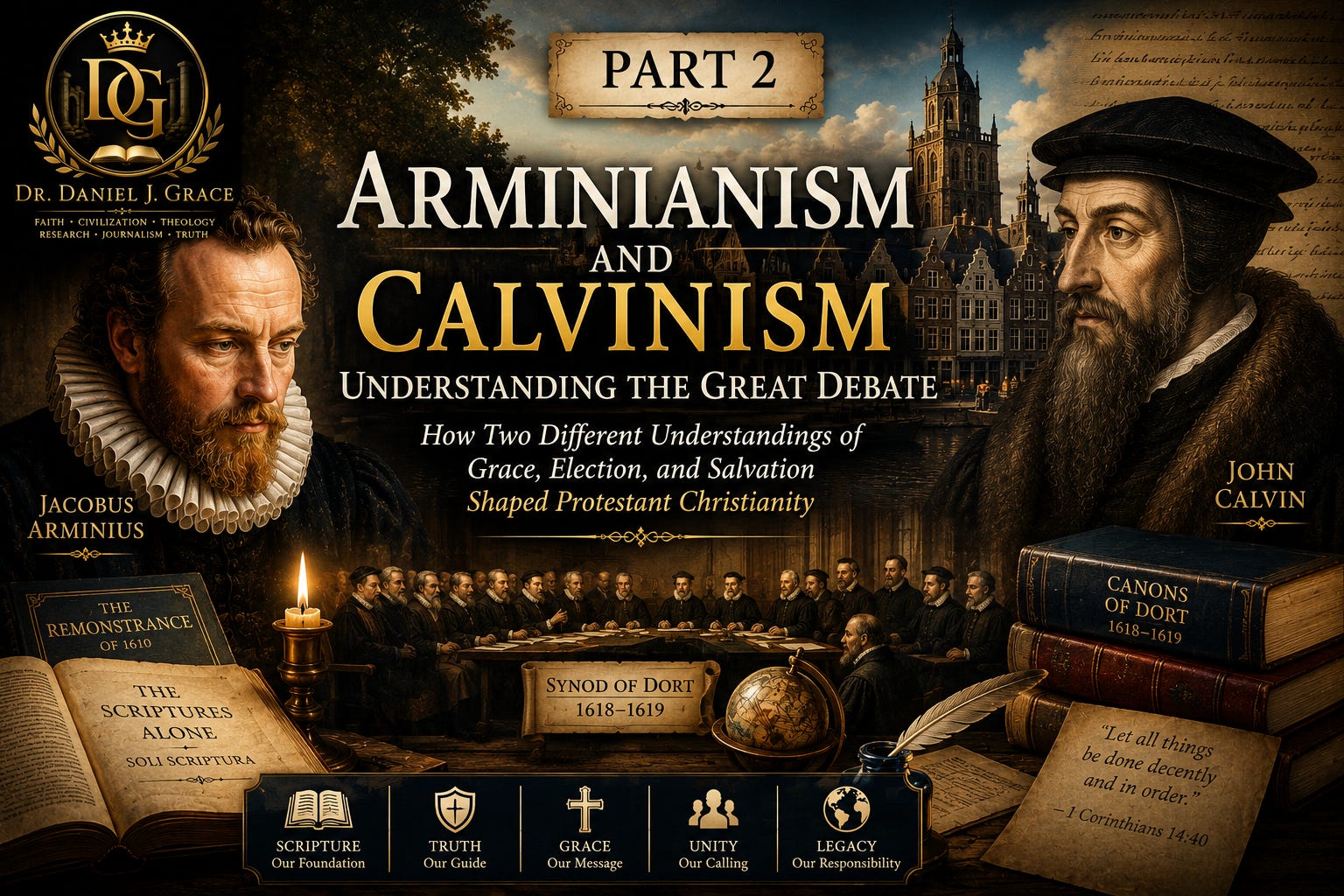
Part 2: Arminianism and Calvinism: Understanding the Great Debate
How a Theological Disagreement Shaped Protestant Christianity
When Jacobus Arminius died in 1609, he probably did not realise that his name would become attached to one of the most significant theological debates in Protestant history.
He had spent much of his life studying Scripture, teaching theology, and serving as a pastor. Yet the questions he raised about predestination, grace, and salvation did not disappear with his death. Instead, they became the centre of a controversy that would influence churches for centuries to come.
To understand this debate, we must first understand an important fact: Arminius was not attempting to reject the Protestant Reformation.
He was part of it.
Like John Calvin, Martin Luther, and many other Reformers, Arminius believed that salvation was found only through Jesus Christ and received by faith. He believed Scripture was the final authority for Christian belief and practice. He rejected salvation by works and affirmed humanity’s deep need for God’s grace.
The disagreement was not about whether people needed grace.
The disagreement was about how grace works.
The Influence of John Calvin
Long before Arminius entered the discussion, John Calvin had become one of the most influential theologians of the Protestant Reformation.
Calvin’s writings helped shape the Reformed tradition across Europe. His emphasis on God’s sovereignty, the authority of Scripture, and salvation by grace alone profoundly influenced churches in Switzerland, France, Scotland, the Netherlands, and beyond.
After Calvin’s death in 1564, many of his followers sought to organise and explain his teachings in greater detail.
One of the most influential among them was Theodore Beza, Calvin’s successor in Geneva and one of Arminius’s former teachers.
As the Reformed tradition developed, increasing attention was given to questions surrounding election, predestination, and the eternal purposes of God.
It was within this theological environment that Arminius began asking difficult questions.
The Question That Divided the Debate
The central issue was surprisingly simple.
If salvation is entirely by God’s grace, what role, if any, does human response play?
Calvinist theologians generally argued that God’s choice of those who would be saved was based entirely on His sovereign will and not on anything foreseen in human beings.
Arminius agreed that salvation begins with God’s grace.
However, he questioned whether Scripture taught that God’s election was completely unrelated to human faith.
Could God, in His foreknowledge, know who would respond to His gracious invitation?
Could divine sovereignty and genuine human responsibility exist together?
These questions became the foundation of the debate.
Areas of Agreement
Modern discussions often exaggerate the differences between Calvinists and Arminians.
In reality, they share many important beliefs.
Both affirm:
The authority of Scripture.
The deity of Christ.
Humanity’s sinful condition.
Salvation through Christ alone.
The necessity of God’s grace.
The importance of faith.
The reality of eternal judgment.
Both traditions stand firmly within historic Protestant Christianity.
The debate concerns how certain biblical truths should be understood rather than whether those truths exist.
Areas of Disagreement
The greatest disagreements centred on several important questions.
Election
Calvinists generally teach unconditional election, meaning God’s choice is based entirely on His sovereign purpose.
Arminians teach conditional election, believing God’s choice is connected to His foreknowledge of faith.
Grace
Both sides affirm grace.
The disagreement concerns whether God’s saving grace can ultimately be resisted.
Atonement
Calvinists traditionally teach that Christ died specifically for the elect.
Arminians teach that Christ’s atonement was intended for all people, although only believers receive its saving benefits.
Perseverance
Can a believer ultimately fall away from the faith?
Different answers emerged within both traditions, and this question remains debated even among Arminians today.
The Synod of Dort
Following Arminius’s death, his followers presented their views in a document known as the Remonstrance.
Their opponents responded strongly.
To settle the dispute, church leaders and civil authorities convened the Synod of Dort between 1618 and 1619.
The Synod rejected the teachings of the Remonstrants and affirmed what later became known as the Five Points of Calvinism.
Although the Synod sought to resolve the controversy, the debate did not disappear.
Instead, it spread throughout Europe and eventually around the world.
Why the Debate Still Matters
More than four hundred years later, Christians continue discussing these questions.
Yet perhaps the greatest lesson from this history is not found in the differences themselves.
It is found in the shared desire of both sides to honour God and remain faithful to Scripture.
Arminius and his opponents believed eternal truths were at stake. Their debates were passionate because they cared deeply about the character of God and the message of salvation.
While Christians continue to disagree on these matters, they remain united in the central truth that salvation is found through Jesus Christ alone.
Looking Ahead
In Part 3, we will examine one of the defining features of Arminian theology: the relationship between free will, prevenient grace, and human responsibility in salvation.
Dr. Daniel J. Grace
Faith • Civilization • Theology
Research • Journalism • Truth
🌐 danieljamesgrace.com
© 2026 Dr. Daniel J. Grace. All Rights Reserved.
No part of this article may be reproduced, distributed, transmitted, or published in any form or by any means without prior written permission from the author, except for brief quotations used in academic citation, review, or research purposes.