
Anglican Theology – Part 7
How a Prayer Book Shaped a Global Christian Tradition

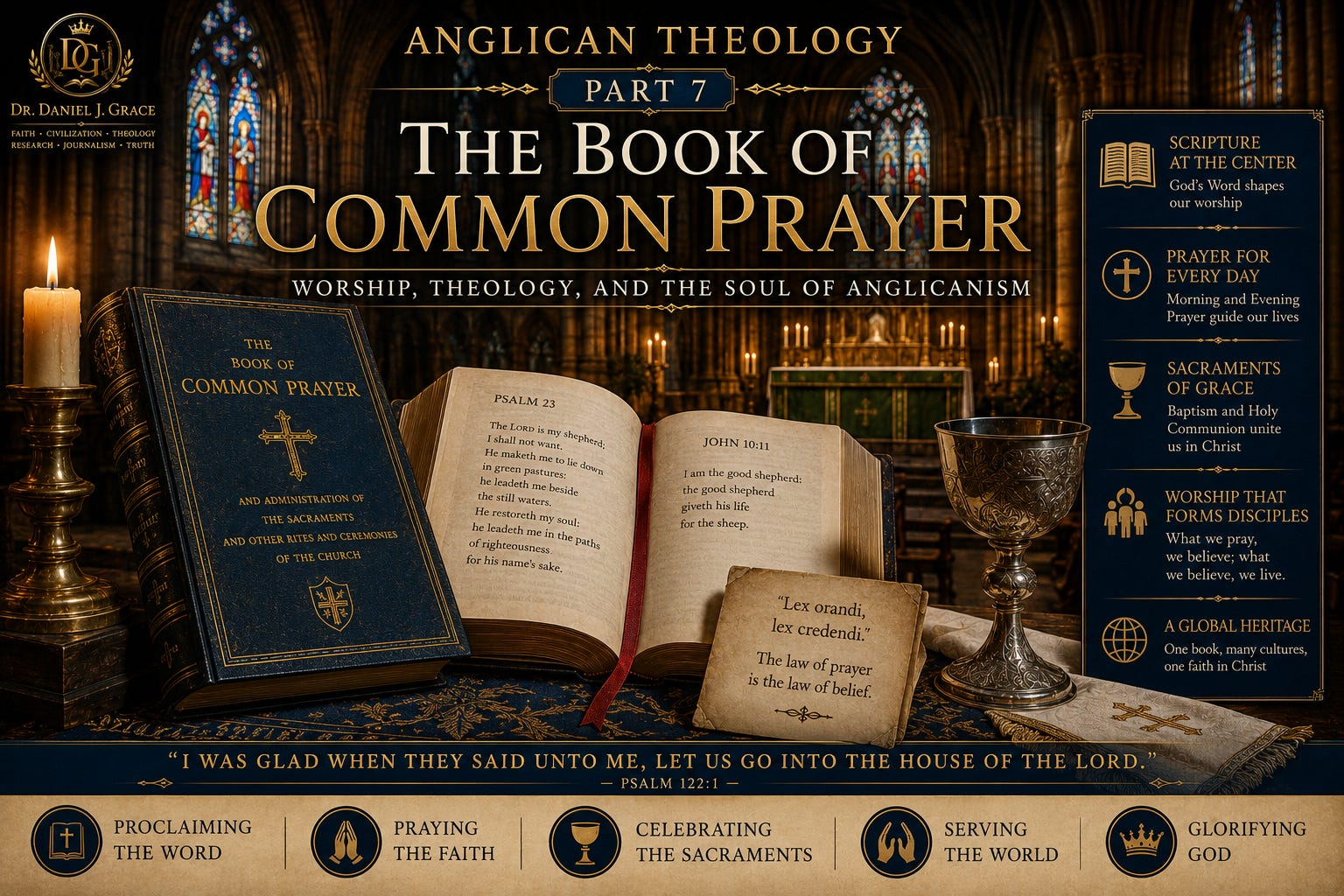
The Book of Common Prayer: Worship, Theology, and the Soul of Anglicanism
Introduction
Few books outside the Bible have influenced Christian worship as profoundly as the Book of Common Prayer. For nearly five centuries, it has shaped the spiritual lives of millions of believers across the world. It has been used in village churches, great cathedrals, mission stations, military chapels, royal ceremonies, and family homes. Through its prayers, scripture readings, liturgies, and sacraments, generations of Anglicans have learnt how to worship God, confess sin, receive grace, and follow Christ.
The Book of Common Prayer is far more than a collection of services. It is a theological document, a spiritual guide, and a historical treasure. Some have even described it as the heart of Anglican identity. If the Thirty-Nine Articles explain Anglican doctrine, the Book of Common Prayer demonstrates Anglican theology in action.
At the centre of Anglican worship lies a simple conviction: Christians are formed by what they pray. Worship is not merely an expression of faith; it is also a means through which faith is shaped. The prayers of the Church teach believers how to consider God, salvation, Scripture, the sacraments, and Christian living.
This chapter explores the origins, development, theology, and continuing significance of the Book of Common Prayer. Understanding this remarkable book poffers one of the clearest insightsinto Anglican theology itself.
The Religious World Before the Prayer Book
Before the English Reformation, worship throughout England was conducted primarily in Latin.
The ordinary believer often attended Mass faithfully but understood little of the language that the priest spoke. While many clergy were devoted servants of God, worship had become increasingly distant from the daily lives of ordinary people.
Services varied from region to region.
Different dioceses followed different customs.
Various local liturgical traditions existed.
The result was often confusion and inconsistency.
Reformers desired something different.
They wanted worship that was the following:
Biblical
Understandable
Unified
Spiritually enriching
Most importantly, they wanted people to hear and understand God’s Word.
The English Reformation therefore sought not merely doctrinal reform but also liturgical reform.
This vision would eventually produce one of Christianity’s most influential books.
Thomas Cranmer: Architect of Anglican Worship
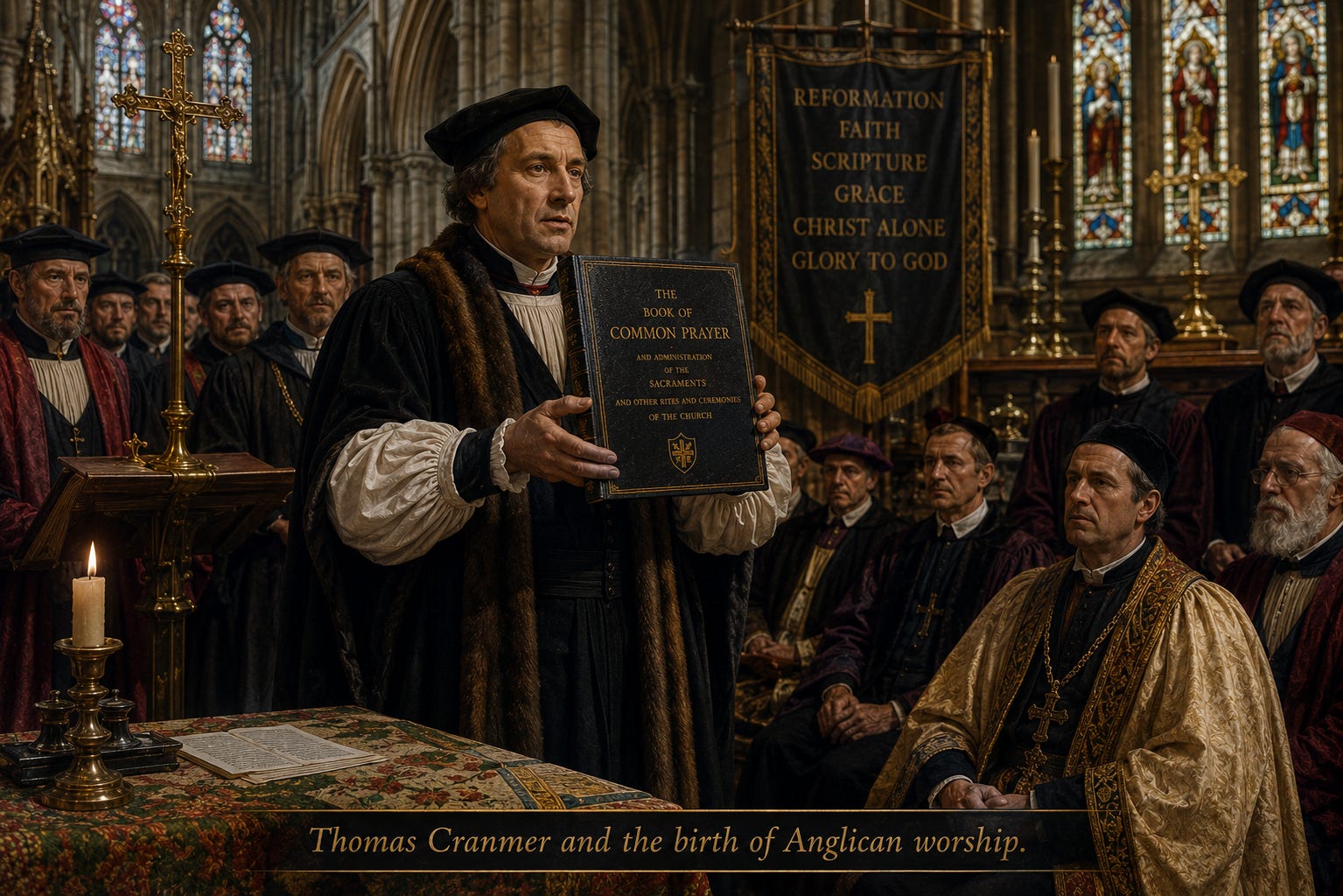
No person played a greater role in creating the Book of Common Prayer than Thomas Cranmer.
As Archbishop of Canterbury, Cranmer believed that worship should reflect biblical truth.
He possessed an extraordinary gift for language.
His prayers combined theological depth with literary beauty.
Many phrases that remain famous today originated from Cranmer’s pen.
Examples include:
“Read, mark, learn, and inwardly digest.”
“Earth to earth, ashes to ashes, dust to dust.”
“Till death us do part.”
“We have left undone those things which we ought to have done.”
These phrases entered not only Anglican worship but also the English language itself.
Cranmer believed worship should accomplish three goals:
Proclaim Scripture.
Teach Christian doctrine.
Lead believers into communion with God.
The Book of Common Prayer was designed to achieve all three.
The First Prayer Book of 1549
The first Book of Common Prayer appeared in 1549 during the reign of King Edward VI.
For the first time, worship throughout England was conducted in English rather than Latin.
This was revolutionary.
Ordinary Christians could now understand the prayers, readings, and sacraments.
The 1549 Prayer Book retained many traditional elements while introducing significant reforms.
Its goals included:
Simplicity
Unity
Accessibility
Scriptural focus
Not everyone welcomed the changes.
Some believed the reforms went too far.
Others believed they did not go far enough.
Yet the prayer book quickly became central to English worship.
The Revision of 1552
Only three years later, a revised edition appeared.
The 1552 Prayer Book reflected stronger Protestant influences.
Its language emphasised the following:
Salvation by grace
Biblical authority
Christ’s finished work
Spiritual participation in the sacraments
Many historians regard the 1552 edition as one of the defining moments in Anglican theology.
It clarified many doctrinal questions and established principles that continue to influence Anglican worship today.
The Elizabethan Settlement
Following periods of religious conflict under Mary I and Elizabeth I, Anglican worship required stability.
The Prayer Book became a key instrument in creating unity.
The Elizabethan version balanced the following:
Catholic heritage
Reformed theology
National identity
Biblical worship
This balance became a hallmark of Anglicanism.
The Prayer Book helped establish a church that was both ancient and reformed.
Worship as Theology
One of Anglicanism’s most distinctive beliefs is that worship teaches theology.
The phrase often used is the following:
Lex Orandi, Lex Credendi
“The law of prayer is the law of belief.”
In other words:
How Christians pray shapes what Christians believe.
The Prayer Book embodies this principle.
Rather than presenting theology only through academic texts, Anglicanism teaches theology through worship itself.
Every confession teaches repentance.
Every Eucharist teaches grace.
Every baptism teaches new life.
Every funeral teaches resurrection hope.
Thus worship becomes a theological classroom.
Scripture at the Center
A defining feature of the Book of Common Prayer is its emphasis on Scripture.
Large portions of the Prayer Book are drawn directly from the Bible.
Morning Prayer and Evening Prayer immerse worshippers in Scripture.
The Psalms occupy a central role.
Old Testament readings are included.
New Testament readings are included.
The Gospels are proclaimed regularly.
Historically, a faithful Anglican attending daily prayer would hear most of the Bible read within a year.
This reflects Anglican theology’s conviction that Scripture is God’s primary means of revealing Himself.
Morning Prayer and Evening Prayer
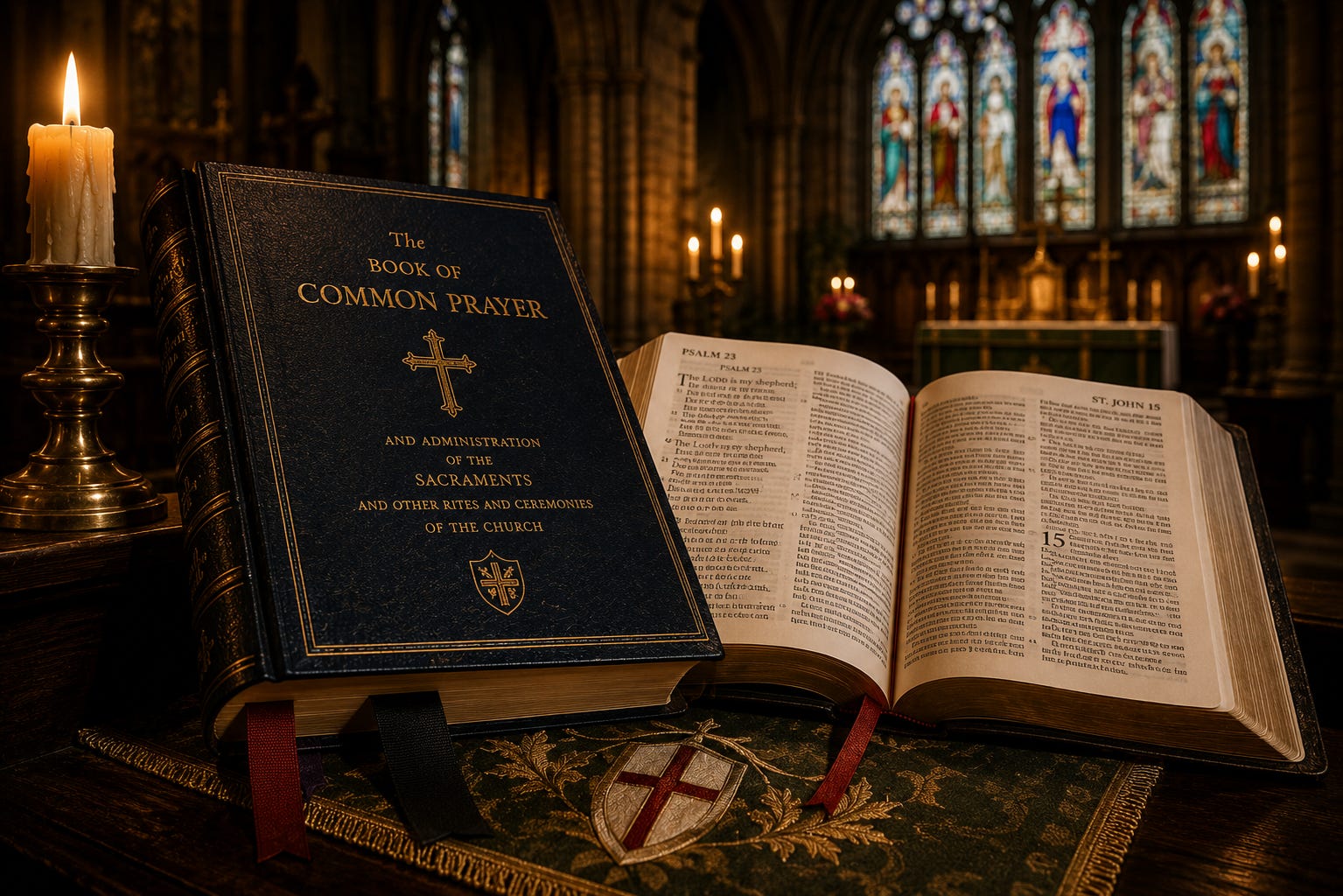
Among the Prayer Book’s greatest contributions are Morning Prayer and Evening Prayer.
These daily offices transformed Christian devotion.
Rather than reserving worship for Sundays alone, Anglicans were encouraged to pray daily.
Morning prayer typically includes the following:
Opening sentences
Confession
Psalms
Scripture readings
Canticles
Apostles’ Creed
Intercessions
Evening Prayer follows a similar pattern.
Together these services create a rhythm of daily worship centred upon Scripture.
Many Anglicans consider them among the greatest treasures of their tradition.
The General Confession
One of the most beloved sections of the Prayer Book is the General Confession.
It begins:
“We have erred and strayed from thy ways like lost sheep.”
This prayer reflects a profound biblical understanding of sin.
It acknowledges:
Human weakness
Personal responsibility
Divine mercy
Yet confession is never the final word.
Forgiveness follows.
Grace triumphs.
The Prayer Book consistently points believers toward God’s mercy in Christ.
The Eucharist and Anglican Theology
The Holy Communion service stands at the centre of Anglican worship.
The Eucharist proclaims the following:
Christ’s sacrifice
Christ’s presence
Christ’s victory
Christian unity
Anglican theology historically avoids rigid explanations concerning exactly how Christ is present in the sacrament.
Instead, it affirms that believers genuinely encounter Christ through faith.
This reflects Anglicanism’s preference for mystery where scripture does not speak definitively.
The Prayer Book therefore encourages reverence, gratitude, and faith rather than speculation.
Baptism and New Life
The baptismal liturgies reveal Anglican teaching concerning Christian initiation.
Baptism signifies:
Entry into Christ’s Church
Union with Christ
New life
Covenant membership
The Prayer Book presents baptism not as a mere ceremony but as a profound spiritual reality.
Through baptism, Christians publicly identify with Christ and His people.
Marriage and Family Life
The Prayer Book’s marriage service has profoundly influenced Christian understanding of marriage.
Its language remains among the most beautiful in Christian literature.
Marriage is described as:
Holy
Lifelong
Faithful
God-given
The famous phrase:
“Till death us do part”
originated from the Prayer Book tradition.
For centuries these words have shaped Christian marriages throughout the English-speaking world.
Funerals and Christian Hope
The Prayer Book’s funeral service reflects deep confidence in the resurrection.
Its language avoids despair.
Instead, it points believers toward eternal hope.
The famous words:
“Earth to earth, ashes to ashes, dust to dust”
remind Christians of mortality.
Yet they are spoken within the context of resurrection faith.
Death is not the end.
Christ has conquered the grave.
This hope remains central to Anglican theology.
The Beauty of Anglican Language
One reason the prayer book has endured is its extraordinary literary quality.
Its language combines:
Reverence
Simplicity
Beauty
Theological depth
Even secular literary scholars have admired its influence.
Alongside the King James Bible, it helped shape the English language itself.
Many of its phrases remain recognisable centuries later.
The Prayer Book Around the World
As Anglicanism expanded globally, the Prayer Book travelled with missionaries.
Today Anglican worship exists across the following:
Africa
Asia
Australia
Europe
North America
South America
Different provinces have developed their own prayer books.
Yet most remain deeply influenced by Cranmer’s original vision.
The result is remarkable diversity united by a common heritage.
Modern Prayer Books
Many Anglican churches now use contemporary liturgies.
Examples include:
Common Worship (England)
A Prayer Book for Australia
Book of Alternative Services (Canada)
Various provincial prayer books
These modern resources often use contemporary language while preserving historic structures.
Although styles vary, the influence of the original Prayer Book remains unmistakable.
Why the Prayer Book Still Matters
Some wonder whether a sixteenth-century prayer book can remain relevant in the modern world.
The answer is yes.
The Prayer Book continues to offer the following:
Biblical worship
Theological depth
Spiritual discipline
Historical continuity
In an age of constant change, it connects believers with centuries of Christian faith.
It reminds the Church that worship is not entertainment.
Worship is participation in the life of God.
Conclusion
The Book of Common Prayer remains one of Anglicanism’s greatest gifts to the Christian world.
It transformed English worship.
It shaped Anglican theology.
It influenced global Christianity.
For nearly five centuries it has taught believers how to confess, pray, worship, celebrate, marry, mourn, and hope.
More importantly, it has pointed countless people toward Jesus Christ.
The Prayer Book reflects the heart of Anglican theology: scripture-centred, Christ-focused, sacramental, pastoral, and deeply rooted in the historic faith of the Church.
To understand Anglicanism is to understand its worship.
And to understand Anglican worship is ultimately to encounter the longstanding legacy of the Book of Common Prayer.
Dr Daniel J. Grace
Faith • Civilization • Theology
Research • Journalism • Truth
🌐 danieljamesgrace.com
© 2026 Dr Daniel J. Grace. All Rights Reserved.
No part of this article may be reproduced, distributed, transmitted, or published in any form or by any means without prior written permission from the author, except for brief quotations used in academic citation, review, or research purposes.