
Anglican Theology – Part 6
Defining Anglican Belief Through Scripture, Reform, and Historic Christianity

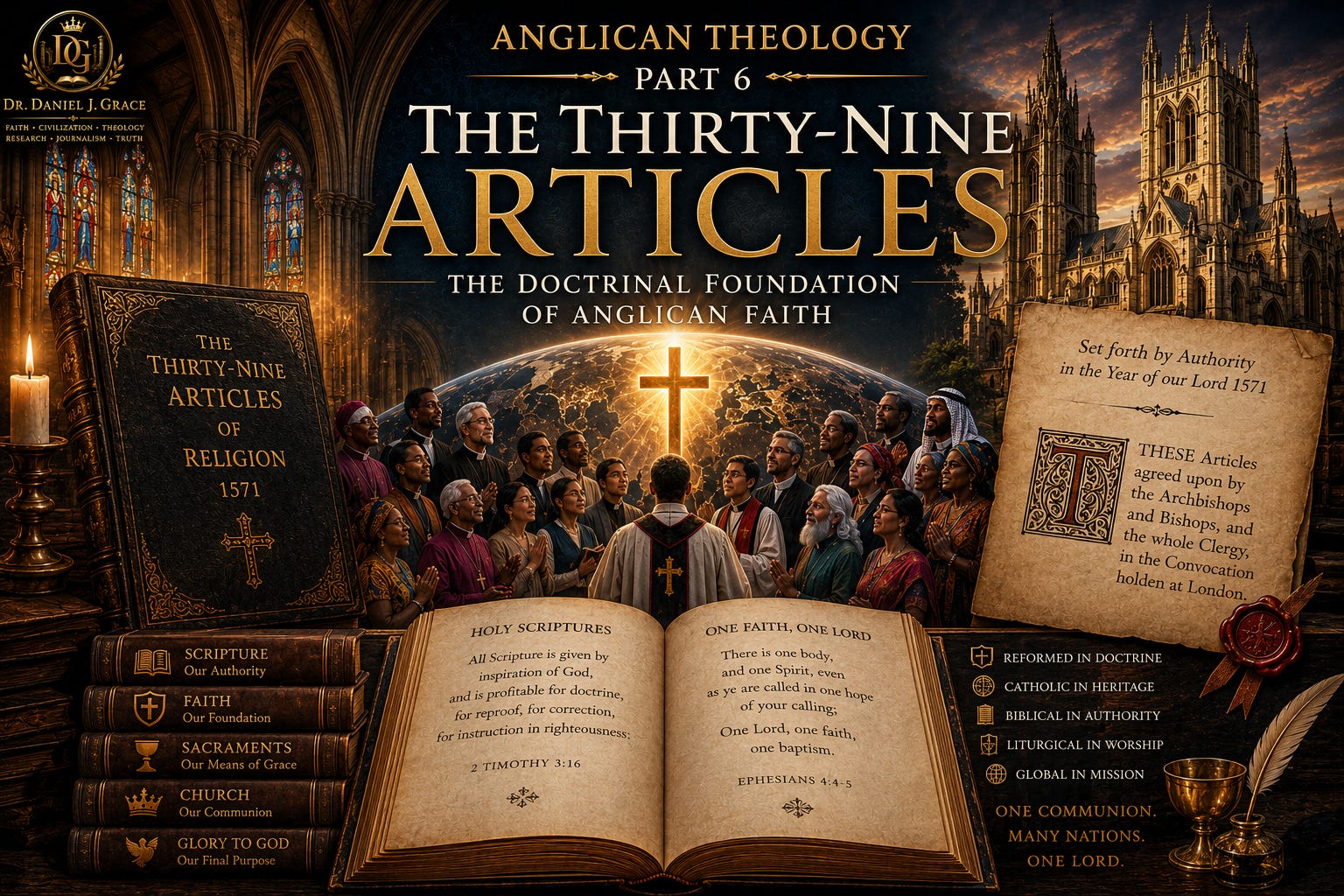
The Thirty-Nine Articles: The Doctrinal Foundation of Anglican Faith
Introduction
Within all the documents that have shaped Anglican theology, few have had as much influence as the Thirty-Nine Articles of Religion. For more than four centuries, these articles have served as a foundational statement of Anglican doctrine, helping to define what Anglicans believe about Scripture, salvation, the Church, the sacraments, and the Christian life.
Many Christians today are familiar with the Apostles’ Creed, the Nicene Creed, or the Book of Common Prayer, yet fewer understand the significance of the Thirty-Nine Articles. These articles emerged during one of the most turbulent periods in English history and helped establish Anglicanism as a distinct Christian tradition. They sought to preserve the ancient faith of the Church while addressing theological controversies that arose during the Protestant Reformation.
The Thirty-Nine Articles are not intended to replace the Bible. Rather, they summarise key biblical teachings and provide a framework for understanding Anglican doctrine. They reflect a church committed to the authority of Scripture, grounded in historic Christianity, and shaped by careful theological reflection.
Throughout Anglican history, various groups have interpreted the Articles in different ways. Evangelical Anglicans often emphasise their Protestant character, while Anglo-Catholics highlight their continuity with the ancient church. Nevertheless, the Articles remain an important witness to the theological identity of Anglicanism.
To understand Anglican theology, one must understand the Thirty-Nine Articles. They reveal how Anglicans sought to navigate between extremes, preserving biblical truth while maintaining historical continuity with the Christian tradition.
The Historical Background of the Thirty-Nine Articles
The Thirty-Nine Articles did not emerge in isolation. They were the product of dramatic religious, political, and cultural changes that transformed England during the sixteenth century.
The Medieval Church
Before the Reformation, England was part of the Western Church under the authority of the Bishop of Rome. The mediaeval church shaped every aspect of society. Religious festivals marked the calendar. Monasteries served communities. Pilgrimages were common. The sacraments structured Christian life from birth to death.
However, by the late Middle Ages concerns had emerged regarding corruption, abuses of authority, and theological practices that many believed lacked biblical support. Calls for reform appeared throughout Europe long before Martin Luther nailed his Ninety-Five Theses in 1517.
Many Christians desired a return to biblical teaching, greater access to Scripture, and reform within church leadership.
Henry VIII and the Break with Rome
The English Reformation began differently from many continental reform movements.
King Henry VIII initially defended Roman Catholic doctrine and even received the title “Defender of the Faith” from Pope Leo X. Yet political circumstances eventually led to a break with Rome.
When the Pope refused to grant Henry an annulment from Catherine of Aragon, tensions increased. In 1534, the Act of Supremacy declared the king to be the supreme head of the Church of England.
This separation was primarily political rather than theological. Many traditional doctrines remained unchanged during Henry’s reign. Nevertheless, the break from Rome created the conditions that allowed theological reform to develop later.
Thomas Cranmer and Reform
No individual shaped Anglican theology more profoundly than Archbishop Thomas Cranmer.
The Protestant Reformation deeply influenced Cranmer, who believed that Scripture should be central to Christian life. He supported translating the Bible into English, revising worship services, and clarifying doctrine according to biblical principles.
Under Cranmer’s leadership, major reforms transformed English Christianity.
The Book of Common Prayer was introduced.
Services were conducted in English rather than Latin.
Scripture became more accessible.
Theology increasingly emphasised justification by faith and the authority of God’s Word.
Cranmer sought a balanced approach between rejecting church tradition and accepting every inherited practice. Instead, he desired reform rooted in Scripture and the early church.
This balanced approach would later become a defining characteristic of Anglicanism.
The Forty-Two Articles
During the reign of King Edward VI, Protestant reforms accelerated.
In 1553 Cranmer produced the Forty-Two Articles. These articles aimed to provide a clear statement of doctrine for the reformed Church of England.
The Forty-Two Articles addressed the following:
Scripture
Salvation
Sacraments
Church authority
Worship practices
Christian conduct
They reflected many themes common among Protestant reformers while retaining elements that distinguished the English church.
However, political circumstances soon interrupted these developments.
The Reign of Mary I
Following Edward VI’s death, Queen Mary I restored Roman Catholicism.
Many Protestant leaders were imprisoned, exiled, or executed. Thomas Cranmer himself was burnt at the stake in 1556.
This period profoundly affected English Protestantism.
The suffering of reformers reinforced commitments to biblical authority and strengthened opposition to perceived abuses within the mediaeval church.
The memory of these events would influence Anglican theology for generations.
Elizabeth I and Religious Settlement
When Elizabeth I became Queen in 1558, she inherited a deeply divided nation.
Some desired a complete return to Roman Catholicism.
Others sought more radical Protestant reforms.
Elizabeth attempted to establish stability through what became known as the Elizabethan Settlement.
Her goal was not theological compromise but national unity grounded in a reformed church.
This settlement preserved the following:
Episcopal leadership
Historic liturgy
Ancient creeds
While also affirming:
Scriptural authority
Protestant doctrine
Reformed theology
It was within this context that the Thirty-Nine Articles emerged.
From Forty-Two to Thirty-Nine
In 1563 church leaders revised Cranmer’s Forty-Two Articles.
Several articles were modified.
Others were removed.
The final result consisted of thirty-nine articles.
These articles were formally adopted in 1571 and became the official doctrinal standard of the Church of England.
Their purpose was not to answer every theological question but to establish boundaries for Anglican belief.
The articles addressed major controversies of the time while affirming core Christian doctrines shared by the historic church.
The Purpose of the Thirty-Nine Articles
The articles served several important functions.
First, they clarified doctrine.
In a period of theological confusion, the church needed a clear statement of belief.
Second, they promoted unity.
The Articles established a common doctrinal foundation for clergy and congregations throughout England.
Third, they defended biblical teaching.
The reformers believed that many mediaeval practices had obscured the Gospel. The Articles sought to restore clarity regarding salvation, Scripture, and worship.
Fourth, they distinguished Anglicanism from both Roman Catholicism and more radical forms of Protestantism.
The Articles rejected certain Roman doctrines while also avoiding some positions associated with extreme reform movements.
This commitment to balance became a hallmark of Anglican theology.
A Distinct Anglican Identity
The Thirty-Nine Articles helped shape Anglicanism into a unique Christian tradition.
They demonstrated that Anglicanism was the following:
Reformed in doctrine
Catholic in heritage
Biblical in authority
Liturgical in worship
This combination remains one of Anglicanism’s defining characteristics.
The articles reveal a church seeking faithfulness rather than novelty. Their authors did not believe they were inventing a new religion. Rather, they saw themselves as recovering biblical Christianity while maintaining continuity with the ancient church.
For this reason the Thirty-Nine Articles continue to occupy an important place in Anglican theology today.
They remind Anglicans that authentic reform is not abandonment of tradition but renewal according to the Word of God.
Next: Part 7Anglican Worship and the Book of Common Prayer
Explore how the Book of Common Prayer shaped Anglican identity, worship, devotion, sacraments, and spiritual life, uniting believers across centuries and cultures worldwide.
Dr Daniel J. Grace
Faith • Civilization • Theology
Research • Journalism • Truth
🌐 danieljamesgrace.com
© 2026 Dr Daniel J. Grace. All Rights Reserved.
No part of this article may be reproduced, distributed, transmitted, or published in any form or by any means without prior written permission from the author, except for brief quotations used in academic citation, review, or research purposes.