

Anglican Theology – Part 5
One Faith, Many Cultures: The Anglican Communion Across the World

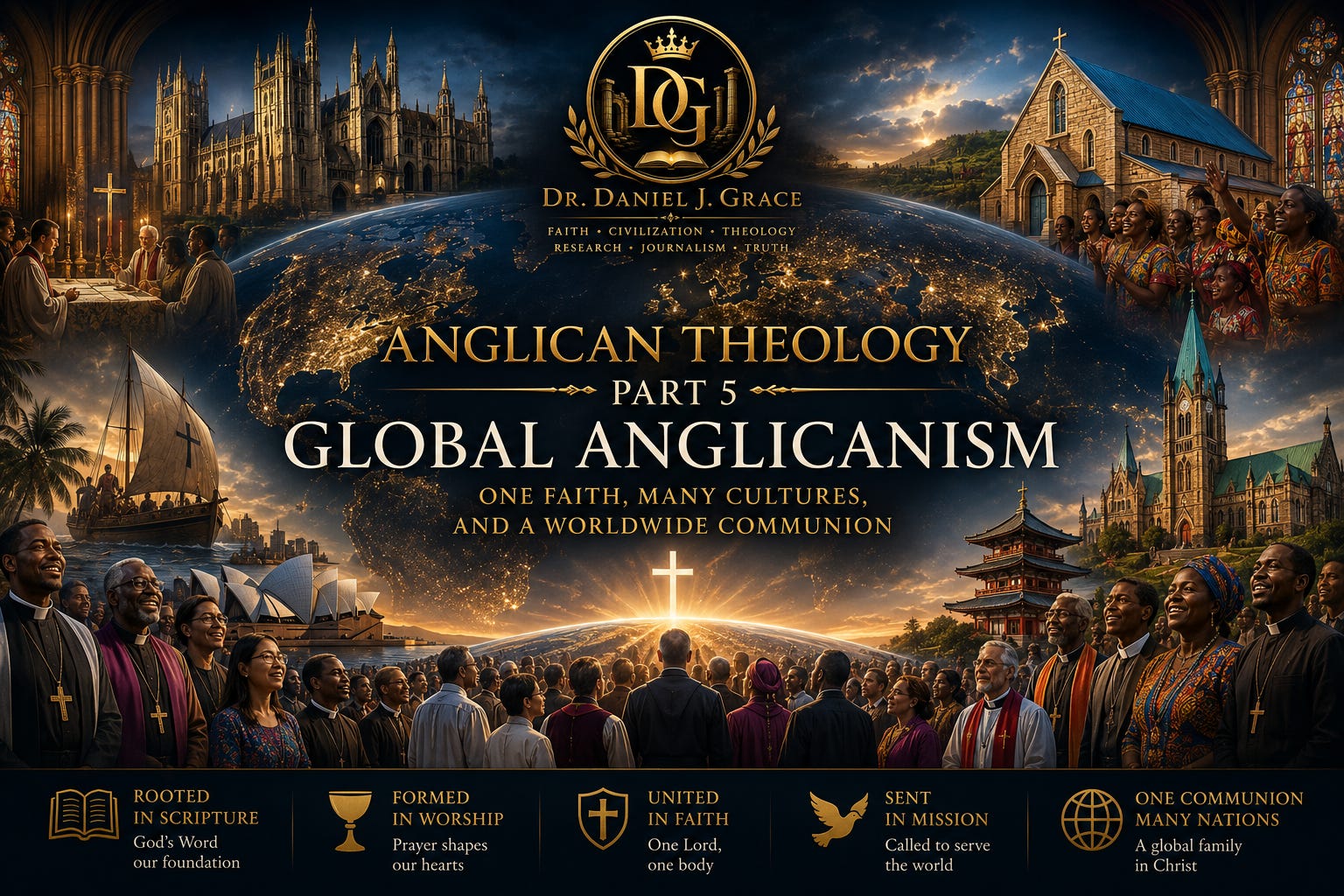
Global Anglicanism: One Faith, Many Cultures, and a Worldwide Communion
Introduction
Anglicanism began as a movement within the Church of England, shaped by the English Reformation and the theological developments that followed. Yet over the centuries, it became far more than an English religious tradition. Today Anglicanism is a global communion spanning continents, cultures, languages, and ethnic backgrounds. From England to Nigeria, from Australia to Kenya, from Canada to Singapore, Anglican churches worship the same Lord Jesus Christ while expressing their faith through diverse cultural forms.
The story of Global Anglicanism is one of remarkable growth, adaptation, and mission. What began as a national church evolved into one of the largest Christian traditions in the world. The Anglican Communion now includes tens of millions of believers across more than 165 countries. Despite cultural differences, these churches remain connected through shared theological foundations, historic episcopal leadership, Scripture, and common worship traditions.
Understanding Global Anglicanism is essential because it demonstrates how Christianity can remain faithful to biblical truth while engaging different cultures. It also reveals the challenges and opportunities of maintaining unity across diverse nations and traditions. This article explores the history, development, strengths, tensions, and future of Anglicanism as a worldwide communion.
The Birth of a Global Communion
The spread of Anglicanism was closely connected to the expansion of the British Empire. As English settlers, merchants, soldiers, and missionaries travelled across the world, they brought their faith with them.
Anglican churches were established throughout North America, Africa, Asia, Australia, New Zealand, and the Pacific Islands. Yet Anglicanism did not remain merely a transplanted English institution. Over time local believers shaped these churches according to their own cultural realities.
Missionaries translated Scripture into local languages. Indigenous clergy emerged. Local leadership replaced foreign control. Eventually many churches became self-governing provinces while maintaining fellowship with the wider Anglican family.
This transformation changed Anglicanism forever. What was once primarily English became truly international.
The Anglican Communion
Unlike the Roman Catholic Church, Anglicanism has no single worldwide governing authority. There is no Anglican equivalent of the Pope.
Instead, Anglican churches are linked through what is called the Anglican Communion.
The Archbishop of Canterbury serves as a symbolic focus of unity but does not govern the entire communion.
Four instruments of communion help maintain relationships among Anglican churches:
1. The Archbishop of Canterbury
The Archbishop of Canterbury is regarded as the first among equals. His role is primarily spiritual and relational rather than authoritative.
2. The Lambeth Conference
Bishops from around the world gather approximately every ten years to discuss theology, mission, and global issues.
3. The Anglican Consultative Council
This council includes bishops, clergy, and lay representatives who work together on matters affecting the Communion.
4. The Primates’ Meeting
Senior archbishops and presiding bishops from Anglican provinces meet to discuss major challenges and opportunities.
Together these structures encourage cooperation while allowing significant local autonomy.
Anglicanism in Africa
One of the most remarkable developments in modern Christianity is the growth of Anglicanism in Africa.
In the nineteenth century many Anglican churches in Africa were small missionary communities. Today, the African continent hosts some of the largest Anglican provinces in the world.
Nigeria alone has millions of Anglicans. Uganda, Kenya, Tanzania, Rwanda, and South Sudan also have vibrant Anglican communities.
African Anglicanism is often characterised by the following:
Strong biblical preaching
Evangelistic zeal
Active prayer life
Church planting
Community development
Vibrant worship
Many African Anglican leaders have become influential voices within global Christianity.
The demographic centre of Anglicanism has shifted dramatically from Europe toward Africa.
Anglicanism in Asia
Asia presents a unique context for Anglican theology.
Anglican churches operate in societies shaped by Buddhism, Hinduism, Islam, Confucianism, and traditional religions.
Because Christians are often minorities, Anglican churches in Asia have developed strong approaches to interfaith dialogue while maintaining Christian identity.
Countries with significant Anglican presence include:
India
Pakistan
Bangladesh
Singapore
Malaysia
Hong Kong
Japan
South Korea
Asian Anglican theology frequently explores questions of culture, identity, religious diversity, and Christian witness.
Anglicanism in Australia and New Zealand
The Anglican Church has played a significant role in Australian history.
Early Anglican clergy accompanied settlers and helped establish schools, hospitals, and community institutions.
Today Australian Anglicanism includes the following:
Evangelical traditions
Anglo-Catholic traditions
Broad Church traditions
This diversity reflects Anglicanism’s historic commitment to theological breadth.
New Zealand Anglicanism has become notable for its partnership among Māori, Pacific Islander, and European communities.
These developments demonstrate Anglicanism’s capacity to adapt to multicultural contexts.
Anglicanism in North America
North American Anglicanism has experienced significant change over the past two centuries.
The Episcopal Church in the United States emerged after the American Revolution and developed its own identity while remaining within the Anglican Communion.
Canada also established a strong Anglican tradition.
North American Anglican churches have often engaged social questions such as the following:
Human rights
Education
Social justice
Poverty
Healthcare
Public ethics
These discussions have sometimes generated theological debates that continue throughout the Communion.
Unity and Diversity
One of Anglicanism’s defining characteristics is its ability to hold together diversity.
Anglicans often differ in:
Worship styles
Church traditions
Cultural expressions
Political contexts
Theological emphases
Yet they remain united by several key foundations:
Scripture
The Bible remains central to Anglican faith and practice.
Creeds
The Apostles’ Creed and Nicene Creed provide doctrinal unity.
Sacraments
Baptism and Holy Communion remain essential elements of worship.
Historic Episcopate
Bishops provide continuity with the historic church.
Common Worship
Although forms vary, Anglican liturgy continues to connect believers worldwide.
This combination of unity and diversity has become one of Anglicanism’s greatest strengths.
Challenges Facing the Anglican Communion
Like all Christian traditions, Anglicanism faces serious challenges.
Theological Disagreements
Different provinces sometimes disagree about doctrine and ethics.
Cultural Differences
Issues that seem important in one nation may appear very different in another.
Secularization
Western societies have experienced declining church attendance and increasing secularism.
Leadership Development
Training future clergy remains a major concern in many regions.
Economic Inequality
Some Anglican provinces have significant financial resources while others struggle with poverty.
Despite these challenges, the Communion continues to seek ways to remain united in Christ.
Anglican Mission in the Twenty-First Century
Modern Anglican mission extends far beyond traditional evangelism.
Today Anglican churches engage with the following:
Church planting
Education
Healthcare
Poverty relief
Refugee support
Disaster response
Community development
Digital ministry
Many Anglican organisations serve vulnerable populations while sharing the Gospel.
The Anglican understanding of mission emphasises both proclamation and practical service.
This reflects the ministry of Jesus, who preached the Kingdom of God while caring for physical and spiritual needs.
The Future of Global Anglicanism
The future of Anglicanism will likely be shaped increasingly by churches in Africa, Asia, and Latin America.
Growth in these regions contrasts sharply with decline in parts of Europe.
This demographic shift may influence:
Leadership
Theology
Mission priorities
Worship practices
Global partnerships
Yet the core challenge remains unchanged: how can Anglicans maintain faithfulness to Scripture while serving an increasingly complex world?
The answer will require humility, prayer, theological wisdom, and a renewed commitment to Christ.
Conclusion
Global Anglicanism represents one of Christianity’s most remarkable stories. What began in England became a worldwide communion embracing countless cultures and languages.
Its strength lies not in uniformity but in unity centred upon Jesus Christ. Anglicans around the world may worship differently, speak different languages, and face different challenges, yet they confess the same Lord, read the same Scriptures, and share the same hope.
As the Anglican Communion moves into the future, its mission remains clear: to proclaim the Gospel, serve the world, and glorify God among all nations.
The story of Anglicanism is no longer merely English. It is African, Asian, Australian, American, Pacific, and global. Above all, it is a testimony to the power of the Gospel to cross every cultural boundary while remaining rooted in the truth of Christ.
Next: Anglican Theology – Part 6
The Thirty-Nine Articles: The Doctrinal Foundation of Anglican Faith

Dr Daniel J. Grace
Faith • Civilization • Theology
Research • Journalism • Truth
🌐 danieljamesgrace.com
© 2026 Dr Daniel J. Grace. All Rights Reserved.
No part of this article may be reproduced, distributed, transmitted, or published in any form or by any means without prior written permission from the author, except for brief quotations used in academic citation, review, or research purposes.