
Anglican Theology – Part 3
The Anglican Approach to Authority and Theological Reflection

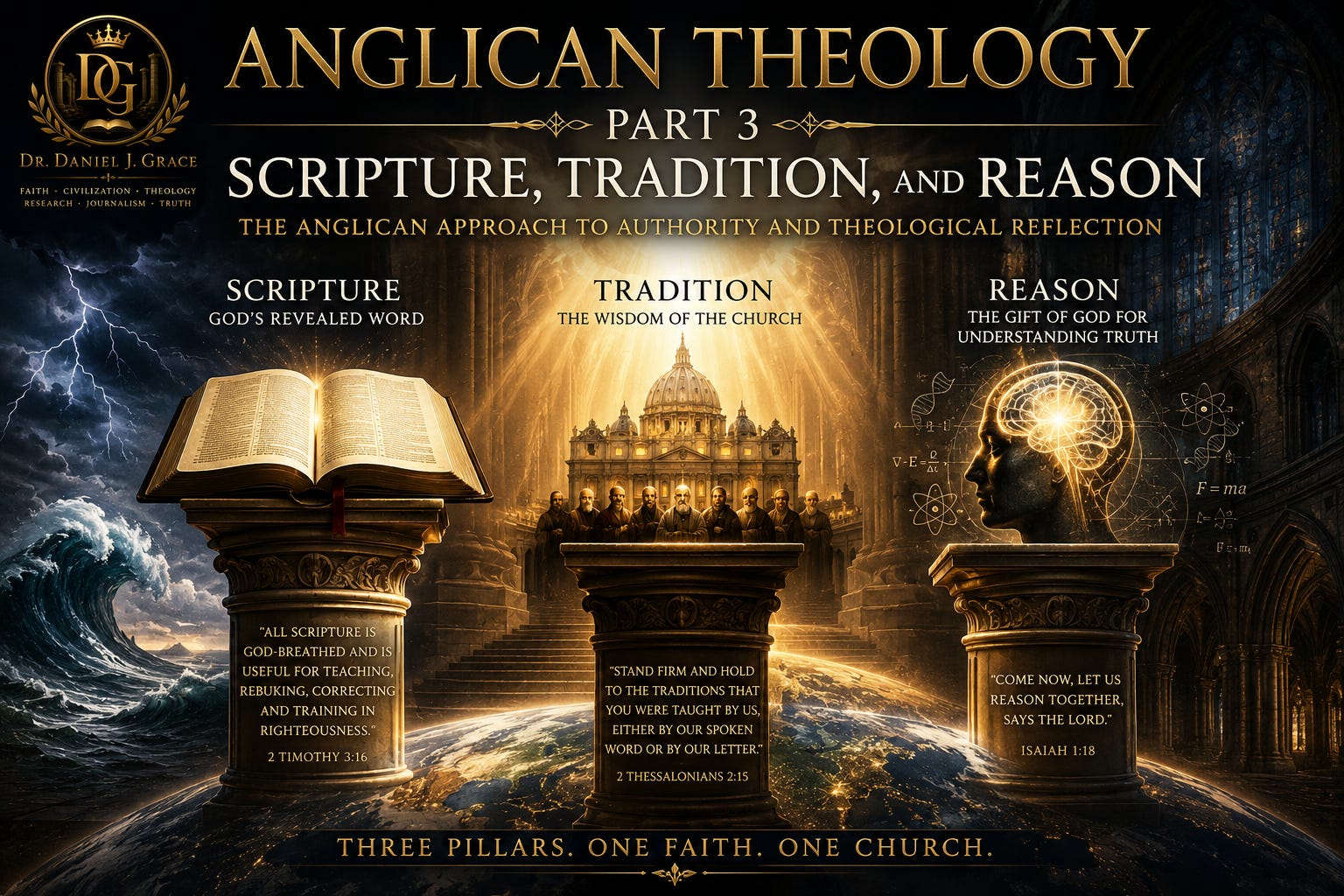
Scripture, Tradition, and Reason
Introduction
One of the most distinctive features of Anglican theology is its approach to authority. Christians throughout history have asked fundamental questions: How do we know what is true? Who has the authority to interpret Scripture? How should believers respond to new challenges and changing cultures while remaining faithful to the Gospel?
Different Christian traditions answer these questions in different ways. Some place strong emphasis on church authority and tradition. Others focus almost exclusively on Scripture. Anglicanism developed a unique approach that seeks to hold together three important sources of theological reflection: Scripture, Tradition, and Reason.
This approach has shaped Anglican theology for centuries and remains one of the defining characteristics of the Anglican Communion today. It is not a simple formula or a rigid system. Rather, it is a framework that helps Anglicans think carefully, faithfully, and prayerfully about Christian truth.
The goal is not to elevate human reasoning above God’s Word or to place tradition on the same level as Scripture. Instead, Anglican theology seeks to ensure that Christians remain grounded in biblical truth while benefiting from the wisdom of the Church and the God-given ability to think critically and responsibly.
The Search for Authority
Every Christian tradition must answer the question of authority.
When believers face questions about doctrine, ethics, worship, or church practice, where should they turn for guidance?
The early Church looked first to the teachings of Christ and the apostles. As Christianity spread throughout the Roman Empire, the Church preserved these teachings through Scripture, preaching, worship, and the writings of church leaders.
Over time, different traditions developed different understandings of authority.
The Roman Catholic Church emphasizes Scripture and Tradition interpreted through the teaching authority of the Church.
Many Protestant churches emphasize Scripture alone as the ultimate authority.
Anglicanism emerged during the English Reformation and sought a middle path that respected the authority of Scripture while also recognizing the value of historical Christian tradition and human reason.
This approach would become one of the most distinctive aspects of Anglican theology.
Scripture: The Foundation of Anglican Theology
For Anglicans, Scripture is the primary authority in matters of faith and doctrine.
The Bible is regarded as the inspired Word of God and the supreme standard by which all teaching must be tested.
The Thirty-Nine Articles express this clearly:
“Holy Scripture containeth all things necessary to salvation.”
This statement has enormous significance.
It means that everything necessary for salvation is found within Scripture.
Nothing outside Scripture is required as a condition of salvation.
The Bible serves as the foundation upon which Anglican theology is built.
Scripture reveals:
The character of God
The story of creation
Human sinfulness
God’s covenant promises
The life, death, and resurrection of Jesus Christ
The work of the Holy Spirit
The hope of eternal life
For Anglicans, all theological reflection begins with Scripture.
The Church does not stand above Scripture.
Tradition does not stand above Scripture.
Reason does not stand above Scripture.
Rather, Scripture stands as the ultimate authority.
Why Scripture Matters
Anglicans believe that God speaks through Scripture.
The Bible is not merely an ancient collection of religious writings.
It is the living witness to God’s revelation.
When Christians read Scripture, they encounter God’s truth.
Through Scripture:
Faith is strengthened.
Worship is guided.
Doctrine is formed.
Sin is exposed.
Hope is renewed.
The Anglican tradition places great emphasis on public reading of Scripture during worship services.
This is why Anglican liturgy contains extensive Bible readings from both the Old and New Testaments.
The goal is to immerse believers in God’s Word.
Tradition: The Wisdom of the Church
While Scripture is primary, Anglican theology also values tradition.
Tradition refers to the accumulated wisdom, teachings, practices, and experiences of Christians throughout history.
This includes:
The writings of the Church Fathers
Early creeds
Church councils
Historic liturgies
Theological reflections
Christian practices developed over centuries
Tradition serves as a guide.
It reminds believers that Christianity did not begin yesterday.
The Church has wrestled with theological questions for two thousand years.
Ignoring that history would be both arrogant and dangerous.
Tradition connects modern Christians to the faith of previous generations.
The Early Church Fathers
Anglican theology places particular value on the writings of the early Church Fathers.
These leaders lived closest to the apostolic era and helped define Christian doctrine during the first centuries of Christianity.
Among them were:
Ignatius of Antioch
Irenaeus
Athanasius of Alexandria
Augustine of Hippo
Their writings helped shape Christian understanding of:
The Trinity
The nature of Christ
Salvation
Church unity
Christian ethics
Anglicans often look to these voices when interpreting Scripture.
The Importance of the Creeds
Tradition is also expressed through the historic creeds.
The most important include:
Apostles’ Creed
Nicene Creed
Athanasian Creed
These creeds summarize essential Christian beliefs.
They provide continuity with historic Christianity.
When Anglicans recite the Nicene Creed during worship, they join believers across centuries and continents in confessing the same faith.
The creeds serve as guardrails that help prevent theological error.
Tradition as a Servant, Not a Master
Anglican theology values tradition, but tradition remains subordinate to Scripture.
This distinction is crucial.
Tradition can guide interpretation.
Tradition can provide wisdom.
Tradition can preserve historical continuity.
However, tradition cannot override Scripture.
When a tradition conflicts with biblical teaching, Scripture must prevail.
This principle reflects the Reformation heritage of Anglicanism.
The Church is called to reform itself continually according to God’s Word.
Reason: God’s Gift for Understanding
The third element of Anglican theology is reason.
Reason refers to humanity’s God-given ability to think, analyze, evaluate, and understand.
God created human beings with minds capable of reflection and learning.
Reason allows Christians to:
Study Scripture carefully
Examine evidence
Engage with science
Address ethical questions
Apply biblical principles to new situations
Reason is not viewed as the enemy of faith.
Instead, reason is considered a gift from God.
Faith and reason work together.
Truth cannot ultimately contradict truth.
If God is the Creator of both the natural world and divine revelation, then genuine discoveries about either should ultimately be compatible.
The Legacy of Richard Hooker
No figure is more associated with the Anglican understanding of Scripture, Tradition, and Reason than Richard Hooker.
Writing during the late sixteenth century, Hooker defended the Church of England against critics who wanted more radical reforms.
Hooker argued that Scripture is supreme but that tradition and reason have important supporting roles.
He believed Christians should approach theological questions thoughtfully and responsibly.
His writings profoundly shaped Anglican theology.
Although Hooker never formally described a “three-legged stool,” later Anglicans used that image to explain his ideas.
The image remains popular today.
The Three-Legged Stool
Many people describe Anglican theology as a three-legged stool.
The three legs are:
Scripture
Tradition
Reason
If one leg is removed, stability is lost.
The illustration emphasizes balance.
However, it is important to understand that Anglican theology does not treat all three as equal authorities.
Scripture remains primary.
Tradition and reason support Scripture.
They help Christians understand and apply biblical truth.
The stool analogy is useful but should not obscure the priority of God’s Word.
Applying Scripture, Tradition, and Reason
Consider a modern ethical issue.
The Bible may not directly mention contemporary technologies such as artificial intelligence, genetic engineering, or social media.
How should Christians respond?
Anglican theology approaches such questions by asking:
What does Scripture teach?
What biblical principles apply?
What does tradition teach?
How has the Church addressed similar issues throughout history?
What does reason reveal?
What can careful study and thoughtful analysis contribute?
Together these sources help Christians respond faithfully to new challenges.
Strengths of the Anglican Approach
The Anglican method offers several strengths.
It Is Rooted in Scripture
The Bible remains the ultimate authority.
It Respects Christian History
Believers benefit from centuries of theological reflection.
It Encourages Thoughtful Faith
Christians are encouraged to think deeply rather than accept simplistic answers.
It Engages Contemporary Culture
Reason allows Anglican theology to address modern issues responsibly.
It Promotes Humility
No individual possesses complete understanding.
Christians learn from Scripture, the Church, and one another.
Challenges and Criticisms
The Anglican approach is not without criticism.
Some argue that reason can become too influential.
Others fear that appeals to tradition may preserve outdated practices.
Still others worry that emphasizing balance can lead to ambiguity.
These concerns are important.
The challenge for Anglican theology is maintaining the proper relationship among Scripture, Tradition, and Reason.
When Scripture remains central, the balance can be healthy and fruitful.
When Scripture loses its primary place, problems arise.
Scripture, Tradition, and Reason in Worship
Anglican worship reflects these three elements beautifully.
Scripture
Bible readings are central to the liturgy.
Tradition
Ancient prayers and creeds connect believers to historic Christianity.
Reason
Sermons encourage reflection, understanding, and application.
Together they create a worship experience that is both ancient and contemporary.
This combination has attracted Christians for centuries.
Global Anglicanism and Authority
Today the Anglican Communion spans many cultures and nations.
Anglicans in:
England
Australia
Kenya
Nigeria
Canada
South Africa
often face different social and cultural challenges.
The framework of Scripture, Tradition, and Reason provides a common approach while allowing engagement with local contexts.
This flexibility has contributed significantly to Anglicanism’s global growth.
Why This Matters Today
Modern Christians face questions that previous generations never imagined.
Artificial intelligence.
Digital ethics.
Globalization.
Environmental concerns.
Biotechnology.
Political polarization.
In such a complex world, believers need more than slogans.
They need a thoughtful framework for faithful reflection.
The Anglican approach provides one such framework.
By grounding faith in Scripture, learning from tradition, and using reason responsibly, Christians can navigate modern challenges without abandoning biblical truth.
Conclusion
Scripture, Tradition, and Reason form one of the most distinctive aspects of Anglican theology. Together they provide a framework for understanding God’s truth, interpreting Christian doctrine, and responding to contemporary challenges.
Scripture remains the supreme authority. Tradition connects believers to the wisdom of the historic Church. Reason enables thoughtful engagement with the world God created.
When held together properly, these three elements create a rich and balanced approach to Christian faith.
This approach has guided Anglicans for centuries and continues to shape the life of the Anglican Communion around the world.
In Part 4, we will explore another defining characteristic of Anglican theology:
The Book of Common Prayer
How Worship Shaped Anglican Identity and Spirituality
This journey will examine the history, theology, beauty, and enduring influence of one of the most important books in Christian history.
Dr Daniel J. Grace
Faith • Civilization • Theology
Research • Journalism • Truth
🌐 danieljamesgrace.com
© 2026 Dr Daniel J. Grace. All Rights Reserved.
No part of this article may be reproduced, distributed, transmitted, or published in any form or by any means without prior written permission from the author, except for brief quotations used in academic citation, review, or research purposes.