

Anglican Theology – Part 15
Faithful Worship, Faithful Witness, Faithful Service

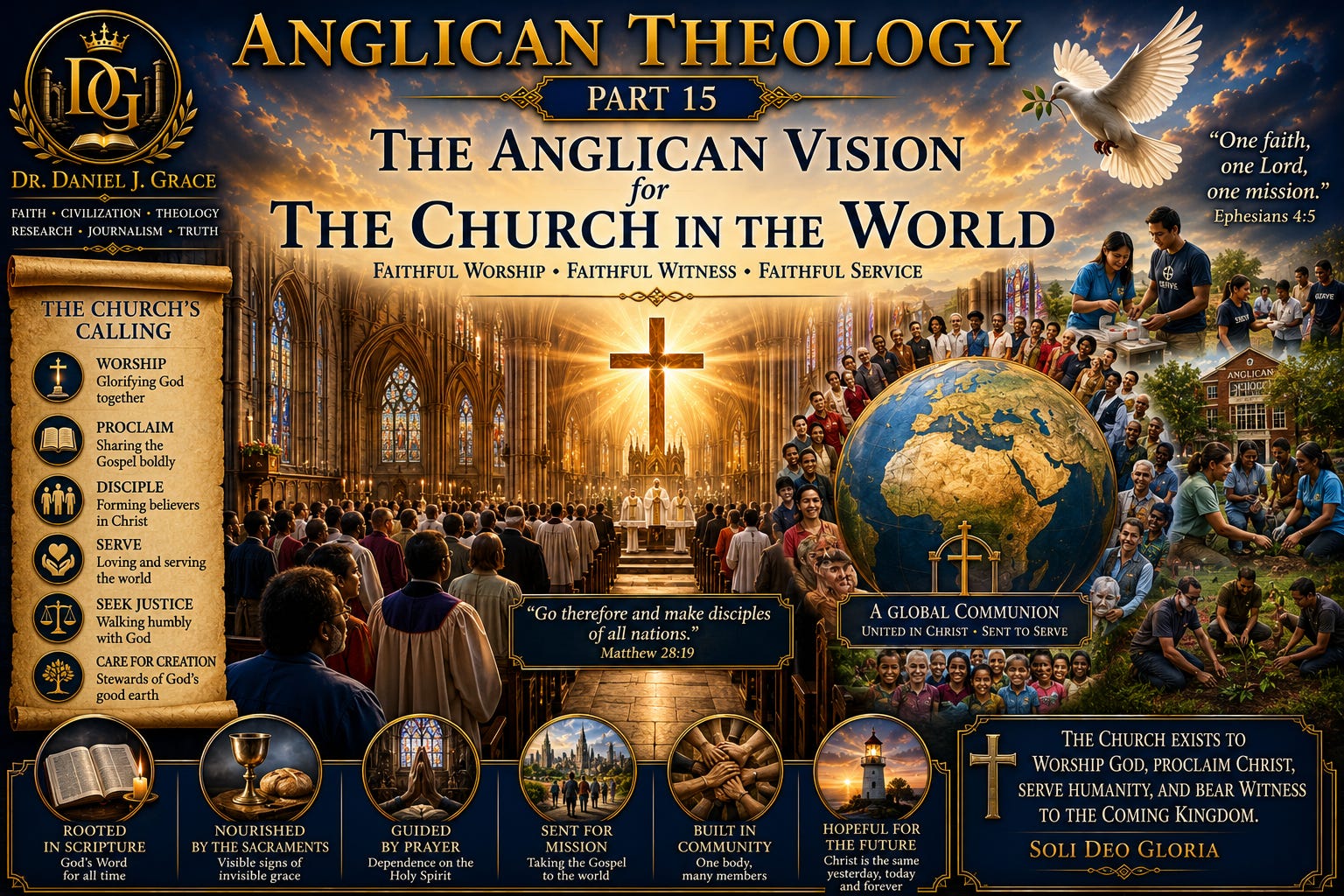
The Anglican Vision for the Church in the World
Introduction
Throughout this Anglican theology series, we have explored the history, beliefs, worship, mission, spirituality, sacraments, and future of Anglicanism. We have journeyed from the English Reformation to the global Anglican Communion. We have examined Scripture, tradition, reason, prayer, salvation, mission, and the sacraments.
Yet one final question remains:
What is the ultimate purpose of the Church?
Why does the Church exist?
Why has God preserved His people throughout history?
What is the mission of Anglicanism in the modern world?
The answer reaches beyond buildings, institutions, and denominations.
The Church exists to glorify God, proclaim Jesus Christ, disciple believers, serve humanity, and bear witness to the Kingdom of God.
This final chapter brings together the themes of the entire series and explores the Anglican vision of the Church’s calling in the world today.
The Church Belongs to Christ
Anglican theology begins with a simple truth:
The Church does not belong to bishops.
The Church does not belong to governments.
The church does not belong to denominations.
The Church belongs to Jesus Christ.
Scripture describes Christ as:
Head of the Church
Good Shepherd
Lord of Lords
King of Kings
The Church exists because Christ established it.
Its authority comes from Him.
Its mission comes from Him.
Its future rests in Him.
Worship as the Church’s First Calling
Before the Church serves the world, it worships God.
Throughout Anglican history, worship has stood at the centre of Christian life.
The Book of Common Prayer reminds believers that worship is not entertainment.
It is the offering of:
Praise
Thanksgiving
Prayer
Adoration
Anglican worship directs attention toward God rather than ourselves.
In worship Christians remember who God is and who they are called to become.
A Church that forgets worship eventually loses its spiritual identity.
church
Proclaiming the Gospel
The Church is called not only to worship but also to proclaim.
Jesus commanded His followers:
“Go therefore and make disciples of all nations.”
This command remains central to Anglican mission.
The Gospel is good news.
It announces:
Forgiveness
Grace
Salvation
Hope
New Life in Christ
The Church cannot remain silent.
Every generation requires faithful proclamation of the Gospel.
The methods may change.
The message must not.
Discipleship and Spiritual Formation
Christianity involves more than conversion.
It involves transformation.
The Church exists to form disciples who grow in:
Faith
Holiness
Wisdom
Service
Anglican spirituality provides rich resources for this journey.
Through:
Scripture
Prayer
Worship
Sacraments
Fellowship
Believers are shaped into the likeness of Christ.
The goal is not merely church attendance.
The goal is spiritual maturity.
The Church as a Community
Modern society often experiences loneliness and fragmentation.
The Church offers something increasingly rare:
A genuine community.
Within the church, people find:
Friendship
Support
Encouragement
Belonging
The New Testament repeatedly describes Christians as members of one body.
The Church is not merely an organisation.
It is a family.
This vision remains vital in an age of social isolation.
Service to the World
The Anglican mission has always included practical service.
Throughout history Anglicans have established:
Schools
Hospitals
Universities
Orphanages
Relief organizations
This reflects Christ’s own ministry.
Jesus cared for:
The poor
The sick
The vulnerable
The forgotten
The Church continues this work today.
Christian witness includes both word and action.
Justice and Compassion
The Gospel calls believers to pursue justice and mercy.
This does not mean aligning the Church with political ideologies.
Rather, it means reflecting God’s character.
The prophets repeatedly emphasised:
Justice
Compassion
Righteousness
Anglicans, therefore, seek to address:
Poverty
Oppression
Inequality
Human suffering
Faith expresses itself through love.
Stewardship of Creation
The world belongs to God.
Human beings are stewards rather than owners.
The Church increasingly recognises its responsibility to care for creation.
This stewardship includes:
Environmental responsibility
Sustainable living
Wise use of resources
Creation care reflects gratitude toward the Creator.
Global Mission
The Anglican Communion spans the globe.
Today Anglicans worship in:
Africa
Asia
Europe
North America
South America
Australia
Oceania
This diversity enriches the Church.
The future of Anglicanism is increasingly global.
The Church’s mission extends beyond national boundaries.
Christ’s Kingdom includes every tribe, language, and people.
The Role of Technology
The digital age presents both opportunities and challenges.
Technology allows the Church to:
Reach new audiences
Provide education
Share Scripture
Connect communities
Yet technology must remain a tool rather than a master.
The Church’s mission ultimately depends upon people, relationships, and spiritual transformation.
Digital ministry should support—not replace—Christian fellowship.
Hope in a Changing World
Many people today experience uncertainty.
Society changes rapidly.
Political systems rise and fall.
Technologies evolve.
Cultures transform.
Yet Christianity proclaims a message of hope.
The Church’s confidence does not rest in worldly stability.
It rests in God’s faithfulness.
The same Christ who guided the Church through centuries of history continues to guide it today.
The Kingdom of God
Ultimately the church points beyond itself.
Its mission is not self-preservation.
Its mission is participation in God’s Kingdom.
The Kingdom of God represents:
God’s rule
God’s justice
God’s peace
God’s redemption
The Church serves as a sign of that Kingdom in the world.
Every act of worship, mission, and service points toward God’s future.
The Anglican Legacy
The Anglican tradition has contributed greatly to global Christianity.
Its legacy includes:
Liturgical worship
Biblical scholarship
Missionary expansion
Educational institutions
Social service
Theological reflection
This legacy remains important.
Yet the future depends not on past achievements but on present faithfulness.
Each generation must renew its commitment to Christ.
Looking Forward
The future Anglican Church will face new questions and challenges.
Yet its calling remains unchanged.
It must continue:
Worshipping faithfully
Teaching Scripture
Administering the sacraments
Making disciples
Serving the world
The Church’s mission remains as urgent today as it was in the first century.
Final Reflections
At the heart of Anglican theology stands Jesus Christ.
Not a system.
Not an institution.
Not a tradition.
Christ Himself.
Everything explored in this series ultimately points to Him.
Scripture reveals Him.
The sacraments proclaim Him.
The Church serves Him.
Mission advances His Kingdom.
Worship glorifies His name.
The Anglican tradition is valuable precisely because it seeks to lead believers toward Christ.
Conclusion
The Anglican vision for the Church is both ancient and modern.
It is rooted in Scripture.
Shaped by tradition.
Guided by reason.
Empowered by the Holy Spirit.
It calls believers to worship God faithfully, proclaim Christ boldly, serve others compassionately, and live with hope.
As this series concludes, one truth remains above all others:
The Church’s future does not depend upon human strength alone.
It depends upon the faithfulness of God.
And because God remains faithful, the Church can move forward with confidence, courage, and hope.
"The Church exists to worship God, proclaim Christ, serve humanity, and bear witness to the coming Kingdom."
Dr Daniel J. Grace
Faith • Civilization • Theology
Research • Journalism • Truth
🌐 danieljamesgrace.com
© 2026 Dr Daniel J. Grace. All Rights Reserved.
No part of this article may be reproduced, distributed, transmitted, or published in any form or by any means without prior written permission from the author, except for brief quotations used in academic citation, review, or research purposes.