
Anglican Theology – Part 14
Visible Signs of Invisible Grace

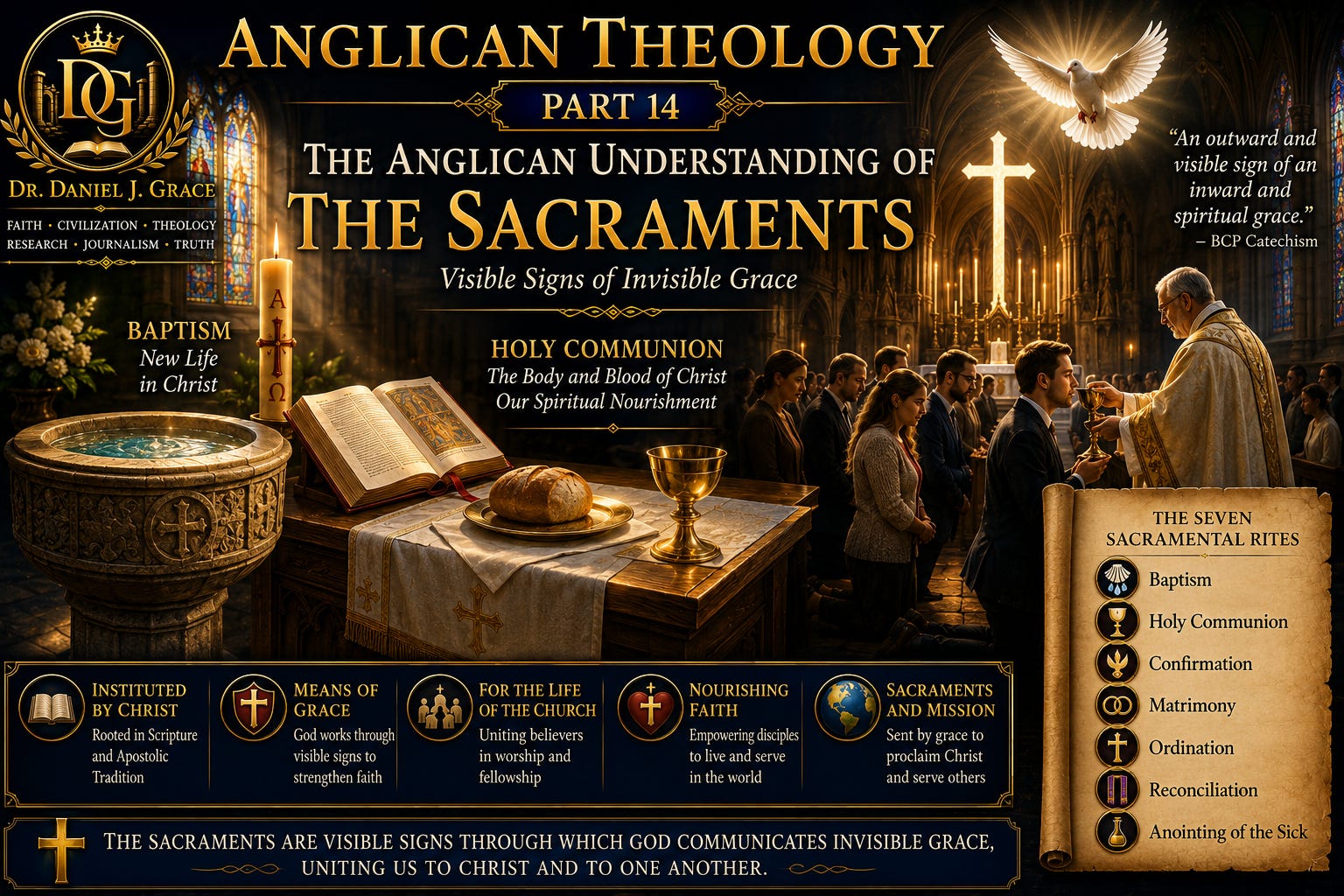
The Anglican Understanding of the Sacraments
Introduction
One of the most distinctive features of Anglican theology is its understanding of the sacraments. Throughout Christian history, believers have sought to understand how God communicates His grace to His people. Anglicanism teaches that God speaks through Scripture and strengthens believers through sacred actions instituted by Christ Himself.
The sacraments occupy a central place in Anglican worship and spirituality. They connect faith with daily life, unite believers with Christ, and remind the Church that Christianity is not merely a collection of ideas but a living relationship with God.
The Anglican tradition inherited sacramental theology from the ancient Church while reforming certain mediaeval practices during the Reformation. As a result, Anglican sacramental theology stands between Roman Catholic and many Protestant approaches, maintaining both reverence and biblical simplicity.
This chapter explores the Anglican understanding of the sacraments, their biblical foundations, their role in worship, and their significance for Christian life.
What Is a Sacrament?
The classic Anglican definition comes from the Catechism in the Book of Common Prayer:
“An outward and visible sign of an inward and spiritual grace.”
A sacrament therefore has two dimensions:
The Outward Sign
Something visible and physical.
Examples include:
Water
Bread
Wine
The Inward Grace
God’s spiritual action within believers.
The sacrament points beyond itself to God’s saving work.
Anglicans emphasise that sacraments are not magical rituals.
Rather, they are God-given means through which grace is communicated and faith strengthened.
Christ Instituted the Sacraments
Anglican theology teaches that Jesus Christ directly instituted the two principal sacraments.
These are:
Baptism
Holy Communion (The Eucharist)
Because Christ Himself commanded these practices, they hold a unique place within Anglican worship.
The Thirty-Nine Articles describe them as:
“Sacraments ordained of Christ.”
Baptism
Baptism is the sacrament of initiation into the Christian life.
Jesus commanded:
“Go and make disciples of all nations, baptizing them...”
(Matthew 28:19)
Water symbolises:
Cleansing
New life
Forgiveness
Union with Christ
Anglicans baptise:
Adults
Children
Infants
This reflects the belief that God’s covenant grace extends to families as well as individuals.
Baptism marks entry into the Church and the beginning of the Christian journey.
The Meaning of Baptism
Baptism signifies several important truths.
Forgiveness
God cleanses believers from sin.
New Birth
Believers become new creations in Christ.
Union with Christ
Christians share in Christ’s death and resurrection.
Membership in the Church
Believers become part of God’s covenant community.
These themes appear throughout Anglican baptismal liturgies.
Infant Baptism
Anglicanism has historically practiced infant baptism.
This practice rests upon several convictions:
God’s grace precedes human response.
Children belong within the covenant community.
Christian families nurture faith from an early age.
Infant baptism is later affirmed through confirmation, where individuals personally profess their faith.
Confirmation
Although not considered a gospel sacrament in the same sense as baptism and holy communion, confirmation remains important.
In Confirmation:
Baptised Christians publicly affirm their faith.
The bishop prays for strengthening by the Holy Spirit.
Confirmation represents spiritual maturity and commitment.
The Eucharist
The Eucharist occupies the centre of Anglican worship.
It is also called:
Holy Communion
The Lord’s Supper
The Holy Mysteries
Jesus instituted the Eucharist during the Last Supper.
He commanded:
“Do this in remembrance of me.”
The Eucharist therefore remains central to Anglican life.
The Meaning of the Eucharist
The Eucharist carries multiple layers of meaning.
Remembrance
Believers remember Christ’s sacrifice.
Thanksgiving
The word ‘Eucharist’ means ‘thanksgiving’.
Communion
Believers share fellowship with Christ and one another.
Spiritual Nourishment
Faith is strengthened through participation.
The Eucharist is therefore both a memorial and a spiritual encounter.
The Presence of Christ
One of the most discussed questions concerns Christ’s presence in the Eucharist.
Anglican theology generally avoids rigid definitions.
Instead, it affirms:
Christ is truly present.
However, Anglicans have historically differed regarding precisely how this presence is understood.
The focus remains upon receiving Christ through faith.
This balanced approach reflects Anglican theological moderation.
The Book of Common Prayer and the Eucharist
The Prayer Book provides one of Anglicanism’s most treasured Eucharistic liturgies.
It emphasizes:
Repentance
Thanksgiving
Faith
Communion
The liturgy combines biblical language with theological depth.
For centuries it has shaped Anglican spirituality around the world.
The Sacraments and Faith
Anglican theology rejects the idea that sacraments automatically produce spiritual benefits regardless of faith.
Faith remains essential.
The sacraments strengthen those who receive them faithfully.
Without faith, the outward sign loses its intended purpose.
The relationship between sacrament and faith remains central to Anglican theology.
The Five Other Sacramental Rites
Anglicanism recognises five additional rites, often called “sacramental ministries.”
These are:
Confirmation
Matrimony
Ordination
Reconciliation (Confession)
Anointing of the Sick
These are respected and valued but differ from Baptism and Eucharist because they were not directly instituted by Christ.
Marriage
Marriage is understood as a sacred covenant.
It reflects:
Faithfulness
Love
Unity
The marriage service remains one of the most beloved parts of Anglican liturgy.
Marriage points beyond itself to Christ’s relationship with His Church.
Ordination
Ordination sets individuals apart for ministry.
Through prayer and laying on of hands, the Church commissions:
Deacons
Priests
Bishops
This practice reflects continuity with the apostolic Church.
Reconciliation
Private confession exists within Anglican tradition but is not normally required.
A famous Anglican principle states:
“All may, some should, none must.”
Confession serves as a means of spiritual healing and renewal.
Ministry to the Sick
Anointing with oil and prayer for healing reflects biblical practice.
The Church offers:
Comfort
Healing
Spiritual support
This ministry demonstrates Christ’s compassion toward those who suffer.
Sacraments and Daily Life
Anglican theology emphasises that sacramental worship should shape daily life.
The sacraments encourage believers to:
Serve others
Practise holiness
Grow in faith
Live gratefully
Worship and discipleship belong together.
Sacraments and the Early Church
The Anglican understanding of the sacraments is deeply rooted in the Early Church.
The writings of:
Ignatius
Justin Martyr
Augustine
Demonstrate the importance of Baptism and Eucharist from the earliest centuries.
Anglicans see themselves as continuing this historic tradition.
Sacraments and Mission
The sacraments are not isolated religious rituals.
They strengthen believers for the mission.
After receiving God’s grace, Christians are sent into the world to:
Proclaim the Gospel
Serve others
Bear witness to Christ
Sacramental worship therefore fuels Christian mission.
Modern Challenges
Contemporary society often struggles with sacred symbolism.
Many people think only in practical or material terms.
The sacraments remind Christians that God works through both spiritual and physical realities.
In a fragmented world, sacramental worship provides:
Meaning
Stability
Community
Hope
Conclusion
The Anglican understanding of the sacraments reflects its broader theological vision.
Grounded in Scripture, shaped by tradition, and expressed through worship, the sacraments serve as visible signs of God’s invisible grace.
Baptism welcomes believers into the covenant community.
Holy Communion nourishes them throughout their spiritual journey.
Together these sacraments remind Christians that God’s grace is not distant or abstract.
It is experienced through worship, community, faith, and daily life.
For Anglicans, the sacraments stand as enduring testimonies that Christ remains present with His Church, strengthening believers until the day when faith becomes sight.
Dr Daniel J. Grace
Faith • Civilization • Theology
Research • Journalism • Truth
🌐 danieljamesgrace.com
© 2026 Dr Daniel J. Grace. All Rights Reserved.
No part of this article may be reproduced, distributed, transmitted, or published in any form or by any means without prior written permission from the author, except for brief quotations used in academic citation, review, or research purposes.