
Anglican Theology – Part 11
"Listening to the Ancient Voices That Shaped Anglican Faith"

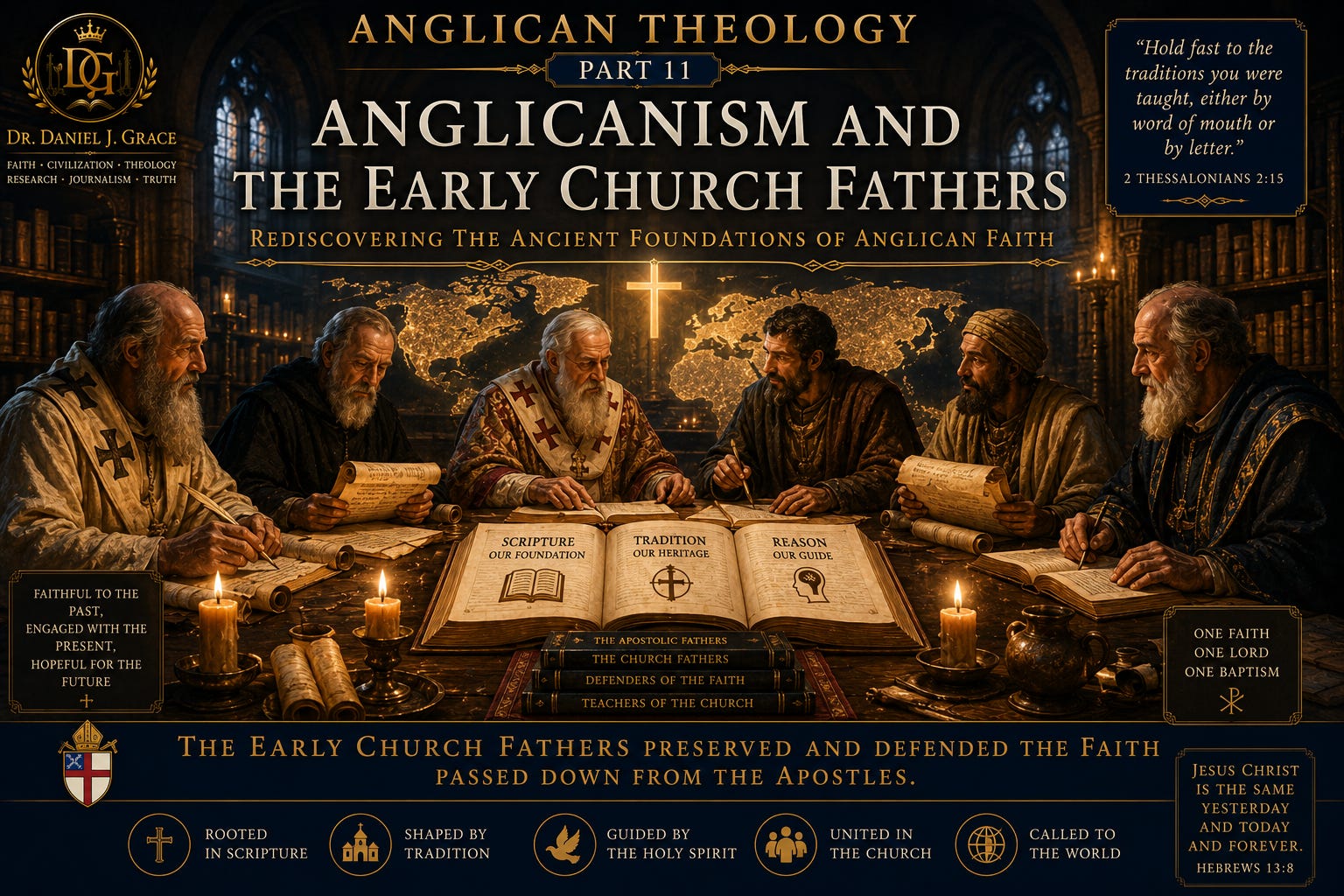
Anglicanism and the Early Church Fathers
Rediscovering the Ancient Foundations of Anglican Faith
Introduction
One of the most distinctive characteristics of Anglican theology is its deep respect for the Early Church. While Anglicanism emerged during the English Reformation of the sixteenth century, it has never viewed itself as an entirely new church. Instead, Anglicans have traditionally understood themselves as heirs of the historic Christian faith that stretches back through the centuries to the Apostles themselves.
This connection to ancient Christianity is often expressed through Anglican engagement with the Early Church Fathers. These influential Christian leaders, theologians, bishops, and writers helped shape Christian doctrine during the first several centuries after Christ. Their writings defended the faith against heresy, clarified theological truths, interpreted Scripture, and guided the Church through times of persecution and controversy.
For Anglicans, the Early Church Fathers provide a vital link between the New Testament and the Church today. They help believers understand how the earliest Christians worshipped, interpreted Scripture, and understood doctrines such as the Trinity, the Incarnation, salvation, and the Church itself.
This chapter explores the significance of the Early Church Fathers in Anglican theology, examines key figures and their contributions, and considers how their legacy continues to shape Anglican faith and practice.
Who Were the Early Church Fathers?
The term “Church Fathers” refers to influential Christian teachers and leaders from approximately the first eight centuries of Christian history.
These figures were not apostles, but many lived close to the apostolic era.
Their writings provide invaluable insights into early Christianity.
The Fathers helped preserve and explain Christian doctrine during a time when the Church faced:
Persecution
False teachings
Political instability
Theological controversy
They served as bishops, theologians, pastors, scholars, and defenders of the faith.
For Anglicans, they are respected as important witnesses to apostolic Christianity.
Why Anglicanism Values the Church Fathers
Anglican theology is rooted in three major sources:
Scripture
Tradition
Reason
The Church Fathers occupy a crucial place within tradition.
They help modern Christians understand how earlier generations interpreted Scripture.
Richard Hooker, one of Anglicanism’s greatest theologians, frequently cited the Fathers.
The Reformers themselves regularly appealed to patristic writings.
This distinguishes Anglicanism from approaches that rely exclusively on either tradition or personal interpretation.
The Fathers help anchor Anglican theology within the broader Christian tradition.
“The Early Church Fathers preserved and defended the faith passed down from the Apostles.”
The Apostolic Fathers
The earliest group of Church Fathers are often called the Apostolic Fathers.
These individuals lived during the late first and early second centuries.
Some may have known the Apostles personally.
Important figures include:
Clement of Rome
Clement wrote one of the earliest Christian letters outside the New Testament.
His writings emphasise unity, order, and faithful leadership.
Ignatius of Antioch
Ignatius wrote letters while travelling to his martyrdom.
He stressed:
Church unity
Episcopal leadership
Faithfulness to Christ
Polycarp of Smyrna
He was a disciple of the Apostle John.
Polycarp’s life demonstrates the continuity between the Apostolic age and later Christianity.
His martyrdom became one of Christianity’s most inspiring testimonies.
For Anglicans, these figures offer a direct connection to the earliest Christian generations.
Defending the Faith: The Apologists
As Christianity expanded, critics and opponents challenged its beliefs.
Christian apologists responded by defending the faith intellectually.
Among the most important were:
Justin Martyr
Justin explained Christianity to Roman authorities and philosophers.
He demonstrated that Christian faith was reasonable and intellectually defensible.
Irenaeus of Lyons
Irenaeus opposed Gnostic heresies.
He emphasised:
Apostolic teaching
Biblical authority
Church unity
His work remains highly influential within Anglican theology.
The Development of Christian Doctrine
One of the Fathers’ greatest contributions was doctrinal clarification.
Many central Christian doctrines required careful explanation.
Questions arose concerning the following:
The Trinity
The divinity of Christ
The humanity of Christ
Salvation
Scripture
The Fathers helped articulate biblical truths in precise language.
Their efforts laid the foundation for later creeds and confessions.
Athanasius and the Trinity
Perhaps no Church Father influenced Christian doctrine more than Athanasius.
During the fourth century, the Church faced a serious challenge from Arianism.
Arius taught that Jesus was created rather than fully divine.
Athanasius strongly opposed this teaching.
He defended the belief that:
Jesus Christ is both fully God and fully man.
His efforts helped shape the outcome of the Council of Nicaea (325 AD).
The Nicene Creed remains central to Anglican worship today.
Augustine of Hippo
Among all Church Fathers, Augustine may be the most influential.
His writings profoundly shaped Western Christianity.
Augustine addressed topics such as:
Grace
Sin
Salvation
The Church
Human nature
His works include:
Confessions
The City of God
On the Trinity
Augustine’s understanding of grace and redemption has significantly influenced Anglican theology.
Anglican seminaries and universities continue to study his writings.
The Cappadocian Fathers
Three important theologians known as the Cappadocian Fathers further developed Trinitarian doctrine.
These were:
Basil the Great
Gregory of Nazianzus
Gregory of Nyssa
Their work clarified how Christians understand:
One God in three Persons.
Their theological precision remains foundational for orthodox Christianity.
The Church Fathers and Scripture
The Fathers deeply valued Scripture.
They believed:
Scripture was inspired by God.
Scripture was authoritative.
Scripture should guide Christian life.
However, they also recognised the importance of interpretation.
The Fathers frequently
Preached on Scripture
Wrote commentaries
Defended biblical teaching
Anglicanism follows this same commitment.
The Bible remains central, but interpretation benefits from the wisdom of the historic Church.
Worship in the Early Church
The writings of the Fathers provide important information about early Christian worship.
They reveal practices such as:
Baptism
Eucharist
Prayer
Scripture reading
Hymn singing
Many aspects of Anglican worship reflect these ancient patterns.
The Book of Common Prayer preserves elements that trace back to early Christian liturgy.
This continuity demonstrates Anglicanism’s desire to remain connected to historic Christianity.
“Many elements of Anglican worship reflect the practices of the ancient Church.”
The Ecumenical Councils
The Church Fathers played major roles in the Ecumenical Councils.
These gatherings addressed theological controversies.
Important councils include:
Nicaea (325)
Affirmed Christ’s full divinity.
Constantinople (381)
Expanded Trinitarian doctrine.
Ephesus (431)
Defended Christ’s unity.
Chalcedon (451)
Affirmed Christ’s full humanity and divinity.
Anglicanism accepts these historic councils as authoritative expressions of orthodox Christian faith.
The Fathers and Anglican Identity
Anglicanism often describes itself as both the following:
Reformed
Catholic
The Church Fathers help explain this balance.
Anglicans embrace Reformation principles while maintaining continuity with ancient Christianity.
The Fathers provide evidence that Anglican theology is not a modern invention.
Instead, it seeks to preserve the faith of the historic Church.
Lessons for Modern Christians
The Church Fathers remain relevant today.
They teach believers:
Faithfulness
Many endured persecution.
Courage
They defended truth despite opposition.
Wisdom
They addressed difficult theological questions.
Holiness
Their lives often reflected deep devotion to God.
Modern Christians continue learning from their example.
Challenges in Reading the Fathers
While valuable, the Fathers were not infallible.
Anglican theology maintains that:
Scripture alone possesses ultimate authority.
The Fathers deserve respect but not unquestioning acceptance.
Their writings must be evaluated carefully and interpreted within their historical context.
This balanced approach reflects the Anglican commitment to Scripture, tradition, and reason.
Anglican Scholarship and Patristic Studies
Modern Anglican scholars continue studying the Fathers extensively.
Patristic studies remain important in the following areas:
Seminaries
Universities
Research programs
Many contemporary theological discussions benefit from renewed engagement with ancient Christian thought.
The Fathers often provide insights that remain surprisingly relevant today.
The Continuing Legacy of the Fathers
The influence of the Church Fathers can be seen throughout Anglican life.
Their impact appears in:
Creeds
Worship
Theology
Spirituality
Biblical interpretation
Every time Anglicans recite the Nicene Creed, they participate in a theological tradition shaped by the Fathers.
Their legacy continues to guide the Church centuries after their deaths.
Conclusion
The Early Church Fathers occupy a special place within Anglican theology.
They connect modern believers to the ancient Church and help preserve continuity with apostolic Christianity.
Through their writings, Christians gain insight into the faith, worship, struggles, and victories of the earliest generations of believers.
While Scripture remains the ultimate authority, the Fathers serve as trusted guides who help illuminate biblical truth.
Their defence of orthodox doctrine, commitment to holiness, and devotion to Christ continues to inspire Christians around the world.
For Anglicans, the Church Fathers are not merely historical figures.
They are faithful witnesses whose voices continue speaking across the centuries, reminding the Church of its ancient roots and its enduring mission.
Dr Daniel J. Grace
Faith • Civilization • Theology
Research • Journalism • Truth
🌐 danieljamesgrace.com
© 2026 Dr Daniel J. Grace. All Rights Reserved.
No part of this article may be reproduced, distributed, transmitted, or published in any form or by any means without prior written permission from the author, except for brief quotations used in academic citation, review, or research purposes.