

Anglican Theology, Part 1
"Exploring the History, Beliefs, and Global Influence of the Anglican Tradition"

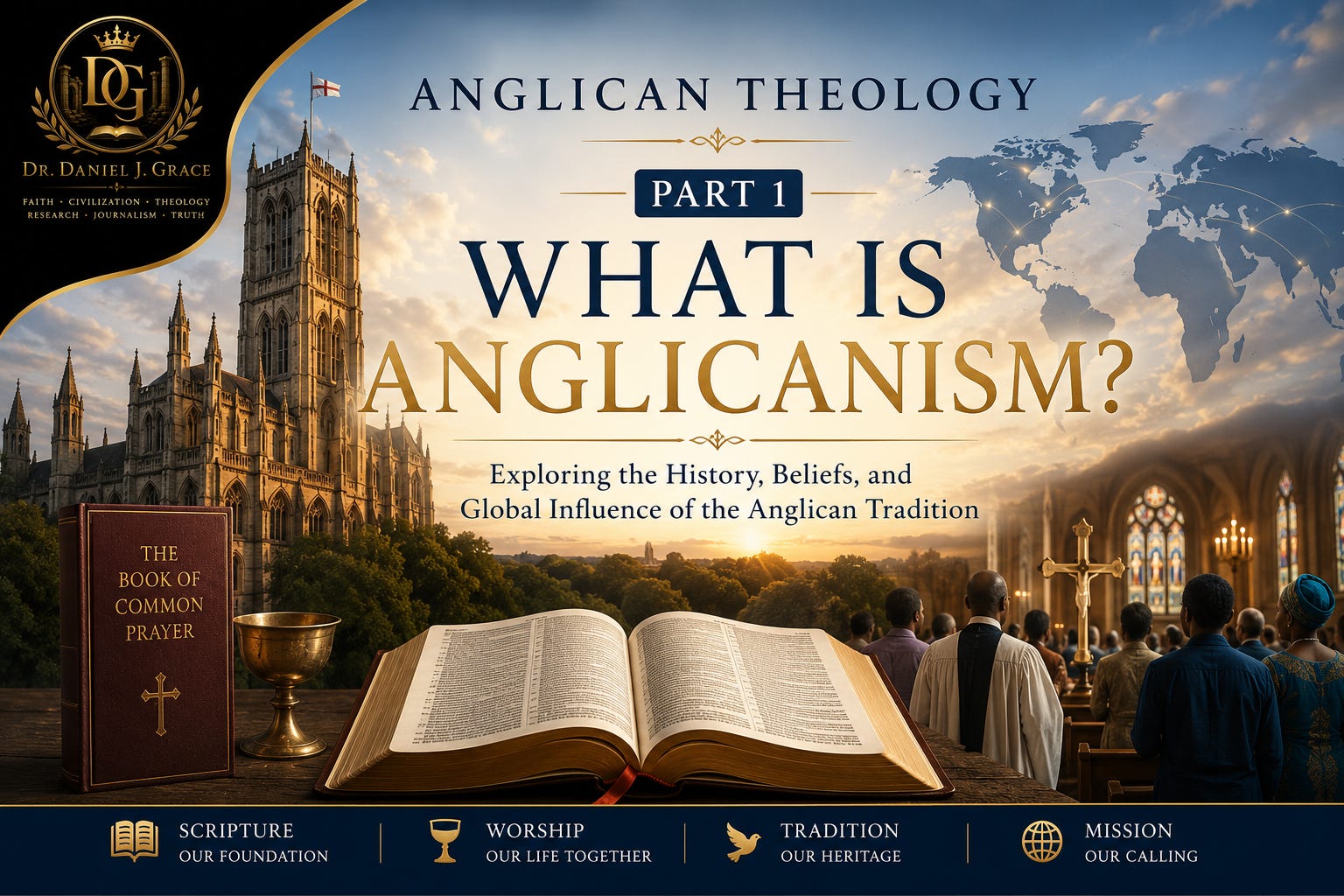
What Is Anglicanism?
Of the many Christian traditions that have shaped the history of the Church, Anglicanism occupies a unique position. It stands at the intersection of ancient Christian tradition and Protestant reform, combining historical continuity with a commitment to biblical authority. Today, Anglicanism is one of the largest Christian traditions in the world, with tens of millions of believers spread across every continent.
Yet many people, including Christians, often ask a simple question:
What is Anglicanism?
The answer is both historical and theological.
The Origins of Anglicanism
The word “Anglican” comes from the Latin phrase “Ecclesia Anglicana”, meaning “the Church of England”. Its roots stretch back to the earliest centuries of Christianity when the Gospel first reached the British Isles.
For centuries, the Church in England remained part of the wider Western Church. However, during the sixteenth century, significant religious and political changes transformed Christianity throughout Europe. This period became known as the Reformation.
While many people associate the English Reformation solely with King Henry VIII, the story is far more complex. The emergence of Anglicanism involved theological reform, biblical renewal, and a desire to return to the teachings of the early Church.
A Church Between Two Traditions
One of the most distinctive features of Anglicanism is its position between Roman Catholicism and Protestantism.
Anglicans retained many ancient Christian practices, including liturgical worship, episcopal leadership through bishops, and a deep respect for the historic Church.
At the same time, Anglicanism embraced key Reformation principles such as the following:
The authority of Scripture.
Salvation through faith in Jesus Christ.
The importance of preaching and biblical teaching.
Worship in the language of the people.
Because of this balance, Anglicanism is often described as a via media, a Latin phrase that means “the middle way.”
This does not mean compromise. Rather, it reflects an attempt to preserve what is valuable from the Christian past while remaining faithful to biblical truth.
The Centrality of Scripture
Although Anglicanism values tradition, it places Scripture at the centre of Christian belief and practice.
The Bible is regarded as God’s inspired Word and the primary authority for faith and life.
Throughout Anglican history, believers have been encouraged to read, study, and apply Scripture personally.
The famous Anglican reformer Thomas Cranmer sought to make the Bible accessible to ordinary people, believing that God’s Word should shape both individual discipleship and public worship.
Worship and Common Prayer
Another defining characteristic of Anglicanism is its emphasis on common worship.
The Book of Common Prayer, first published in 1549, became one of the most influential Christian books ever written.
It provided prayers, Scripture readings, and liturgies that united believers in worship across England and eventually throughout the world.
For Anglicans, worship is not merely a personal experience. It is the shared expression of faith within the community of believers.
A Global Communion
Although Anglicanism began in England, it is now a global Christian movement.
Today, Anglican churches can be found throughout the following regions:
Africa
Asia
Australia
Europe
North America
South America
The Pacific Islands
In many regions, particularly Africa, Anglicanism has experienced remarkable growth.
Countries such as Kenya, Nigeria, and Uganda now play a major role in shaping global Anglican theology and mission.
This worldwide presence demonstrates that Anglicanism is no longer simply an English tradition. It is a truly international expression of Christianity.
Core Anglican Beliefs
While Anglican churches vary in style and emphasis, several beliefs remain central:
Faith in the Holy Trinity.
The authority of Scripture.
Salvation through Jesus Christ.
The importance of prayer and worship.
The sacraments of Baptism and Holy Communion.
The mission of the Church is to proclaim the Gospel.
These beliefs connect Anglicans with the broader Christian tradition while maintaining their distinctive identity.
Why Anglicanism Matters Today
In an age marked by division, uncertainty, and rapid cultural change, Anglicanism offers a rich theological heritage grounded in Scripture, historical continuity, and thoughtful reflection.
Its commitment to biblical faith, liturgical worship, and intellectual engagement continues to attract believers seeking both spiritual depth and historical rootedness.
For many Christians, Anglicanism represents an attempt to hold together faithfulness to the Gospel with a deep appreciation for the wisdom of the historic Church.
Conclusion
Anglicanism is far more than a denomination. It is a global Christian tradition shaped by Scripture, history, worship, and mission.
Its roots lie in the English Reformation, but its influence now extends around the world. By seeking to balance biblical authority, Christian tradition, and thoughtful reflection, Anglican theology continues to offer valuable perspectives to believers in the twenty-first century.
In the next article, we will explore the dramatic events of the English Reformation and examine how they shaped the birth of Anglican theology.

Dr Daniel J. Grace
Faith • Civilization • Theology
Research • Journalism • Truth
🌐 danieljamesgrace.com
© 2026 Dr Daniel J. Grace. All Rights Reserved.
No part of this article may be reproduced, distributed, transmitted, or published in any form or by any means without prior written permission from the author, except for brief quotations used in academic citation, review, or research purposes.